
How Many Calories Are in Condensed Milk?
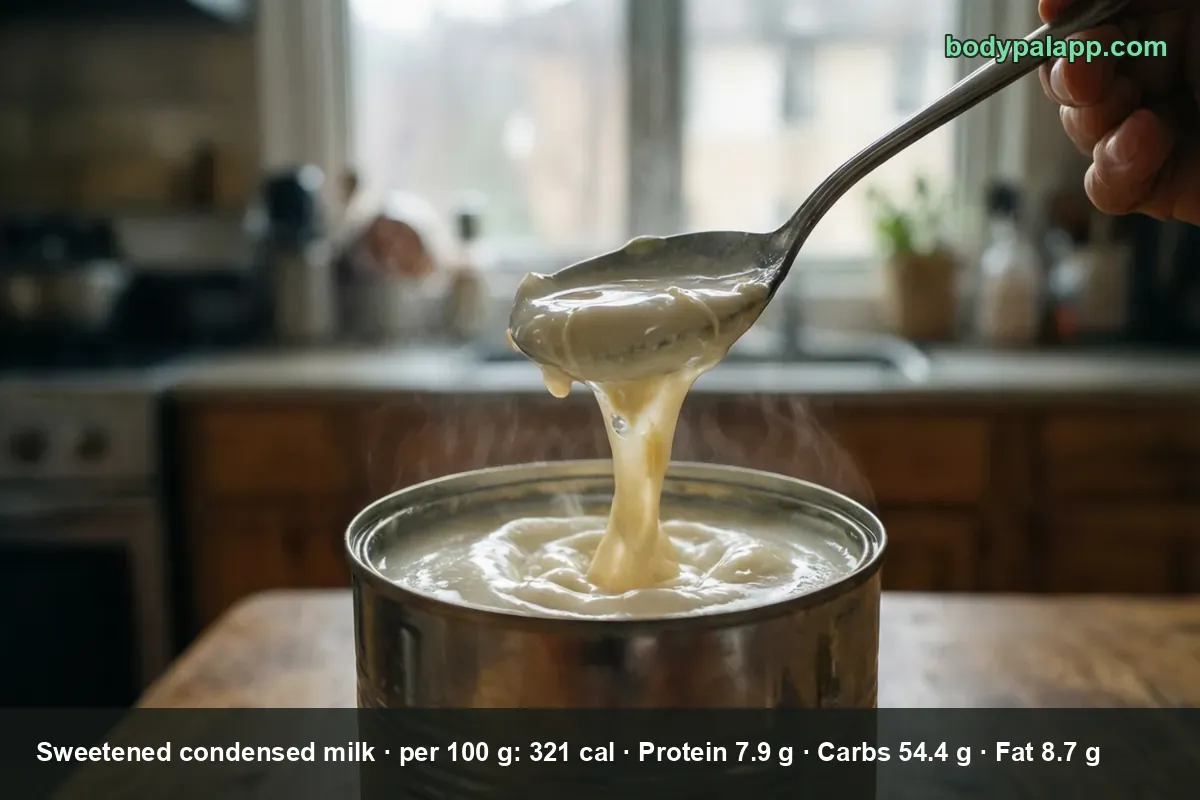
Two tablespoons of sweetened condensed milk — one fluid ounce, 38 g — come to 122 calories, and 100 g of it runs 321 calories. Pour out the whole 14 oz can and you have 1,271. If you came looking for calories in condensed milk and the can in your hand says 130, both numbers are correct, and the reason is worth two minutes.
On this page
- Condensed milk quick facts
- Why the can says 130 and USDA says 122
- Serving sizes, from a teaspoon to the whole can
- A cup of condensed milk is not a cup of milk
- The sugar, in teaspoons
- Condensed milk vs evaporated milk
- Fat-free cans and the boiled can
- Condensed milk in coffee
- How condensed milk compares
- Most popular sweetened condensed milk brands
- FAQ
Condensed milk quick facts
The reference here is the generic canned product, USDA SR Legacy 171275, "Milk, canned, condensed, sweetened". In an American store, condensed milk with no other word on the label always means sweetened; the unsweetened version is sold as evaporated milk.
| Nutrient | Per 100 g | Per 2 tbsp (38 g) | % Daily Value |
|---|---|---|---|
| Calories | 321 | 122 | — |
| Total fat | 8.7 g | 3.3 g | 4% |
| Saturated fat | 5.5 g | 2.1 g | 10% |
| Carbohydrate | 54.4 g | 20.7 g | 8% |
| Dietary fiber | 0 g | 0 g | 0% |
| Total sugars | 54.4 g | 20.7 g | — |
| Protein | 7.9 g | 3.0 g | 6% |
| Sodium | 127 mg | 48 mg | 2% |
% Daily Value is based on a 2,000-calorie diet.
Verified nutrition data
Numbers on this page come from USDA FoodData Central, the U.S. Department of Agriculture’s food composition database, and from manufacturer labels where a branded product is named. Last verified September 2026. How we verify our data →
Every gram of carbohydrate in that row is sugar. Fiber is a measured zero, not a gap in the data — it is a dairy product, and the can prints the same zero. Two spoons also carry 108 mg of calcium (8% DV), 141 mg of potassium (3%) and 13 mg of cholesterol (4%).
Two rows the table leaves out on purpose. Added sugars is not in the USDA record at all, because SR Legacy predates the current label; that figure comes from the Nutrition Facts panel instead, and it gets its own section below. Iron works out to 0.07 mg a serving, under 1% of the day, so printing it would only make it look like a deficiency rather than an irrelevance.
Why the can says 130 and USDA says 122
Read the panel on the can and it declares 130 calories per 2 tablespoons. The USDA record says 122. Nobody is wrong.
USDA measured the food: 321 calories per 100 g, with 2 tablespoons weighing 38 g. The label is built a different way. Every national brand declares 333 calories per 100 g and calls the same 2 tablespoons 39 g, because FDA rules let manufacturers calculate calories from the rounded gram values printed on the panel rather than from a fresh assay. One gram of declared serving weight plus a rounded density, and you get eight calories a spoon.
| Source | Calories per 100 | 2 tbsp | Whole 14 oz can (396 g) |
|---|---|---|---|
| USDA SR Legacy 171275 | 321 per 100 g | 122 (38 g) | 1,271 |
| Nutrition Facts panel, Eagle Brand 2578612 | 333 per 100 g | 130 (39 g) | 1,319 |
| Nutrition Facts panel, Carnation 2566661 | 433 per 100 mL | 130 (30 mL) | 1,319 |
Do not split the difference. An average of 122 and 130 describes nothing that exists; pick the source that matches what you are holding. Tracking from a USDA-based database, log 122. Reading the can, log 130.
That third row is the other trap, and it catches whole websites. Carnation declares its serving in milliliters — 2 Tbsp (30 mL) — so any database that normalizes to "per 100" files it as 433 while Eagle Brand sits at 333. Same milk. Condensed milk is dense, roughly 1.30 g/mL, because the water is boiled off and sugar is stirred in: 39 g ÷ 30 mL = 1.30. Convert and the mystery dissolves — 433 × (30 ÷ 39) = 333. Any brand ranking that sorts cans by "calories per 100" is quietly comparing milliliters against grams.
Serving sizes, from a teaspoon to the whole can
| Serving | Weight | Calories |
|---|---|---|
| 1 teaspoon | 6.3 g | 20 |
| 1 tablespoon | 19 g | 61 |
| 2 tbsp (1 fl oz) | 38 g | 122 |
| 3 tablespoons | 57 g | 183 |
| 1/4 cup | 76 g | 244 |
| 1/3 cup | 101 g | 324 |
| 1/2 cup | 152 g | 488 |
| 3/4 cup | 228 g | 732 |
| 1 cup | 304 g | 976 |
| 1 oz by weight | 28.35 g | 91 |
| Whole 14 oz can | 396 g | 1,271 |
The gram weights come from USDA's own portion file for this food. One detail in there is worth repeating: when USDA records condensed milk eaten with no amount specified, it assumes 19 g — a single tablespoon. That is the survey data's guess at how Americans actually use the stuff, and at 61 calories it is a modest thing.
The trouble starts at the quarter cup, which is what dessert recipes and iced coffee actually call for. That is 244 calories, double the label serving, and it goes down in about four seconds.
A cup of condensed milk is not a cup of milk
Here is the measurement error that wrecks recipe math. One cup of condensed milk weighs 304 g. One cup of whole milk weighs 244 g. The condensed version is 25% heavier for the same volume, because most of the water is gone and sugar has taken its place.
So a cup is 976 calories, not the ~780 you would get by borrowing milk's cup weight. Fudge, key lime pie and tres leches recipes usually skip the cup entirely and call for one can — 396 g, 1,271 calories — before anything else goes in the bowl.
Eating from the can with a spoon, which is the confessed national habit, the full 396 g works out to 31.3 g of protein (63% DV), 215.4 g of carbohydrate (78% DV), 34.5 g of fat (44% DV) and 21.7 g of saturated fat. That last one is 109% of the daily value — one can holds more saturated fat than a whole day allows. Sodium lands at 503 mg (22% DV) and calcium at 1,125 mg (87%).
The sugar, in teaspoons
Grams of sugar are hard to picture, so convert them. USDA puts a teaspoon of granulated sugar at 4.2 g. Two tablespoons of condensed milk hold 20.7 g of sugars, which is about 5 teaspoons. The whole can holds 215.4 g, or roughly 51 teaspoons.
The Nutrition Facts panel adds the piece USDA does not carry. Eagle Brand's record lists 46.2 g of added sugars per 100 g, which is 18 g in a 2-tablespoon serving — 36% of the added sugars Daily Value, against 3 g of protein at 6% DV. The Dietary Guidelines for Americans put the ceiling at 10% of daily calories from added sugars; two spoons of this use up a third of the FDA benchmark.
Line it up against the other sweeteners in the pantry and the category becomes obvious. One tablespoon of condensed milk is 61 calories. One tablespoon of honey is 64. One tablespoon of maple syrup is 52. By calorie behavior this is a syrup with some milk in it, and treating it as a dairy product is how people underestimate it.
Condensed milk vs evaporated milk
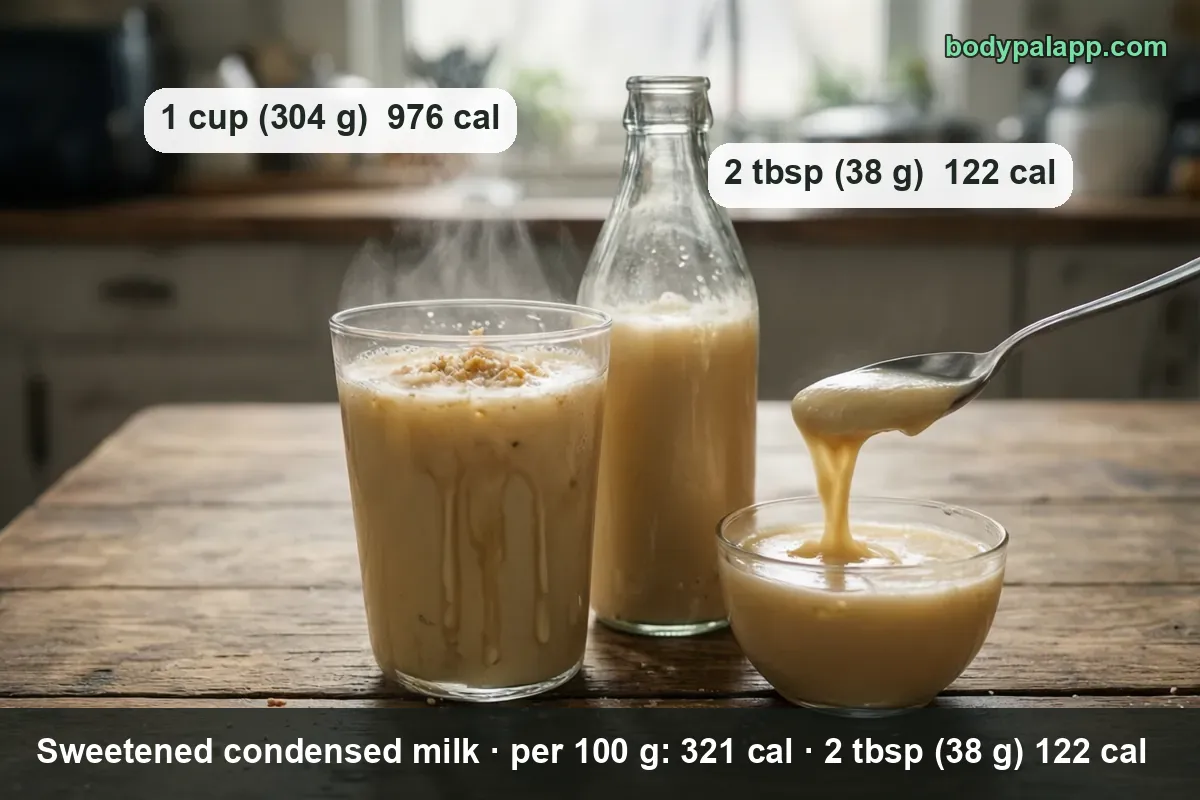
Two cans, same size, same shelf, same aisle. The calorie gap between them is 2.4x.
Sweetened condensed milk is 321 calories per 100 g. Evaporated milk (SR 172194) is 134. Per 2 tablespoons that is 122 against 42. The fat is nearly identical — 8.7 g versus 7.6 g per 100 g — so the entire difference is sugar: 54.4 g of carbohydrate against 10.0 g. Evaporated milk is milk boiled down with nothing added. Condensed milk is milk boiled down with enough sugar stirred in to reach 54.4 g per 100 g.
Swapping one for the other is the most common canned-milk mistake in an American kitchen. Pumpkin pie wants evaporated. Key lime pie and fudge want condensed. Substitute in either direction and the dessert either fails to set or turns cloying.
Evaporated milk portions, for the record: 1 cup is 338 calories, and a 13 oz can (369 g) is 494. The 2% version drops a cup to 270 and the nonfat version to 200. USDA's main evaporated record carries no total sugars value at all, so there is no sugar row to print for it; the matching vitamin D record for the same milk, 171276, puts them at 10.04 g per 100 g, all of it lactose that was in the milk to begin with.
Fat-free cans and the boiled can
Fat-free condensed milk sounds like the fix. It saves 15%. Eagle Brand's fat-free record is 268 calories per 100 g against 333 for the regular can, which is 110 calories per 2 tbsp instead of 130. The low-fat version lands at 120. Carbohydrate actually climbs, from 56 g to 61 g per 100 g, because the sugar stays exactly where it was and now has more room. Full-fat condensed milk only carries 8.7 g of fat per 100 g to begin with; the weight in this food was never the cream.
Boiling the unopened can into dulce de leche does not help either. USDA's dulce de leche record comes in at 315 calories per 100 g against 321 for the milk that went in — six calories, inside measurement noise. Caramelizing rearranges the sugar rather than removing it; total sugars fall from 54.4 g to 49.7 g as lactose and sucrose break down in the Maillard reaction, but the energy stays on the plate. A 1/4 cup of dulce de leche is 236 calories, and a full cup is 945.
Condensed milk in coffee
Brewed black coffee is 2 calories a cup. That single number settles most of the questions about Vietnamese coffee.
Hot cà phê sữa, one cup of coffee with 2 tablespoons of condensed milk, is 124 calories — 122 of them from the milk. The iced version poured over a full glass, made the way US cafés make it with 3 tablespoons, is 185. The coffee is a rounding error; the drink is the spoonfuls.
Used as a creamer replacement, one tablespoon in a mug puts you at 63 calories, against 41 for the same coffee with 2 tablespoons of half-and-half. That is a real difference over a daily habit, though the two are not trying to taste the same.
How condensed milk compares
| Food | Per 100 g | US serving | Calories | Protein / carbs / fat per serving |
|---|---|---|---|---|
| Sweetened condensed milk | 321 | 2 tbsp (38 g) | 122 | 3.0 / 20.7 / 3.3 g |
| Evaporated milk | 134 | 2 tbsp (31.5 g) | 42 | 2.1 / 3.2 / 2.4 g |
| Half-and-half | 131 | 2 tbsp (30 g) | 39 | 0.9 / 1.3 / 3.5 g |
| Heavy whipping cream | 340 | 2 tbsp (30 g) | 102 | 0.9 / 0.9 / 10.8 g |
| Whole milk | 61 | 1 cup (244 g) | 149 | 7.7 / 11.7 / 7.9 g |
Heavy cream is the only thing here that beats condensed milk per 100 g, at 340, and it does it with fat instead of sugar — 10.8 g of fat in two spoons against 0.9 g of protein. Our take: for coffee, half-and-half at 39 calories a serving does the job for a third of the calories and none of the sugar. For dessert, nothing substitutes for condensed milk, so measure it instead of pouring, and remember that the recipe's single can is already 1,271 calories before flour, butter or crust.
Most popular sweetened condensed milk brands in the United States
Ranked by how widely each product appears among foods sold in the United States, from the BodyPal food database of over 3.3 million products. Calories are the figures printed on each Nutrition Facts label, checked against USDA FoodData Central.
| Product | Calories (per 100 g) |
|---|---|
| Eagle Brand Sweetened Condensed Milk | 333 cal |
| Carnation Sweetened Condensed Milk | 333 cal |
| La Lechera Sweetened Condensed Milk | 333 cal |
| Great Value Sweetened Condensed Milk | 333 cal |
| Eagle Brand Low Fat Sweetened Condensed Milk | 300 cal |
| Eagle Brand Fat Free Sweetened Condensed Milk | 268 cal |
Brand popularity: BodyPal food database. Nutrition: manufacturer labels / USDA FoodData Central.
Condensed milk FAQs
How many calories are in condensed milk?
122 calories in 2 tablespoons (38 g), and 321 calories per 100 g, from USDA SR Legacy record 171275. The Nutrition Facts panel on the can declares 130 for the same two spoons, because label calories are calculated from rounded gram values rather than measured directly.
How many calories are in sweetened condensed milk?
The same 122 calories per 2 tablespoons and 321 per 100 g. In a US store, condensed milk always means sweetened — the unsweetened product is sold as evaporated milk, which is only 42 calories for the same two spoons. Federal standards fix the recipe, so brands barely differ.
How many calories are in 1 tablespoon of condensed milk?
61 calories in one tablespoon, which weighs 19 g. USDA's survey data uses that same 19 g as the default amount when no quantity is recorded. A teaspoon is 20 calories, and 3 tablespoons — the pour for an iced coffee — is 183.
How many calories are in a can of condensed milk?
1,271 calories in a standard 14 oz can, which holds 396 g. The Nutrition Facts panel's own math gives 1,319 for the same can. Either way it carries 21.7 g of saturated fat, 109% of the daily value, and about 51 teaspoons' worth of sugar.
How many calories are in 1/4 cup of condensed milk?
244 calories in a quarter cup, which weighs 76 g. A full cup is 304 g and 976 calories — a cup of condensed milk weighs 25% more than a cup of regular milk, so borrowing milk's cup weight underestimates it by roughly 200 calories.
Condensed milk vs evaporated milk: what is the calorie difference?
321 calories per 100 g against 134 — condensed milk has 2.4 times more. Per 2 tablespoons it is 122 against 42. Fat is almost the same in both, at 8.7 g versus 7.6 g per 100 g; the gap is sugar, 54.4 g of carbohydrate against 10.0 g.
How much sugar is in condensed milk?
20.7 g of sugars in 2 tablespoons, which is close to 5 teaspoons of table sugar. Eagle Brand's label reports 18 g of that as added sugars, 36% of the daily value, next to 3 g of protein. A whole 14 oz can holds 215.4 g, or about 51 teaspoons.
How many calories are in Vietnamese coffee with condensed milk?
124 calories for a hot cà phê sữa made with one cup of coffee and 2 tablespoons of condensed milk. Brewed coffee contributes 2 of those. The iced version served in US cafés, with 3 tablespoons, comes to 185 calories.
Similar foods
- Honey — 64 cal per tablespoon
- Cheeseburger — 488 cal per cheeseburger
- Wonton wrapper — 23 cal per wonton wrapper
- Gouda cheese — 75 cal per slice
- Thousand Island Dressing — 216 cal per dipping-size container
- Maple Syrup — 216 cal for 1/4 cup
Count it without the math
Point the camera at the can and BodyPal logs the spoonfuls, the sugar and the saturated fat together.


How long does it take to burn off condensed milk?
2 tablespoons (38 g) is 122 kcal. Enter your weight and the amount you ate to see how long it takes you to burn that off:
lb
| Activity | Time to burn 122 kcal |
|---|---|
| Walking, brisk | 24 min |
| Cycling, moderate | 15 min |
| Swimming, moderate | 17 min |
| Jogging | 14 min |
| Weight training, moderate | 27 min |
Times are for a 155 lb adult at a steady pace; change the weight to see yours. The amount is set to the portion in the text (38 g); change it to what you actually ate. BodyPal works this out from your steps automatically.
This table assumes you know your daily total. If you do not, the daily calorie calculator works it out from five numbers.