
How Many Calories Are in Honey?
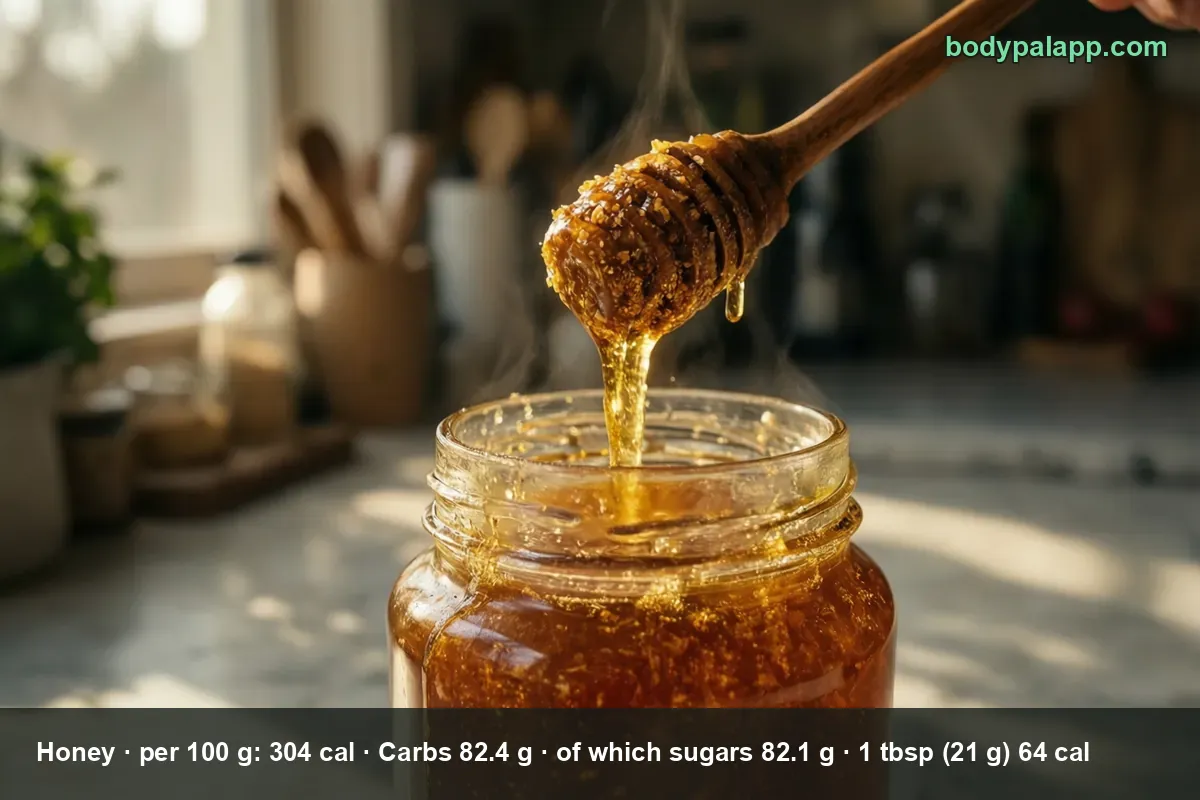
A tablespoon of honey is 64 calories. That is the serving printed on the Nutrition Facts panel of nearly every jar on an American shelf — 21 grams of it — and honey runs 304 calories per 100 g. A teaspoon comes to 21, a 0.5 oz squeeze packet to 43, and a full cup to 1,031.
On this page
- What one tablespoon of honey contains
- Why 82 grams of carbs is only 304 calories
- US serving sizes, from packet to squeeze bear
- Honey by the cup
- Your jar says 60 calories
- The added sugars line and the dagger
- Raw honey, honeycomb and the mineral claim
- Honey against the other sweeteners
- Most popular honey brands
- Honey calories FAQ
What one tablespoon of honey contains
The reference is the USDA entry for plain honey, FDC 169640, scaled to the 21 g tablespoon that every US label uses as its serving.
| Nutrient | Per 100 g | Per 1 tbsp (21 g) | % Daily Value |
|---|---|---|---|
| Calories | 304 | 64 | — |
| Total fat | 0 g | 0 g | 0% |
| Saturated fat | 0 g | 0 g | 0% |
| Carbohydrate | 82.4 g | 17.3 g | 6% |
| Dietary fiber | 0.2 g | 0 g | 0% |
| Total sugars | 82.1 g | 17.2 g | — |
| Protein | 0.3 g | 0.1 g | 0% |
| Sodium | 4 mg | 1 mg | 0% |
% Daily Value is based on a 2,000-calorie diet.
Verified nutrition data
Numbers on this page come from USDA FoodData Central, the U.S. Department of Agriculture’s food composition database, and from manufacturer labels where a branded product is named. Last verified September 2026. How we verify our data →
There is no added sugars row above, and that is deliberate rather than an omission: the USDA record for plain honey carries no added-sugars figure, because nothing was added to it. What happens on the jar instead is worth a section of its own, further down.
Total sugars have no Daily Value under FDA labeling rules, so that row stays blank too. Every other line rounds to zero. Honey is carbohydrate and water, and the carbohydrate is sugar.
Why 82 grams of carbs is only 304 calories
Run the usual arithmetic and honey should be heavier than it is. Carbohydrate is normally counted at 4 calories per gram, and 82.4 × 4 comes to 330. USDA publishes 304.
The gap is real and it has a cause. USDA assigns honey its own energy conversion factors rather than the standard 4/4/9: 3.68 calories per gram of carbohydrate, 3.36 for protein, 8.37 for fat. Check it: 82.4 × 3.68 = 303.2, plus 0.3 × 3.36 = 1.0, which lands on 304. Anyone estimating honey as grams × 4 inflates it by roughly 9%.
What sits behind that factor is the sugar itself. Table sugar is 99.8% sucrose, one molecule that your gut has to split before anything happens. Honey holds just 0.89 g of sucrose per 100 g. The rest arrives pre-split: fructose 40.94 g, glucose 35.75 g, plus galactose at 3.10 and maltose at 1.44. Add the three single sugars and you get 97% of honey's total sugars already in monosaccharide form, against zero percent in the sugar bowl.
That composition is the reason honey tastes sweeter than its weight suggests, and the reason a calorie chart built on generic factors gets it wrong.
US serving sizes, from packet to squeeze bear
| Serving | Weight | Calories |
|---|---|---|
| 1 teaspoon | 7 g | 21 |
| 1 tablespoon | 21 g | 64 |
| 1 honey packet (0.5 oz) | 14 g | 43 |
| 1 oz | 28.35 g | 86 |
| ¼ cup | 84.75 g | 258 |
| 1 cup | 339 g | 1,031 |
| 12 oz squeeze bear, all of it | 340 g | 1,034 |
USDA lists three of those directly for honey: the cup at 339 g, the tablespoon at 21 g and the diner packet at 14 g. The teaspoon works out to 7 g, which is the tablespoon divided by three and also the weight USDA files under "quantity not specified" — two routes to the same number, so it is about as solid as a spoon measure gets.
Note what the packet does. Half an ounce of honey, the kind that comes with a tea order, is 43 calories — two thirds of a tablespoon, not the trivial thing the size of the tub implies.
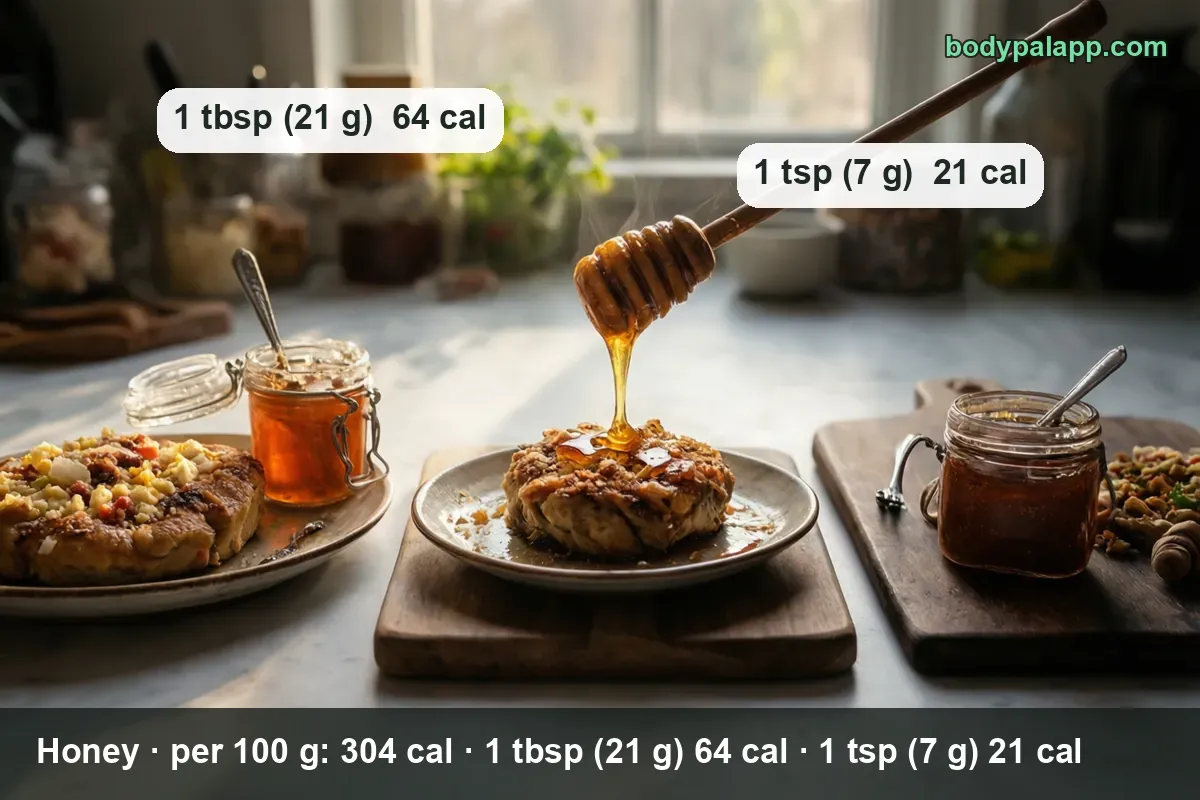
Honey rarely travels alone, and the partner usually costs more than the drizzle. A baked buttermilk biscuit is 165 calories for a 51 g one, so a biscuit with a tablespoon of honey is 229. The sodium in that pairing comes almost entirely from the biscuit: 511 mg against honey's 1 mg, which is 22% of the day in the bread and nothing at all in the honey. An ounce of walnuts under the same tablespoon makes 249 calories, and this time the fat and the protein are worth having.
Honey by the cup
Honey breaks people at the cup line, not the spoon line. One cup of honey is 339 g and 1,031 calories. One cup of granulated sugar is 200 g and 774. Cup for cup, the "healthier" swap in a baking recipe adds 257 calories to the bowl.
The rest of the measuring set, from the same USDA figure: ½ cup is 515 calories, ⅓ cup is 344, ¼ cup is 258.
Then there is the bear. A 12 oz squeeze bottle holds 340 g, which is 1,034 calories in a container most kitchens treat as a condiment. Nobody drinks it in one sitting, but a bear that empties over three weeks is roughly 50 calories a day that never showed up in anyone's log.
Your jar says 60 calories
Pick up seven American honeys and six of them print 60 calories per tablespoon: Sue Bee, Kirkland Signature, Great Value, Local Hive, Bee Harmony, Wholesome and Good & Gather all declare 286 calories per 100 g. Nature Nate's, on the same shelf, prints 70 — its USDA record shows 333 per 100 g. The lab figure for plain honey, 64, sits between the two.
Neither label is lying. FDA rounding rules let a food above 50 calories per serving report to the nearest 10, and carbohydrate is declared in whole grams, so 17.3 g becomes 17 g on one panel and 18 g on another before the calorie line is even calculated. Two jars of identical honey can legally differ by 10 calories a spoon.
Our take: log 64 and stop reading the panel. For someone using three tablespoons a day, the difference between 60 and 64 is 12 calories daily and about 4,400 across a year, which is the kind of quiet drift that makes a food log stop matching the scale.
The added sugars line and the dagger
Honey sits in an odd corner of the Nutrition Facts label. Every gram of sugar in the jar is added sugar by FDA's definition once it leaves the hive and goes into anything, yet declaring "17 g added sugars" on a jar of pure honey reads as though a manufacturer stirred sugar into it. FDA settled this by letting single-ingredient sweeteners carry a dagger symbol (†) and a footnote in place of a gram figure — the rule is spelled out in the agency's added sugars labeling guidance.
The symbol changes the panel, not the sugar. A tablespoon of honey delivers 17.2 g of it, and the Daily Value for added sugars is 50 g. That is 34% of the day's allowance in one spoon. Three tablespoons — a mug of tea, a bowl of yogurt and a marinade — puts you past the limit before anything else sweet is counted.
For the wider target, dietary guidelines keep added sugars under 10% of daily calories, and MyPlate files honey with syrups rather than with the foods it gets poured on.
Raw honey, honeycomb and the mineral claim
Raw honey does not carry fewer calories, and the reason is easy to check: USDA has exactly one entry for honey in its legacy database and one in its survey database, with no separate record for raw, unfiltered or pasteurized. The labels agree. Kirkland Signature's raw unfiltered honey and Great Value's filtered clover honey print the same 60 calories a spoon. Raw honey differs in enzymes, pollen and how fast it crystallizes, not in energy: 21 calories a teaspoon and 64 a tablespoon, either way.
Honeycomb is the genuine exception. USDA's record for comb honey shows 333 calories per 100 g and 6.67 g of fat, the only honey with any fat at all, because the beeswax is part of what you chew. Its serving is smaller too, 15 g rather than 21, which puts a spoon of comb honey at 50 calories.
The mineral argument does not survive the panel either. A tablespoon carries 11 mg of potassium, 0% of the Daily Value. Even a full 100 g of honey supplies 52 mg, which is 1%. Reaching that 1% costs 304 calories.
Honey against the other sweeteners
| Sweetener | Per 100 g | Typical tablespoon | Calories |
|---|---|---|---|
| Honey | 304 | 21 g | 64 |
| Agave nectar | 310 | about 20.7 g | 64 |
| Molasses | 290 | 20 g | 58 |
| Maple syrup | 260 | 20 g | 52 |
| Table sugar | 387 | about 12.6 g | 49 |
The two columns disagree, and the right one wins. Per 100 g, sugar is far heavier than honey, 387 against 304. Per spoon the order flips completely, because a tablespoon of honey weighs 21 g while a tablespoon of granulated sugar weighs about 12.6 g. Honey is the heaviest ordinary spoonful in the American pantry, tied with agave and ahead of molasses, maple and sugar.
Our take: on calories alone, maple syrup at 52 and table sugar at 49 are the smaller spoons, so switching to honey to save calories moves the wrong way. Honey earns its place on flavor and on sweetness per gram, not on the number. If you want the number down, the lever is the spoon, and the teaspoon column proves it: honey and agave 21 each, molasses 19, maple 17, sugar 16.
Most popular honey brands in the United States
Ranked by how widely each product appears among foods sold in the United States, from the BodyPal food database of over 3.3 million products. Calories are the figures printed on each Nutrition Facts label, checked against USDA FoodData Central.
| Product | Calories (per 100 g) |
|---|---|
| Local Hive Clover Honey | 286 cal |
| Kirkland Signature Raw Unfiltered Honey | 286 cal |
| Nature Nate’s 100% Pure Raw & Unfiltered Honey | 333 cal |
| Great Value Clover Honey | 286 cal |
| Sue Bee Pure Premium Clover Honey | 286 cal |
| Bee Harmony American Raw Clover Honey | 286 cal |
Brand popularity: BodyPal food database. Nutrition: manufacturer labels / USDA FoodData Central.
Honey calories FAQ
How many calories in a tablespoon of honey?
64 calories in a 21 g tablespoon, based on USDA's figure of 304 calories per 100 g. That spoon carries 17.3 g of carbohydrate and 17.2 g of sugar, with no fat and effectively no protein. Jars on the shelf print 60 or 70 because of FDA rounding.
How many calories in a teaspoon of honey?
21 calories in a level teaspoon, which weighs 7 g. That is a third of a tablespoon, and it is the same figure USDA files for an unspecified amount of honey. Two teaspoons in a mug and one on yogurt comes to 63 calories across a day.
Does raw honey have fewer calories than regular honey?
No. Both are 64 calories a tablespoon. USDA holds a single record for honey with no separate raw or pasteurized entry, and US labels back it up: raw unfiltered jars and filtered clover jars declare the same 60 calories a spoon. The difference is in enzymes and pollen, not energy.
How many calories are in raw honeycomb?
50 calories in a tablespoon of comb honey, which is 15 g rather than the usual 21. Comb honey runs 333 calories per 100 g and is the only honey with fat, 6.67 g per 100 g, because the beeswax is eaten along with the honey.
How many calories are in 100 grams of honey?
304 calories, with 82.4 g of carbohydrate and 82.1 g of sugar. That is about five tablespoons. Recipes are where the 100 g figure earns its keep, since a full cup weighs 339 g and comes to 1,031 calories.
Is honey better than sugar for cutting calories?
Not by the spoon. A tablespoon of honey is 64 calories against 49 for a tablespoon of granulated sugar, because honey is denser and the same spoon holds 21 g of it against 12.6 g. Per 100 g the ranking reverses, 304 for honey and 387 for sugar. FDA counts both as added sugars.
How much sugar is in a tablespoon of honey?
17.2 g, which is 34% of the 50 g Daily Value for added sugars. Almost none of it is sucrose: honey holds 0.89 g of sucrose per 100 g, with fructose at 40.94 g and glucose at 35.75 g already in single-sugar form.
How many calories are in a cup of honey?
1,031 calories in one cup, which weighs 339 g. Half a cup is 515 and a quarter cup 258. A cup of granulated sugar weighs 200 g and delivers 774, so swapping honey into a recipe cup for cup adds 257 calories.
Similar foods
- Honey Packet — 43 cal per packet
- Shredded Cheese — 261 cal per cup
- Spoon Of Honey — 64 cal per tablespoon
- Queso Fresco — 84 cal per ounce
- Cheeseburger — 488 cal per cheeseburger
- Double Cheeseburger — 607 cal per double cheeseburger
Count it without the math
Point the camera at the biscuit and BodyPal logs the honey, the bread under it and the walnuts beside it in one shot.


How long does it take to burn off honey?
A tablespoon (21 g) is 64 kcal. Enter your weight and the amount you ate to see how long it takes you to burn that off:
lb
| Activity | Time to burn 64 kcal |
|---|---|
| Walking, brisk | 13 min |
| Cycling, moderate | 8 min |
| Swimming, moderate | 9 min |
| Jogging | 8 min |
| Weight training, moderate | 14 min |
Times are for a 155 lb adult at a steady pace; change the weight to see yours. The amount is set to the portion in the text (21 g); change it to what you actually ate. BodyPal works this out from your steps automatically.
Want the bigger picture? Calculate your daily calorie needs — your maintenance figure, a target for losing or gaining, and the date you get there.