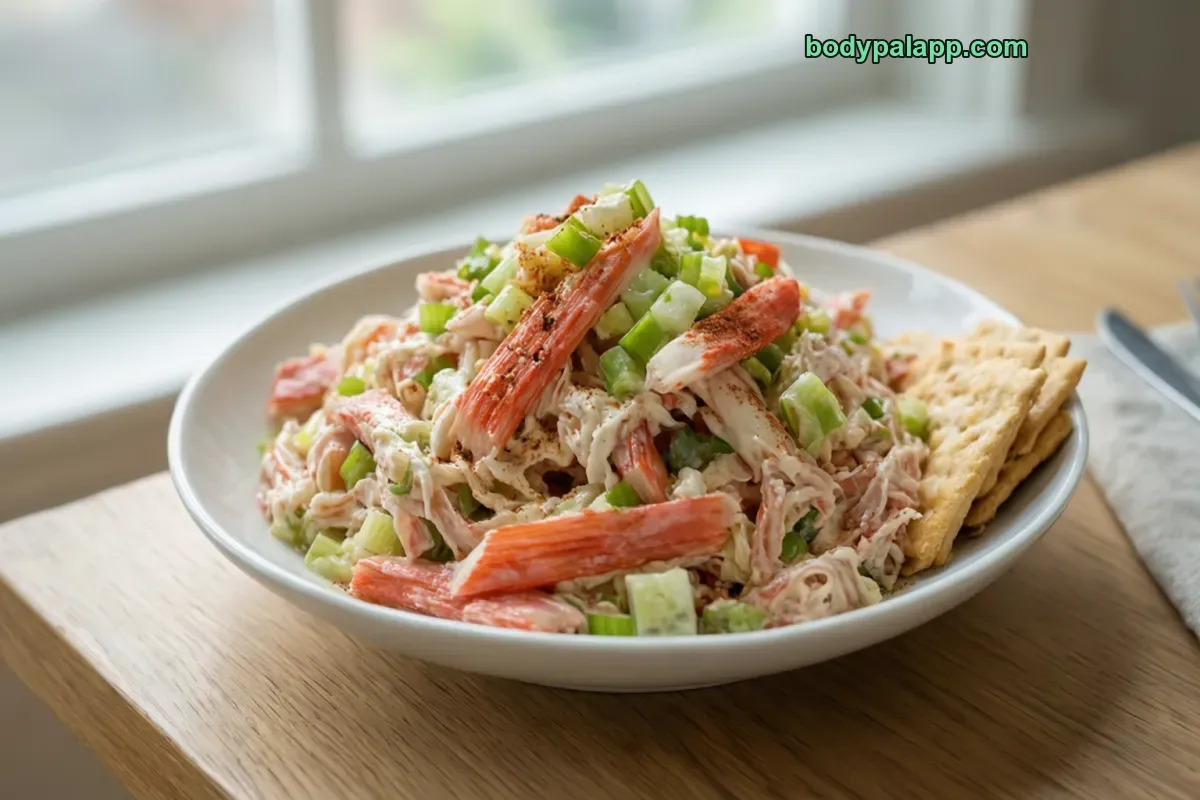
Crab salad calories come to 391 for 1 cup (208 g) and 188 per 100 g. The number to notice is the fat: it supplies 77% of those calories, so the creamy dressing, not the crab, sets the total. A cup also carries 961 mg of sodium, 42% of the daily value.
391kcal
1 cup · 208 g, made with real crab
20%protein
19.6 gProtein
3 gCarbs
33 gFat
How to burn off 391 kcal
—Walking, brisk
—Jogging
—Cycling, moderate
—Swimming
Skip the math. BodyPal counts these calories from your steps and workouts automatically.
Nutrition facts
Made with real crab · per 208 g
Calories
391 kcal
Protein
19.6 g
Carbohydrate
2.6 g
Fat
33 g
Saturated fat
5.3 g
Cholesterol
121 mg
Sodium
961 mg
Potassium
418 mg
Iron
0.6 mg
Source: USDA FoodData Central
🛡️
Verified nutrition data
Numbers on this page come from USDA FoodData Central, the U.S. Department of Agriculture’s food composition database, and from manufacturer labels where a branded product is named. Last verified September 2026. How we verify our data →
Crab salad: calories, protein and sodium by serving
Percent of daily value uses the FDA reference of 2,000 kcal a day.
Serving
kcal
Protein
Carbs
Fat
Sodium
% DV kcal
1 cup (208 g)
391
19.6 g
2.6 g
33.1 g
961 mg
20%
Half cup (104 g)
196
9.8 g
1.3 g
16.5 g
480 mg
10%
With imitation crab (208 g)
410
8.5 g
18 g
33.9 g
1,102 mg
20%
100 g
188
9.4 g
1.3 g
15.9 g
462 mg
9%
3 × 1 cup (208 g)
1,173
58.7 g
2,883 mg
5 × 1 cup (208 g)
1,955
97.8 g
4,805 mg
A half cup is a 196-calorie scoop
A half cup (104 g) of crab salad made with real crab comes to 196 calories, about 10% of the daily calorie value. That scoop gives you 9.8 g of protein and 16.5 g of fat. A full cup (208 g) roughly doubles everything: 391 calories, 19.6 g of protein and 33.1 g of fat.
Scooping is where the total drifts. Crab salad is soft and dense, so a heaped serving spoon holds more than it looks. Two cups, the kind of pile that ends up on a generous lunch plate, reach 782 calories. Three cups come to 1,173 calories, and a 5-cup party bowl holds 1,955.
If you build a sandwich, a stuffed avocado or lettuce wraps, measure the salad rather than guessing. The filling usually decides whether the meal lands near the half-cup total or the full-cup one. Leveling a measuring cup once is enough to calibrate your eye for the next time.
Fat supplies 77% of the calories
Per 100 g, crab salad has 15.9 g of fat, 9.4 g of protein and only 1.3 g of carbs. Turned into calories, that is 77% fat, 20% protein and 3% carbs. The crab brings the protein; the mayonnaise-style dressing brings most of the fat and most of the calories.
That split makes crab salad closer to a rich spread than to a lean seafood dish. Saturated fat is moderate at 2.5 g per 100 g, and cholesterol sits at 58 mg. Fiber and sugar barely register, at 0.4 g and 0.6 g.
The protein is still real. A cup delivers 19.6 g, which is 39% of the daily value, and that is the main reason the dish keeps you fuller than its carb count suggests. If you want more protein per calorie, the lever is the dressing: a lighter hand with it shifts the split toward the crab. Two cups give you 39.1 g of protein, but also 782 calories, so the trade gets less favorable as portions grow.
Sodium is the row to watch
Crab salad has 462 mg of sodium per 100 g. A half cup carries 480 mg, or 21% of the daily value, and a full cup carries 961 mg, or 42%. That is a large share for a side dish that rarely gets eaten alone.
The sodium climbs fast with portions. Two cups hold 1,922 mg, and three cups reach 2,883 mg, which is more than the full daily value on its own. Add bread, crackers or chips and a crab salad lunch can take up most of a day's sodium before dinner.
If you watch sodium, keep the portion at a half cup and pair it with foods that bring little salt of their own: plain greens, sliced cucumber, tomatoes or fresh fruit. Crab salad has some potassium, 201 mg per 100 g, but not enough to balance the sodium row by itself. Unsalted crackers or a plain baked potato also work as a base without pushing the total higher.
Imitation crab adds carbs, sugar and sodium
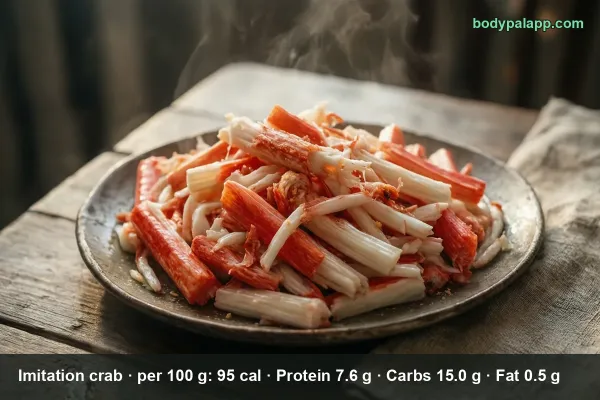
Deli and grocery crab salad is often made with imitation crab, and the numbers change more than the calories suggest. A 208 g serving of the imitation version has 410 calories, close to the 391 in a cup made with real crab. The calorie gap is small; the rest of the label is not.
Protein drops to 8.5 g, only 17% of the daily value, compared with 19.6 g for real crab. Carbs jump from 2.6 g to 18 g, and sugars go from 1.2 g to 7.6 g, because imitation crab is made with starch and added sugar. Sodium rises too, from 961 mg to 1,102 mg, which is 48% of the daily value.
If you buy crab salad ready-made, check whether the label lists real crab or surimi. Brands such as Great American Seafood Crab Salad sell versions in the seafood case, and the ingredient list tells you which numbers apply. BodyPal can log either version from a photo, but the protein difference is worth knowing before you choose.
How does crab salad compare?
Here crab salad sits next to imitation crab, broccoli salad and chef salad, compared per 100 g and per usual serving.
Verdict: For the fewest calories pick chef salad at 71 per 100 g or plain imitation crab at 95, and treat broccoli salad at 270 as the heaviest option. Crab salad at 188 per 100 g earns its place on protein, with 9.4 g against 5.8 g for broccoli salad and 4.2 g for chef salad.
Most popular crab salad brands in the United States
Ranked by popularity in the BodyPal database
# Productkcal / 100 g
1Great American Seafood Crab Salad0.5 cup · 100 g190 kcal
The packaged salad is labeled per 100 g, so it lines up with the per 100 g number above; sushi rolls sold as crab salad are mostly rice and are left out. Source: manufacturer labels / USDA FoodData Central.
Crab salad FAQs
How many calories are in crab salad?
A 1 cup serving is about 391 calories, and half a cup is 196. Per 100 g crab salad is 188 calories.
Is crab salad good for weight loss?
Crab salad is 188 calories per 100 g, with 15.9 g fat against 9.4 g protein per 100 g. A half cup portion keeps it to 196 calories.
Crab salad or imitation crab: which has fewer calories?
Plain imitation crab is 95 calories per 100 g, about half the 188 calories per 100 g in crab salad, because the salad adds a creamy dressing.
How much protein is in crab salad?
About 9.4 g per 100 g, which works out to 19.6 g in a 1 cup (208 g) serving and 9.8 g in half a cup. The imitation crab version has only 4.1 g per 100 g.
What are the nutrition facts for crab salad?
Per 100 g, crab salad has 188 calories, 9.4 g of protein, 1.3 g of carbs, 15.9 g of fat and 462 mg of sodium. It also has 2.5 g of saturated fat, 58 mg of cholesterol and 0.4 g of fiber.
Is crab salad fattening?
It is calorie-dense at 188 calories per 100 g, with 77% of those calories from fat. A half cup at 196 calories fits most days easily, but three cups reach 1,173, so portion size matters most.
How many carbs are in crab salad?
A cup of crab salad made with real crab has just 2.6 g of carbs, and a half cup has 1.3 g. Carbs supply only 3% of its calories. The imitation crab version has 18 g per 208 g.
How many calories are in imitation crab salad?
Crab salad made with imitation crab has 410 calories per 208 g, slightly more than the 391 in a cup made with real crab. It also has less protein, 8.5 g versus 19.6 g, and more sugar.