
How many calories are in imitation crab?
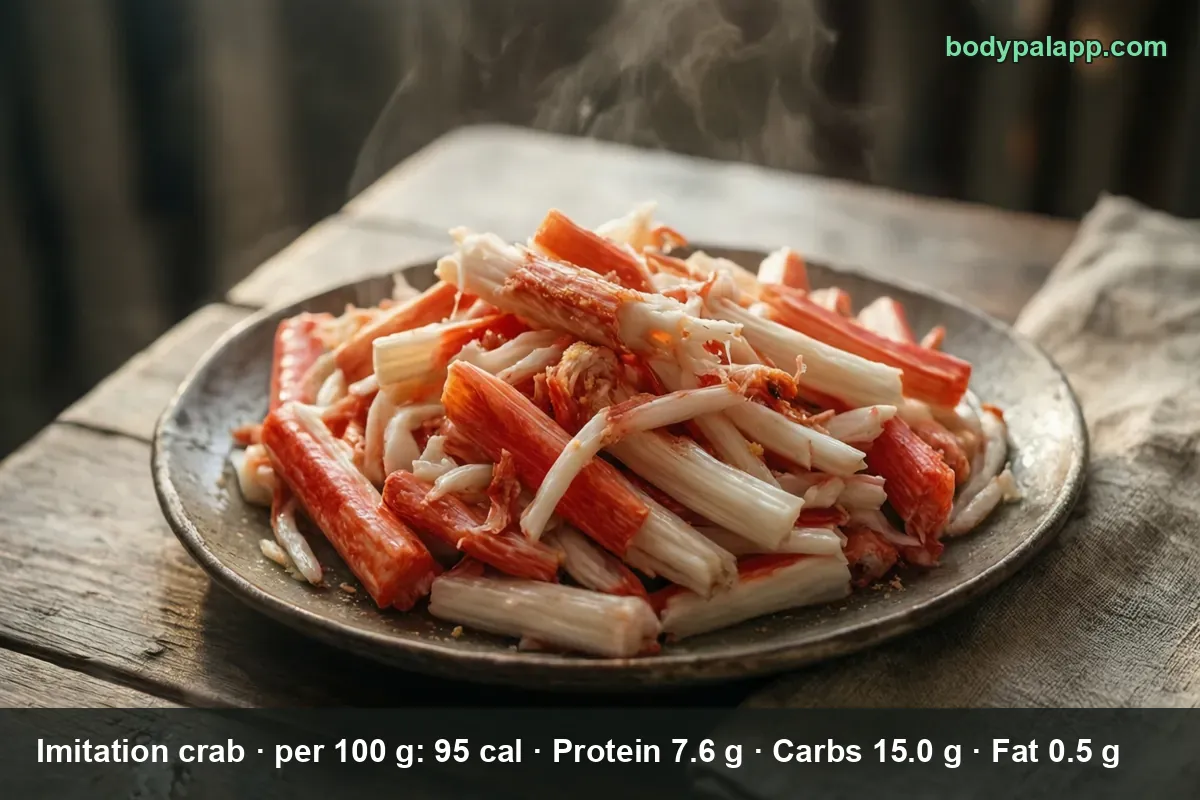
Three ounces of imitation crab, a standard 85 g serving, is 81 calories, and per 100 g the surimi runs 95 calories. That is light for a protein food, but the number hides two things: the carbohydrate is 15 g per 100 g, and one small serving already carries 450 mg of sodium.
On this page
- Imitation crab quick facts
- US servings, from one stick to an 8 oz package
- Sticks, shredded cups and crab salad
- Sodium and carbs are the rows to watch
- How does imitation crab compare?
- Most popular imitation crab brands
- FAQ
Imitation crab quick facts
The record here is SR Legacy 174203, "Crustaceans, crab, alaska king, imitation, made from surimi". That is the plain surimi meat you pull out of the package, which is what almost everyone searching this actually has in hand. The same product also sits in the FNDDS survey file as 2706568, "Imitation crab meat" with identical values per 100 g; the survey row gives a cup measure, the SR Legacy row gives the 3 oz household serving, and neither one changes the food.
| Nutrient | Per 100 g | Per 3 oz (85 g) | % Daily Value |
|---|---|---|---|
| Calories | 95 | 81 | — |
| Total fat | 0.46 g | 0.4 g | 1% |
| Saturated fat | 0.22 g | 0.2 g | 1% |
| Carbohydrate | 15 g | 12.8 g | 5% |
| Dietary fiber | 0.5 g | 0.4 g | 2% |
| Total sugars | 6.25 g | 5.3 g | — |
| Protein | 7.62 g | 6.5 g | 13% |
| Sodium | 529 mg | 450 mg | 20% |
| Cholesterol | 20 mg | 17 mg | 6% |
| Potassium | 90 mg | 77 mg | 2% |
% Daily Value is based on a 2,000-calorie diet.
Verified nutrition data
Numbers on this page come from USDA FoodData Central, the U.S. Department of Agriculture’s food composition database, and from manufacturer labels where a branded product is named. Last verified September 2026. How we verify our data →
There is no added sugars row on the table because USDA does not break out added sugars for this record, even though the sugar in surimi comes from the binder rather than from the fish. Trans fat is not published for it either. The Daily Values used above are the FDA reference amounts on the Nutrition Facts label.
Store brands land close to this. Per 100 g, TransOcean flake style is 94 calories, Kroger Crab Select 94, Fremont Fish Market 94, Hy-Vee 106, Great American Seafood Imports flakes 119, and Arctic Shores crab legs 129. On the shared 85 g label serving that is 80 calories at the low end and 110 at the high end, so the package in your cart can be about a third heavier per bite than the USDA average.
US servings, from one stick to an 8 oz package
| Serving | Weight | Calories |
|---|---|---|
| 1 stick | 17 g | 16 kcal |
| 1 oz | 28 g | 27 kcal |
| 3 oz, USDA household measure | 85 g | 81 kcal |
| 1/2 cup, flake style, the label serving | 85 g | 81 kcal |
| 1 cup, flake or shredded | 135 g | 128 kcal |
| 8 oz package | 227 g | 215 kcal |
| Per 100 g | 100 g | 95 kcal |
Two of these are USDA measures: the 3 oz serving on the SR Legacy record and the 1 cup measure on the FNDDS row. The half cup is the packaging serving, and it happens to weigh the same 85 g, which is why the panel on almost every flake-style tub reads somewhere near 80 calories.
The single stick and the full 8 oz package are our own arithmetic from the USDA 100 g figure, not USDA servings: a stick runs about 17 g, and the package itself is 226.8 g. Five sticks, then, make up the 3 oz serving. Nobody eats five sticks and calls it a meal, which is exactly how a plain-looking snack turns into 215 calories while you are standing at the counter.
Sticks, shredded cups and crab salad
| Version | Per 100 g | Typical portion | Calories |
|---|---|---|---|
| Imitation crab meat, flake or shredded | 95 kcal | 1 cup, 135 g | 128 kcal |
| Imitation crab sticks | 95 kcal | 1 stick, 17 g | 16 kcal |
| Crab salad made with imitation crab | 197 kcal | 1 cup, 208 g | 410 kcal |
Sticks, flakes and shreds are the same food. Cutting shape does not change a calorie, so a stick eaten whole and a stick torn into a salad both cost about 16 calories. What changes is how many go in.
The cup is the trap. A cup of shredded imitation crab weighs 135 g and costs 128 calories, more than half again what the 3 oz serving costs, and it looks like a modest scoop in a bowl. Use a brand at the top of the range and that same cup goes higher: at 129 calories per 100 g it works out to about 174, our arithmetic from the label figure rather than a USDA number.
Crab salad is a different food and the table shows it. At 197 calories per 100 g it is more than double the plain meat, and a 1-cup portion of 208 g is 410 calories with 16.28 g of fat per 100 g against 0.46 g for the meat alone. The mayonnaise did that, not the surimi. If the deli case says crab salad, price it as a mayonnaise dish that happens to contain fish.
Sodium and carbs are the rows to watch
Nothing on the nutrition panel is dramatic except two lines. Sodium is 529 mg per 100 g, which is 450 mg in a 3 oz serving, or 20% of the 2,300 mg Daily Value. That is a fifth of the day gone in a serving most people would call a garnish. Scale up to a cup of shreds and it is 714 mg by our own arithmetic, close to a third of the day.
The second line is carbohydrate. Imitation crab carries 15 g per 100 g, of which 6.25 g is sugars, because starch and sugar are what hold milled fish paste together. Steamed cod and steamed white fish have 0 g. If you are counting carbs, this is the one seafood in the case that behaves partly like a bread product, and the sugars are why sweet-tasting surimi tastes sweet.
Protein is the other half of the story, and it goes the other way. At 7.62 g per 100 g, imitation crab has less than half the protein of the fish it imitates. In a 3 oz serving that is 6.5 g, or 13% of the Daily Value, where the same 85 g of steamed cod would give 16.4 g by our arithmetic from the USDA 100 g figure. MyPlate counts surimi in the protein foods group, and it belongs there, but it is a weak member of it.
Fat and cholesterol barely register. Total fat is 0.46 g per 100 g and saturated fat 0.22 g, so a serving is 1% of the Daily Value on each. Cholesterol is 20 mg per 100 g, 17 mg in a serving, 6% of the Daily Value. Potassium is low at 90 mg per 100 g, 2% of the Daily Value in a serving, which is worth knowing if you were counting on seafood for it.
How does imitation crab compare?
| Fish or seafood | Per 100 g | US serving | Calories |
|---|---|---|---|
| Imitation crab | 95 kcal | 3 oz, 85 g | 81 kcal |
| Cod, steamed | 87 kcal | 3 oz, 85 g | 74 kcal |
| Tuna, canned | 85 kcal | 3 oz, 85 g | 72 kcal |
| White fish, steamed | 104 kcal | 3 oz, 85 g | 88 kcal |
Serving calories for the three fish are our arithmetic from the USDA 100 g figures at 85 g, not USDA servings.
Our take: imitation crab is not the calorie bargain of this group. Two of the three fish here, canned tuna at 72 and steamed cod at 74 in a 3 oz serving, are lighter than its 81, and both bring roughly 16 g of protein where surimi brings 6.5 g. For a lunch built around fullness, canned tuna wins on every line that matters, and it does it with 0.08 g of carbohydrate against 15 g per 100 g. Keep imitation crab for what it is genuinely good at: a cheap, sweet, ready-to-eat filler in a California roll or a cold salad, where 81 calories buys texture rather than protein.
Most popular imitation crab brands in the United States
Ranked by how widely each product appears among foods sold in the United States, from the BodyPal food database of over 3.3 million products. Calories are the figures printed on each Nutrition Facts label, checked against USDA FoodData Central.
| Product | Calories (per 100 g) |
|---|---|
| TransOcean Flake Style Imitation Crab | 94 cal |
| Hy-Vee Fish Market Flake Style Imitation Crab Meat | 106 cal |
| Fremont Fish Market Flake Style Imitation Crab Meat | 94 cal |
| Kroger Crab Select Flake Style Imitation Crab Meat | 94 cal |
| Arctic Shores Seafood Imitation Crab Meat | 129 cal |
| Great American Seafood Imports Imitation Crab Flakes | 119 cal |
Brand popularity: BodyPal food database. Nutrition: manufacturer labels / USDA FoodData Central.
Imitation crab FAQs
How many calories are in imitation crab?
Imitation crab is 95 calories per 100 g, so a 3 oz (85 g) serving is 81 calories. That comes with 6.5 g of protein, 12.8 g of carbohydrate and 450 mg of sodium. The USDA record is Alaska king crab, imitation, made from surimi.
How many calories are in 3 oz of imitation crab?
81 calories in 3 oz (85 g), which is also the half-cup label serving on most flake-style packages. Protein is 6.5 g and carbohydrate 12.8 g. Brands vary: the same 85 g runs 80 calories for TransOcean flake style and 110 for Arctic Shores crab legs.
How many calories are in one imitation crab stick?
One stick is about 16 calories at 17 g. That weight is our own arithmetic from the USDA 100 g figure, not a USDA serving. Five sticks make up the 3 oz (85 g) serving at 81 calories, and the whole 8 oz package is 215.
How much protein is in imitation crab?
6.5 g of protein in a 3 oz (85 g) serving, or 7.62 g per 100 g, which is 13% of the Daily Value. Steamed cod in the same 85 g gives 16.4 g, our arithmetic from the USDA 100 g figure. Surimi is a moderate protein food, not a high one.
Does imitation crab have carbs?
Yes, 15 g per 100 g, or 12.8 g in a 3 oz serving, 5% of the Daily Value. Of that, 6.25 g per 100 g is sugars. The starch and sugar bind the fish paste. Steamed cod and steamed white fish, by contrast, have 0 g of carbohydrate.
How much sodium is in imitation crab?
450 mg in a 3 oz (85 g) serving, 20% of the 2,300 mg Daily Value, and 529 mg per 100 g. A 1-cup shredded serving of 135 g is 714 mg by our arithmetic, closer to a third of the day. That is close to a third of a teaspoon of table salt.
Is imitation crab healthy?
It is low in fat at 0.46 g per 100 g and low in calories, but it is not a substitute for fish on protein: 6.5 g per 3 oz against 16.4 g for steamed cod. Sodium is the real cost at 20% of the Daily Value per serving.
Is imitation crab good for weight loss?
At 95 calories per 100 g it is one of the lighter things in the seafood case, and 3 oz costs 81 calories. Steamed cod is lighter still at 87 per 100 g with more than twice the protein. If fullness matters more than the calorie count, pick the cod.
Similar foods
- Crab Stick — 81 cal per 3 oz
- Cowboy Caviar — 217 cal per cup
- Lobster — 194 cal per lobster
- Lobster Tail — 97 cal per lobster tail
- Tuna Nigiri — 29 cal per piece
- Shrimp — 84 cal per 3 oz
Count it without the math
Point the camera at the plate and BodyPal counts the sticks, shreds and salad for you.


How long does it take to burn off imitation crab?
A 3 oz (85 g) serving is 81 kcal. Enter your weight and the amount you ate to see how long it takes you to burn that off:
lb
| Activity | Time to burn 81 kcal |
|---|---|
| Walking, brisk | 16 min |
| Cycling, moderate | 10 min |
| Swimming, moderate | 12 min |
| Jogging | 10 min |
| Weight training, moderate | 18 min |
Times are for a 155 lb adult at a steady pace; change the weight to see yours. The amount is set to the portion in the text (85 g); change it to what you actually ate. BodyPal works this out from your steps automatically.
This table assumes you know your daily total. If you do not, the daily calorie calculator works it out from five numbers.