
How many calories are in a lobster tail?
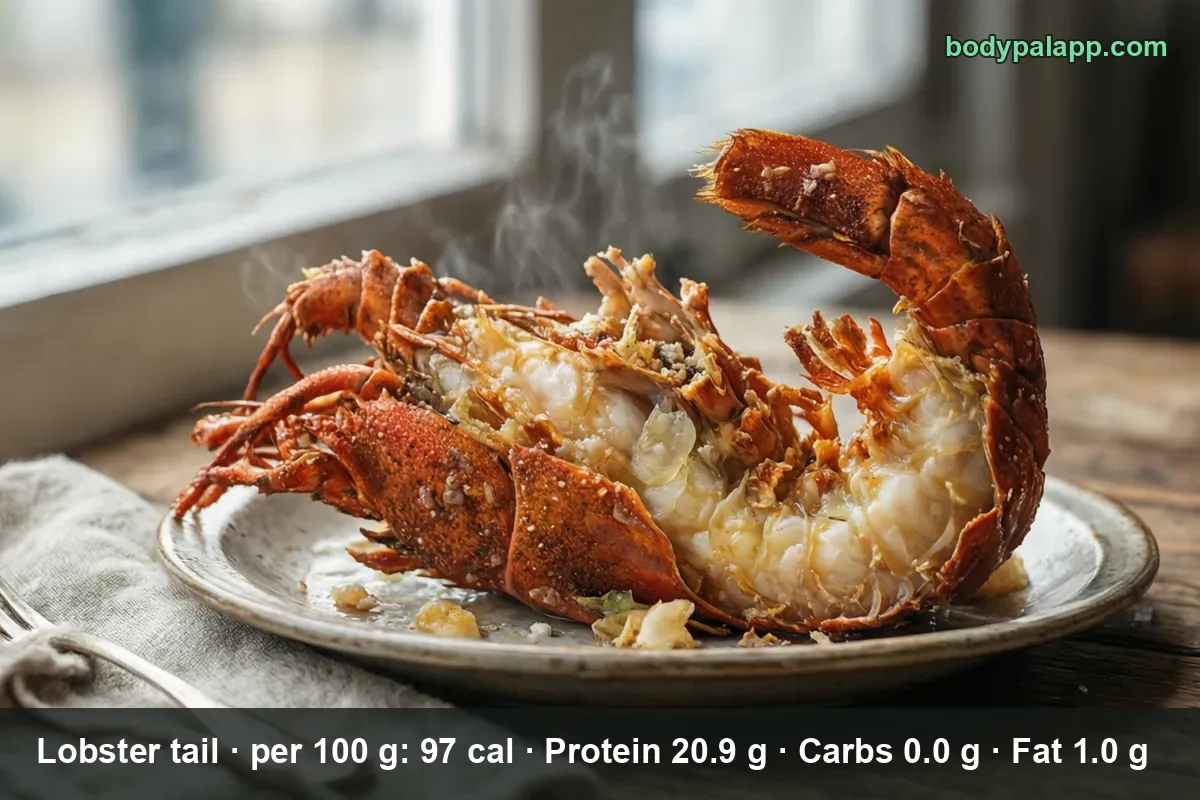
A 4 oz (113 g) cooked lobster tail carries 110 calories. Straight meat, no shell, no butter. Per 100 g lobster runs 97 calories, which is also what USDA counts as one tail. Almost all of it is protein: 23.6 g in that 4 oz, with 1.1 g of fat.
On this page
- Lobster tail quick facts
- US servings, from one ounce to a whole lobster
- Boiled, raw, spiny and stuffed
- Sodium and cholesterol, not fat, are the rows to watch
- How does lobster tail compare?
- Most popular lobster tail brands
- Lobster tail FAQs
Lobster tail quick facts
The numbers below come from the USDA record FNDDS 2706349, "Lobster". It was picked over the older species-specific entries for one reason: it is lobster in the state you actually eat it, cooked and out of the shell, and its household measure is literally one tail at 100 g. That matches what lands on the plate when someone orders a tail, so it anchors this page.
The serving column is 4 oz (113 g) of cooked meat, the size most US recipes and freezer packs are written around. That weight is our own arithmetic from the USDA 100 g figure, not a USDA serving.
| Nutrient | Per 100 g | Per 4 oz cooked tail (113 g) | % Daily Value |
|---|---|---|---|
| Calories | 97 | 110 | — |
| Total fat | 0.95 g | 1.1 g | 1% |
| Saturated fat | 0.23 g | 0.3 g | 1% |
| Carbohydrate | 0 g | 0 g | 0% |
| Dietary fiber | 0 g | 0 g | 0% |
| Total sugars | 0 g | 0 g | — |
| Protein | 20.91 g | 23.6 g | 47% |
| Sodium | 535 mg | 605 mg | 26% |
| Cholesterol | 161 mg | 182 mg | 61% |
| Potassium | 253 mg | 286 mg | 6% |
% Daily Value is based on a 2,000-calorie diet.
Verified nutrition data
Numbers on this page come from USDA FoodData Central, the U.S. Department of Agriculture’s food composition database, and from manufacturer labels where a branded product is named. Last verified September 2026. How we verify our data →
Two rows are missing on purpose. USDA does not publish added sugars or trans fat for this lobster record, so there is nothing honest to put in those cells. Nothing is lost: the carbohydrate line is a flat zero, which means there is no sugar of any kind in plain lobster meat.
US servings, from one ounce to a whole lobster
| Serving | Weight | Calories |
|---|---|---|
| 1 oz | 28 g | 27 kcal |
| 1 claw | 50 g | 49 kcal |
| One lobster tail, per 100 g | 100 g | 97 kcal |
| 4 oz cooked tail meat | 113 g | 110 kcal |
| 1 cup lobster meat | 135 g | 131 kcal |
| 1 whole lobster, meat only | 200 g | 194 kcal |
The 100 g tail, the cup, the claw and the whole-lobster line are USDA household measures. The 1 oz and 4 oz rows are our own arithmetic from the USDA 100 g figure, not USDA servings.
Watch the shell. A tail sold as "6 oz" is weighed with the shell on, and only about half of that comes out as meat, so you are logging roughly 85 g and about 82 calories, again our arithmetic. Restaurant menus quote the same shell-on weight. The scale in your kitchen should see the meat only.
Boiled, raw, spiny and stuffed
| Version | Per 100 g | Typical serving | Calories |
|---|---|---|---|
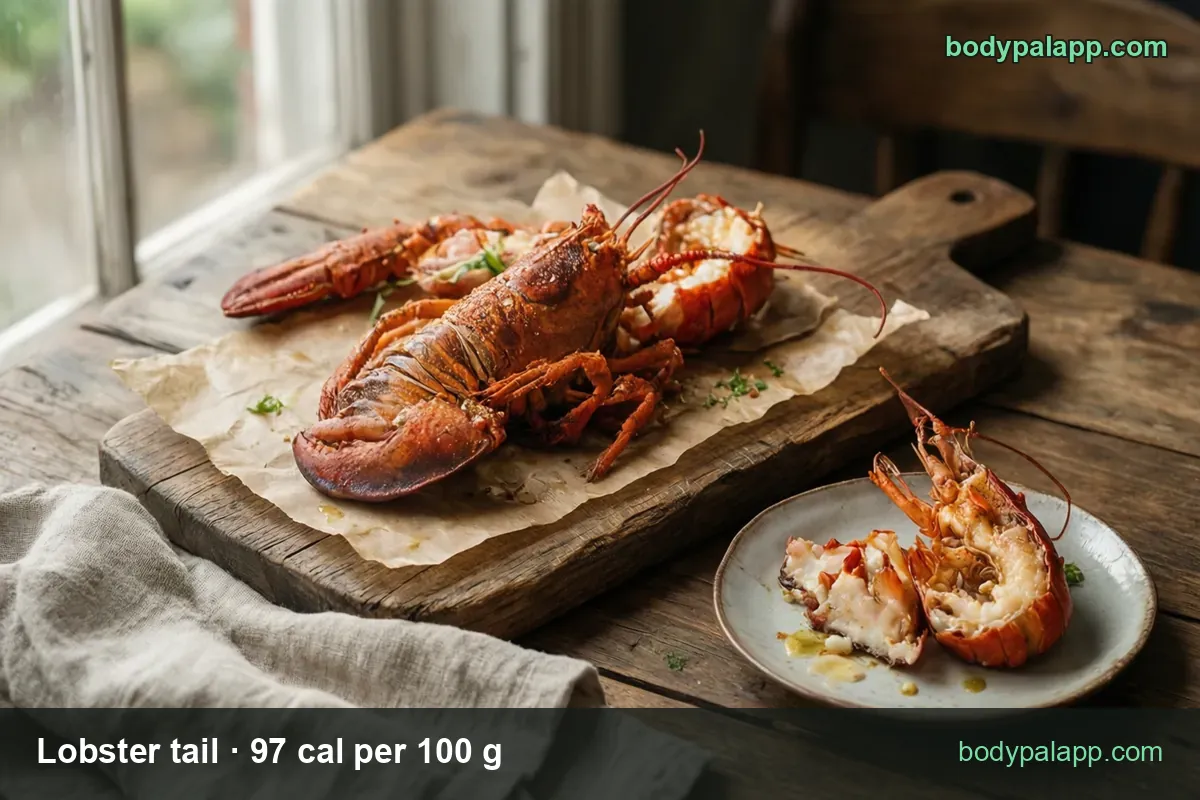
| Boiled or steamed Maine lobster tail | 89 kcal | 4 oz meat (113 g) | 101 kcal |
| Raw Maine lobster tail | 77 kcal | 4 oz meat (113 g) | 87 kcal |
| Spiny (rock) lobster tail, cooked | 143 kcal | 4 oz meat (113 g) | 162 kcal |
| Spiny (rock) lobster tail, raw | 112 kcal | 4 oz meat (113 g) | 127 kcal |
| Baked stuffed lobster | 177 kcal | one lobster (400 g) | 708 kcal |
| Lobster salad | 187 kcal | 1 cup (182 g) | 340 kcal |
Raw and cooked are not the same food on a scale. Northern lobster is 77 calories per 100 g raw and 89 once it has been steamed, because water leaves the meat and everything else concentrates. If you weigh the tail frozen and log it as cooked, you overcount by about 15% per gram.
Species matters more than people expect. Those frozen warehouse tails are usually spiny or rock lobster, and cooked they run 143 calories per 100 g against 89 for northern Maine lobster, roughly 60% more on the same weight. You get something for it: 26.41 g of protein per 100 g against 19 g. If a menu says "rock lobster tail," use the higher line.
The last two rows are where lobster stops being a light food. Baked stuffed lobster is 177 calories per 100 g, close to double plain tail meat, because bread stuffing and butter come along for the ride, and a whole one is 708 calories. Lobster salad is 187 per 100 g and 15.4 g of fat, almost all of it mayonnaise rather than lobster.
Retail packages tell a similar story with smaller swings. Across common US frozen tail brands the label figures run from 71 to 116 calories per 100 g, with half of them sitting near 80. The spread comes from whether the pack weighs raw meat, cooked meat or edible portion, not from the lobster.
Sodium and cholesterol, not fat, are the rows to watch
Fat is a non-issue here. A 4 oz tail carries 1.1 g of total fat and 0.3 g of saturated fat, 1% of the Daily Value on each line. There is no sugar and no fiber, because there is no carbohydrate at all.
Salt is the real line. Lobster lives in seawater and arrives salty: 535 mg of sodium per 100 g, 605 mg in a 4 oz portion, which is 26% of the 2,300 mg Daily Value the FDA uses on the Nutrition Facts label. That is the sodium in about a quarter teaspoon of table salt, before you salt the pot or the plate.
Cholesterol is the other surprise: 182 mg in a 4 oz tail, 61% of the 300 mg Daily Value, in a portion that costs 110 calories. Very few foods pack that ratio.
The upside is protein. That same 110-calorie portion delivers 23.6 g, or 47% of the Daily Value, which is why one tail eats like a full entree. The Dietary Guidelines for Americans put adults at about 8 ounces of seafood a week; two 4 oz tails cover it for 220 calories.
How does lobster tail compare?
| Shellfish | Per 100 g | US serving | Calories |
|---|---|---|---|
| Lobster tail | 97 kcal | 4 oz meat (113 g) | 110 kcal |
| Shrimp, steamed or boiled | 90 kcal | 3 oz (85 g) | 77 kcal |
| Crayfish, cooked | 97 kcal | 3 oz (85 g) | 82 kcal |
| Scallops, steamed or boiled | 87 kcal | 3 oz (85 g) | 74 kcal |
Our take: on calories per gram this is a photo finish. Only shrimp and scallops come in lighter than lobster, and crayfish matches it exactly at 97. Lobster wins the row that matters for a dinner plate, protein, at 20.91 g per 100 g against 20.22 for crayfish, 17.19 for shrimp and 15.24 for scallops. If you are cutting calories, any of the four works and the sauce decides the meal; if you want the plate to hold you until morning, take the tail.
Most popular lobster tail brands in the United States
Ranked by how widely each product appears among foods sold in the United States, from the BodyPal food database of over 3.3 million products. Calories are the figures printed on each Nutrition Facts label, checked against USDA FoodData Central.
| Product | Calories (per 100 g) |
|---|---|
| Sea Best Lobster Tails | 80 cal |
| SeaMazz Lobster Tails | 80 cal |
| Orion Seafood Lobster Tail | 79 cal |
| Greenhead Lobster Tails | 94 cal |
| Island Prince 7 oz Lobster Tails | 116 cal |
| East Coast Seafood Lobster Tails | 71 cal |
Brand popularity: BodyPal food database. Nutrition: manufacturer labels / USDA FoodData Central.
Lobster tail FAQs
How many calories are in one lobster tail?
97 calories. USDA's household measure for lobster is one tail at 100 g of meat, and that record runs 97 calories per 100 g. It is nearly all protein, 20.9 g, with under a gram of fat and no carbohydrate at all. Shell weight is not counted.
How many calories in a 4 oz lobster tail?
110 calories for 4 oz (113 g) of cooked tail meat. That is our own arithmetic from the USDA 100 g figure, not a USDA serving. It brings 23.6 g of protein, 47% of the Daily Value, along with 1.1 g of fat and 605 mg of sodium.
How many calories in a 6 oz lobster tail?
About 82 calories, because a 6 oz tail is sold shell-on and roughly half of that weight is edible meat, around 85 g, or 82 calories at 97 per 100 g. That is our arithmetic, not a USDA serving. Weigh the meat after you pull it out of the shell.
Is lobster tail high in protein?
Yes, 20.9 g per 100 g, or 23.6 g in a 4 oz portion, which is 47% of the Daily Value in 110 calories. Among the shellfish on this page it is the densest: crayfish 20.2 g, shrimp 17.2 g and scallops 15.2 g per 100 g.
Is lobster tail high in cholesterol?
161 mg per 100 g, and 182 mg in a 4 oz portion, 61% of the 300 mg Daily Value the FDA uses on the Nutrition Facts label. That is a lot of cholesterol for 110 calories. Fat is not the issue here: the same portion carries 1.1 g of fat.
How much sodium is in lobster tail?
535 mg per 100 g, or 605 mg in a 4 oz portion, 26% of the 2,300 mg Daily Value, about the sodium in a quarter teaspoon of table salt. Lobster is naturally salty from seawater, and the USDA figure is before you salt the pot or the plate.
Does butter change the calories in lobster tail?
Yes, and butter adds more than the 110-calorie tail itself does. The USDA record is plain meat: 110 calories and 1.1 g of fat in 4 oz. Anything melted alongside it gets logged separately. For scale, USDA's baked stuffed lobster runs 177 calories per 100 g against 97 for plain tail meat.
Which has fewer calories, lobster tail or shrimp?
Shrimp, but barely: 90 calories per 100 g steamed or boiled against 97 for lobster. A 3 oz (85 g) shrimp serving is 77 calories. Lobster carries more protein though, 20.9 g per 100 g against 17.2 g, so the seven-calorie gap buys you a denser piece of meat.
Similar foods
- Lobster — 194 cal per lobster
- Tuna Nigiri — 29 cal per piece
- Crab Stick — 81 cal per 3 oz
- Imitation Crab — 81 cal for 3 oz
- Shrimp — 84 cal per 3 oz
- Shrimp — 84 cal per 3 oz
Count it without the math
Point the camera at the plate and BodyPal counts the tail for you, shell and butter sorted out.


How long does it take to burn off a lobster tail?
A 4 oz (113 g) cooked tail is 110 kcal. Enter your weight and the amount you ate to see how long it takes you to burn that off:
lb
| Activity | Time to burn 110 kcal |
|---|---|
| Walking, brisk | 22 min |
| Cycling, moderate | 14 min |
| Swimming, moderate | 16 min |
| Jogging | 13 min |
| Weight training, moderate | 24 min |
Times are for a 155 lb adult at a steady pace; change the weight to see yours. The amount is set to the portion in the text (113 g); change it to what you actually ate. BodyPal works this out from your steps automatically.
Burning it off is one side of it. The other is knowing your number: work out how many calories you need a day, with macros and a goal date.