
How many calories are in a lobster?
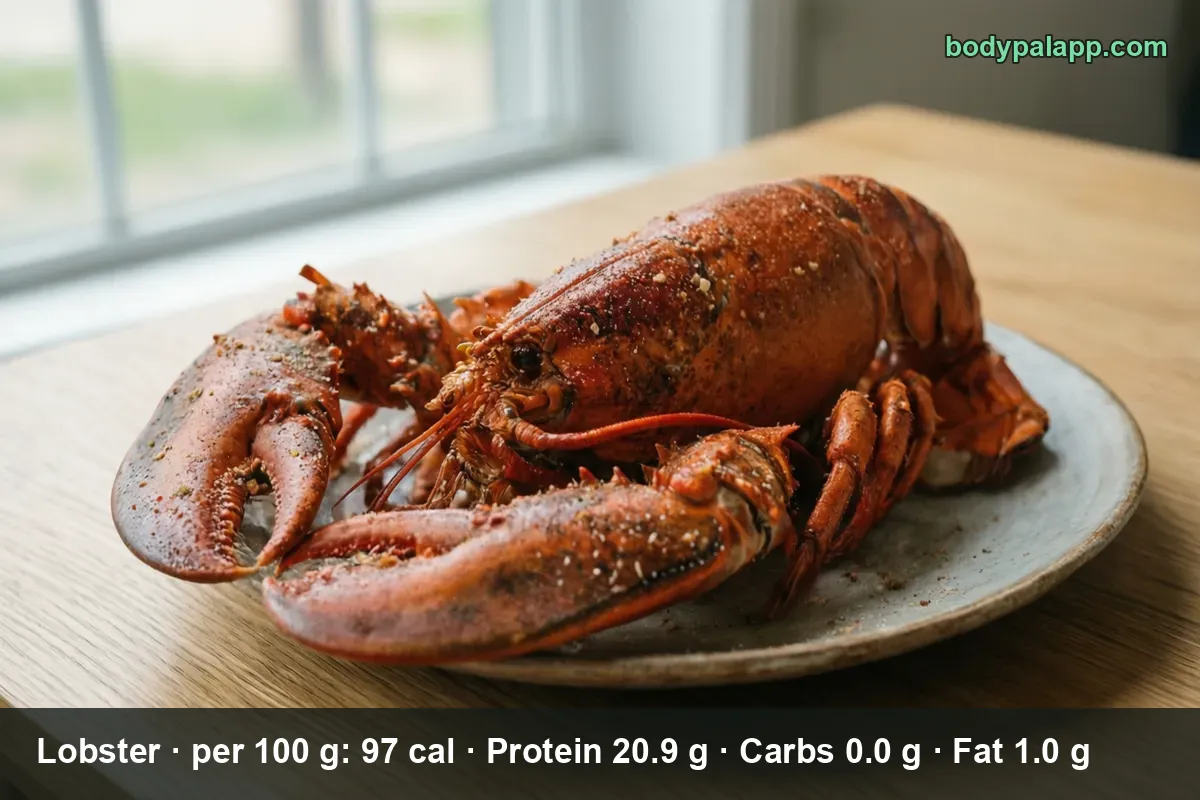
One whole cooked lobster of 200 g carries 194 calories, and the meat itself runs 97 calories per 100 g. That is a full shell's worth of food for under 200 calories. Almost all of it is protein, 41.8 g, with 1.9 g of fat and no carbohydrate at all. The cholesterol line is the one that surprises people.
On this page
- Lobster quick facts
- US servings, from one ounce to a whole lobster
- Lobster salad, baked stuffed lobster and other versions
- Maine lobster vs spiny lobster, raw vs cooked
- Cholesterol and sodium are the rows to watch
- How does lobster compare?
- Most popular lobster brands
- Lobster FAQs
Lobster quick facts
The number below comes from the USDA survey record 2706349, "Lobster". It describes cooked lobster meat the way people actually eat it, and it is the only lobster entry that ships with American household measures: one lobster, one tail, one claw, one cup of picked meat. The older SR Legacy entries split lobster by species instead, and those sit in their own section further down.
One whole lobster is treated as 200 g of meat here, which is the USDA measure, not a guess about how heavy the animal was before the shell came off.
| Nutrient | Per 100 g | Per 1 lobster (200 g) | % Daily Value |
|---|---|---|---|
| Calories | 97 | 194 | — |
| Total fat | 0.95 g | 1.9 g | 2% |
| Saturated fat | 0.23 g | 0.5 g | 2% |
| Carbohydrate | 0 g | 0 g | 0% |
| Dietary fiber | 0 g | 0 g | 0% |
| Total sugars | 0 g | 0 g | — |
| Protein | 20.91 g | 41.8 g | 84% |
| Sodium | 535 mg | 1070 mg | 47% |
| Cholesterol | 161 mg | 322 mg | 107% |
| Potassium | 253 mg | 506 mg | 11% |
% Daily Value is based on a 2,000-calorie diet.
Verified nutrition data
Numbers on this page come from USDA FoodData Central, the U.S. Department of Agriculture’s food composition database, and from manufacturer labels where a branded product is named. Last verified September 2026. How we verify our data →
Two rows you would see on a packaged label are missing here: added sugars and trans fat. USDA does not publish either value for this survey food, so no number is invented for them. Nothing in plain lobster would carry added sugar anyway, since the carbohydrate row is a flat zero.
US servings, from one ounce to a whole lobster
| Serving | Weight | Calories |
|---|---|---|
| 1 oz | 28 g | 27 kcal |
| 3 oz cooked meat | 85 g | 82 kcal |
| One tail | 100 g | 97 kcal |
| 1 cup, picked meat | 135 g | 131 kcal |
| One whole lobster | 200 g | 194 kcal |
| Per 100 g | 100 g | 97 kcal |
The whole lobster, the tail and the cup are USDA household measures attached to record 2706349. The 3 oz and 1 oz lines are our own arithmetic from the USDA 100 g figure, not USDA servings, but 3 oz is the portion size most nutrition advice is written around, so it is worth having.
Two traps hide in this table. The first is the cup: a cup of picked lobster meat is 135 g, not the 240 g a cup of liquid would be, so anyone logging "1 cup" from a generic list can overshoot badly. The second is the tail. A tail reads like a small portion, but at 100 g it is the reference weight for every per-100-g number on this page, and two tails come out at almost exactly the calories of one whole lobster.
Lobster salad, baked stuffed lobster and other versions
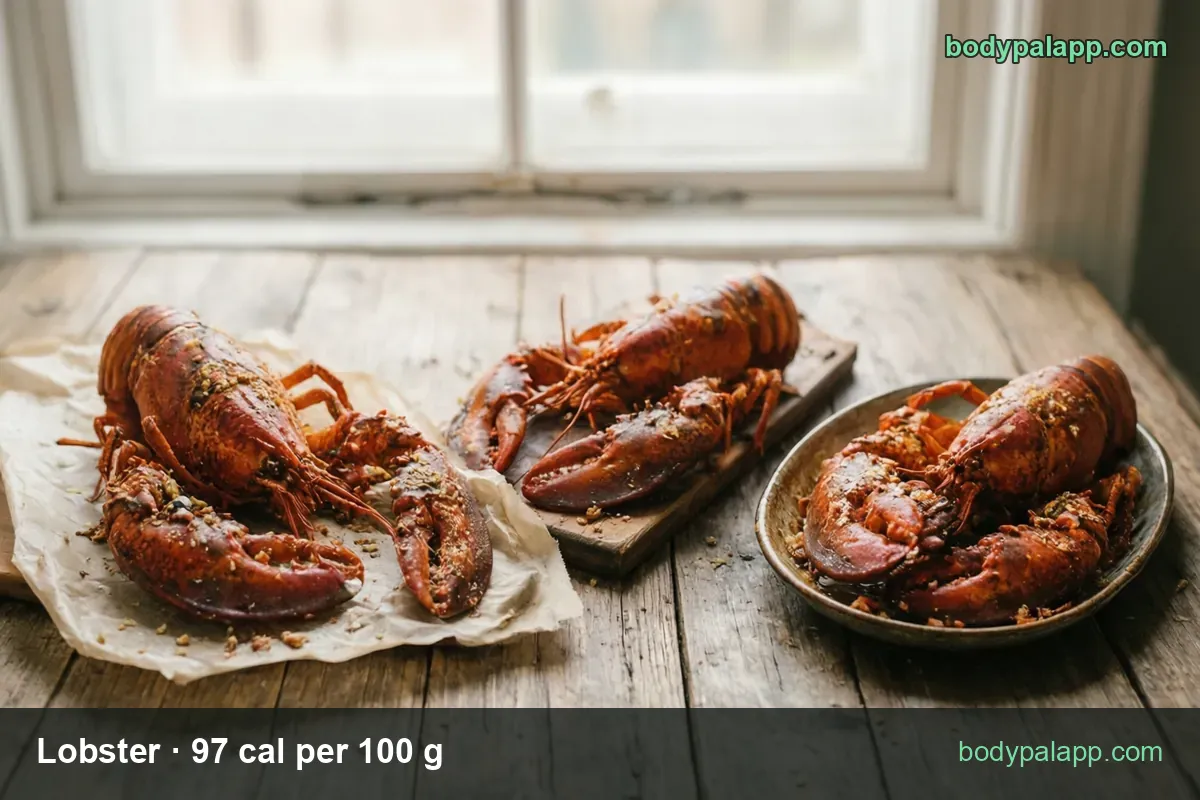
Lobster barely has calories of its own. What gets added to it does.
| Version | Per 100 g | Typical serving | Calories |
|---|---|---|---|
| Lobster, plain cooked | 97 kcal | one lobster, 200 g | 194 kcal |
| Lobster gumbo | 59 kcal | 1 cup, 244 g | 144 kcal |
| Lobster with sauce, Puerto Rican style | 154 kcal | 1 cup, 242 g | 373 kcal |
| Lobster salad | 187 kcal | 1 cup, 182 g | 340 kcal |
| Baked stuffed lobster | 177 kcal | one lobster, 400 g | 708 kcal |
Lobster salad is the cleanest example. Plain meat is 20.91 g of protein against 0.95 g of fat per 100 g; bound with mayonnaise, the same weight drops to 10.29 g of protein and climbs to 15.4 g of fat. The calories nearly double, and the protein halves, because half the bowl is no longer lobster.
Baked stuffed lobster goes further. At 177 calories per 100 g it is not far off the salad, but the serving is a whole 400 g animal, so one order is 708 calories and 4.17 g of saturated fat per 100 g — the fattiest saturated-fat figure of any lobster record here, courtesy of the bread stuffing and the butter in it. Gumbo runs the other way: at 59 calories per 100 g it is mostly broth, and a full cup is 144 calories.
Packaged lobster tracks the plain record closely. The one USDA Branded item that is actually lobster rather than a pasta or a bisque, Tampa Bay Fisheries Lobster Claws & Arms, lists 94 calories per 100 g, so a 3 oz (85 g) label serving is 80 calories — within a couple of calories of fresh-picked meat.
Maine lobster vs spiny lobster, raw vs cooked
This is where most calorie counts on the internet quietly disagree with each other, and the reason is species, not cooking.
| USDA record | Per 100 g | 3 oz (85 g) |
|---|---|---|
| Northern lobster, raw | 77 kcal | 65 kcal |
| Northern lobster, cooked, moist heat | 89 kcal | 76 kcal |
| Lobster, cooked (survey record) | 97 kcal | 82 kcal |
| Spiny lobster, raw | 112 kcal | 95 kcal |
| Spiny lobster, cooked, moist heat | 143 kcal | 122 kcal |
The 3 oz column is our own arithmetic from each record's 100 g figure, not a USDA serving.
Cooked northern lobster — the Maine lobster in the tank at the front of the restaurant — is 89 calories per 100 g. Cooked spiny lobster, the warm-water species sold mostly as tails, is 143, about 61% higher for the same weight and the same moist-heat method. It also carries more protein, 26.41 g per 100 g against 19 g, and denser meat. Steaming or boiling changes the number far less than picking the wrong species does.
Raw versus cooked matters too, in the direction people rarely expect. Raw northern lobster is 77 calories per 100 g and cooked is 89, not because anything was added but because water leaves the meat and everything left behind concentrates. The sodium row shows the same effect with an extra push from the pot: 423 mg per 100 g raw against 535 mg cooked.
Cholesterol and sodium are the rows to watch
Fat is a non-event. A whole lobster has 1.9 g of total fat and 0.5 g of saturated fat, 2% of the FDA Daily Value for each. You would have to eat more than forty lobsters to hit the 78 g daily fat reference.
Cholesterol is the exception. One 200 g lobster carries 322 mg, or 107% of the 300 mg Daily Value — the only line on this page that clears its reference in a single serving. It sits oddly next to a fat row that barely registers, and it is worth knowing before a two-lobster dinner.
Sodium is the other one to keep an eye on, and most of it is not seasoning at the table. A whole lobster is 1,070 mg, 47% of the 2,300 mg Daily Value, roughly what half a teaspoon of table salt would contribute. Even a modest cup of picked meat is 722 mg, 31% DV, before any drawn butter. If you are watching sodium, the raw-cooked gap says something useful: a lot of that number arrives from the salted water, so lobster cooked at home in unsalted water lands closer to the 423 mg raw figure per 100 g. Federal Dietary Guidelines put seafood squarely on the recommended plate, and lobster fits — it is the sodium and the butter around it that need the attention, not the meat.
How does lobster compare?
| Shellfish | Per 100 g | US serving | Calories |
|---|---|---|---|
| Lobster | 97 kcal | 3 oz, 85 g | 82 kcal |
| Crayfish, cooked | 97 kcal | 3 oz, 85 g | 82 kcal |
| Shrimp, canned | 100 kcal | 3 oz, 85 g | 85 kcal |
| Scallops, steamed or boiled | 87 kcal | 3 oz, 85 g | 74 kcal |
Our take: on calories these four are effectively the same food, spread across 13 calories per 100 g from scallops at 87 to shrimp at 100. The tiebreaker is protein. Lobster is 20.91 g per 100 g, crayfish 20.22 g, shrimp 20.42 g and scallops 15.24 g, which gives lobster the highest protein-per-calorie ratio of the four. If you are eating for fullness on a calorie budget, lobster wins this table on the numbers, though scallops are the lightest per gram. What lobster does not win on is price, and it loses badly the moment butter joins the plate.
Most popular lobster brands in the United States
Ranked by how widely each product appears among foods sold in the United States, from the BodyPal food database of over 3.3 million products. Calories are the figures printed on each Nutrition Facts label, checked against USDA FoodData Central.
| Product | Calories (per 100 g) |
|---|---|
| Tampa Bay Fisheries Lobster Claws & Arms | 94 cal |
Brand popularity: BodyPal food database. Nutrition: manufacturer labels / USDA FoodData Central.
Lobster FAQs
How many calories are in a whole lobster?
A whole 200 g lobster is 194 calories. USDA's survey record for lobster puts the meat at 97 calories per 100 g, so the number scales with the size of the animal. Almost all of those calories are protein, 41.8 g of it, alongside 1.9 g of fat and zero carbohydrate.
How many calories are in a lobster tail?
One lobster tail as measured by USDA weighs 100 g and comes to 97 calories. That is meat only, with no butter or drawn sauce. A tail is roughly half the meat of a whole lobster, so two tails land close to the 194 calories of one 200 g lobster.
Is lobster high in cholesterol?
A 200 g lobster carries 322 mg of cholesterol, 107% of the FDA Daily Value of 300 mg. That is the one row on the label that runs high. Fat does not: the same lobster has 1.9 g of total fat and 0.5 g of saturated fat, both 2% DV.
How much protein is in lobster?
A whole 200 g lobster gives 41.8 g of protein, 84% of the 50 g Daily Value. Per 100 g the meat is 20.91 g of protein against 97 calories, the highest protein-per-calorie ratio of the four shellfish compared on this page, ahead of shrimp, crayfish and scallops.
Is lobster high in sodium?
A whole lobster carries 1,070 mg of sodium, 47% of the 2,300 mg Daily Value, and a cup of picked meat 722 mg, or 31%. Much of that arrives during cooking: raw northern lobster is 423 mg per 100 g against 535 mg in the cooked record.
Maine lobster vs spiny lobster calories?
Cooked northern (Maine) lobster is 89 calories per 100 g; cooked spiny lobster is 143, about 61% more for the same weight and the same moist-heat cooking. Spiny lobster also carries more protein, 26.41 g per 100 g against 19 g. Species moves the number more than the cooking method does.
How many calories in lobster with butter?
Plain lobster is 97 calories per 100 g, and butter is not part of that USDA record, so anything melted alongside sits on top of the 194 calories of a whole lobster. For a figure that already includes the fat, baked stuffed lobster is 177 calories per 100 g, or 708 for a 400 g serving.
Is lobster good for weight loss?
At 97 calories and 20.91 g of protein per 100 g, lobster is one of the leanest ways to fill a plate, and a whole one is 194 calories. Sodium is the tradeoff at 1,070 mg per lobster, 47% DV. Butter and lobster salad, 340 calories a cup, move the total.
Similar foods
- Lobster Tail — 97 cal per lobster tail
- Tuna Nigiri — 29 cal per piece
- Crab Stick — 81 cal per 3 oz
- Imitation Crab — 81 cal for 3 oz
- Shrimp — 84 cal per 3 oz
- Shrimp — 84 cal per 3 oz
Count it without the math
Point the camera at the plate and BodyPal counts the lobster for you, tail, claws and all.


How long does it take to burn off lobster?
One whole lobster (200 g) is 194 kcal. Enter your weight and the amount you ate to see how long it takes you to burn that off:
lb
| Activity | Time to burn 194 kcal |
|---|---|
| Walking, brisk | 39 min |
| Cycling, moderate | 24 min |
| Swimming, moderate | 28 min |
| Jogging | 23 min |
| Weight training, moderate | 43 min |
Times are for a 155 lb adult at a steady pace; change the weight to see yours. The amount is set to the portion in the text (200 g); change it to what you actually ate. BodyPal works this out from your steps automatically.
Burning it off is one side of it. The other is knowing your number: work out how many calories you need a day, with macros and a goal date.