Crab rangoon calories come to 210 for 3 pieces (84 g) and 250 per 100 g, which works out to about 70 per piece. What matters most is how fast a plate adds up. These are small, dense parcels of wrapper and cream cheese filling, and the calories and sodium climb with every handful.
210kcal
1 3-piece serving · 84 g, packaged, per label
17%protein
9 gProtein
26 gCarbs
8 gFat
How to burn off 210 kcal
—Walking, brisk
—Jogging
—Cycling, moderate
—Swimming
Skip the math. BodyPal counts these calories from your steps and workouts automatically.
Nutrition facts
Packaged, per label · per 84 g
Calories
210 kcal
Protein
9 g
Carbohydrate
26 g
Fat
8 g
Saturated fat
3 g
Cholesterol
20 mg
Sodium
390 mg
Source: USDA FoodData Central
🛡️
Verified nutrition data
Numbers on this page come from USDA FoodData Central, the U.S. Department of Agriculture’s food composition database, and from manufacturer labels where a branded product is named. Last verified September 2026. How we verify our data →
Crab rangoon: calories, protein and sodium by serving
Percent of daily value uses the FDA reference of 2,000 kcal a day.
Serving
kcal
Protein
Carbs
Fat
Sodium
% DV kcal
3 pieces (84 g)
210
9 g
26 g
8 g
390 mg
11%
1 piece (28 g)
70
3 g
8.7 g
2.7 g
130 mg
4%
6 pieces (99 g)
300
9 g
36 g
14 g
680 mg
15%
100 g
250
10.7 g
31 g
9.5 g
464 mg
13%
3 × 3 pieces (84 g)
630
27 g
1,169 mg
5 × 3 pieces (84 g)
1,050
45 g
1,949 mg
Three pieces is a snack, a full plate is a meal
One piece (28 g) carries 70 calories and 130 mg of sodium, about 4% of a 2000-calorie day. That sounds harmless, and on its own it is. The trouble is that nobody eats one. The label serving of 3 pieces (84 g) lands at 210 calories, or 11% of the daily value, with 9 g of protein.
Restaurant and takeout portions run bigger. The USDA row for an order of 6 pieces (99 g) lists 300 calories, 14 g of fat and 680 mg of sodium, which is 30% of the daily sodium value in a side dish. Those pieces are smaller than the packaged ones, so counting pieces alone can mislead you. Weight tells the real story.
Scale up and the numbers turn serious. Two label servings come to 420 calories and 780 mg of sodium. Three servings reach 630 calories and 1,169 mg of sodium. Five servings, the kind of total a shared appetizer platter can quietly become for one person, hit 1,050 calories and 1,949 mg of sodium. If you snack straight from the box, count out the pieces first.
Carbs supply about half the calories
Crab rangoon gets 49% of its calories from carbohydrate, 34% from fat and 17% from protein. Per 100 g that is 31 g of carbs, 9.5 g of fat and 10.7 g of protein. The wrapper drives the carb number, while the cream cheese filling and cooking oil account for most of the fat.
The protein is real but modest. Three pieces give 9 g, about 18% of the 50 g daily value, so they do a little more than chips would. Still, a snack that is only 17% protein will not keep most people full for long. Treat it as a starter, not as the protein part of a meal.
Fiber and sugar barely register. There is 1.2 g of fiber and 1.2 g of sugars per 100 g, roughly 1 g of each in a label serving. That low fiber is another reason a few pieces go down easily and leave room for more. If you want something that lasts until the next meal, the rest of the plate has to bring the fiber.
Sodium is the row to watch
A label serving of 3 pieces holds 390 mg of sodium, 17% of the daily value, while supplying only 11% of the day's calories. Per 100 g the figure is 464 mg, or 20%. Sodium outpaces calories here, which is typical of filled, seasoned frozen snacks.
The 6-piece takeout row is steeper still at 680 mg, or 30% of the daily value. Add the sweet and sour or duck sauce that usually rides along, plus a soy-heavy main course, and a single Chinese-American dinner can cover most of the day's sodium before dessert. If you watch sodium, this is the number to track, not the calories.
Saturated fat and cholesterol are milder. Per 100 g you get 3.6 g of saturated fat against a 20 g daily value and 24 mg of cholesterol against 300 mg. A label serving keeps both well within reason. Large portions push them up in step with everything else, so portion control handles all of these rows together.
Make rangoon the side, not the base
Crab rangoon works best as a measured extra next to food that brings what it lacks. Steamed or stir-fried vegetables add fiber and volume for few calories. A lean protein such as chicken, shrimp or tofu covers the protein gap without adding much more fat.
Brand matters less than portion. Sea Cuisine, Member's Mark, Target, Harris Teeter, Schwan Food Company and Yankee Trader Seafood all sell frozen versions, and their piece sizes vary, so check the grams on the box against the 84 g label serving. Baking or air frying frozen pieces instead of deep frying keeps you closer to the label figures; restaurant pieces fried in oil tend to run higher, as the 6-piece row shows.
If you order out, decide the number of pieces before the box opens and split the rest. Dipping sauces are mostly sugar and add calories that are not counted in these rows. BodyPal can log crab rangoon from a photo, which helps when the takeout portion does not match any label.
How does crab rangoon compare?
Here is how crab rangoon stacks up against other crab foods on calories, protein, carbs, fat and sodium, both per 100 g and per usual serving.
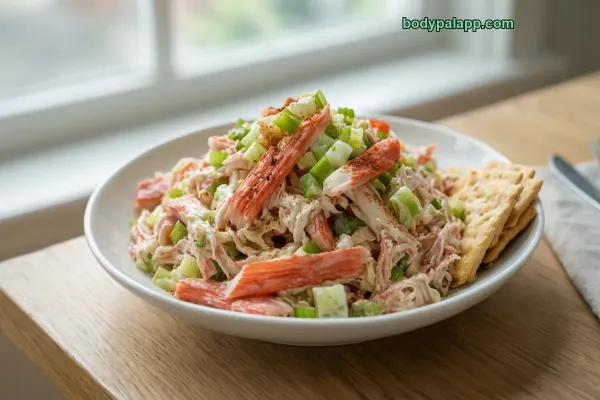
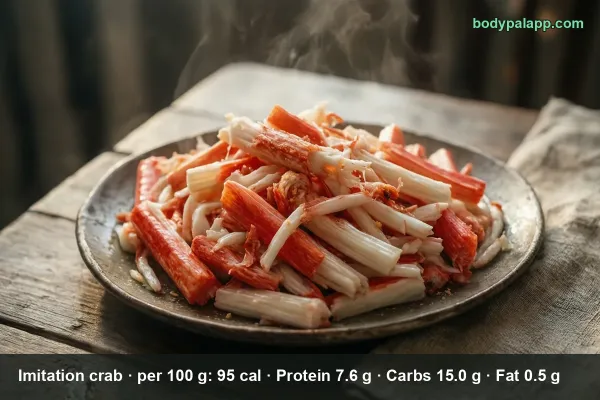
Verdict: For the fewest calories and the most protein, pick crab claw meat at 83 calories and 17.9 g of protein per 100 g, or imitation crab at 95 calories. Crab salad is lower than rangoon per 100 g at 188 versus 250, but a 1 cup serving reaches 391 calories, so rangoon in a 3-piece portion is the smaller hit.
Most popular crab rangoon brands in the United States
Ranked by popularity in the BodyPal database
# Productkcal / 100 g
1Sea Cuisine Crab Rangoon3 pieces · 84 g250 kcal
2Member's Mark Crab Rangoon3 pieces · 85 g294 kcal
One piece is about 70 calories, so the usual 3-piece serving is 210 calories.
Is crab rangoon good for weight loss?
Three pieces are 210 calories with 8 g of fat and 26 g of carbs, and only 9 g of protein, so they are calorie-dense for their size.
Crab rangoon or crab salad: which has fewer calories?
Crab rangoon has 250 calories per 100 g and crab salad 188, so the same weight of crab rangoon is 62 calories more.
How much protein is in crab rangoon?
A 3-piece serving has 9 g of protein and 100 g has 10.7 g, since the filling is mostly cream cheese with a little crab.
How many calories are in a 6-piece order of crab rangoon?
An order of 6 pieces (99 g) has 300 calories in the USDA data, about 15% of the daily value. It also carries 14 g of fat and 680 mg of sodium, which is 30% of the daily sodium value.
How much sodium is in crab rangoon?
A label serving of 3 pieces has 390 mg of sodium, 17% of the daily value. Per 100 g it is 464 mg. One piece alone has 130 mg, so a large plate adds up quickly.
How many carbs are in crab rangoon?
Three pieces contain 26 g of carbohydrate, and 100 g contains 31 g. Carbs supply 49% of the calories, mostly from the wonton wrapper, with only about 1 g of fiber per serving.
How much fat is in crab rangoon?
A 3-piece serving has 8 g of fat, and 100 g has 9.5 g, including 3.6 g of saturated fat. Fat provides 34% of the calories, largely from the cream cheese filling and cooking oil.
Does crab rangoon have a lot of sugar?
No. The packaged version has 1 g of sugars per 3 pieces and 1.2 g per 100 g. The 6-piece takeout row lists 4 g, and sweet dipping sauces add more on top.