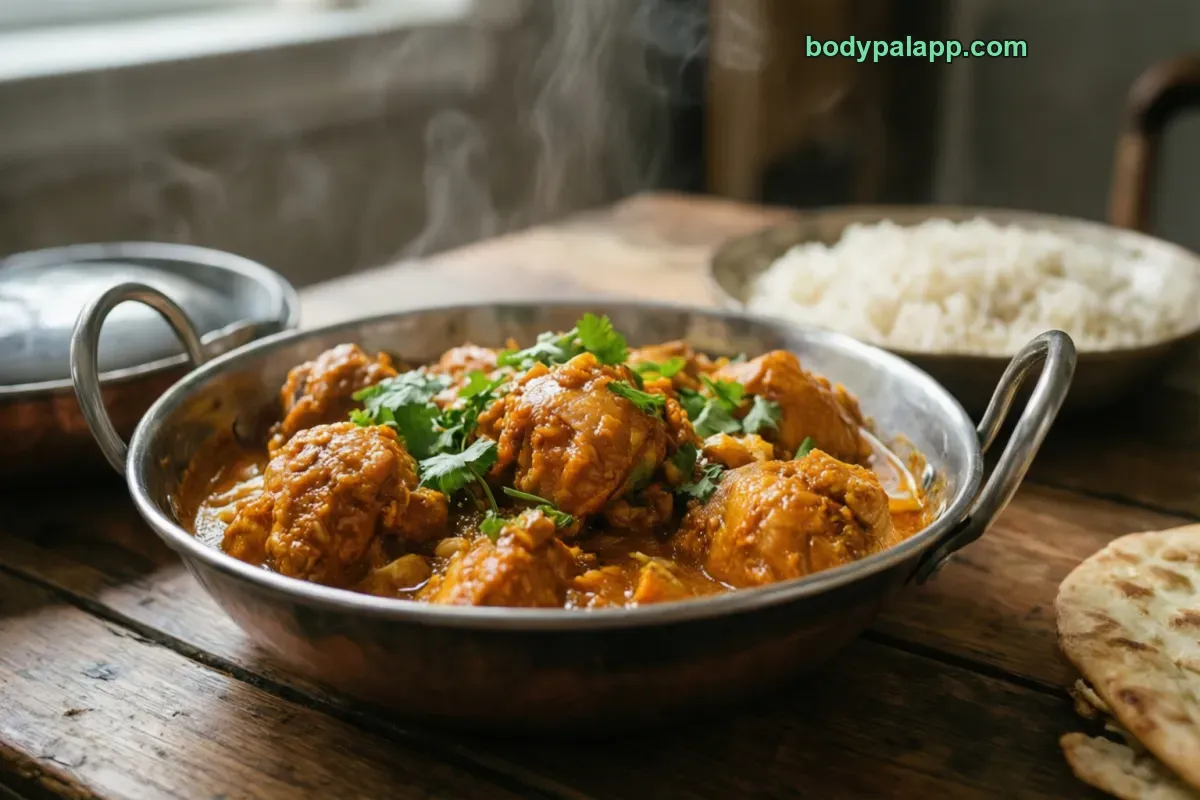
Curry calories come to 257 for a 1 cup (240 g) serving of chicken curry, or 107 per 100 g. Fat supplies 53 percent of those calories, and the same cup carries 902 mg of sodium, 39 percent of the daily value. How much you ladle out matters more than which curry you pick.
257kcal
1 cup · 240 g, chicken curry, prepared
23%protein
15.6 gProtein
16 gCarbs
15.6 gFat
How to burn off 257 kcal
—Walking, brisk
—Jogging
—Cycling, moderate
—Swimming
Skip the math. BodyPal counts these calories from your steps and workouts automatically.
Nutrition facts
Chicken curry, prepared · per 240 g
Calories
257 kcal
Protein
15.6 g
Carbohydrate
15.7 g
Fat
15.6 g
Saturated fat
3.7 g
Cholesterol
53 mg
Sodium
902 mg
Potassium
672 mg
Iron
1.7 mg
Source: USDA FoodData Central
🛡️
Verified nutrition data
Numbers on this page come from USDA FoodData Central, the U.S. Department of Agriculture’s food composition database, and from manufacturer labels where a branded product is named. Last verified September 2026. How we verify our data →
Curry: calories, protein and sodium by serving
Percent of daily value uses the FDA reference of 2,000 kcal a day.
Serving
kcal
Protein
Carbs
Fat
Sodium
% DV kcal
1 cup (240 g)
257
15.6 g
15.7 g
15.6 g
902 mg
13%
With beef (240 g)
271
18.2 g
15.7 g
15.8 g
862 mg
14%
Vegetable (240 g)
206
3.8 g
21.1 g
12.6 g
931 mg
10%
100 g
107
6.5 g
6.5 g
6.5 g
376 mg
5%
3 × 1 cup (240 g)
770
46.7 g
2,707 mg
5 × 1 cup (240 g)
1,284
77.8 g
4,512 mg
One cup is 257 calories, a full bowl is far more
A measured cup of chicken curry weighs 240 g and lands at 257 calories, about 13 percent of the daily calorie value. That cup gives 15.6 g of protein, 15.7 g of carbs and 15.6 g of fat, a near even spread by weight. It is a reasonable main for a single meal. The trouble is that few people stop at one level cup.
A generous bowl easily holds two cups, and the totals climb fast. Two cups come to 514 calories and 1,805 mg of sodium. Three cups reach 770 calories. A five-cup pot that feeds one hungry person over a weekend adds up to 1,284 calories before anything goes underneath it.
Rice, naan and chutney are not in these numbers. Everything here is the curry alone, so the base you serve it on brings its own total. If you track, weigh the curry and the base separately once so you know what your usual bowl really holds, or snap a photo and let BodyPal log it for you.
Fat supplies more than half the calories
Per 100 g, chicken curry has 6.5 g each of protein, carbs and fat. Equal grams do not mean equal calories. Fat carries more energy per gram than the other two, so it ends up as 53 percent of the calorie split, against 23 percent from protein and 24 percent from carbs.
Most of that fat rides in the sauce, not the meat. Saturated fat is 1.6 g per 100 g, a modest share of the total fat. If you make curry at home, the oil or cream you stir in is the lever that moves the calorie count most, while the chicken itself stays fairly constant.
Protein is the bright spot. One cup covers 31 percent of the daily value with 15.6 g, a solid return for 257 calories. Fiber is lighter at 3.4 g per cup and sugars sit at 6.1 g, so the dish leans on its sauce and protein rather than on vegetables or sweetness. Cholesterol is low at 22 mg per 100 g.
Sodium is the row to watch
Chicken curry carries 376 mg of sodium per 100 g. In a 1 cup serving that becomes 902 mg, or 39 percent of the daily value in a single dish. Calories look moderate on this page. Sodium does not.
The other versions are no gentler. Vegetable curry is the saltiest at 931 mg per cup, 40 percent of the daily value, and beef curry sits at 862 mg, or 37 percent. Portions compound it: two cups bring 1,805 mg, and three cups reach 2,707 mg, past the full daily value in one sitting.
If you watch sodium, serve one cup rather than two and keep the rest of the plate plain: unsalted rice, raw vegetables, plain yogurt. When you cook with a jarred paste such as Mae Ploy or Thai Kitchen Red Curry Paste, taste the sauce before you reach for the salt shaker. Potassium, at 280 mg per 100 g, does not offset much of it.
Beef adds protein, vegetable curry cuts calories
Swap chicken for beef and a cup rises to 271 calories with 18.2 g of protein, 36 percent of the daily value. Fat barely moves at 15.8 g, and carbs stay at 15.7 g. For a small calorie bump you get noticeably more protein, which makes beef curry the more filling of the meat options.
Vegetable curry is the lightest at 206 calories per cup, but it trades protein for carbs. It has 3.8 g of protein, 21.1 g of carbs and 12.6 g of fat. It does bring the most fiber at 4.3 g and the most sugars at 7.6 g, mostly from the vegetables themselves.
Pick by what the meal needs to do. If you want to stay full on a set number of calories, beef or chicken gives far more protein per bite. If you want the lowest number on the log, vegetable curry wins, and a protein side such as lentils, eggs or yogurt closes the gap.
How does curry compare?
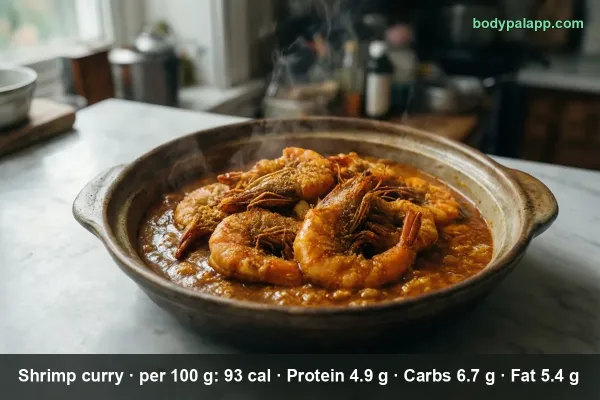
Here is chicken curry next to shrimp curry, shown per 100 g and per usual serving.
Verdict: For the fewest calories pick shrimp curry, at 93 per 100 g against 107, with slightly less sodium at 351 mg. For staying full pick chicken curry, which brings 6.5 g of protein per 100 g against 4.9 g.
Most popular curry brands in the United States
Ranked by popularity in the BodyPal database
# Productkcal / 100 g
1Mae Ploy Red Curry Paste2 tsp · 10 g100 kcal
2Mae Ploy Yellow Curry Paste2 tsp · 10 g150 kcal
3A Taste Of Thai Red Curry Paste1 tsp · 7 g143 kcal
4Thai Kitchen Red Curry Paste1 Tbsp · 15 g133 kcal
5Thai Taste Red Curry Paste1 pack · 43 g163 kcal
6Aroy-D Red Curry Paste1 Tbsp · 15 g100 kcal
7Thai Home Red Curry Paste1 tsp · 4.5 g222 kcal
These are concentrated curry pastes measured by the teaspoon, so their per 100 g numbers run above the finished dish above. Source: manufacturer labels / USDA FoodData Central.
Curry FAQs
How many calories are in a cup of curry?
A cup of chicken curry (240 g) is 257 calories. The same cup of beef curry is 271 calories and vegetable curry 206.
Is curry good for weight loss?
A cup of chicken curry has 257 calories, 15.6 g protein and 15.6 g fat, while a cup of vegetable curry has 206 calories and 3.8 g protein.
Curry or shrimp curry: which has fewer calories?
Shrimp curry is 93 calories per 100 g against 107 for chicken curry, so a cup is 223 calories versus 257.
How much protein is in curry?
Chicken curry has 6.5 g protein per 100 g, so a cup gives 15.6 g. Beef curry has 7.6 g per 100 g, or 18.2 g per cup.
Is curry high in calories?
Not especially. Chicken curry has 107 calories per 100 g and 257 per cup, about 13 percent of the daily value. Portion size is the bigger factor, since two cups already reach 514 calories.
How many calories are in a bowl of curry?
It depends on the bowl. A one-cup bowl of chicken curry has 257 calories, a two-cup bowl has 514 and three cups come to 770. Weigh your usual bowl once to know which number applies to you.
How many carbs are in curry?
Chicken curry has 6.5 g of carbs per 100 g and 15.7 g per cup. Vegetable curry is higher at 21.1 g per cup. Rice or naan on the side adds its own carbs on top.
How many calories are in 100 g of curry?
100 g of chicken curry has 107 calories, with 6.5 g each of protein, carbs and fat. Shrimp curry comes in a little lower at 93 calories per 100 g.
What are the nutrition facts for curry?
One cup of chicken curry has 257 calories, 15.6 g protein, 15.7 g carbs, 15.6 g fat, 3.4 g fiber, 6.1 g sugars and 902 mg sodium. Per 100 g it also has 22 mg cholesterol and 280 mg potassium.