
How many calories are in chicken curry?
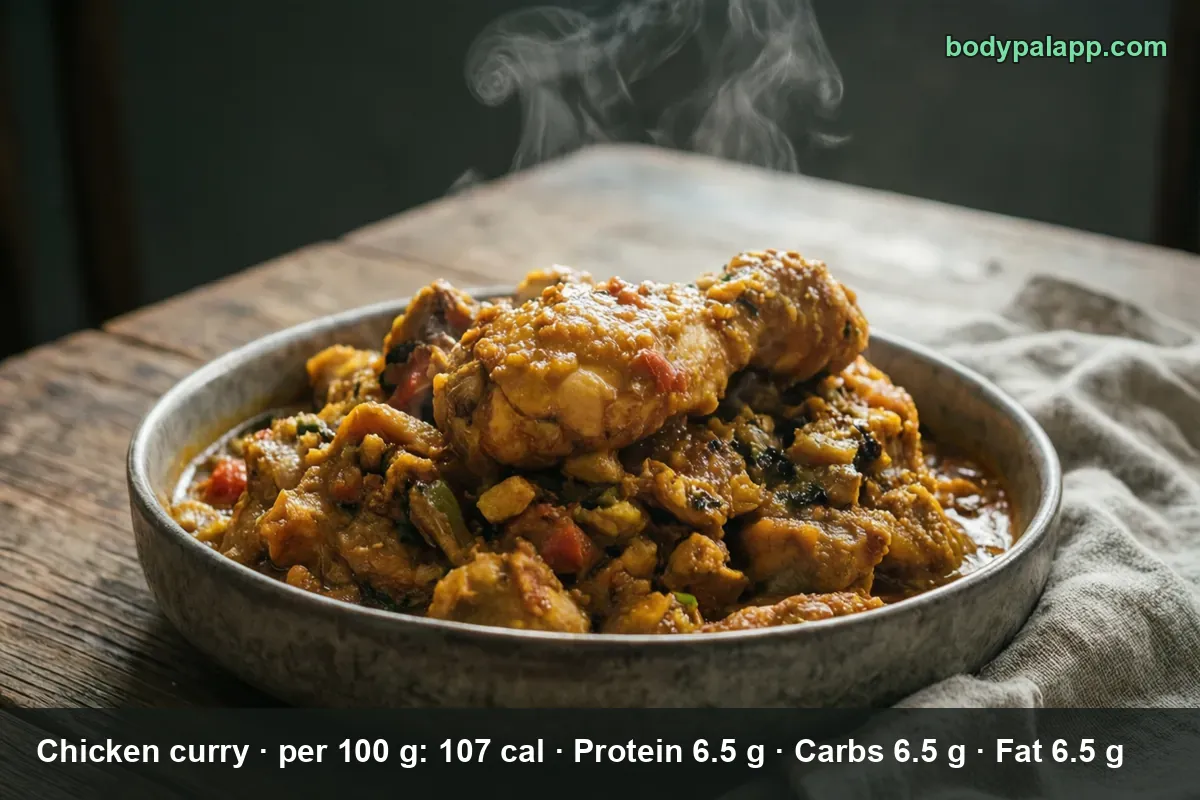
A 1-cup serving of chicken curry weighs 240 g and carries 257 calories. Per 100 g the dish runs 107 calories, which is light for something that tastes this rich. The sauce does the work: fat, protein and carbohydrate all land near 6.5 g per 100 g, and the sodium takes a bigger bite out of the day's limit than any of them.
On this page
- Chicken curry quick facts
- US servings, from one ounce to a cup and a half
- With rice, butter chicken and Thai coconut
- Sodium is the row to watch
- How does chicken curry compare?
- Most popular chicken curry brands
- FAQ
Chicken curry quick facts
The record used here is FNDDS 2706437, "Chicken curry", from the 2021–2023 survey food set. It describes the curry on its own: chicken, sauce, onion and spices, with nothing underneath it. That is the food most people are holding when they reach for a tracker, because rice, naan or roti get logged separately. There is a second USDA record for curry served with rice, and it belongs in the variants section rather than in this table.
Two things jump out of the column below. Fat, protein and carbohydrate are almost the same number per 100 g, which is unusual and explains why the dish behaves well on a plan. And sodium is the line that reaches deepest into the Daily Value.
| Nutrient | Per 100 g | Per 1 cup (240 g) | % Daily Value |
|---|---|---|---|
| Calories | 107 | 257 | — |
| Total fat | 6.48 g | 15.6 g | 20% |
| Saturated fat | 1.56 g | 3.7 g | 19% |
| Carbohydrate | 6.54 g | 15.7 g | 6% |
| Dietary fiber | 1.4 g | 3.4 g | 12% |
| Total sugars | 2.56 g | 6.1 g | — |
| Protein | 6.48 g | 15.6 g | 31% |
| Sodium | 376 mg | 902 mg | 39% |
% Daily Value is based on a 2,000-calorie diet.
Verified nutrition data
Numbers on this page come from USDA FoodData Central, the U.S. Department of Agriculture’s food composition database, and from manufacturer labels where a branded product is named. Last verified September 2026. How we verify our data →
Added sugars and trans fat have no row here because USDA does not publish those values for mixed dishes in this survey release. Cholesterol comes to 22 mg per 100 g, or 53 mg in a cup, which is 18% of the Daily Value. Potassium runs 280 mg per 100 g, 672 mg per cup, or 14% — the tomato and onion in the sauce are doing that. The rest of the label comes straight from the record, so a homemade curry with extra oil or a heavier cream finish will sit above these numbers.
US servings, from one ounce to a cup and a half
One cup is the household measure USDA actually publishes for this record, at 240 g. Everything else in the table is our own arithmetic from the USDA 100 g figure, not a USDA serving, which is worth knowing when you compare against a restaurant menu.
| Serving | Weight | Calories |
|---|---|---|
| 1 oz | 28 g | 30 kcal |
| 4 oz | 113 g | 121 kcal |
| 1/2 cup | 120 g | 128 kcal |
| One cup, the USDA measure | 240 g | 257 kcal |
| 1 1/2 cups | 360 g | 385 kcal |
| Per 100 g | 100 g | 107 kcal |
A cup of curry sounds modest, but a takeout portion is rarely one cup. Restaurant entrées and to-go trays land closer to 1 1/2 cups of sauce and chicken, which is 385 calories before a single grain of rice. If you scoop with a ladle rather than a measuring cup, weigh the bowl once and you will not need to guess again — the numbers scale cleanly, since every 100 g is another 107 calories.
The ounce line matters for a different reason. Curry is wet, so 4 oz on a food scale is a small ladle, not the 4 oz portion of chicken you would picture raw. There is no raw-versus-cooked conversion to make here: the record is already a finished dish, and the chicken inside it has lost its cooking water.
With rice, butter chicken and Thai coconut
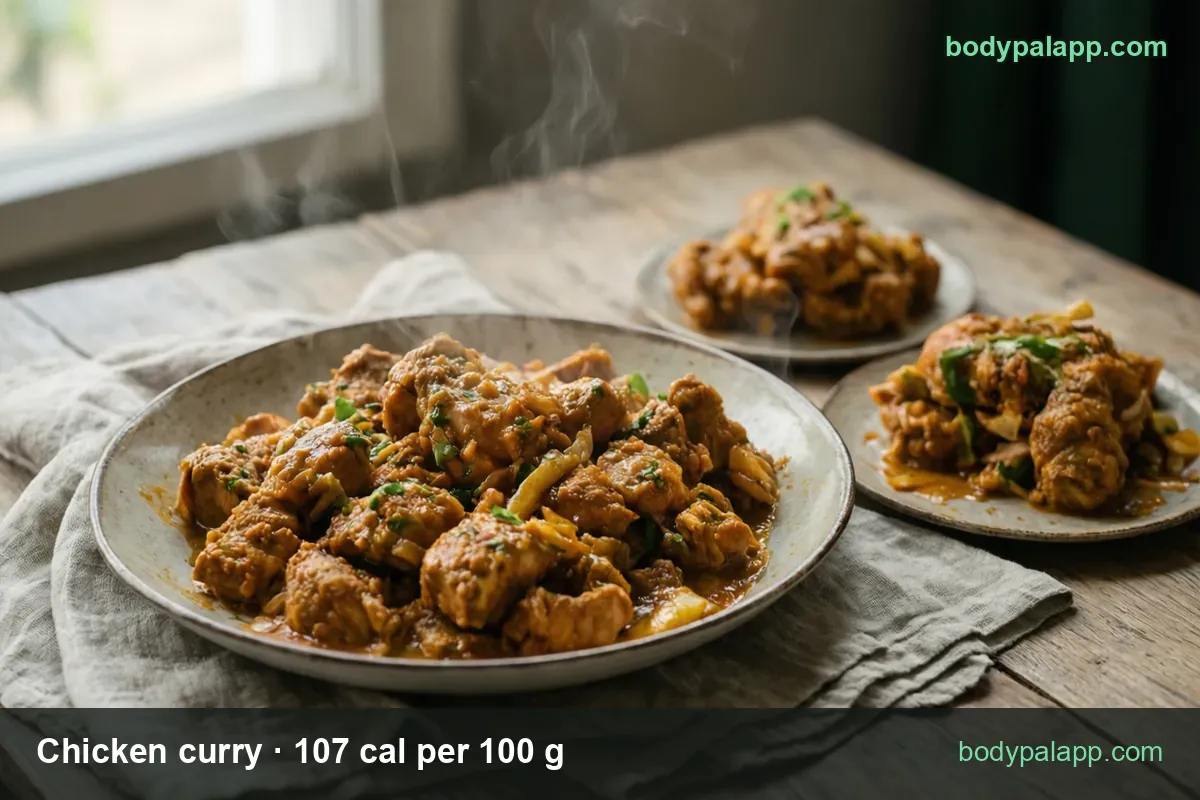
Here is the trap in this food. Adding rice raises the calories per 100 g, from 107 to 116, but it lowers the calories per cup — because a cup of the mixed dish weighs 200 g instead of 240 g. Rice packs less air and less sauce into the same volume. So chicken curry with rice comes to 232 calories a cup while plain curry comes to 257. The trade is in the macros, not the total: carbohydrate climbs to 15.12 g per 100 g and protein falls to 4.96 g, from 6.48 g.
Store-made versions run higher than the generic record almost across the board. A World Kitchen To Go butter chicken container is 144 calories per 100 g, and the container holds 369 g. A Deep Indian Kitchen railway-style pouch is the outlier at 230 calories per 100 g, which is more than double the plain record, though the pouch is only 113 g. Signature Select's Thai-style coconut curry sits at 112 per 100 g in an 11 oz tray.
| Version | Per 100 g | Typical serving | Calories |
|---|---|---|---|
| Chicken curry, no rice | 107 kcal | 1 cup (240 g) | 257 kcal |
| Chicken curry with rice | 116 kcal | 1 cup (200 g) | 232 kcal |
| Thai-style coconut chicken curry, store tray | 112 kcal | 312 g (11 oz) | 349 kcal |
| Butter chicken, to-go container | 144 kcal | 369 g | 531 kcal |
| Restaurant-style pouch curry | 230 kcal | 113 g (1 pouch) | 260 kcal |
Read that last column rather than the first. The butter chicken container is 531 calories, more than double a homemade cup, and it gets there mostly through size. The pouch has the densest sauce of the five yet lands at 260 calories, close to a plain cup, because it is a small pouch.
Sodium is the row to watch
Calories are not the ceiling on this dish. Sodium is. One cup carries 902 mg, which is 39% of the Daily Value of 2,300 mg — roughly two fifths of a teaspoon of table salt stirred into a single bowl. The Dietary Guidelines for Americans set the same 2,300 mg as the daily limit for adults, so a curry-and-rice dinner with a side can use up more than half a day before you have touched breakfast or lunch.
Saturated fat is the other line people expect to be worse than it is. A cup gives 3.7 g, 19% of the Daily Value, which is fine for a dish built on a fatty sauce — the coconut milk or cream is diluted by tomato, onion and stock. Protein is the pleasant surprise at 15.6 g a cup, 31% of the Daily Value, and it counts toward the protein foods group even though it arrives inside a sauce.
If you are watching sodium, the fix is not a smaller portion but a lower-salt build: less bouillon, no added salt at the finish, and lime or extra spice to carry the flavor. If you are watching calories, the portion is the only lever that moves much.
How does chicken curry compare?
| Dish | Per 100 g | US serving | Calories |
|---|---|---|---|
| Chicken curry | 107 kcal | 1 cup, 240 g | 257 kcal |
| Chicken curry with rice | 116 kcal | 1 cup, 200 g | 232 kcal |
| Stew, chicken, with pasta | 108 kcal | not published | — |
| Chicken or turkey creole, without rice | 103 kcal | not published | — |
The last two rows have no calorie figure for a serving because USDA does not publish a household weight for those records, and inventing one would be guesswork. On a per-100-gram basis all four are within 13 calories of each other, which is the real headline: the sauce style barely moves the number.
Our take: for weight loss, creole is the pick at 103 calories per 100 g with 13.8 g of protein — more than twice the protein of chicken curry, in a tomato base instead of a coconut one. For satiety at dinner, plain chicken curry wins, because 257 calories a cup buys 15.6 g of protein and enough fat to keep you full past nine o'clock. Chicken curry with rice is the convenience choice: fewer calories per cup than plain curry, but roughly a quarter less protein per 100 g, so it works better as a side of a meal than as the whole meal.
Most popular chicken curry brands in the United States
Ranked by how widely each product appears among foods sold in the United States, from the BodyPal food database of over 3.3 million products. Calories are the figures printed on each Nutrition Facts label, checked against USDA FoodData Central.
| Product | Calories (per 100 g) |
|---|---|
| Signature Select Thai Style Coconut Chicken Curry | 112 cal |
| Deep Indian Kitchen Railway Chicken Curry | 230 cal |
| World Kitchen To Go Butter Chicken Curry | 144 cal |
| Ahold Chicken Curry | 157 cal |
| Mr. Kook's Chicken Curry | 113 cal |
Brand popularity: BodyPal food database. Nutrition: manufacturer labels / USDA FoodData Central.
Chicken curry FAQs
How many calories are in chicken curry?
257 calories in a 1-cup serving of 240 g, and 107 calories per 100 g. That is the USDA figure for the curry alone, without rice or naan on the side. A half cup of 120 g comes to 128 calories, our own arithmetic from the same 100 g figure.
How many calories are in a cup of chicken curry?
257 calories for one cup, 240 g on the scale. A cup and a half is 385 calories and a half cup 128, both scaled from the USDA per-100-gram figure of 107 calories. The cup also carries 902 mg of sodium, which matters more than the calorie count.
How much protein is in chicken curry?
6.48 g per 100 g, so a 1-cup serving gives 15.6 g of protein, 31% of the Daily Value. That is decent but not high for a chicken dish, because the sauce is most of the weight. Chicken creole, for comparison, runs 13.8 g per 100 g.
How many calories are in chicken curry with rice?
232 calories in a 1-cup serving, because that cup weighs 200 g rather than 240 g. Per 100 g the mixed dish is 116 calories, slightly higher than plain curry at 107. Carbohydrate jumps to 15.12 g per 100 g and protein drops to 4.96 g.
Is chicken curry high in sodium?
Yes: 902 mg in a 1-cup serving, 39% of the Daily Value and about two fifths of a teaspoon of table salt. Per 100 g it is 376 mg. The Dietary Guidelines cap sodium at 2,300 mg a day, so one cup spends a big share of the day's budget in one bowl.
How many calories are in butter chicken?
531 calories in one 369 g to-go container, at 144 calories per 100 g for that product. Butter chicken sits above plain chicken curry because cream and butter replace part of the broth. A 240 g cup of it would work out near 346 calories, our own arithmetic.
Is Thai chicken curry lower in calories than Indian?
Not by much: the store-made Thai-style coconut chicken curry runs 112 calories per 100 g against 107 for the generic USDA record, so coconut milk costs about as much as a yogurt or tomato base. Style matters less than portion size: that tray holds 312 g, or 349 calories.
Is chicken curry good for weight loss?
At 107 calories per 100 g, chicken curry is lighter than its creamy reputation, and a 1-cup serving of 257 calories leaves room for rice on the side. The catch is sodium at 902 mg per cup. Skip the naan and the numbers stay friendly.
Similar foods
- Broccoli Casserole — 244 cal per cup
- Butter Chicken — 257 cal per cup
- Chicken Katsu Curry — 257 cal per cup
- Chicken Korma — 257 cal per cup
- Chicken Masala — 257 cal per cup
- Chicken Tikka Masala — 257 cal per cup
Count it without the math
Point the camera at the bowl and BodyPal counts the curry for you, sauce and all.


How long does it take to burn off chicken curry?
A 1-cup (240 g) serving is 257 kcal. Enter your weight and the amount you ate to see how long it takes you to burn that off:
lb
| Activity | Time to burn 257 kcal |
|---|---|
| Walking, brisk | 51 min |
| Cycling, moderate | 32 min |
| Swimming, moderate | 37 min |
| Jogging | 30 min |
| Weight training, moderate | 57 min |
Times are for a 155 lb adult at a steady pace; change the weight to see yours. The amount is set to the portion in the text (240 g); change it to what you actually ate. BodyPal works this out from your steps automatically.
One food is easy to picture; a whole day is harder. See how many calories you need a day and what a deficit actually looks like.