
How many calories are in chicken masala?
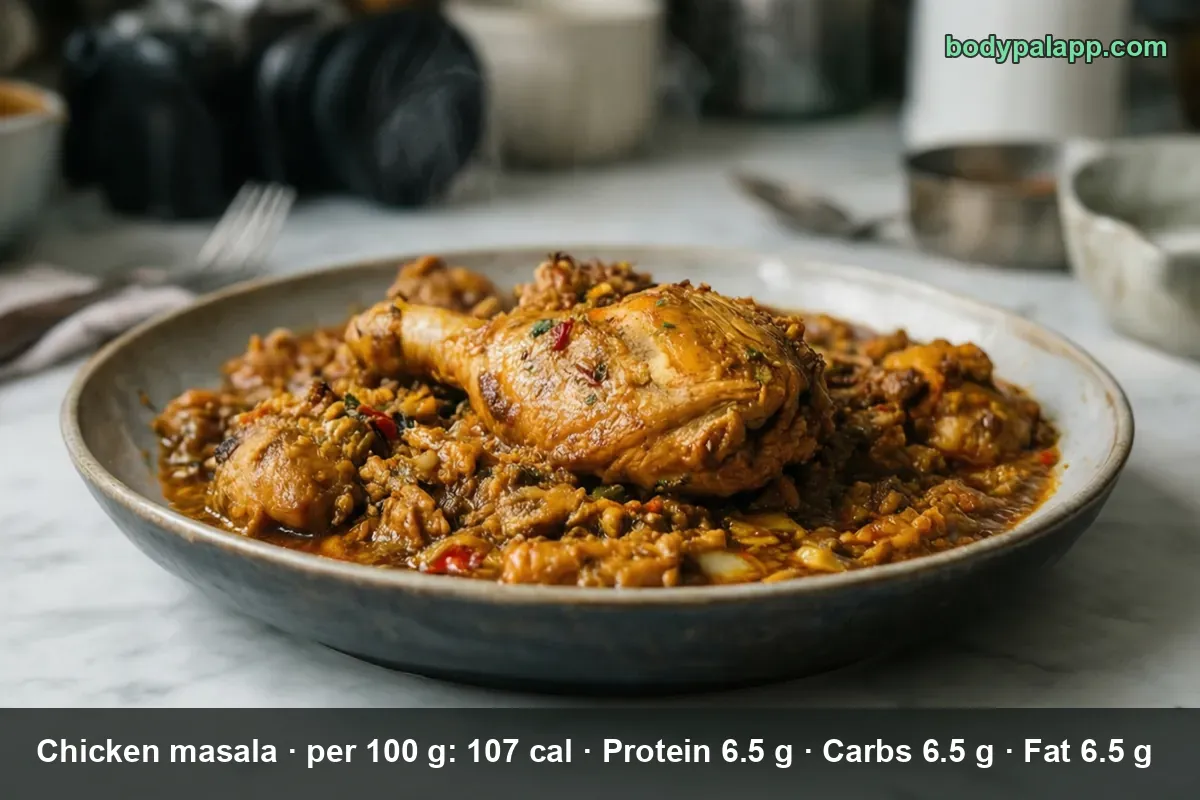
A 1-cup serving of chicken masala, 240 g of chicken and sauce, is 257 calories. Per 100 g the dish runs 107 calories, which is light for something that tastes this rich. The sauce is mostly onion, tomato and spice, and the fat sits at 6.48 g per 100 g.
On this page
- Chicken masala quick facts
- US servings, from one ounce to a cup and a half
- With rice, from a tray, or from a box
- Sodium is the row that moves
- How does chicken masala compare?
- Most popular chicken masala brands
- Chicken masala FAQs
Chicken masala quick facts
USDA has no line called "chicken masala." The record that matches the plate — bone-in and boneless chicken simmered in a thick spiced sauce, no rice underneath — is FNDDS 2706437, "Chicken curry", in the Poultry mixed dishes category of the 2021–2023 survey files. That is the record every number below is built from. Masala, curry and tikka masala differ by spice blend and by how much cream or ghi goes in at the end, but they land in the same USDA bucket, and the branded trays later on show how narrow the real spread is.
The dish USDA files as chicken curry with rice is a separate record with its own weight and its own numbers. It gets its own section rather than an average, because averaging two dishes gives you a number that describes neither.
| Nutrient | Per 100 g | Per 1 cup (240 g) | % Daily Value |
|---|---|---|---|
| Calories | 107 | 257 | — |
| Total fat | 6.48 g | 15.6 g | 20% |
| Saturated fat | 1.56 g | 3.7 g | 19% |
| Carbohydrate | 6.54 g | 15.7 g | 6% |
| Dietary fiber | 1.4 g | 3.4 g | 12% |
| Total sugars | 2.56 g | 6.1 g | — |
| Protein | 6.48 g | 15.6 g | 31% |
| Sodium | 376 mg | 902 mg | 39% |
| Cholesterol | 22 mg | 53 mg | 18% |
| Potassium | 280 mg | 672 mg | 14% |
% Daily Value is based on a 2,000-calorie diet.
Verified nutrition data
Numbers on this page come from USDA FoodData Central, the U.S. Department of Agriculture’s food composition database, and from manufacturer labels where a branded product is named. Last verified September 2026. How we verify our data →
Two rows you would see on a supermarket label are missing here: added sugars and trans fat. FNDDS does not publish either value for mixed dishes, so they are left out rather than guessed at. Total sugars, 6.1 g in a cup, are almost all from the onion and tomato in the sauce, and they have no Daily Value of their own — the FDA limit of 50 g applies to added sugars, which is a different measurement. The percentages come from the FDA Daily Values for the Nutrition Facts label.
US servings, from one ounce to a cup and a half
The cup is the one household measure USDA publishes for this record, and it weighs 240 g — heavier than a cup of most soups, because the chicken sits in the sauce rather than floating in broth. Everything else in the table below is our own arithmetic from the USDA 100 g figure, not a USDA serving.
| Serving | Weight | Calories |
|---|---|---|
| 1 oz | 28 g | 30 kcal |
| Per 100 g | 100 g | 107 kcal |
| 4 oz | 113 g | 121 kcal |
| 1/2 cup | 120 g | 128 kcal |
| 1 cup, the USDA measure | 240 g | 257 kcal |
| 1 1/2 cups | 360 g | 385 kcal |
The trap on this dish is the ladle. A cup looks like a modest portion in a wide bowl, and a second ladle is easy to justify — but a cup and a half is 385 calories before a grain of rice, and two full cups would put you past 500. If you serve it over rice, count the rice on its own line; the numbers on this page cover chicken and sauce only.
Four ounces, 113 g, is roughly what lands next to a half cup of rice on a restaurant plate: 121 calories of the meal, with the rice doing most of the rest. That is worth knowing before you assume the curry is the expensive part of the plate.
With rice, from a tray, or from a box
| Version | Per 100 g | Typical serving | Calories |
|---|---|---|---|
| Chicken masala, sauce and chicken only | 107 kcal | 1 cup (240 g) | 257 kcal |
| Chicken masala with rice | 116 kcal | 1 cup (200 g) | 232 kcal |
| Store-bought tikka masala, Lidl | 110 kcal | 10 oz (283 g) | 311 kcal |
| Restaurant-style tray, Deep Indian Kitchen | 145 kcal | 1 tray (255 g) | 370 kcal |
| Ready meal, Primitive Feast Chicken Masala | 133 kcal | 1 package (255 g) | 339 kcal |
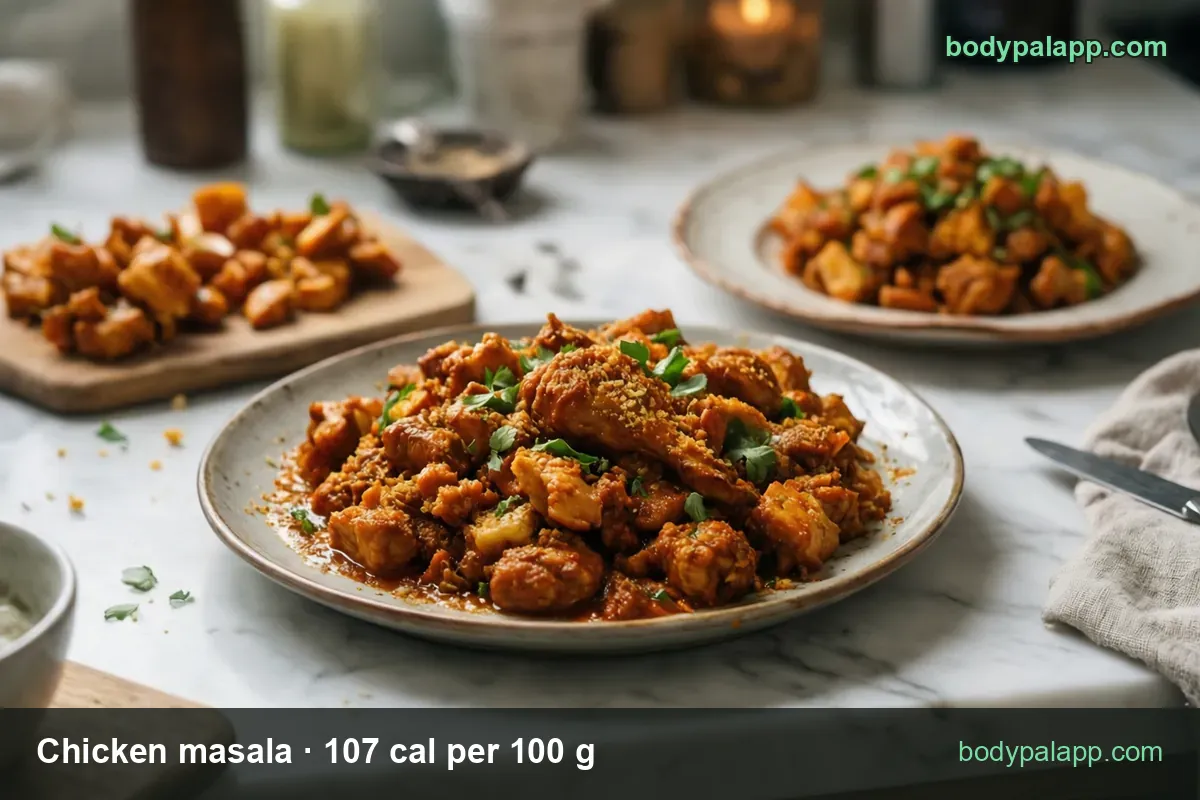
The rice version is the counter-intuitive one. Per 100 g it reads higher, 116 against 107, so you would expect the plate with rice to cost more. It does not, because the USDA cup of chicken curry with rice weighs 200 g rather than 240 g: rice grains pack differently than chunks of chicken in sauce. One cup of it is 232 calories, twenty-five fewer than the plain version. What you actually lose is protein — 9.9 g in that cup instead of 15.6 g, because rice displaces chicken.
Store-bought is a different story. The six branded chicken tikka masala and chicken masala trays in the USDA Branded files all run above the FNDDS home-cooked figure of 107 per 100 g: Lidl at 110, Signature Select at 115, Ethnic Gourmet at 122, Primitive Feast at 133, Performance Kitchen at 138, Deep Indian Kitchen at 145. The trays are creamier per gram, and they are also portioned generously. Deep Indian Kitchen's 255 g tray gives 370 calories — 113 more than a home-cooked cup at 240 g, from only 15 g more food. Performance Kitchen's 340 g package is the heaviest of the six at 469 calories, and Signature Select's 11 oz (312 g) tray comes to 359.
If you are logging a takeout container rather than a tray, the honest move is to weigh it. A restaurant portion is rarely one cup, and the sauce there is usually richer than the FNDDS average.
Sodium is the row that moves
Look back at the Daily Value column. Carbohydrate in a cup of chicken masala is 6% of a day. Sodium is 39%. That is more than six times the share, in a dish most people mentally file as "some chicken and vegetables."
In milligrams: 902 mg in one cup, against the FDA Daily Value of 2,300 mg. That is roughly two-fifths of a teaspoon of table salt in a single serving. Two cups and you are at 78% of the day before breakfast and lunch are counted. The Dietary Guidelines for Americans treat sodium as one of the nutrients most Americans over-consume, and simmered sauce dishes are a common reason why — the salt goes in early, dissolves, and never tastes like much.
The good news in the same table: 15.6 g of protein in a cup, 31% of the 50 g Daily Value, and 3.4 g of fiber from the onion, tomato and any legumes in the sauce. Chicken is one of the protein foods MyPlate puts at the center of a meal, and the masala treatment does not take that away. If sodium is what you are watching, a half cup of sauce over a larger pile of rice and vegetables gets you the flavor at 451 mg — half the cup figure, our own arithmetic — and keeps the protein reasonable.
How does chicken masala compare?
| Dish | Per 100 g | US serving | Calories |
|---|---|---|---|
| Chicken masala (chicken curry) | 107 kcal | 1 cup (240 g) | 257 kcal |
| Chicken with rice and vegetables, frozen diet meal | 111 kcal | 1 meal, 8.5 oz (241 g) | 268 kcal |
| Chicken or turkey hash | 110 kcal | 1 cup | — |
| Chicken or turkey creole, without rice | 103 kcal | 1 cup | — |
USDA does not publish a cup weight for the hash or the creole records, so those two are compared per 100 g only rather than invented a serving.
Our take: chicken masala is the fattiest of these four per gram — 6.48 g against 4.22 g for creole, 4.1 g for hash and 3.03 g for the frozen meal — and it is also the lowest in protein, at 6.48 g per 100 g where creole gives 13.8 g. That is the trade you are making: sauce weight instead of meat weight. Only the creole record is lighter per 100 g, and by four calories, so calorie counting is not what separates these dishes. If you want the same 250-calorie dinner with more protein in it, creole or hash does it. If you want the masala, get it — then keep the ladle honest and watch the salt, because that is where this dish actually costs you.
Most popular chicken masala brands in the United States
Ranked by how widely each product appears among foods sold in the United States, from the BodyPal food database of over 3.3 million products. Calories are the figures printed on each Nutrition Facts label, checked against USDA FoodData Central.
| Product | Calories (per 100 g) |
|---|---|
| Lidl Chicken Tikka Masala | 110 cal |
| Signature Select Chicken Tikka Masala | 115 cal |
| Deep Indian Kitchen Chicken Tikka Masala | 145 cal |
| Performance Kitchen Chicken Tikka Masala | 138 cal |
| Ethnic Gourmet Chicken Tikka Masala | 122 cal |
| Primitive Feast Chicken Masala | 133 cal |
Brand popularity: BodyPal food database. Nutrition: manufacturer labels / USDA FoodData Central.
Chicken masala FAQs
How many calories are in chicken masala?
A 1-cup serving, 240 g, is 257 calories, and the dish runs 107 calories per 100 g. That covers chicken and sauce only. USDA files chicken masala with rice as a separate dish at 116 calories per 100 g, so a plate served over rice is counted differently.
How many calories in 1 cup of chicken masala?
257 calories in one cup, 240 g. Half a cup is 128 and a cup and a half is 385, both scaled from the USDA 100 g figure rather than listed as USDA servings. The cup is the one household measure USDA publishes for this record.
How much protein is in chicken masala?
6.48 g per 100 g, which works out to 15.6 g in a 1-cup serving, or 31% of the 50 g Daily Value. That is solid but not high for a chicken dish, because sauce is most of the weight. USDA's chicken creole record carries 13.8 g per 100 g.
Is chicken masala high in sodium?
Yes — one cup carries 902 mg of sodium, 39% of the FDA Daily Value of 2,300 mg, or roughly two-fifths of a teaspoon of table salt. It is the biggest number on the label: the same cup is only 6% of the carbohydrate Daily Value. Half a cup halves it to 451 mg.
Chicken masala vs chicken tikka masala calories?
USDA has no separate record for chicken tikka masala, so the closest US figures are branded trays: 110 to 145 calories per 100 g, against 107 for the chicken curry record used here. Tikka masala is creamier and lands a little higher per gram, but the gap is small.
How many calories in chicken masala with rice?
232 calories in a 1-cup serving, because the USDA cup of chicken curry with rice weighs 200 g rather than 240 g. Per 100 g it is higher, 116 against 107, but the cup is lighter, and protein drops from 15.6 g to 9.9 g as rice replaces chicken.
Is chicken masala good for weight loss?
A cup is 257 calories with 15.6 g of protein, which fits inside a 400 to 500 calorie dinner once rice is added. The fat is the cost: 15.6 g a cup, 20% of the Daily Value. If you are cutting calories, half a cup over vegetables at 128 calories beats a 370-calorie tray.
How many carbs are in chicken masala?
6.54 g per 100 g, so 15.7 g in a 1-cup serving, 6% of the 275 g Daily Value. On its own it is a low-carb dish; the rice next to it is what moves the number. The USDA rice version is 15.12 g per 100 g, more than double.
Similar foods
- Broccoli Casserole — 244 cal per cup
- Butter Chicken — 257 cal per cup
- Chicken Curry — 257 cal per cup
- Chicken Katsu Curry — 257 cal per cup
- Chicken Korma — 257 cal per cup
- Chicken Tikka Masala — 257 cal per cup
Count it without the math
Point the camera at the bowl and BodyPal counts the masala for you, sauce and all.


How long does it take to burn off chicken masala?
A 1-cup (240 g) serving is 257 kcal. Enter your weight and the amount you ate to see how long it takes you to burn that off:
lb
| Activity | Time to burn 257 kcal |
|---|---|
| Walking, brisk | 51 min |
| Cycling, moderate | 32 min |
| Swimming, moderate | 37 min |
| Jogging | 30 min |
| Weight training, moderate | 57 min |
Times are for a 155 lb adult at a steady pace; change the weight to see yours. The amount is set to the portion in the text (240 g); change it to what you actually ate. BodyPal works this out from your steps automatically.
This table assumes you know your daily total. If you do not, the daily calorie calculator works it out from five numbers.