
How many calories are in chicken tikka masala?
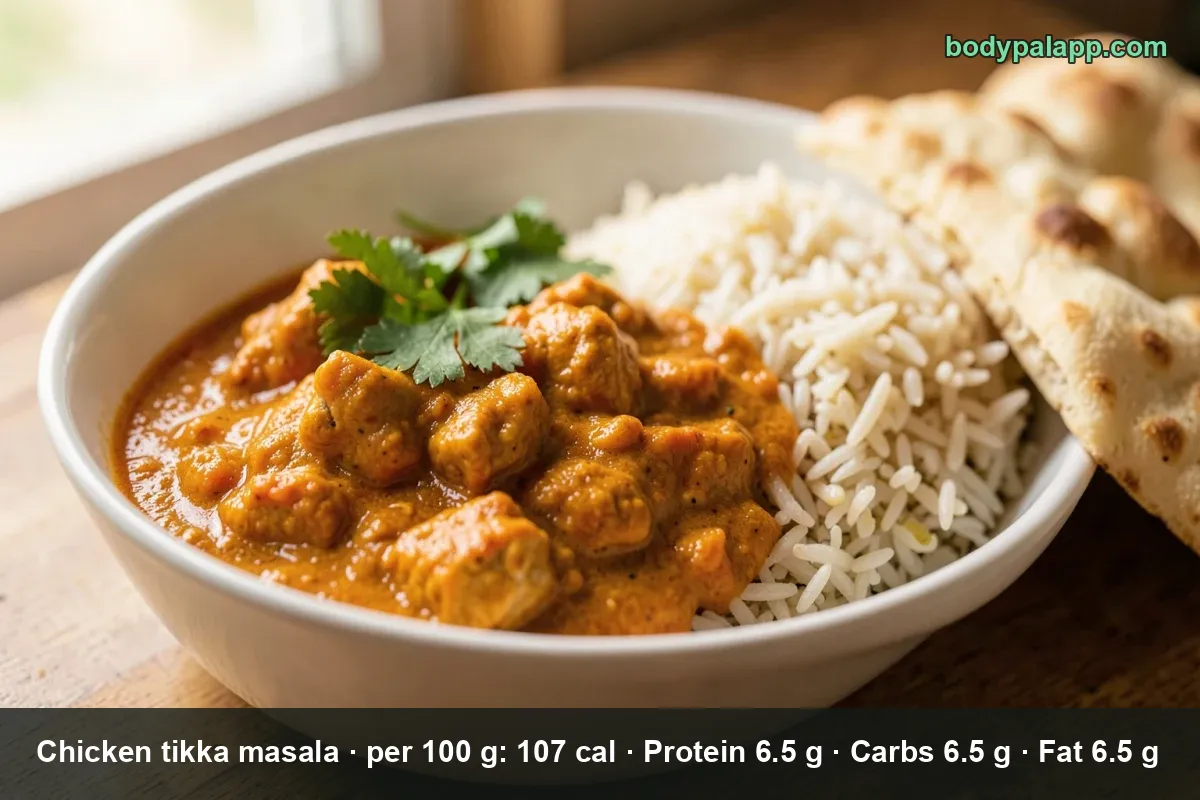
A 1-cup (240 g) serving of chicken tikka masala is 257 calories, and the curry itself runs 107 calories per 100 g, lighter per spoonful than most people guess. The catch is the salt. That same cup carries 902 mg of sodium, 39% of a day's limit, before any rice or naan joins the plate.
On this page
- Chicken tikka masala quick facts
- US servings, from one ounce to a restaurant plate
- With rice, frozen and jarred versions
- Sodium is the row to watch
- How does chicken tikka masala compare?
- Most popular chicken tikka masala brands
- Chicken tikka masala FAQs
Chicken tikka masala quick facts
USDA does not publish a record called "chicken tikka masala." The closest generic match, and the one used here, is FNDDS 2706437, "Chicken curry": chicken pieces in a spiced, creamy sauce with no rice underneath it. That is exactly what you spoon out of the bowl, which makes it the honest number for the dish in your hand.
The branded trays sold as tikka masala bracket that record on both sides, from 99 to 145 calories per 100 g, so 107 sits in the middle of the real American supply rather than at one edge of it.
| Nutrient | Per 100 g | Per 1 cup (240 g) | % Daily Value |
|---|---|---|---|
| Calories | 107 | 257 | — |
| Total fat | 6.48 g | 15.6 g | 20% |
| Saturated fat | 1.56 g | 3.7 g | 19% |
| Carbohydrate | 6.54 g | 15.7 g | 6% |
| Dietary fiber | 1.4 g | 3.4 g | 12% |
| Total sugars | 2.56 g | 6.1 g | — |
| Protein | 6.48 g | 15.6 g | 31% |
| Sodium | 376 mg | 902 mg | 39% |
| Cholesterol | 22 mg | 53 mg | 18% |
| Potassium | 280 mg | 672 mg | 14% |
% Daily Value is based on a 2,000-calorie diet.
Verified nutrition data
Numbers on this page come from USDA FoodData Central, the U.S. Department of Agriculture’s food composition database, and from manufacturer labels where a branded product is named. Last verified September 2026. How we verify our data →
Two rows you would see on a supermarket label are missing above: added sugars and trans fat. USDA does not publish either value for mixed dishes in this FNDDS release, so listing them would mean inventing numbers.
One quirk worth noticing: protein and fat land on the same figure, 6.48 g per 100 g. Gram for gram the fat therefore supplies more than twice the calories the protein does, which is the whole story of a cream-and-butter sauce in a single line. Daily Values used here are the FDA reference amounts published on the Nutrition Facts label.
US servings, from one ounce to a restaurant plate
| Serving | Weight | Calories |
|---|---|---|
| 1 oz | 28 g | 30 kcal |
| 1/2 cup | 120 g | 128 kcal |
| 3/4 cup | 180 g | 193 kcal |
| 1 cup | 240 g | 257 kcal |
| 1 1/2 cups, restaurant plate | 360 g | 385 kcal |
| Per 100 g | 100 g | 107 kcal |
Only the 1-cup line and the 100 g line come straight from USDA. The half cup, three-quarter cup, ounce and restaurant plate are our own arithmetic from the USDA 100 g figure, not USDA servings.
That spread hides the trap most people fall into. An ounce of tikka masala is 30 calories, a number so small it feels like the dish is free. But nobody eats an ounce. A takeout container from a curry house holds closer to 1 1/2 cups, which is 385 calories, roughly thirteen times the ounce and still without a grain of rice. If you are logging by eye, picture the cup, not the spoon.
Half a cup, at 128 calories, is the portion that works when rice or naan is doing the filling. A full cup with a small side is the version that reads like a normal dinner.
With rice, frozen and jarred versions
| Version | Per 100 g | Typical serving | Calories |
|---|---|---|---|
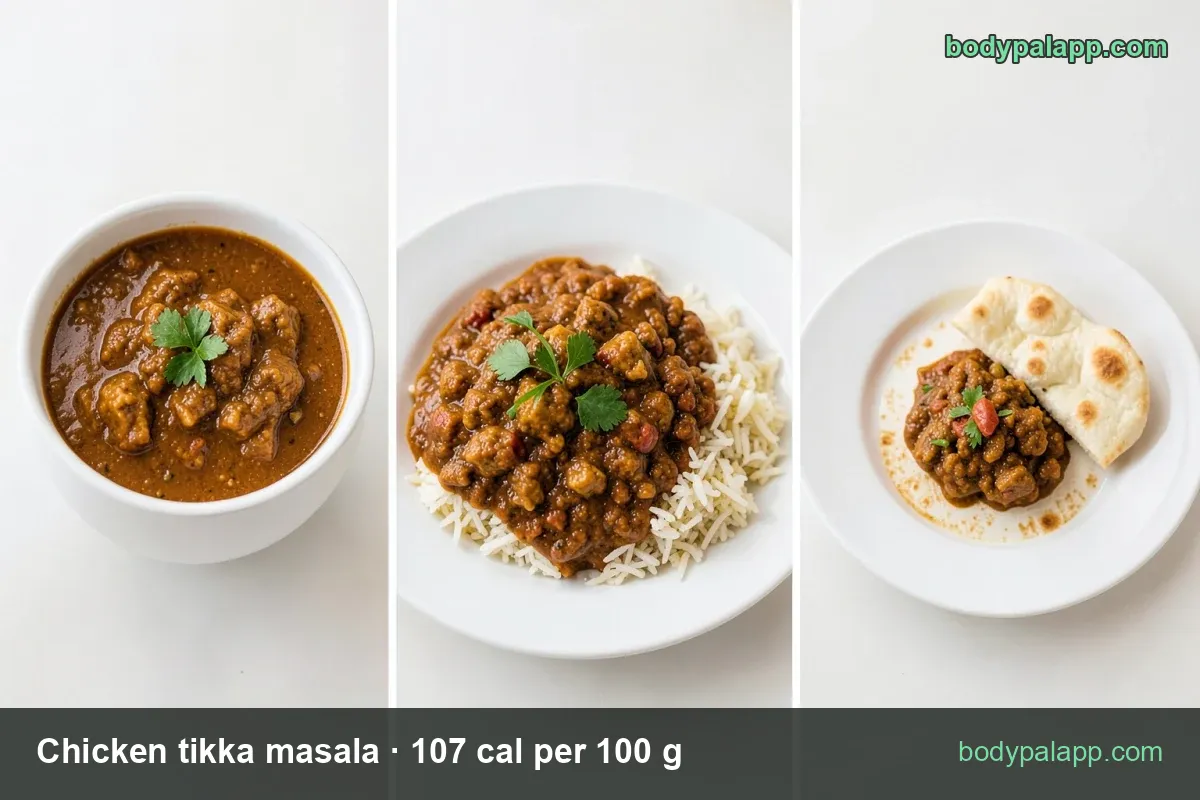
| Curry only, chicken and sauce | 107 kcal | 1 cup (240 g) | 257 kcal |
| With rice, mixed together | 116 kcal | 1 cup (200 g) | 232 kcal |
| Frozen tray dinner | 145 kcal | 1 tray (255 g) | 370 kcal |
| Supermarket chilled tub | 115 kcal | 11 oz (312 g) | 359 kcal |
| Simmer sauce from a jar | 94 kcal | 1/4 cup (64 g) | 60 kcal |
| Meal kit, dry mix | 238 kcal | 3 oz (84 g) | 200 kcal |
With rice (FNDDS 2706438) is the denser of the two per 100 g, 116 calories against 107, yet the cup comes out lighter: 232 versus 257, because a cup of the mixed dish weighs 200 g rather than 240 g. The trade is protein. That cup gives you 9.9 g against 15.6 g for the curry alone, since the rice is displacing chicken. Same bowl, two-thirds of the protein.
Frozen trays are the densest version on the shelf. Deep Indian Kitchen's tray runs 145 calories per 100 g and 370 for the 255 g tray. Lidl's frozen version is gentler at 110 per 100 g and 311 calories for a 10 oz (283 g) box, while Wicked Kitchen's 354 g meal lands at 350 calories.
Chilled supermarket tubs sit close to the USDA generic: Signature Select is 115 calories per 100 g, 359 for an 11 oz (312 g) tub. The extra calories over a homemade cup come from portion size, not from a richer recipe.
Jarred simmer sauce is the cheapest way to control the dish. A quarter cup is 60 calories at 94 per 100 g, and since you add your own chicken, you decide how much cream and oil follows it.
Meal kits are dry spice-and-sauce bases: 238 calories per 100 g sounds alarming, but 3 oz (84 g) makes a family-size pan, so the 200 calories are split across everyone at the table.
Sodium is the row to watch
Calories are not the problem with this dish. Sodium is. One cup delivers 902 mg, 39% of the 2,300 mg Daily Value, which is roughly two-fifths of a teaspoon of table salt in a single serving. Order a restaurant-size 1 1/2 cups and you are at about 1,353 mg from the curry alone, before the rice, the pickle or the naan.
Packaged versions can go further. The Wicked Kitchen frozen meal is a modest 350 calories, yet it carries 1,459 mg of sodium, 63% of a day's Daily Value from one tray. That is the pattern the CDC's sodium guidance keeps pointing at: most American sodium arrives in restaurant and packaged food, not from the shaker.
The good news is on the protein line. A cup gives 15.6 g, 31% of the Daily Value, which puts it in the same league as the cooked-poultry portions described by MyPlate's protein foods guidance. Saturated fat is fair too, 3.7 g per cup, 19% of the DV, well inside the limit the Dietary Guidelines set for the day. If you are watching sodium, cooking from a jarred sauce and salting the pan yourself is the single change that moves the number most.
How does chicken tikka masala compare?
| Dish | Per 100 g | US serving | Calories |
|---|---|---|---|
| Chicken tikka masala, curry only | 107 kcal | 1 cup (240 g) | 257 kcal |
| Chicken curry with rice | 116 kcal | 1 cup (200 g) | 232 kcal |
| Chicken or turkey hash | 110 kcal | 1 oz (28 g) | 31 kcal |
| Chicken and vegetables with gravy | 112 kcal | 1 oz (28 g) | 31 kcal |
Our take: of these four USDA records, the plain tikka masala is the lightest per 100 g, which is not the reputation the dish has. What separates them is the serving, not the recipe. The hash and the gravy dish are only 31 calories at an ounce because an ounce is a rounding error of a meal, while the curry gets logged by the cupful. For weight loss, half a cup of curry with a big pile of vegetables beats a full cup with rice; for satiety on the same calories, the curry-only version wins on protein, 15.6 g against 9.9 g when rice is stirred through.
Most popular chicken tikka masala brands in the United States
Ranked by how widely each product appears among foods sold in the United States, from the BodyPal food database of over 3.3 million products. Calories are the figures printed on each Nutrition Facts label, checked against USDA FoodData Central.
| Product | Calories (per 100 g) |
|---|---|
| Lidl Chicken Tikka Masala | 110 cal |
| Signature Select Chicken Tikka Masala | 115 cal |
| Deep Indian Kitchen Chicken Tikka Masala | 145 cal |
| Performance Kitchen Chicken Tikka Masala | 138 cal |
| Ethnic Gourmet Chicken Tikka Masala | 122 cal |
| Wicked Kitchen Dehlilicous Chicken Tikka Masala | 99 cal |
Brand popularity: BodyPal food database. Nutrition: manufacturer labels / USDA FoodData Central.
Chicken tikka masala FAQs
How many calories are in chicken tikka masala?
257 calories in a 1-cup (240 g) serving of the curry itself, which works out to 107 calories per 100 g. A half cup is 128 calories, and a restaurant-size plate of about 1 1/2 cups reaches 385. None of those figures include rice or naan on the side.
How many calories in 1 cup of chicken tikka masala?
257 calories per cup, based on the USDA FNDDS chicken curry record at 107 calories per 100 g and a cup weighing 240 g. That cup also brings 15.6 g of protein, 15.7 g of carbohydrate and 15.6 g of fat, so fat supplies more than half the calories.
How much protein is in chicken tikka masala?
15.6 g of protein in a 1-cup (240 g) serving, which is 31% of the Daily Value, from 6.48 g per 100 g. Stir rice through it and the same cup drops to 9.9 g, because the rice takes up space the chicken used to fill. Curry only is the higher-protein option.
How many carbs are in chicken tikka masala?
15.7 g of carbohydrate in a 1-cup serving, only 6% of the Daily Value, with 3.4 g of that as fiber and 6.1 g as total sugars from the tomato, onion and dairy. The curry on its own is a genuinely low-carb dish. Rice is what changes that, taking the mixed dish to 15.12 g per 100 g.
Is chicken tikka masala high in sodium?
Yes. One cup carries 902 mg of sodium, 39% of the 2,300 mg Daily Value, or about two-fifths of a teaspoon of table salt. Frozen versions can go higher: one 354 g supermarket meal reaches 1,459 mg, 63% of a day, despite being only 350 calories in total.
How many calories in chicken tikka masala with rice?
232 calories in a 1-cup (200 g) serving of the mixed dish, at 116 calories per 100 g. That is fewer calories than a cup of curry alone only because the mixed cup weighs less. The protein falls to 9.9 g and carbohydrate climbs to 15.12 g per 100 g.
How many calories in a frozen chicken tikka masala meal?
Between 311 and 469 calories per package across the six US brands checked. A 255 g tray at 145 calories per 100 g is 370; a 10 oz (283 g) box at 110 per 100 g is 311; a 340 g package at 138 per 100 g reaches 469. Read the pack weight before the calorie figure.
Is chicken tikka masala good for weight loss?
A half cup at 128 calories with 7.8 g of protein fits most calorie targets easily, and the curry is low in carbohydrate at 6.54 g per 100 g. The risk is portion creep and the side dishes, since a restaurant plate plus rice clears 600 calories quickly. Serve it over vegetables and the math stays friendly.
Similar foods
- Broccoli Casserole — 244 cal per cup
- Butter Chicken — 257 cal per cup
- Chicken Curry — 257 cal per cup
- Chicken Katsu Curry — 257 cal per cup
- Chicken Korma — 257 cal per cup
- Chicken Masala — 257 cal per cup
Count it without the math
Point the camera at the bowl and BodyPal counts the curry, the rice and the naan separately.


How long does it take to burn off 257 kcal of chicken tikka masala?
A 1-cup (240 g) serving is 257 kcal. Enter your weight and the amount you ate to see how long it takes you to burn that off:
lb
| Activity | Time to burn 257 kcal |
|---|---|
| Walking, brisk | 51 min |
| Cycling, moderate | 32 min |
| Swimming, moderate | 37 min |
| Jogging | 30 min |
| Weight training, moderate | 57 min |
Times are for a 155 lb adult at a steady pace; change the weight to see yours. The amount is set to the portion in the text (240 g); change it to what you actually ate. BodyPal works this out from your steps automatically.
One food is easy to picture; a whole day is harder. See how many calories you need a day and what a deficit actually looks like.