
How many calories are in chicken korma?
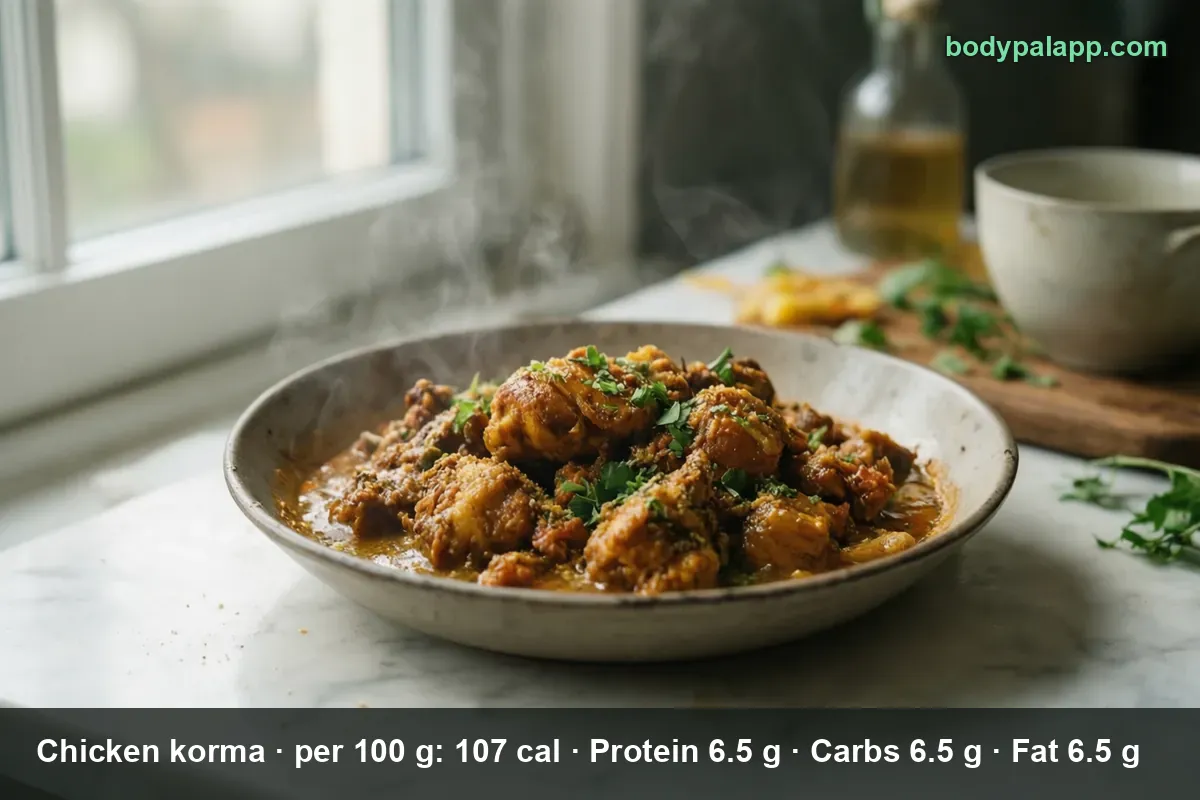
A 1-cup serving of chicken korma, sauce and chicken with no rice underneath, comes to 257 calories at 240 g. Per 100 g the dish runs 107 calories, which is lighter per gram than most people expect from something this creamy. The sodium is the number that actually stings.
On this page
- Chicken korma quick facts
- US servings, from one ounce to a takeout container
- Korma with rice, from a jar, or from the freezer
- Sodium is the row to watch, not calories
- How does chicken korma compare?
- Most popular chicken korma brands
- Chicken korma FAQs
Chicken korma quick facts
There is no USDA record called "korma." The closest match, and the one every number on this page is built from, is FNDDS 2706437, "Chicken curry" — chicken cooked in a spiced, thickened sauce with no grain in the bowl. That is exactly what a korma order looks like when the rice comes in its own container: pieces of chicken swimming in sauce, and nothing else. Branded rows that do carry the word korma are almost all simmer sauces in a jar or frozen dinners with rice already mixed in, so they answer a different question.
A restaurant korma is usually richer than this record — more cream, more cashew paste, sometimes ghee. Treat 107 calories per 100 g as the honest middle of home-cooked and lighter takeout versions, and read the jarred-sauce and frozen-meal rows further down if your korma came out of a package.
| Nutrient | Per 100 g | Per 1 cup (240 g) | % Daily Value |
|---|---|---|---|
| Calories | 107 | 257 | — |
| Total fat | 6.48 g | 15.6 g | 20% |
| Saturated fat | 1.56 g | 3.7 g | 19% |
| Carbohydrate | 6.54 g | 15.7 g | 6% |
| Dietary fiber | 1.4 g | 3.4 g | 12% |
| Total sugars | 2.56 g | 6.1 g | — |
| Protein | 6.48 g | 15.6 g | 31% |
| Sodium | 376 mg | 902 mg | 39% |
% Daily Value is based on a 2,000-calorie diet.
Verified nutrition data
Numbers on this page come from USDA FoodData Central, the U.S. Department of Agriculture’s food composition database, and from manufacturer labels where a branded product is named. Last verified September 2026. How we verify our data →
Two rows you would see on a package are missing here: added sugars and trans fat. The FNDDS release does not publish either for mixed dishes, so printing a zero would be an invention rather than a measurement. Cholesterol and potassium do exist for this record: 53 mg of cholesterol per cup, 18% of the Daily Value, and 672 mg of potassium, 14%. The Daily Values used throughout are the FDA's current set.
US servings, from one ounce to a takeout container
| Serving | Weight | Calories |
|---|---|---|
| 1 oz | 28 g | 30 kcal |
| 1/2 cup | 120 g | 128 kcal |
| 4 oz | 113 g | 121 kcal |
| 1 cup | 240 g | 257 kcal |
| 1 1/2 cups, takeout size | 360 g | 385 kcal |
| Per 100 g | 100 g | 107 kcal |
The 1-cup line is the USDA household measure for this record. Everything else in the table is our own arithmetic from the USDA 100 g figure, not a USDA serving — useful, but scaled by us rather than measured.
Here is where korma trips people up. A cup and a 4-ounce spoonful sound like the same order of magnitude, and they are not: 257 calories against 121, more than double, for a food that looks identical in both. Weight settles it, volume does not. A cup of korma that is mostly sauce weighs about the same as a cup that is mostly chicken, but the second one carries far more protein for the same 257 calories. If you are logging by eye, the fair default for a restaurant portion is 1 1/2 cups, because takeout containers are not measuring cups.
Korma with rice, from a jar, or from the freezer
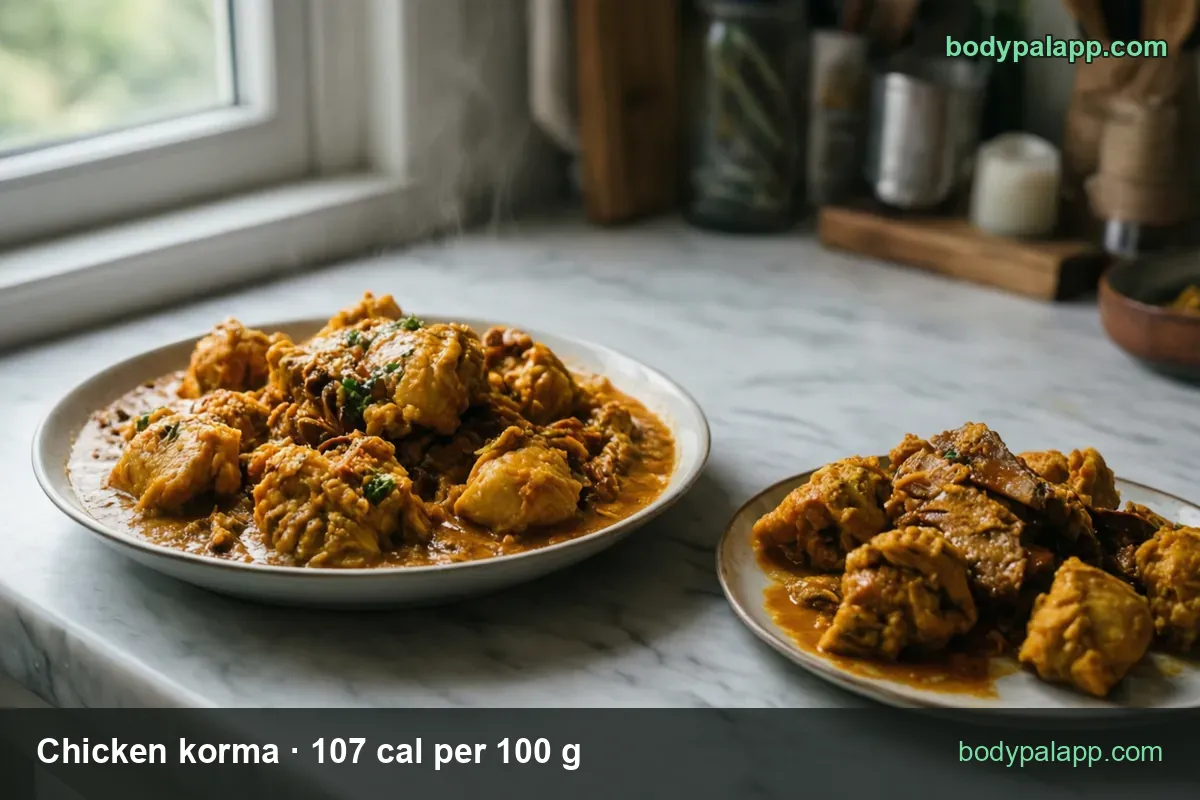
| Version | Per 100 g | Typical serving | Calories |
|---|---|---|---|
| Chicken korma, sauce only, no rice | 107 kcal | 1 cup (240 g) | 257 kcal |
| Chicken korma with rice | 116 kcal | 1 cup (200 g) | 232 kcal |
| Takeout-size chicken korma | 107 kcal | 1 1/2 cups (360 g) | 385 kcal |
| Korma simmer sauce from a jar | 141 kcal | 1/4 cup (64 g) | 90 kcal |
| Vegetable korma | 86 kcal | 2/3 cup (140 g) | 120 kcal |
| Frozen chicken korma meal | 129 kcal | 1 tray (255 g) | 329 kcal |
With rice mixed in, the dish gets denser per gram — 116 calories per 100 g against 107 — and yet a cup of it lands lower, at 232 calories, because a cup of rice-and-curry weighs 200 g rather than 240 g. It also thins out the parts you were paying for: 4.96 g of protein per 100 g instead of 6.48 g, and 4 g of fat instead of 6.48 g. Carbohydrate more than doubles, from 6.54 g to 15.12 g per 100 g.
The jar is the surprise. A mild korma simmer sauce runs 141 calories per 100 g — heavier per gram than the finished dish with chicken in it, because sauce is where the coconut, cream and oil live and chicken is comparatively lean. A quarter-cup ladle is 90 calories before a single piece of chicken goes in the pan. Pour half a jar over dinner for two and the sauce alone is doing more calorie work than the meat.
Vegetable korma drops to 86 calories per 100 g, the lightest version on this page, but the protein goes with it: 2.14 g per 100 g against 6.48 g in the chicken record. A 2/3-cup side is 120 calories.
Frozen korma dinners sit between the two. A Deep Indian Kitchen coconut chicken korma tray is 129 calories per 100 g and 329 for the whole 255 g tray; a Cooking Light chicken korma is 136 per 100 g, or 190 for its 5 oz (140 g) labeled serving. Both are denser per gram than the USDA dish, which is what you would expect from a sauce built to survive freezing.
Sodium is the row to watch, not calories
One cup of korma is 13% of a 2,000-calorie day and 39% of the sodium — 902 mg, close to half a teaspoon of table salt. That gap is the whole story of this food. You can fit korma into almost any calorie target and still spend nearly 40% of your daily sodium before the rice, the naan or the pickle arrives.
The Dietary Guidelines for Americans put the limit at 2,300 mg a day for adults, and most people in the US are well over it. Curry sauces get salted twice, once in the spice base and again when the sauce is finished, and the 376 mg per 100 g in the USDA record is before anyone at the table reaches for more. If you are watching sodium, the useful move is not swapping the dish but holding the portion at a cup and pairing it with plain rice or vegetables rather than a second salted item.
The rows that flatter korma are protein and fiber. A cup delivers 15.6 g of protein, 31% of the Daily Value, and 3.4 g of fiber at 12% — respectable for a dish people file under "indulgent." Saturated fat lands at 3.7 g, 19% of the Daily Value, which is moderate for something this creamy but climbs fast at takeout size: 5.6 g in 1 1/2 cups. Building the rest of the plate around vegetables and a measured scoop of rice, the way MyPlate frames a meal, keeps both numbers in range.
How does chicken korma compare?
| Dish | Per 100 g | US serving | Calories |
|---|---|---|---|
| Chicken korma, no rice | 107 kcal | 1 cup (240 g) | 257 kcal |
| Chicken curry with rice | 116 kcal | 1 cup (200 g) | 232 kcal |
| Chicken creole, without rice | 103 kcal | 1 cup (240 g) | 247 kcal |
| Chicken stew with pasta | 108 kcal | 1 cup (240 g) | 259 kcal |
The 1-cup (240 g) lines for chicken creole and chicken stew are our own scaling from the USDA 100 g figures, not USDA servings.
Our take: these four dishes are so close per gram — 103 to 116 calories per 100 g — that picking between them for calorie reasons is wasted effort. Korma is the second lightest of the four by weight and the second heaviest by the cup, which tells you the serving size decides the outcome, not the recipe. For weight loss, a measured cup of korma with a half-cup of rice beats an unmeasured bowl of anything on this list. For protein per calorie, chicken creole wins outright at 13.8 g per 100 g against korma's 6.48 g, so if the goal is staying full until the next meal, that is the better build. Korma's real cost is sodium, not calories.
Most popular chicken korma brands in the United States
Ranked by how widely each product appears among foods sold in the United States, from the BodyPal food database of over 3.3 million products. Calories are the figures printed on each Nutrition Facts label, checked against USDA FoodData Central.
| Product | Calories (per 100 g) |
|---|---|
| Deep Indian Kitchen Coconut Chicken Korma | 129 cal |
| Cooking Light Chicken Korma | 136 cal |
Brand popularity: BodyPal food database. Nutrition: manufacturer labels / USDA FoodData Central.
Chicken korma FAQs
How many calories are in chicken korma?
A 1-cup serving is 257 calories, based on the USDA's chicken curry record at 107 calories per 100 g. That is the dish alone, chicken and sauce, with no rice under it. Add a cup of korma with rice and the plate reads differently, at 232 calories per cup.
How many calories in a cup of chicken korma?
257 calories in a level 1-cup serving weighing 240 g. Half a cup is 128 calories and a takeout-size 1 1/2 cups is 385. The half-cup and the 1 1/2-cup figures are our own arithmetic from the USDA 100 g number, not USDA servings.
How many calories in chicken korma with rice?
232 calories per cup, using the USDA's chicken curry with rice record at 116 calories per 100 g and a 200 g cup. Per gram it is heavier than korma alone, but a cup of it holds less chicken and less fat: 4 g per 100 g against 6.48 g.
How much protein is in chicken korma?
15.6 g of protein in a 1-cup serving, or 31% of the Daily Value, from 6.48 g per 100 g. That is a real protein contribution for a curry, and it is the reason a cup of korma with a small side of rice still eats like a full meal.
How many carbs are in chicken korma?
15.7 g of carbohydrate in a 1-cup serving, 6% of the Daily Value, including 3.4 g of fiber and 6.1 g of total sugars. Most of that sugar typically comes from onion, tomato and dairy in the sauce rather than added sweetener; the USDA record does not list added sugars.
Is chicken korma healthy?
At 257 calories and 15.6 g of protein per cup, korma fits a normal lunch or dinner budget. The number to check is sodium: 902 mg, 39% of the Daily Value in one cup. If you are watching sodium, keep the portion to a cup and skip a salty side.
Why is chicken korma so high in sodium?
902 mg per cup, 39% of the Daily Value, which is close to half a teaspoon of table salt. Curry sauces are salted twice, once in the spice base and again in the finished sauce, and the USDA record runs 376 mg per 100 g before anyone reaches for more.
Is chicken korma high in calories?
Not by weight: 107 calories per 100 g puts korma below chicken curry with rice at 116 and close to chicken stew with pasta at 108. The trap is volume. A cup is 257 calories, a takeout-size 1 1/2 cups is 385, and a 1/4-cup ladle of jarred korma sauce alone is 90.
Similar foods
- Broccoli Casserole — 244 cal per cup
- Butter Chicken — 257 cal per cup
- Chicken Curry — 257 cal per cup
- Chicken Katsu Curry — 257 cal per cup
- Chicken Masala — 257 cal per cup
- Chicken Tikka Masala — 257 cal per cup
Count it without the math
Point the camera at the bowl and BodyPal counts the korma for you, sauce and all.


How long does it take to burn off chicken korma?
A 1-cup (240 g) serving is 257 kcal. Enter your weight and the amount you ate to see how long it takes you to burn that off:
lb
| Activity | Time to burn 257 kcal |
|---|---|
| Walking, brisk | 51 min |
| Cycling, moderate | 32 min |
| Swimming, moderate | 37 min |
| Jogging | 30 min |
| Weight training, moderate | 57 min |
Times are for a 155 lb adult at a steady pace; change the weight to see yours. The amount is set to the portion in the text (240 g); change it to what you actually ate. BodyPal works this out from your steps automatically.
One food is easy to picture; a whole day is harder. See how many calories you need a day and what a deficit actually looks like.