
How many calories are in chicken katsu curry?
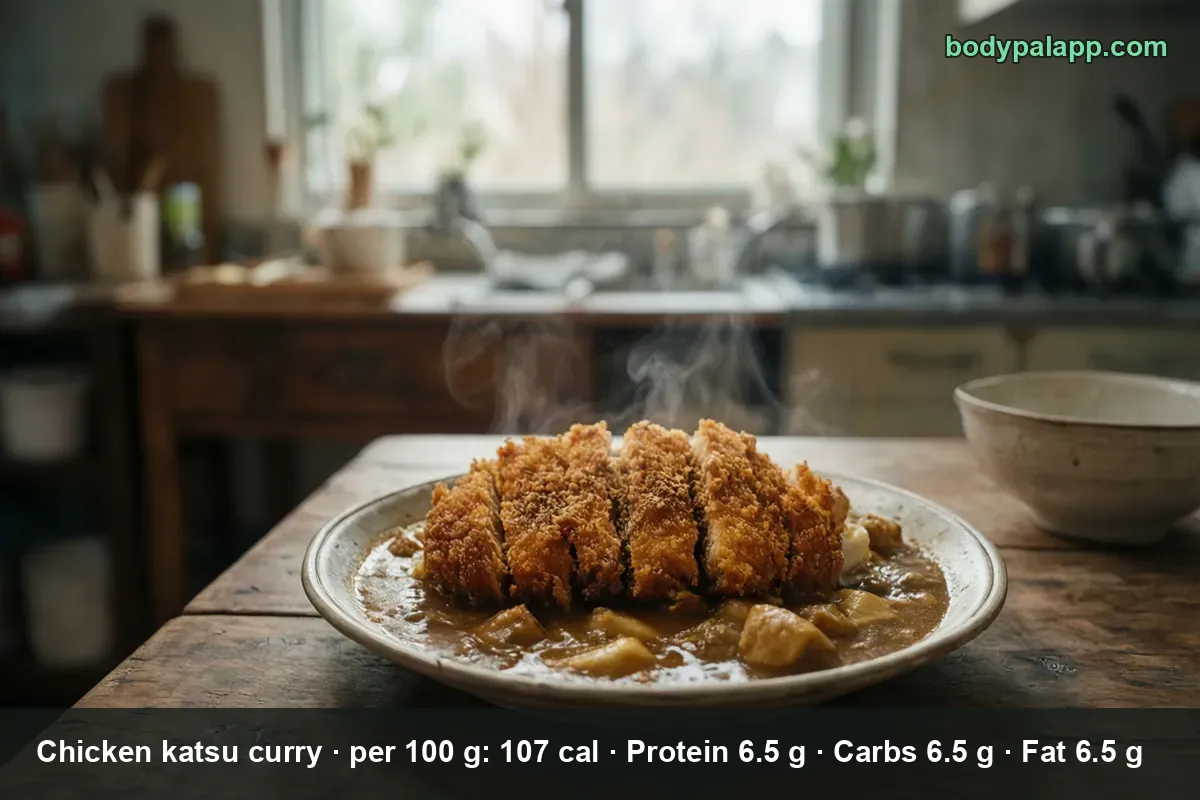
A 1-cup (240 g) serving of chicken katsu curry, sauce and chicken without rice, carries 257 calories, and the curry itself runs 107 calories per 100 g. USDA has no record filed under the katsu name, so the number above comes from its chicken curry record: the sauce, chicken and potato on the plate.
On this page
- Chicken katsu curry quick facts
- US servings, from one ounce to two cups
- With rice, ready meals and pouch curries
- Sodium is the row that outruns the calories
- How does chicken katsu curry compare?
- Most popular chicken katsu curry brands
- Chicken katsu curry FAQs
Chicken katsu curry quick facts
Japanese curry houses do not file nutrition data with USDA, so the honest starting point is the survey record for chicken curry, FNDDS 2706437. It describes exactly what sits under the cutlet in the photo above: chicken, potato and thick curry sauce, no rice. Breading and rice are handled further down, each with its own record, because both change the plate more than the curry does.
That choice matters for anyone logging a katsu plate. The curry itself is a modest 107 calories per 100 g. Almost everything that makes katsu curry feel heavy — the panko crust, the frying oil, the scoop of short-grain rice — sits outside this record, which is why the table below looks lighter than you might expect.
| Nutrient | Per 100 g | Per 1 cup (240 g) | % Daily Value |
|---|---|---|---|
| Calories | 107 | 257 | — |
| Total fat | 6.48 g | 15.6 g | 20% |
| Saturated fat | 1.56 g | 3.7 g | 19% |
| Carbohydrate | 6.54 g | 15.7 g | 6% |
| Dietary fiber | 1.4 g | 3.4 g | 12% |
| Total sugars | 2.56 g | 6.1 g | — |
| Protein | 6.48 g | 15.6 g | 31% |
| Sodium | 376 mg | 902 mg | 39% |
% Daily Value is based on a 2,000-calorie diet.
Verified nutrition data
Numbers on this page come from USDA FoodData Central, the U.S. Department of Agriculture’s food composition database, and from manufacturer labels where a branded product is named. Last verified September 2026. How we verify our data →
Two rows you would see on a packaged curry are missing here. Added sugars and trans fat are not listed because this FNDDS edition does not publish either value for the record, so guessing them would be worse than leaving them out. Cholesterol comes in at 53 mg a cup, 18% of the Daily Value, and potassium at 672 mg, 14%.
US servings, from one ounce to two cups
| Serving | Weight | Calories |
|---|---|---|
| 1 oz | 28 g | 30 kcal |
| Half a cup, a side ladle | 120 g | 128 kcal |
| 1 cup | 240 g | 257 kcal |
| 1 1/2 cups, a full plate | 360 g | 385 kcal |
| 2 cups, a deep bowl | 480 g | 514 kcal |
| Per 100 g | 100 g | 107 kcal |
Only the 1-cup line is a USDA household measure. The half cup, the plate, the two-cup bowl and the ounce are our own arithmetic from the USDA 100 g figure, scaled straight up or down, not USDA servings in their own right.
The plate in the photo is closer to a cup and a half of sauce and chicken than to a single cup — 385 calories before the cutlet is counted. A restaurant portion is rarely a tidy cup, and curry is dense and wet, so a ladle that looks like "a bit" often weighs 150 g or more. If you own a kitchen scale, this is a dish worth weighing once, then estimating from memory forever after.
With rice, ready meals and pouch curries
| Version | Per 100 g | Typical portion | Calories |
|---|---|---|---|
| Chicken curry, no rice | 107 kcal | 1 cup (240 g) | 257 kcal |
| Chicken curry with rice | 116 kcal | 1 cup (200 g) | 232 kcal |
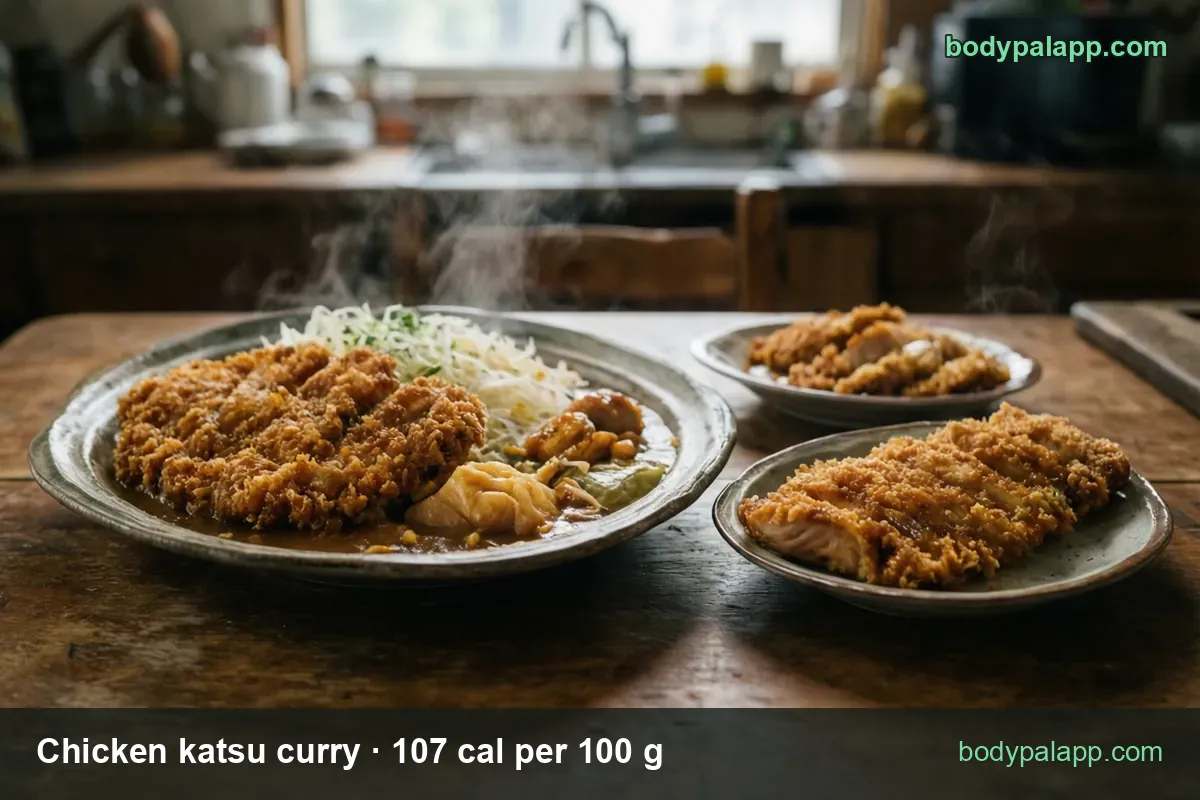
| Ready-meal katsu with jasmine rice | 151 kcal | 1 container (404 g) | 610 kcal |
| Restaurant-style pouch curry | 230 kcal | 1 pouch (113 g) | 260 kcal |
Here is the trap almost every calorie tracker walks into. Chicken curry with rice is denser per gram — 116 calories per 100 g against 107 — yet the USDA cup of it comes to 232 calories, less than the 257 in a cup of plain curry. The reason is weight, not recipe: the rice version's cup weighs 200 g, the sauce-heavy version's cup weighs 240 g. Rice makes the spoon lighter and the carbohydrate heavier, moving from 6.54 g per 100 g to 15.12 g.
The breaded, packaged version is the one that really moves. A ready meal of chicken katsu with jasmine rice runs 151 calories per 100 g, about 40% more per gram than the curry alone, and a whole 404 g container lands at 610 calories — more than double a cup of plain curry. Retail pouches vary just as widely: a Deep Indian Kitchen railway chicken curry is 230 calories per 100 g, while a Signature Select Thai style coconut chicken curry sits at 112 and Mr. Kook's at 113. Same shelf, twice the density.
Sodium is the row that outruns the calories
A cup of this curry uses 39% of the day's sodium and 20% of the day's fat. Nothing else on the label moves that fast. The FDA sets the Daily Value for sodium at 2,300 mg, and 902 mg in one cup is a bit more than a third of a teaspoon of table salt — before soy sauce, pickled ginger or the sweet-brown katsu sauce squeezed over the cutlet.
Protein is the good news. At 15.6 g a cup, 31% of the Daily Value, this is one of the better-fed lunches you can log at 257 calories, and it fits the protein-food guidance on MyPlate without much help. If you are watching sodium, the plate is still workable: skip the extra sauce, keep the portion to a cup, and let the rice and cabbage carry the volume.
How does chicken katsu curry compare?
| Dish | Per 100 g | US serving | Calories |
|---|---|---|---|
| Chicken curry, no rice | 107 kcal | 1 cup (240 g) | 257 kcal |
| Chicken curry with rice | 116 kcal | 1 cup (200 g) | 232 kcal |
| Chicken or turkey hash | 110 kcal | 1 cup | — |
| Chicken or turkey creole, without rice | 103 kcal | 1 cup | — |
USDA lists a cup for the hash and the creole, but no gram weight came back with those records, so their per-serving calories are left blank rather than invented.
Our take: per gram these four are within 13 calories of each other, so the sauce style barely matters — the creole is the lightest at 103 calories per 100 g and the curry with rice the heaviest at 116. What separates them is protein. Creole gives 13.8 g per 100 g and hash 9.57 g, against 6.48 g for the curry and only 4.96 g once rice is folded in. For weight loss, the plain curry at a measured cup is the pick; for staying full on the same calories, a creole-style chicken without rice does more work per bite.
Most popular chicken katsu curry brands in the United States
Ranked by how widely each product appears among foods sold in the United States, from the BodyPal food database of over 3.3 million products. Calories are the figures printed on each Nutrition Facts label, checked against USDA FoodData Central.
| Product | Calories (per 100 g) |
|---|---|
| Signature Select Thai Style Coconut Chicken Curry | 112 cal |
| Deep Indian Kitchen Railway Chicken Curry | 230 cal |
| Ahold Chicken Curry | 157 cal |
| Sukhi's Chicken Curry Medium Spiced | 154 cal |
| Harmons Premium Chicken Curry | 191 cal |
| Mr. Kook's Chicken Curry | 113 cal |
Brand popularity: BodyPal food database. Nutrition: manufacturer labels / USDA FoodData Central.
Chicken katsu curry FAQs
How many calories are in chicken katsu curry?
A 1-cup (240 g) serving of chicken curry without rice runs 257 calories, or 107 calories per 100 g. That is the USDA FNDDS figure for chicken curry, the closest match to a katsu plate served without rice. The breaded cutlet and any rice on the side add to it.
How many calories in katsu curry without rice?
257 calories for a full cup (240 g), 128 for a half cup, since the sauce itself is only 107 calories per 100 g. Without rice the plate is mostly chicken, potato and sauce, so carbohydrate stays at 15.7 g a cup instead of climbing with the starch.
How much protein is in chicken katsu curry?
15.6 g of protein sits in a 1-cup (240 g) serving, 31% of the Daily Value, scaled from 6.48 g per 100 g. Protein is the row that pays here: 257 calories buy close to a third of a day's target, which is why the dish holds off hunger well.
How many carbs are in chicken katsu curry?
15.7 g of carbohydrate in a cup (240 g), 6% of the Daily Value, and 6.54 g per 100 g. Add rice and it changes shape: the USDA record for chicken curry with rice runs 15.12 g per 100 g, so a 200 g cup carries about 30 g by our own arithmetic.
Is chicken katsu curry high in sodium?
Yes: 902 mg of sodium in a 1-cup (240 g) serving is 39% of the 2,300 mg Daily Value, from 376 mg per 100 g. That is a bit more than a third of a teaspoon of table salt, and it lands before soy sauce, pickles or a katsu sauce drizzle.
Does katsu curry with rice have more calories?
Per gram yes: curry with rice is 116 calories per 100 g against 107 without. But the USDA cup of the rice version weighs 200 g and lands at 232 calories, under the 257 of a 240 g cup of plain curry. Weigh, don't eyeball.
How many calories in a ready-meal chicken katsu?
610 calories for a 404 g container of ready-meal chicken katsu with jasmine rice, at 151 calories per 100 g. The breading and the rice do the work: that is more than double the 257 calories in a cup of plain chicken curry, and 428 mg of sodium per 100 g.
Is chicken katsu curry good for weight loss?
It can be: at 107 calories per 100 g it is lighter per gram than the with-rice version at 116, and a cup delivers 15.6 g of protein for 257 calories, 31% of the Daily Value. Sodium, at 39% of the Daily Value a cup, is the row to watch.
Similar foods
- Broccoli Casserole — 244 cal per cup
- Butter Chicken — 257 cal per cup
- Chicken Curry — 257 cal per cup
- Chicken Korma — 257 cal per cup
- Chicken Masala — 257 cal per cup
- Chicken Tikka Masala — 257 cal per cup
Count it without the math
Point the camera at the plate and BodyPal counts the curry, the cutlet and the rice separately.


How long does it take to burn off 257 kcal of chicken katsu curry?
A 1-cup (240 g) serving is 257 kcal. Enter your weight and the amount you ate to see how long it takes you to burn that off:
lb
| Activity | Time to burn 257 kcal |
|---|---|
| Walking, brisk | 51 min |
| Cycling, moderate | 32 min |
| Swimming, moderate | 37 min |
| Jogging | 30 min |
| Weight training, moderate | 57 min |
Times are for a 155 lb adult at a steady pace; change the weight to see yours. The amount is set to the portion in the text (240 g); change it to what you actually ate. BodyPal works this out from your steps automatically.
Want the bigger picture? Calculate your daily calorie needs — your maintenance figure, a target for losing or gaining, and the date you get there.