Fried egg calories come to 90 for one large egg (46 g) and 196 per 100 g. Fat supplies 70% of those calories, so the pan matters as much as the egg. The same egg cooked with no added fat logs 72, while one fried in butter reaches 100.
90kcal
1 large fried egg · 46 g, fried, whole egg
28%protein
6.3 gProtein
0 gCarbs
6.8 gFat
How to burn off 90 kcal
—Walking, brisk
—Jogging
—Cycling, moderate
—Swimming
Skip the math. BodyPal counts these calories from your steps and workouts automatically.
Nutrition facts
Fried, whole egg · per 46 g
Calories
90 kcal
Protein
6.3 g
Carbohydrate
0.4 g
Fat
6.8 g
Saturated fat
2 g
Cholesterol
184 mg
Sodium
95 mg
Potassium
70 mg
Iron
0.9 mg
Source: USDA FoodData Central
🛡️
Verified nutrition data
Numbers on this page come from USDA FoodData Central, the U.S. Department of Agriculture’s food composition database, and from manufacturer labels where a branded product is named. Last verified September 2026. How we verify our data →
Fried egg: calories, protein and sodium by serving
Percent of daily value uses the FDA reference of 2,000 kcal a day.
Serving
kcal
Protein
Carbs
Fat
Sodium
% DV kcal
1 large (46 g)
90
6.3 g
0.4 g
6.8 g
95 mg
5%
No added fat (50 g)
72
6.2 g
0.5 g
5 g
122 mg
4%
Fried in butter (55 g)
100
6.4 g
0.5 g
8.1 g
145 mg
5%
100 g
196
13.6 g
0.8 g
14.8 g
207 mg
10%
3 × 1 large (46 g)
270
18.8 g
286 mg
5 × 1 large (46 g)
451
31.3 g
476 mg
Two fried eggs are a 180-calorie breakfast
One large fried egg weighs 46 g and lands at 90 calories, about 5% of the daily value. It brings 6.3 g of protein, which is 13% of the protein daily value, and 95 mg of sodium. That is a modest single item, and most people do not stop at one.
Two large eggs, 92 g on the plate, come to 180 calories with 12.5 g of protein and 190 mg of sodium. Three eggs reach 270 calories and 18.8 g of protein. Five eggs, 230 g in all, total 451 calories, 31.3 g of protein and 476 mg of sodium.
The math is linear. Every extra egg adds roughly 90 calories, so the count on the plate drives the total far more than anything else. If you track by weight, start from the 100 g figure of 196 calories and work from what the kitchen scale shows. The cooking fat is the only other real lever, and it gets its own section below.
Fat supplies 70% of the calories
A fried egg is a fat-and-protein food with almost no carbohydrate. Per 100 g it holds 14.8 g of fat, 13.6 g of protein and only 0.8 g of carbs. In calorie terms, fat makes up 70% of the energy, protein 28% and carbs just 2%.
That split surprises people who think of eggs as a protein food first. The protein is real, 13.6 g per 100 g, but fat carries more than twice as much of the calorie load. Part of that fat is saturated: 4.3 g per 100 g.
Sugar is a non-issue at 0.4 g per 100 g, and fiber is 0. For low-carb eating, a fried egg fits easily, since one large egg has 0.4 g of carbs. What it cannot do is fill the fiber gap, so the rest of the plate has to do that job.
The pan decides between 72 and 100 calories
USDA lists fried eggs several ways, and the spread is worth knowing. An egg fried with no added fat logs 72 calories for 50 g, with 5 g of fat. The standard large fried egg entry is 90 calories for 46 g and 6.8 g of fat. Fried in butter, a 55 g egg comes to 100 calories with 8.1 g of fat.
Protein barely moves across the three versions: 6.2 g, 6.3 g and 6.4 g. The difference is almost entirely the fat that goes into the pan and stays on the egg. Butter also nudges sodium up, to 145 mg against 122 mg for the egg cooked without added fat.
If you fry eggs daily, the pan fat is the easiest place to save calories without eating fewer eggs. Log the version that matches how you actually cook, because picking the default entry for a butter-fried egg undercounts it. BodyPal can log a fried egg from a photo, but how much butter went in is still worth noting.
Cholesterol is the row to watch
Calories and sodium are moderate here; cholesterol is not. A fried egg has 401 mg of cholesterol per 100 g, which is above the 300 mg daily value used for the labels on this page. Per 100 g, it already passes that reference line on its own.
Sodium is milder: 207 mg per 100 g, or 9% of the daily value, and 95 mg in one large egg. Salt added at the table is not in those numbers, so a heavy hand with the shaker changes the picture fast. Potassium sits at 152 mg per 100 g.
With almost no carbs and no fiber, fried eggs pair well with foods that cover those gaps: vegetables, fruit, beans or whole-grain toast. If you watch cholesterol, one fried egg next to a big portion of vegetables keeps the meal satisfying without stacking eggs. If you want more protein, adding eggs works, but count each one.
How does fried egg compare?
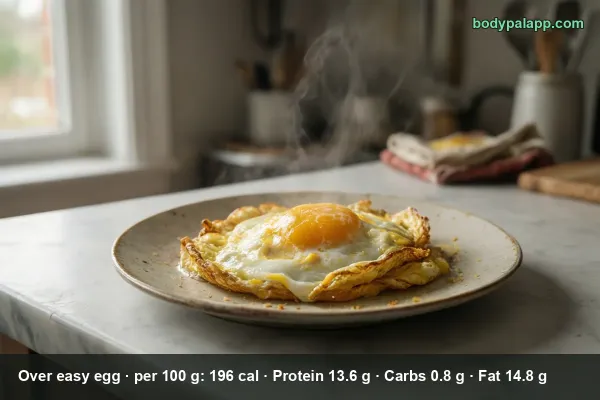
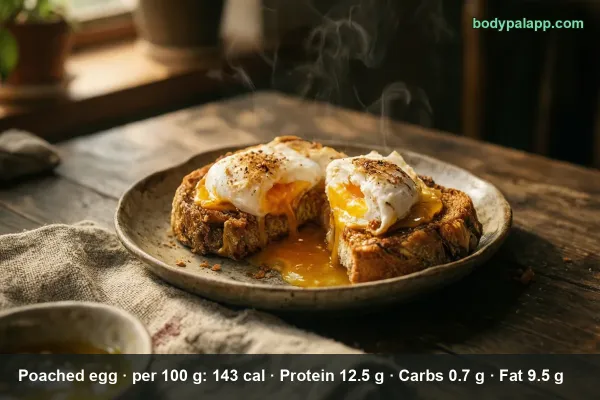
Here is how a fried egg stacks up against over easy, boiled and poached eggs, per 100 g and per usual serving.
Verdict: For the leanest egg, pick poached at 143 calories per 100 g or boiled at 155, both well under the 196 of fried and over easy. Poached carries the most sodium at 297 mg per 100 g, so if you watch salt, boiled with 124 mg is the cleaner choice.
Fried egg FAQs
How many calories are in one fried egg?
A large fried egg of 46 g is about 90 calories, from 196 calories per 100 g. An egg fried in butter at 55 g comes to 100 calories.
Is a fried egg good for weight loss?
One large fried egg is 90 calories with 6.3 g protein. Frying with no added fat brings a 50 g egg down to 72 calories.
Fried egg vs boiled egg: which has fewer calories?
A boiled egg is 155 calories per 100 g against 196 for a fried egg, a difference of 41 calories per 100 g from the cooking fat.
How much protein is in a fried egg?
A 46 g fried egg has 6.3 g protein, 6.8 g fat and 0.4 g carbs. Per 100 g that is 13.6 g protein and 14.8 g fat.
How many calories are in a 50 g fried egg?
A 50 g fried egg cooked with no added fat has 72 calories, with 6.2 g of protein and 5 g of fat. If it was fried in oil or butter, the calorie count rises, so log the matching entry.
How many carbs are in a fried egg?
One large fried egg has just 0.4 g of carbs, and 100 g has 0.8 g. Carbs supply only 2% of its calories, with 0.4 g of sugar per 100 g and no fiber.
How many calories are in two or three fried eggs?
Two large fried eggs have 180 calories and 12.5 g of protein. Three come to 270 calories and 18.8 g of protein, and five reach 451 calories with 31.3 g of protein.
What is the nutritional value of a fried egg per 100 g?
Per 100 g, a fried egg has 196 calories, 13.6 g of protein, 14.8 g of fat and 0.8 g of carbs. It also has 207 mg of sodium, 401 mg of cholesterol and 152 mg of potassium.
How many calories does frying in butter add to an egg?
An egg fried in butter comes to 100 calories for 55 g, against 72 for a 50 g egg fried with no added fat. Most of that gap is fat: 8.1 g versus 5 g.