
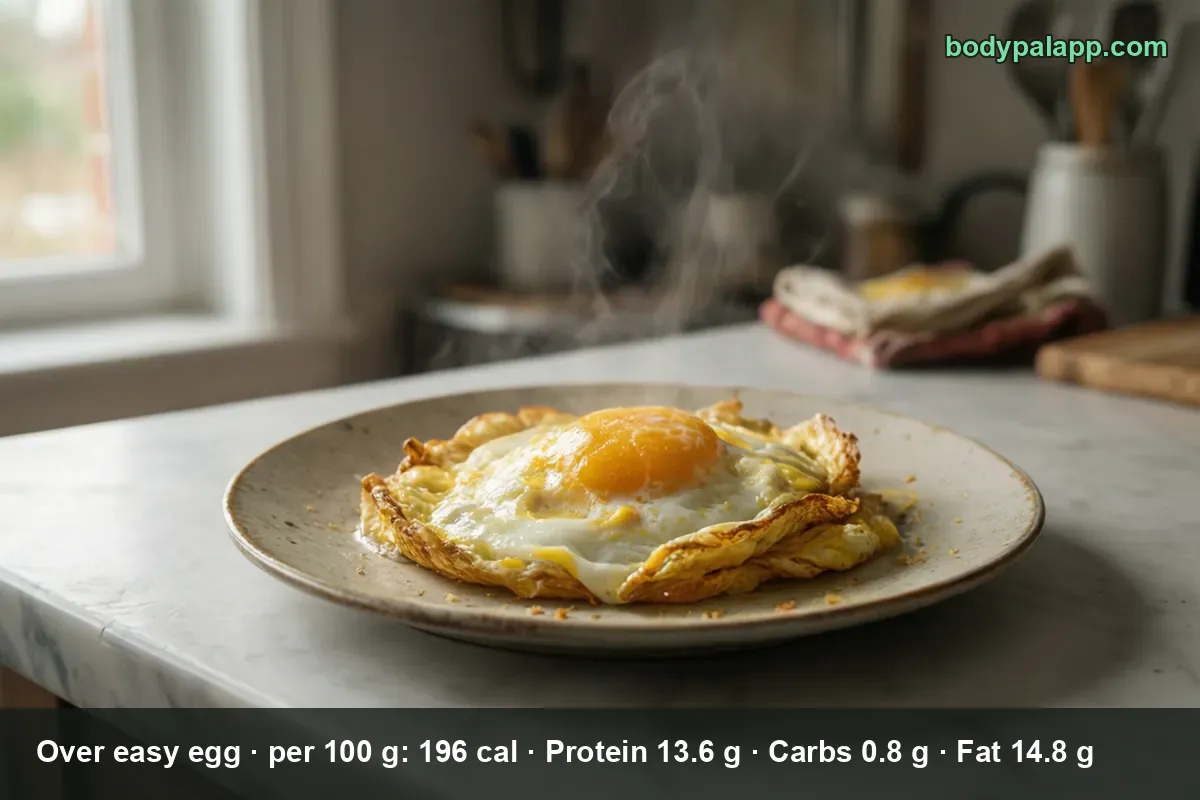
How many calories are in an over easy egg?
One large egg cooked over easy weighs 46 g and lands at 90 calories. Per 100 g the same fried egg runs 196 calories. Two on a plate come to 180. Most of that is fat, not protein: 6.8 g of fat against 6.3 g of protein in a single egg.
On this page
- Over easy egg quick facts
- US servings, from one ounce to a three-egg plate
- What you fry it in moves the number
- Over easy vs sunny side up
- Cholesterol is the row to watch
- How does an over easy egg compare?
- Most popular over easy egg brands
- Over easy egg FAQs
Over easy egg quick facts
Over easy is a whole egg cracked into a hot pan, flipped once, and pulled while the yolk is still liquid. USDA does not carry a record with "over easy" in the name, so the honest match is SR Legacy 173423, "Egg, whole, cooked, fried". It is the only fried-egg record with a household serving of one large egg, and it includes the small amount of fat that ends up in the pan.
That serving is 46 g, which is lighter than a raw large egg out of the shell (about 50 g). Frying drives off water. The record also carries 0.04 g of trans fat, low enough that it rounds to zero on a label.
| Nutrient | Per 100 g | Per 1 large fried egg (46 g) | % Daily Value |
|---|---|---|---|
| Calories | 196 | 90 | — |
| Total fat | 14.84 g | 6.8 g | 9% |
| Saturated fat | 4.32 g | 2.0 g | 10% |
| Carbohydrate | 0.83 g | 0.4 g | 0% |
| Dietary fiber | 0 g | 0 g | 0% |
| Total sugars | 0.4 g | 0.2 g | — |
| Protein | 13.61 g | 6.3 g | 13% |
| Sodium | 207 mg | 95 mg | 4% |
| Cholesterol | 401 mg | 184 mg | 61% |
| Potassium | 152 mg | 70 mg | 1% |
% Daily Value is based on a 2,000-calorie diet.
Verified nutrition data
Numbers on this page come from USDA FoodData Central, the U.S. Department of Agriculture’s food composition database, and from manufacturer labels where a branded product is named. Last verified September 2026. How we verify our data →
There is no added sugars row above because the SR Legacy edition does not publish that field at all, and a fried egg has no added sugar to declare. The 0.4 g of total sugars per 100 g is the trace of glucose that lives in egg white.
US servings, from one ounce to a three-egg plate
| Serving | Weight | Calories |
|---|---|---|
| 1 oz | 28.4 g | 56 kcal |
| One large egg, over easy | 46 g | 90 kcal |
| Two large eggs | 92 g | 180 kcal |
| Three large eggs | 138 g | 270 kcal |
| Per 100 g | 100 g | 196 kcal |
Only the one-egg line is a USDA household measure. The ounce, the two-egg and the three-egg rows are our own arithmetic from the USDA 100 g figure, not USDA servings, and they assume every egg comes out of the pan at the same weight.
That assumption is where kitchen reality bites. A jumbo egg is roughly 20 percent heavier than a large one, so a two-egg breakfast made with jumbos lands nearer 216 calories than 180 on our own scaling of the USDA figure. If you buy by carton size, log by carton size.
The other trap is the diner plate. Two eggs over easy almost never arrive alone; they arrive with toast, hash browns, or bacon, and those add far more than the eggs do. Together those sides usually outweigh the eggs.
What you fry it in moves the number
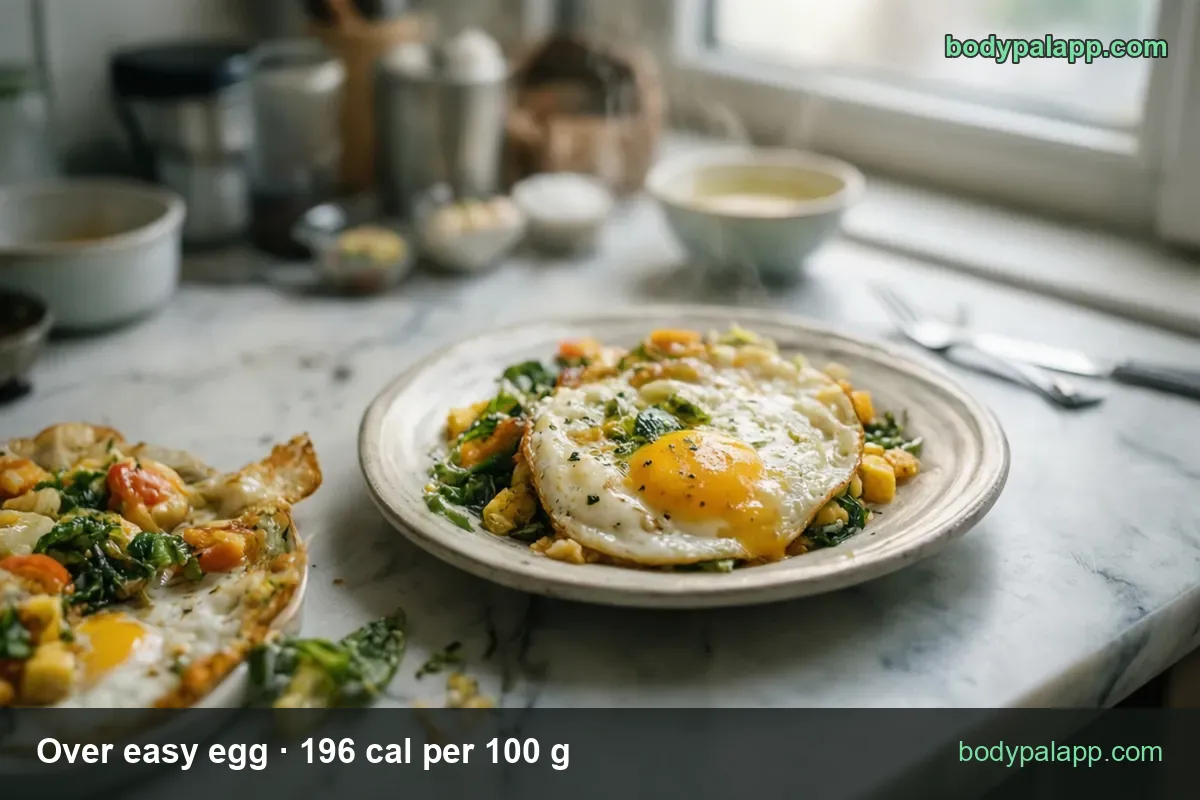
USDA splits fried eggs by the fat in the pan, and the spread is wider than most people expect. Each row below is its own record, weighed with the cooking fat included.
| Version | Per 100 g | Typical egg | Calories |
|---|---|---|---|
| Fried in oil | 192 kcal | 1 egg, 55 g | 106 kcal |
| Fat not specified | 185 kcal | 1 egg, 55 g | 102 kcal |
| Fried in butter | 182 kcal | 1 egg, 55 g | 100 kcal |
| Fried in margarine | 171 kcal | 1 egg, 55 g | 94 kcal |
| Cooked with cooking spray | 149 kcal | 1 egg, 50 g | 75 kcal |
| No added fat | 143 kcal | 1 egg, 50 g | 72 kcal |
The margarine and cooking-spray servings are our own arithmetic from the USDA 100 g figures rather than published household portions; the other four come straight from the records.
Read the top and bottom rows together and the whole page falls into place. An egg fried in oil is 106 calories; the same egg cooked dry in a nonstick pan is 72. Roughly 34 calories, a third of the total, come from the pan and not the egg. That is the single most useful thing to know about this breakfast.
Butter and oil are not far apart on calories, but they are apart on saturated fat: the butter record carries 5.96 g per 100 g against 3.85 g for oil, even though the oil record has more total fat. Swapping butter for oil trims saturated fat without trimming much energy.
One packaged version exists too. The Sunny Fresh frozen over easy egg patty runs 150 calories per 100 g, and one 40 g patty is 60 calories. It is a foodservice product rather than a supermarket item, but the number is a fair stand-in for a fast-food breakfast egg.
Over easy vs sunny side up
There is no calorie difference worth logging: sunny side up has no separate USDA record, and both are one whole egg cooked in a shallow layer of fat. The flip in over easy sets the white on top; it does not add or remove anything. Use the same 90 calories for a 46 g egg either way.
The same logic covers over medium and over hard. A firmer yolk is a longer cook, not a different food. Only two things actually change the number: how much fat goes into the pan, and how big the egg was to begin with.
Basted eggs are the one exception. If a cook spoons hot butter or bacon fat over the top, that fat stays on the egg, and the butter record at 100 calories per egg is the closer match than the 90 above.
Cholesterol is the row to watch
A single over easy egg carries 184 mg of cholesterol, which is 61% of the FDA Daily Value of 300 mg. Two eggs put you at 368 mg, past the full day's reference before 9 a.m. Nothing else on a normal breakfast plate comes close to that density.
Saturated fat is the quieter number. Two eggs over easy give 4.0 g, about 20% of the 20 g DV, and that climbs if the pan had butter in it. If you are watching saturated fat, the oil or cooking-spray version is the better pick.
Protein is the row people overestimate. At 6.3 g per egg, an over easy egg covers 13% of the 50 g Daily Value, so a two-egg breakfast is 12.6 g. MyPlate counts one egg as a single ounce-equivalent of protein foods. Eggs are a fine protein source by quality; they are simply not a large one by quantity.
Carbs are close to nothing. Per 46 g egg you get 0.4 g of carbohydrate and no fiber, which is why over easy eggs slot into low-carb eating without any arithmetic. The Dietary Guidelines treat eggs as a protein food, not a fat, even though the fat gram count in one egg beats the protein gram count.
How does an over easy egg compare?
| Version | Per 100 g | US serving | Calories |
|---|---|---|---|
| Over easy, USDA fried egg | 196 kcal | one large egg, 46 g | 90 kcal |
| Fried with oil | 192 kcal | one egg, 55 g | 106 kcal |
| Fried with butter | 182 kcal | one egg, 55 g | 100 kcal |
| Fried, no added fat | 143 kcal | one egg, 50 g | 72 kcal |
Our take: the 196 figure is the highest per 100 g of the fried-egg records USDA publishes, because it is the driest — less pan fat, less water, more egg per gram. Per actual egg, though, it is one of the lighter options, since the FNDDS eggs are weighed at 50 to 55 g with their cooking fat attached. For cutting calories, cook dry or with spray and log 72 to 75 per egg. For a breakfast that holds you, two eggs at 180 plus something with fiber beats three eggs at 270 on its own.
Most popular over easy egg brands in the United States
Ranked by how widely each product appears among foods sold in the United States, from the BodyPal food database of over 3.3 million products. Calories are the figures printed on each Nutrition Facts label, checked against USDA FoodData Central.
| Product | Calories (per 100 g) |
|---|---|
| Sunny Fresh Fried Over Easy Egg Patty | 150 cal |
Brand popularity: BodyPal food database. Nutrition: manufacturer labels / USDA FoodData Central.
Over easy egg FAQs
How many calories are in an over easy egg?
90 calories for one large egg of 46 g, based on the USDA fried egg record at 196 calories per 100 g. That covers the egg plus the small amount of fat it picks up in the pan. Cooked dry with no added fat, the same egg is 72 calories.
How many calories in 2 over easy eggs?
180 calories for two large eggs at 92 g total, which is our own arithmetic from the USDA 100 g figure rather than a published serving. That plate also carries 13.6 g of fat, 12.6 g of protein and 368 mg of cholesterol. Fried in oil instead, two eggs reach 212.
How much protein is in an over easy egg?
6.3 g of protein in one 46 g egg, or 13% of the 50 g Daily Value. Per 100 g the figure is 13.61 g. Two eggs give 12.6 g, which is less than most people assume for a breakfast that is often called high protein. The fat, at 6.8 g per egg, outweighs it.
Over easy vs sunny side up: is there a calorie difference?
No meaningful difference: both are 90 calories for a 46 g egg. USDA publishes no separate record for sunny side up, because flipping the egg changes only how set the white is. What does change the number is the fat in the pan, which ranges from 143 to 196 calories per 100 g.
Does an over easy egg have carbs?
0.4 g of carbohydrate in one 46 g egg, and zero fiber. Per 100 g the figure is 0.83 g. That is a trace of glucose in the white, not enough to shift any daily target, and it works out to 0% of the 275 g Daily Value for carbohydrate.
How much cholesterol is in an over easy egg?
184 mg in one 46 g egg, which is 61% of the FDA Daily Value of 300 mg. Per 100 g the fried egg carries 401 mg. Two eggs over easy come to 368 mg, past the full reference amount, and almost all of it sits in the yolk rather than the white.
How many calories in an over easy egg fried in butter?
100 calories for one egg of 55 g, from the USDA record for eggs fried with butter at 182 calories per 100 g. Butter shows up less in the calorie count than in the saturated fat: 5.96 g per 100 g against 3.85 g for the same egg fried in oil.
Is an over easy egg keto friendly?
Yes, at 0.4 g of carbohydrate per 46 g egg. The 90 calories are almost entirely fat and protein, with 6.8 g of fat to 6.3 g of protein. Cooked in butter the egg is 100 calories and fattier still, which suits a low-carb plate but not a low-calorie one.
Similar foods
- Omelet — 305 cal for 3-egg omelet
- Crepe — 179 cal per crepe
- Egg — 72 cal per large egg
- Pancake — 423 cal for 3 medium pancakes
- Toast with butter — 100 cal per slice with butter
- Fish Cake — 180 cal per cake or patty
Count it without the math
Point the camera at the plate and BodyPal counts the eggs, pan fat and all.


How long does it take to burn off 90 kcal of over easy egg?
One large fried egg (46 g) is 90 kcal. Enter your weight and the amount you ate to see how long it takes you to burn that off:
lb
| Activity | Time to burn 90 kcal |
|---|---|
| Walking, brisk | 18 min |
| Cycling, moderate | 11 min |
| Swimming, moderate | 13 min |
| Jogging | 11 min |
| Weight training, moderate | 20 min |
Times are for a 155 lb adult at a steady pace; change the weight to see yours. The amount is set to the portion in the text (46 g); change it to what you actually ate. BodyPal works this out from your steps automatically.
Burning it off is one side of it. The other is knowing your number: work out how many calories you need a day, with macros and a goal date.