
How many calories are in a fish sandwich?
A regular fried fish sandwich on a white bun weighs 130 g and carries 307 calories. Per 100 g that is 236 calories. The fillet is the small part of the total: the bun, the batter and the tartar sauce do most of the work, which is why a grilled sandwich of the same weight lands at 234.
On this page
- Fish sandwich quick facts
- US servings, from a slider to a submarine
- Grilled instead of fried
- Cheese slices, wheat buns and the fast-food row
- Sodium is the row to watch
- How does a fish sandwich compare?
- Most popular fish sandwich brands
- Fish sandwich FAQs
Fish sandwich quick facts
When an American types "calories in fish sandwich," the thing in their hand is almost always a breaded fillet in a soft white bun with a smear of tartar sauce. The USDA record that matches it is FNDDS 2707027, "Fish sandwich, fried, on white bun", and it comes with a ready household portion of one regular sandwich at 130 g. That is the baseline for this page.
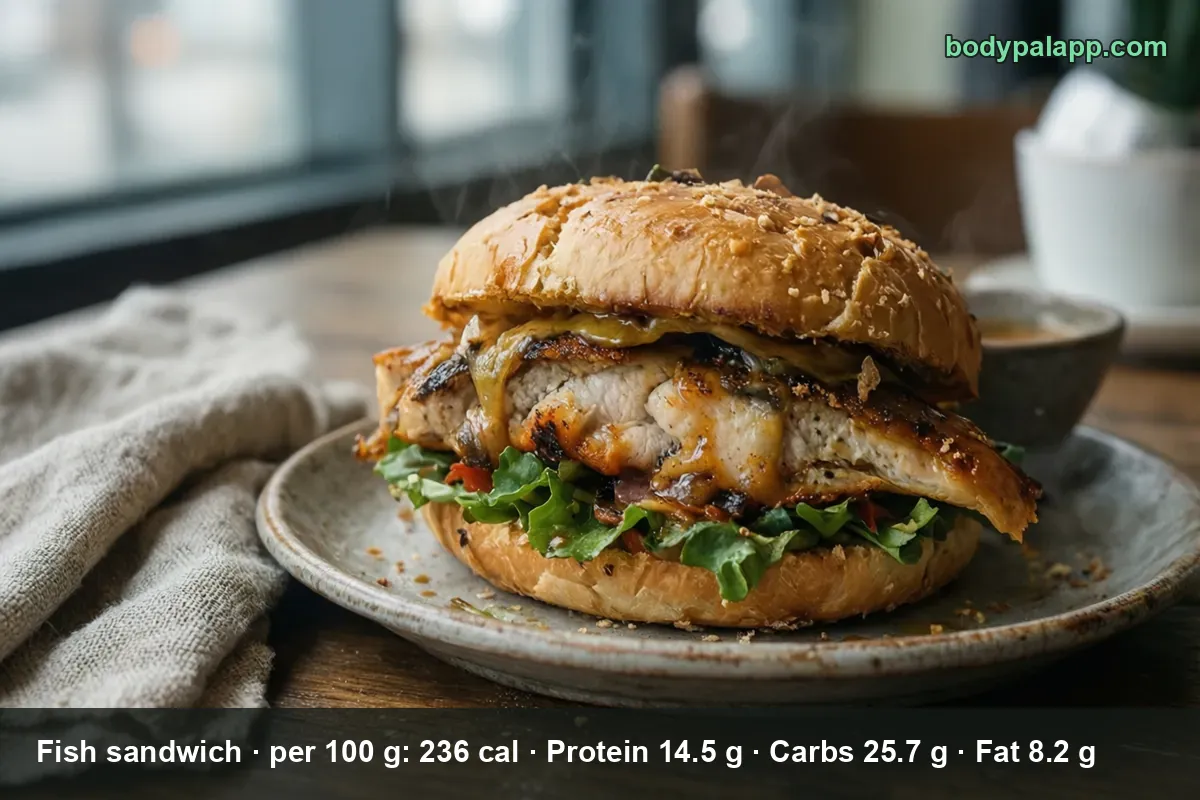
The photo at the top of the page shows a grilled fillet rather than a battered one, and grilled is a genuinely different number. It gets its own section below, with the record behind it. Eight FNDDS fish-sandwich records are compared on this page; four of them come in under the fried white-bun baseline per 100 g and three come in above it.
| Nutrient | Per 100 g | Per 1 regular sandwich (130 g) | % Daily Value |
|---|---|---|---|
| Calories | 236 | 307 | — |
| Total fat | 8.16 g | 10.6 g | 14% |
| Saturated fat | 2.43 g | 3.2 g | 16% |
| Carbohydrate | 25.74 g | 33.5 g | 12% |
| Dietary fiber | 0.9 g | 1.2 g | 4% |
| Total sugars | 3.13 g | 4.1 g | — |
| Protein | 14.48 g | 18.8 g | 38% |
| Sodium | 403 mg | 524 mg | 23% |
% Daily Value is based on a 2,000-calorie diet.
Verified nutrition data
Numbers on this page come from USDA FoodData Central, the U.S. Department of Agriculture’s food composition database, and from manufacturer labels where a branded product is named. Last verified September 2026. How we verify our data →
Two rows you would see on a wrapper are missing here: added sugars and trans fat. FNDDS does not publish either value for composite dishes, so listing them would mean inventing them. Cholesterol and potassium do exist in the record: 34 mg and 230 mg per 100 g, which works out to 44 mg of cholesterol (15% DV) and 299 mg of potassium (6% DV) in one regular sandwich.
The protein line is the one worth staring at. At 18.8 g, a single sandwich covers 38 percent of the 50 g Daily Value the FDA sets for protein, which is a lot of mileage for 307 calories.
US servings, from a slider to a submarine
USDA lists four real sandwich sizes for this record, and they are far apart. A slider is a quarter of a large sandwich.
| Serving | Weight | Calories |
|---|---|---|
| 1 oz | 28.4 g | 67 kcal |
| One miniature or slider | 65 g | 153 kcal |
| One regular sandwich | 130 g | 307 kcal |
| One large sandwich | 260 g | 614 kcal |
| One submarine-style sandwich | 260 g | 614 kcal |
| Per 100 g | 100 g | 236 kcal |
Everything except the 1 oz line is a USDA household measure. The ounce is our own arithmetic from the USDA 100 g figure, not a USDA serving, and it is mostly useful for weighing leftovers.
The trap in this list is the large sandwich. It is not "a bit bigger" than the regular one, it is exactly double: 260 g against 130 g, 614 calories against 307. A deli or diner fish sandwich built on a long roll falls into the same bracket as the submarine line, and that single choice moves more calories than switching from fried to grilled ever will.
If you are logging by eye rather than by scale, the useful anchor is that a standard fast-food-style sandwich is roughly the weight of a deck-and-a-half of cards plus the bun, and that is the 130 g line.
Grilled instead of fried

The grilled record, FNDDS 2707031, is 180 calories per 100 g. At the same 130 g regular size that is 234 calories, a saving of 73 against the fried sandwich for an identical amount of food in your hand.
Fat is where the gap opens: 3.29 g per 100 g grilled against 8.16 g fried, or 4.3 g against 10.6 g per sandwich. Saturated fat falls to about 1.0 g, a twentieth of the daily allowance. Protein moves the other way and climbs to 16.06 g per 100 g, the highest of all eight fish-sandwich records, because there is no batter diluting the fillet.
That combination — lowest calories, highest protein, lowest sodium of the eight — makes grilled the outlier of the group rather than a modest improvement. If you want the sandwich to behave like a protein meal instead of a fried lunch, this is the version to order.
Cheese slices, wheat buns and the fast-food row
A cheese slice does two things at once, and only one of them is obvious. It raises the calories per gram, and it also makes the sandwich heavier: the USDA serving for the cheese versions is 151 g rather than 130 g.
| Version | Per 100 g | Regular sandwich | Calories |
|---|---|---|---|
| Grilled | 180 kcal | 130 g | 234 kcal |
| Fried, wheat bun | 229 kcal | 130 g | 298 kcal |
| Fried, white bun | 236 kcal | 130 g | 307 kcal |
| Fried, from fast food | 235 kcal | 130 g | 306 kcal |
| Fried, wheat bun, with cheese | 247 kcal | 151 g | 373 kcal |
| Fried, white bun, with cheese | 252 kcal | 151 g | 381 kcal |
The white-bun cheese record is 381 calories, 74 more than the plain sandwich. Saturated fat is the sharper change: 4.35 g per 100 g becomes 6.6 g in the serving, a third of the 20 g Daily Value from one sandwich.
The wheat bun is a smaller lever than people expect. At 298 calories it saves nine on the plain sandwich, which is noise. What it actually buys is fiber: 2.4 g per 100 g against 0.9 g, so 3.1 g per sandwich instead of 1.2 g. A school-cafeteria record also exists at 209 calories per 100 g with 3.5 g of fiber, the highest fiber of the group, which lands near 272 calories at 130 g by our own arithmetic from the 100 g figure.
Frozen fillets sold for home sandwiches are a separate product and are listed without a bun: US brands run roughly 184 to 212 calories per 100 g, so a single fillet lands between 130 and 190 calories before you add bread and sauce. One packaged full sandwich in the USDA branded data is 256 calories per 100 g, or 340 for its 133 g serving.
Sodium is the row to watch
Calories are not what makes a fish sandwich a heavy choice. Sodium is. One regular sandwich carries 524 mg, 23 percent of the 2,300 mg Daily Value, which is about a quarter teaspoon of table salt sitting inside a lunch that most people follow with fries.
The restaurant version is worse. The fast-food record holds 462 mg per 100 g, so the same 130 g sandwich reaches 601 mg, 26 percent of the day. The unspecified FNDDS row is saltiest at 537 mg per 100 g, close to 698 mg for a regular sandwich, and adding the cheese slice takes the white-bun version to 735 mg, roughly a third of the daily allowance from one item.
The Dietary Guidelines for Americans put the limit at 2,300 mg a day, and sandwiches are one of the largest single sources of sodium in the American diet. The grilled record is the low end of the group at 379 mg per 100 g, or 493 mg per sandwich. If you are watching sodium rather than calories, grilled and no cheese is the pick, and the fries matter more than the fillet.
How does a fish sandwich compare?
Seafood sandwiches cluster tightly. Once bread and a creamy sauce are involved, the filling barely separates them.
| Sandwich | Per 100 g | US serving | Calories |
|---|---|---|---|
| Fish sandwich, fried, white bun | 236 kcal | one regular, 130 g | 307 kcal |
| Tuna salad sandwich on wheat | 217 kcal | one regular, 130 g | 282 kcal |
| Crab cake sandwich | 231 kcal | one regular, 130 g | 300 kcal |
| Fried seafood sandwich | 234 kcal | one regular, 130 g | 304 kcal |
The 130 g servings for the three neighbors are our own arithmetic from their USDA 100 g figures, matched to the fish sandwich so the comparison is fair.
Our take: the four are within 25 calories of each other, so picking between them on calories alone is pointless. Protein is where they split. The fish sandwich delivers 14.48 g per 100 g against 10.52 g for tuna salad, and the tuna sandwich carries 11.89 g of fat per 100 g against 8.16 g, because mayonnaise is the binder rather than a coating. For weight loss, order the grilled fish sandwich at 234 calories and skip the cheese. For a lunch that keeps you full through the afternoon, the fried fish sandwich at 307 calories and 18.8 g of protein is the better trade than any of its neighbors, as long as the fries stay off the tray. MyPlate counts a fillet like this toward the protein group either way.
Most popular fish sandwich brands in the United States
Ranked by how widely each product appears among foods sold in the United States, from the BodyPal food database of over 3.3 million products. Calories are the figures printed on each Nutrition Facts label, checked against USDA FoodData Central.
| Product | Calories (per 100 g) |
|---|---|
| Gorton's Fish Sandwich Fillets (fillet only) | 192 cal |
| Gorton's Golden Crispy Panko Fish Sandwich Fillets (fillet only) | 200 cal |
| Trident Seafoods The Alaskan Fish Sandwich Fillets (fillet only) | 184 cal |
| Pinnacle Foods Fish Sandwich Fillets (fillet only) | 212 cal |
| Maple View Farms Fish Sandwich | 256 cal |
Brand popularity: BodyPal food database. Nutrition: manufacturer labels / USDA FoodData Central.
Fish sandwich FAQs
How many calories are in a fish sandwich?
A regular fried fish sandwich on a white bun is 307 calories at 130 g, or 236 calories per 100 g. That is the FNDDS record for the fast-food style fillet most people picture. A grilled sandwich of the same size drops to 234, and a slider at 65 g is 153.
How many calories in a grilled fish sandwich?
A grilled fish sandwich is 234 calories for a regular 130 g sandwich, or 180 per 100 g. It carries 4.3 g of fat against 10.6 g in the fried version and slightly more protein at 20.9 g, because the batter and the fryer oil are the difference, not the fish itself.
How many calories in a fish sandwich with cheese?
A fried fish sandwich with a cheese slice on a white bun is 381 calories. The slice adds fat and weight at the same time, since the USDA serving grows from 130 g to 151 g. Saturated fat reaches 6.6 g, a third of the Daily Value, and sodium reaches 735 mg.
How much protein is in a fish sandwich?
A regular fish sandwich has 18.8 g of protein, 38 percent of the 50 g Daily Value, from 14.48 g per 100 g. The grilled version does better at 20.9 g per sandwich. Both beat a tuna salad sandwich, which holds 10.52 g of protein per 100 g.
How many carbs are in a fish sandwich?
A regular fish sandwich has 33.5 g of carbohydrate, 12 percent of the Daily Value, including 4.1 g of total sugars and 1.2 g of fiber. Nearly all of it is the bun. A wheat-bun version of the same weight has 30.9 g of carbs and 3.1 g of fiber.
How much sodium is in a fish sandwich?
A regular fish sandwich has 524 mg of sodium, 23 percent of the 2,300 mg Daily Value and roughly a quarter teaspoon of table salt. The fast-food record is saltier at 601 mg, and the unspecified FNDDS row reaches 698 mg per 130 g. Grilled is lowest at 493 mg.
Does a wheat bun make a fish sandwich lower in calories?
Barely. A fried fish sandwich on a wheat bun is 298 calories per 130 g against 307 on a white bun, a nine-calorie gap that decides nothing. The real change is fiber: 3.1 g instead of 1.2 g per sandwich, with 495 mg of sodium instead of 524 mg.
How many calories in a fish sandwich without tartar sauce?
FNDDS does not publish a sauce-free fish sandwich record, so there is no exact figure to quote. The closest lower-fat entry is the grilled sandwich at 234 calories per 130 g with 4.3 g of fat. Since tartar sauce is mostly mayonnaise, leaving it off moves a fried sandwich toward that number.
Similar foods
- Chicken — 203 cal for 3 oz roasted
- Roast Chicken — 203 cal per 3 oz
- Beef brisket — 208 cal per thick slice
- Tempura shrimp — 109 cal for 6 large shrimp
- Asada taco — 243 cal per taco
- Top Sirloin Steak — 413 cal per 6 oz steak
Count it without the math
Point the camera at the tray and BodyPal counts the sandwich for you, bun, batter and sauce included.


How long does it take to burn off a fish sandwich?
One regular sandwich (130 g) is 307 kcal. Enter your weight and the amount you ate to see how long it takes you to burn that off:
lb
| Activity | Time to burn 307 kcal |
|---|---|
| Walking, brisk | 1 hr 1 min |
| Cycling, moderate | 38 min |
| Swimming, moderate | 44 min |
| Jogging | 36 min |
| Weight training, moderate | 1 hr 8 min |
Times are for a 155 lb adult at a steady pace; change the weight to see yours. The amount is set to the portion in the text (130 g); change it to what you actually ate. BodyPal works this out from your steps automatically.
One food is easy to picture; a whole day is harder. See how many calories you need a day and what a deficit actually looks like.