
How many calories in French bread?
A medium slice of French bread weighs 64 g and carries 174 calories. Cut it thick at 96 g and you are eating 261. Cut it thin at 32 g and it drops to 87. Per 100 g the loaf runs 272 calories, and the calories in French bread barely shift between one shape of loaf and another, so the number on your plate is settled by the knife rather than by the bakery.
On this page
- French bread quick facts
- US serving sizes, slice by slice
- The baguette and the store loaf are the same bread
- Whole wheat, toasted, and what each one changes
- Sodium is the row that outruns the calories
- How does French bread compare?
- Most popular french bread brands
- FAQ
French bread quick facts
The reference record is SR Legacy 172675, "Bread, french or vienna (includes sourdough)". That parenthesis matters, and we come back to it below. The serving column is one medium slice, the 64 g cut USDA treats as regular.
| Nutrient | Per 100 g | Per 1 medium slice (64 g) | % Daily Value |
|---|---|---|---|
| Calories | 272 | 174 | — |
| Total fat | 2.42 g | 1.5 g | 2% |
| Saturated fat | 0.53 g | 0.3 g | 2% |
| Carbohydrate | 51.88 g | 33.2 g | 12% |
| Dietary fiber | 2.2 g | 1.4 g | 5% |
| Total sugars | 4.62 g | 3.0 g | — |
| Protein | 10.75 g | 6.9 g | 14% |
| Sodium | 602 mg | 385 mg | 17% |
% Daily Value is based on a 2,000-calorie diet.
Verified nutrition data
Numbers on this page come from USDA FoodData Central, the U.S. Department of Agriculture’s food composition database, and from manufacturer labels where a branded product is named. Last verified September 2026. How we verify our data →
There is no added sugars line here, and that absence is honest rather than convenient. USDA does not report an added sugars figure for this record in the current release, so the 3.0 g in a slice cannot be split into what the flour brought and what the baker stirred in. Total sugars carry no Daily Value on a US label either, which is why that percentage cell stays blank.
Two more numbers sit outside the label rows. Cholesterol is 0 mg, as it is in any lean yeast bread. Potassium is 117 mg per 100 g, so 75 mg in a slice, which is 2% of the day.
The shape of this bread is a carbohydrate shape. Multiply 51.88 g of carbohydrate by four calories a gram and you get 207 of the 272 calories in 100 g, roughly three quarters of the loaf. Fat is almost a rounding error at 2.42 g, and only 0.53 g of that is saturated. What the bread does not give back is fiber: 2.2 g per 100 g is 8% of the FDA Daily Value of 28 g, and a single slice returns 5%.
US serving sizes, slice by slice
| Serving | Weight | Calories |
|---|---|---|
| 1 snack-size slice | 10 g | 27 |
| 1 slice, Vienna bread | 28 g | 76 |
| 1 oz | 28.35 g | 77 |
| 1 slice, crust not eaten | 31 g | 84 |
| 1 thin (small) slice | 32 g | 87 |
| 1 cup, cubed or torn | 45 g | 122 |
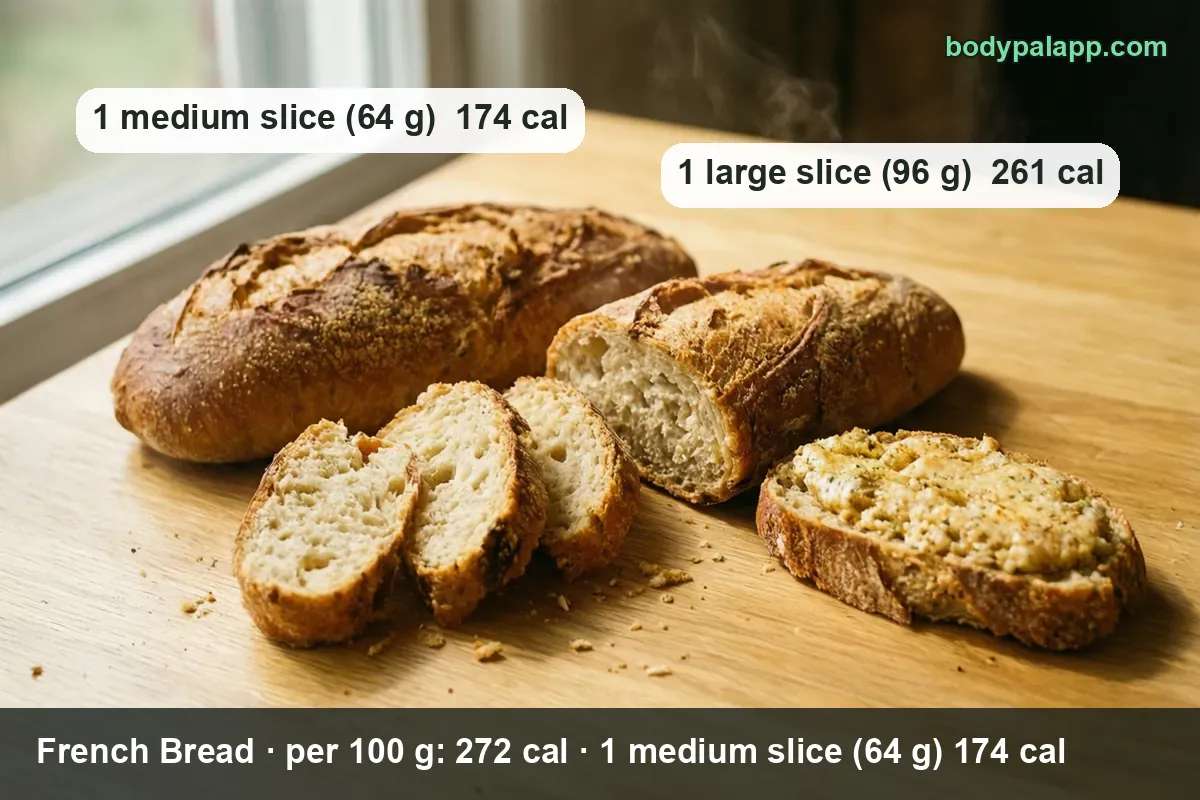
| 1 medium (regular) slice | 64 g | 174 |
| 1 individual loaf | 82 g | 223 |
| 1 large (thick) slice | 96 g | 261 |
| 100 g | 100 g | 272 |
| 1 mini baguette, about 9 inches | 152 g | 413 |
| 1 baguette, about 22 inches | 324 g | 881 |
| 1 loaf, 14 inches | 470 g | 1278 |
Here is the first thing worth taking away: "a slice of French bread" is not one number, it is three. The thin slice, the regular slice and the thick slice are 32 g, 64 g and 96 g in USDA's own household weights, which makes the thick slice exactly three times the thin one. Log a bread basket by the piece and a rustic end cut can cost you 261 calories where you assumed 87.
The gram weights above come from the FNDDS record 2707610, the identical twin of our SR Legacy row. Both carry the same 272 calories and the same 10.75 g of protein down to the last decimal, so it makes no difference to the math which fdc_id you cite. It only matters for the measures: SR Legacy lists just an ounce and one 139 g "slice", which is a wedge hacked off a big country loaf and not what anybody means by a slice. That 139 g piece would be 378 calories on its own, which is why it stays out of the table.
The cup row is the one most people never think to weigh. Bread cubed or torn for stuffing, croutons or a strata packs down to 45 g a cup, so a recipe calling for four cups is putting 488 calories of bread into the dish before the butter arrives, which is our own multiplication of the 122-calorie cup rather than a USDA serving.
The baguette and the store loaf are the same bread
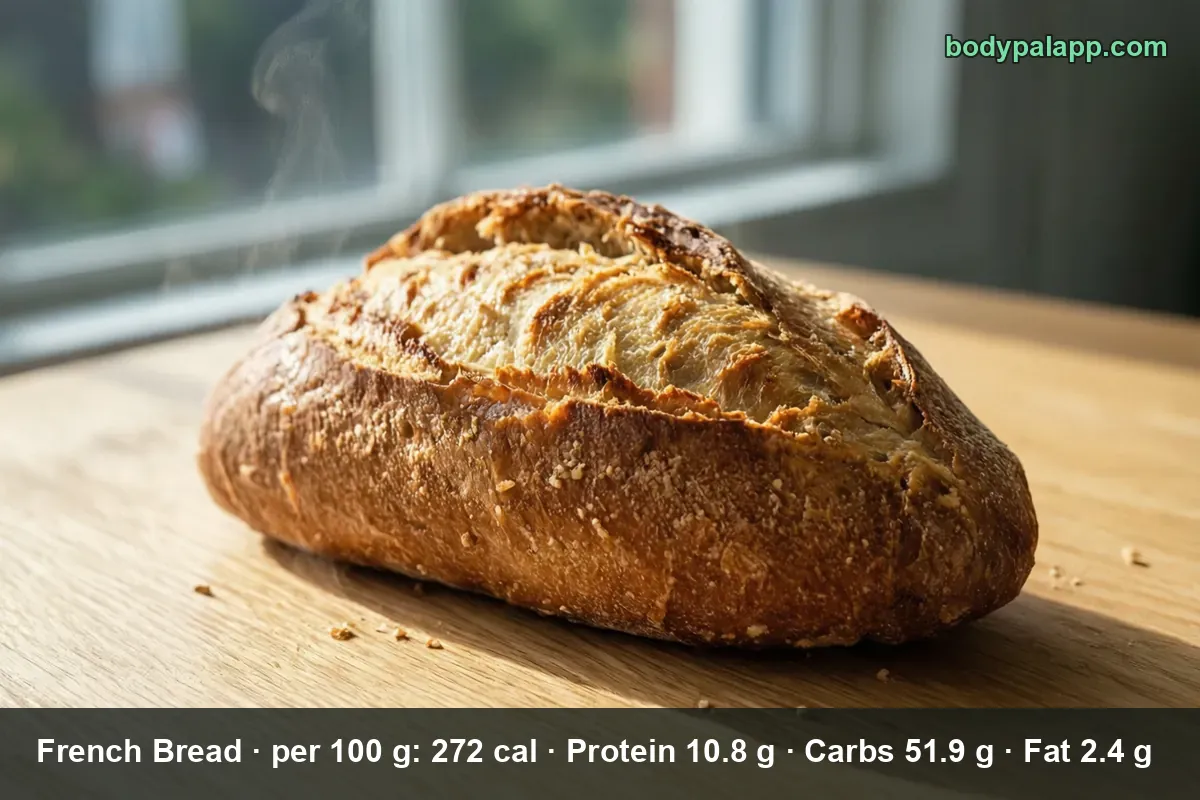
The photograph at the top of this page is a thick oval loaf with slashes across the crust, and for a fair share of American shoppers that is not what "French bread" brings to mind. In a US supermarket the bag labeled French bread usually holds exactly this: a broad, soft-crumbed oblong or oval loaf, closer to Vienna bread than to anything you would carry home under your arm in Paris. USDA writes them into one record for that reason.
The skinny baguette is not a different food nutritionally. It is the same 272 calories per 100 g. What changes is that a baguette is sold as a unit and eaten as a unit, so the portion arithmetic gets brutal fast. A 9-inch mini baguette weighs 152 g and lands at 413 calories before a single thing is spread on it. The full 22-inch baguette is 324 g and 881 calories. The 14-inch supermarket loaf is heavier still at 470 g, or 1,278 calories for the bag.
Then there is the parenthesis in the record name. "Includes sourdough" means USDA has folded sourdough into this same row, and the separate FNDDS entry for sour dough bread reports the same 272 calories, 10.75 g of protein and 51.88 g of carbohydrate. Anyone swapping French bread for sourdough to save calories is trading one number for the identical number. Whatever the case for sourdough is, and there are arguments for it, calories are not part of it.
Whole wheat, toasted, and what each one changes
Whole wheat French bread (SR Legacy 174091) is 239 calories per 100 g, so a 64 g slice is 153 calories and an ounce is 68. That is 21 calories saved per slice, which is not the interesting part. The interesting part is that fiber nearly doubles, from 2.2 g to 4.2 g per 100 g, giving 2.7 g in a slice, or 10% of the day. Sodium falls at the same time, from 602 mg to 375 mg per 100 g, so a slice drops from 385 mg to 240 mg. Three improvements at once, for the price of a darker crumb. USDA reports total sugars as 0 g for this record, and no added sugars figure exists for it, so there is nothing to declare on the sugar side at all. MyPlate asks Americans to make at least half their grains whole grains, and this is one of the cheaper places to do it.
Toasted French bread (FNDDS 2707611) reads 299 calories per 100 g, and that number fools people constantly. Toasting does not add calories to bread. It drives off water, which makes every remaining gram denser. USDA is internally consistent about this: the same regular slice weighs 59 g after toasting instead of 64 g. Do the arithmetic and 59 g at 2.99 calories a gram is 176 calories, against 174 before it went in the toaster. Two calories, and those two are rounding, not browning. A thin toasted slice at 29 g is 87 and a thick one at 88 g is 263, which are the fresh numbers again in different clothing.
That correction is worth stating plainly because USDA carries a second toasted record, SR Legacy 174911, at 319 calories per 100 g. Applied to the same 59 g slice it would produce 188 calories, meaning a slice gained 14 calories in a toaster that added nothing to it. The FNDDS row is the one that reconciles, so it is the one used here. The FNDDS records used here do not report trans fat, so no trans fat line appears for the toasted variants; the SR Legacy rows do carry that field, at 0.01 g per 100 g for plain French bread and 0 g for whole wheat.
Whole wheat, toasted (FNDDS 2707729) closes the circle at 263 calories per 100 g, or 155 calories for a 59 g slice, with 4.6 g of fiber per 100 g and 412 mg of sodium.
Sodium is the row that outruns the calories
Calories are why people look up French bread. Sodium is the row that should hold their attention.
A medium slice is 174 calories, which is under 9% of a 2,000-calorie day. The same slice is 385 mg of sodium, 17% of the Daily Value of 2,300 mg. Per 100 g the mismatch is wider still: 26% of the day's sodium against 14% of the day's calories. Two slices with dinner, plain, nothing on them, spend 34% of a day's sodium.
Scale that to the loaf, our own multiplication of the 602 mg per 100 g, and it gets loud. The 14-inch supermarket loaf holds 2,829 mg of sodium across its 470 g, which is 123% of the Daily Value, more than a level teaspoon of table salt would deliver. A 22-inch baguette carries about 1,951 mg, or 85% of the day. Bread rarely tastes salty, which is precisely how it accumulates; the CDC points to breads and rolls as one of the largest single contributors of sodium in the American diet, and the Dietary Guidelines for Americans put the ceiling at 2,300 mg a day for adults.
If sodium is the number you are tracking, the whole wheat loaf is the practical move: 240 mg a slice instead of 385, a 38% cut, with more fiber for the trouble.
How does French bread compare?
Compared per 100 g and per slice, because the toasted loaf has its own slice weight and comparing it any other way would flatter it.
| Bread | Per 100 g | Slice | Calories per slice | Protein / carbs / fat per slice |
|---|---|---|---|---|
| French bread | 272 | 64 g | 174 | 6.9 / 33.2 / 1.5 g |
| Sourdough | 272 | 64 g | 174 | 6.9 / 33.2 / 1.5 g |
| White bread, bakery style | 272 | 64 g | 174 | 6.5 / 32.2 / 2.2 g |
| Whole wheat French bread | 239 | 64 g | 153 | 5.3 / 31.4 / 0.7 g |
| French bread, toasted | 299 | 59 g | 176 | 7.0 / 33.6 / 1.6 g |
Our take: three of these five breads are the same 174-calorie slice wearing different labels, so choosing between plain French bread, sourdough and bakery white on calories is choosing between identical options. The toasted row sits two calories away, which is rounding. The only row that moves for real is whole wheat, and it moves on the three things that actually matter in bread, giving 21 fewer calories, nearly double the fiber and 145 mg less sodium per slice.
Most popular french bread brands in the United States
Ranked by how widely each product appears among foods sold in the United States, from the BodyPal food database of over 3.3 million products. Calories are the figures printed on each Nutrition Facts label, checked against USDA FoodData Central.
| Product | Calories (per 100 g) |
|---|---|
| Stone House Bread Sweet Baguette French Bread | 281 cal |
| Stone House Bread Rustic Baguette French Bread | 281 cal |
| Marketside French Bread Traditional | 226 cal |
| Marketside French Bread Sesame Seed | 264 cal |
| Marketside Everything French Bread | 226 cal |
| Signature Select French Bread | 281 cal |
Brand popularity: BodyPal food database. Nutrition: manufacturer labels / USDA FoodData Central.
French bread FAQs
How many calories are in a slice of French bread?
174 calories for USDA's medium slice, which it weighs at 64 g. A thin slice at 32 g is 87 calories and a thick slice at 96 g is 261, so one word covers a three-fold range. Per 100 g French bread is 272 calories, with 33.2 g of carbohydrate and 6.9 g of protein in that medium slice.
How many calories are in a whole loaf of French bread?
1,278 calories for a 14-inch supermarket loaf weighing 470 g. A 22-inch baguette at 324 g is 881 calories, and a 9-inch mini baguette at 152 g is 413. The same loaf carries 2,829 mg of sodium, which is 123% of the 2,300 mg Daily Value.
How many carbs are in French bread?
33.2 g in a medium 64 g slice, which is 12% of the 275 g Daily Value, from 51.88 g per 100 g. Of that, 1.4 g is fiber and 3.0 g is sugars. Carbohydrate supplies about 207 of the 272 calories in 100 g of this bread, roughly three quarters of it.
Is French bread healthy?
It is a lean bread with a thin nutrition profile. A slice gives 6.9 g of protein and only 1.5 g of fat for 174 calories, but just 1.4 g of fiber, 5% of the day. Sodium is the weak row at 385 mg a slice, 17% of the Daily Value. The whole wheat version fixes both at once.
French bread or sourdough, which has fewer calories?
Neither. Both are 272 calories per 100 g and 174 per medium slice, with identical protein and carbohydrate. USDA's record is literally titled to include sourdough, and the separate sour dough entry reports the same figures. Any reason to prefer sourdough lies somewhere other than the calorie count.
How many calories are in whole wheat French bread?
153 calories for a 64 g slice, at 239 calories per 100 g. An ounce is 68. Beyond the 21 calories saved per slice, fiber rises from 2.2 g to 4.2 g per 100 g and sodium falls from 602 mg to 375 mg, so a slice drops to 240 mg of sodium instead of 385.
How many calories are in toasted French bread?
176 calories for a toasted medium slice. The per-100 g figure rises to 299 because toasting drives off water, but the slice itself falls from 64 g to 59 g, so the total barely moves from the 174 it started at. Toasting concentrates bread; it does not add anything to it.
How many calories are in a French baguette?
881 calories for a full 22-inch baguette at 324 g, and 413 for a 9-inch mini baguette at 152 g. The bread is the same 272 calories per 100 g as a store French loaf. Only the portion changes, because a baguette gets bought and eaten as one object rather than sliced from a larger loaf.
Similar foods
- Baguette — 413 cal per mini baguette
- Sourdough Bread — 84 cal per medium slice
- Cheese Bagel — 230 cal per bagel
- Dinner Roll — 76 cal per roll
- Cinnamon Raisin Bagel — 288 cal per medium bagel
- Spring Roll — 173 cal per spring roll
Count it without the math
Point the camera at the bread basket and BodyPal logs the slice, the sodium and the garlic butter without a scale.


How long does it take to burn off French bread?
A medium slice (64 g) is 174 kcal. Enter your weight and the amount you ate to see how long it takes you to burn that off:
lb
| Activity | Time to burn 174 kcal |
|---|---|
| Walking, brisk | 35 min |
| Cycling, moderate | 22 min |
| Swimming, moderate | 25 min |
| Jogging | 20 min |
| Weight training, moderate | 39 min |
Times are for a 155 lb adult at a steady pace; change the weight to see yours. The amount is set to the portion in the text (64 g); change it to what you actually ate. BodyPal works this out from your steps automatically.
One food is easy to picture; a whole day is harder. See how many calories you need a day and what a deficit actually looks like.