
How many calories are in a spring roll?
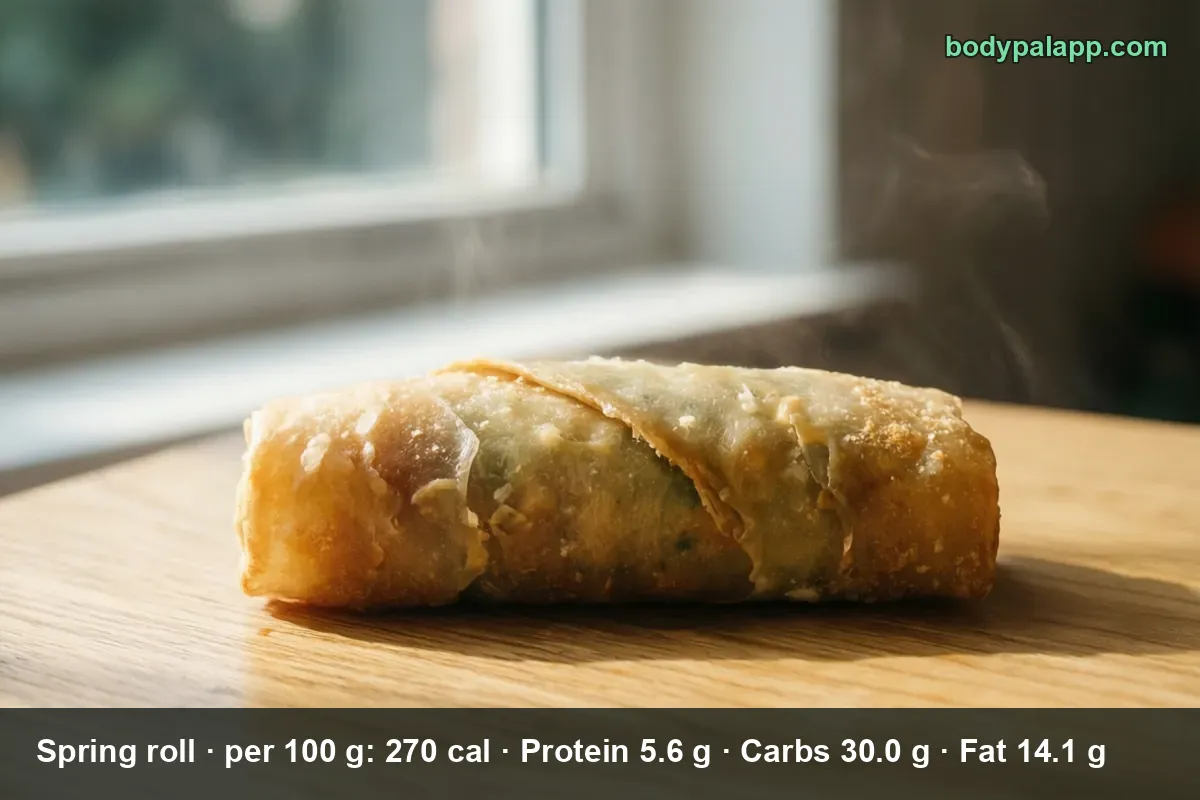
One fried spring roll of 64 g carries 173 calories, and per 100 g fried rolls run 270 calories. Two on a plate come to 346. The wrapper itself is thin and cheap in calories. It is the trip through hot oil that does most of the damage, and the filling barely moves the total.
On this page
- Spring roll quick facts
- US servings, from a mini roll to a plate of two
- What the filling does to the number
- Fried, frozen or still a wrapper
- Sodium is the row that beats fat
- How does a spring roll compare?
- Most popular spring roll brands
- Spring roll FAQs
Spring roll quick facts
The record used here is FNDDS 2708700, "Egg roll, meatless". That is the deliberate choice, and it needs a word of explanation: USDA does not keep a separate line called "spring roll." Fried rolls with a wheat wrapper are filed as egg rolls, and the meatless version is the one that matches what most takeout counters hand over as a vegetable spring roll. It is the finished, fried item, not a wrapper and not a frozen product waiting for the oven.
| Nutrient | Per 100 g | Per 1 spring roll (64 g) | % Daily Value |
|---|---|---|---|
| Calories | 270 | 173 | — |
| Total fat | 14.14 g | 9.0 g | 12% |
| Saturated fat | 2.08 g | 1.3 g | 7% |
| Carbohydrate | 30.02 g | 19.2 g | 7% |
| Dietary fiber | 2.3 g | 1.5 g | 5% |
| Total sugars | 5.63 g | 3.6 g | — |
| Protein | 5.62 g | 3.6 g | 7% |
| Sodium | 463 mg | 296 mg | 13% |
% Daily Value is based on a 2,000-calorie diet.
Verified nutrition data
Numbers on this page come from USDA FoodData Central, the U.S. Department of Agriculture’s food composition database, and from manufacturer labels where a branded product is named. Last verified September 2026. How we verify our data →
Two rows are missing on purpose. USDA does not publish added sugars or trans fat for this prepared-dish record, so there is nothing honest to put in those cells. Cholesterol is 0 mg, which is what you would expect from a meatless filling fried in vegetable oil, and potassium is 210 mg per 100 g, or 134 mg in one roll, 3% of the Daily Value. Total sugars have no Daily Value at all, which is why that cell shows a dash rather than a percentage.
US servings, from a mini roll to a plate of two
| Serving | Weight | Calories |
|---|---|---|
| 1 miniature spring roll | 13 g | 35 kcal |
| 1 oz | 28 g | 77 kcal |
| 3 miniature spring rolls | 39 g | 105 kcal |
| 1 spring roll | 64 g | 173 kcal |
| 2 spring rolls | 128 g | 346 kcal |
| Per 100 g | 100 g | 270 kcal |
Two of those weights come straight from USDA household measures: the full-size roll at 64 g and the cocktail-size roll at 13 g. The rest are our own arithmetic from the USDA 100 g figure, not USDA servings, which is worth knowing before you quote them.
Here is the trap nobody warns you about. The word "roll" on a menu covers a five-fold range. A tray of party rolls at a holiday buffet is 35 calories a piece, so four of them cost less than one full-size roll from the takeout container. Log by weight when you can, or at least decide which of the two shapes is on your plate. Getting that wrong is a bigger error than getting the filling wrong, by a wide margin.
What the filling does to the number
| Version | Per 100 g | Typical piece | Calories |
|---|---|---|---|
| Meatless (the main record) | 270 kcal | 1 roll (64 g) | 173 kcal |
| Pork or beef | 272 kcal | 1 roll (64 g) | 174 kcal |
| Chicken or turkey | 266 kcal | 1 roll (64 g) | 170 kcal |
| Shrimp | 258 kcal | 1 roll (64 g) | 165 kcal |
| Restaurant Chinese egg roll, assorted | 250 kcal | 1 oz (28 g) | 71 kcal |
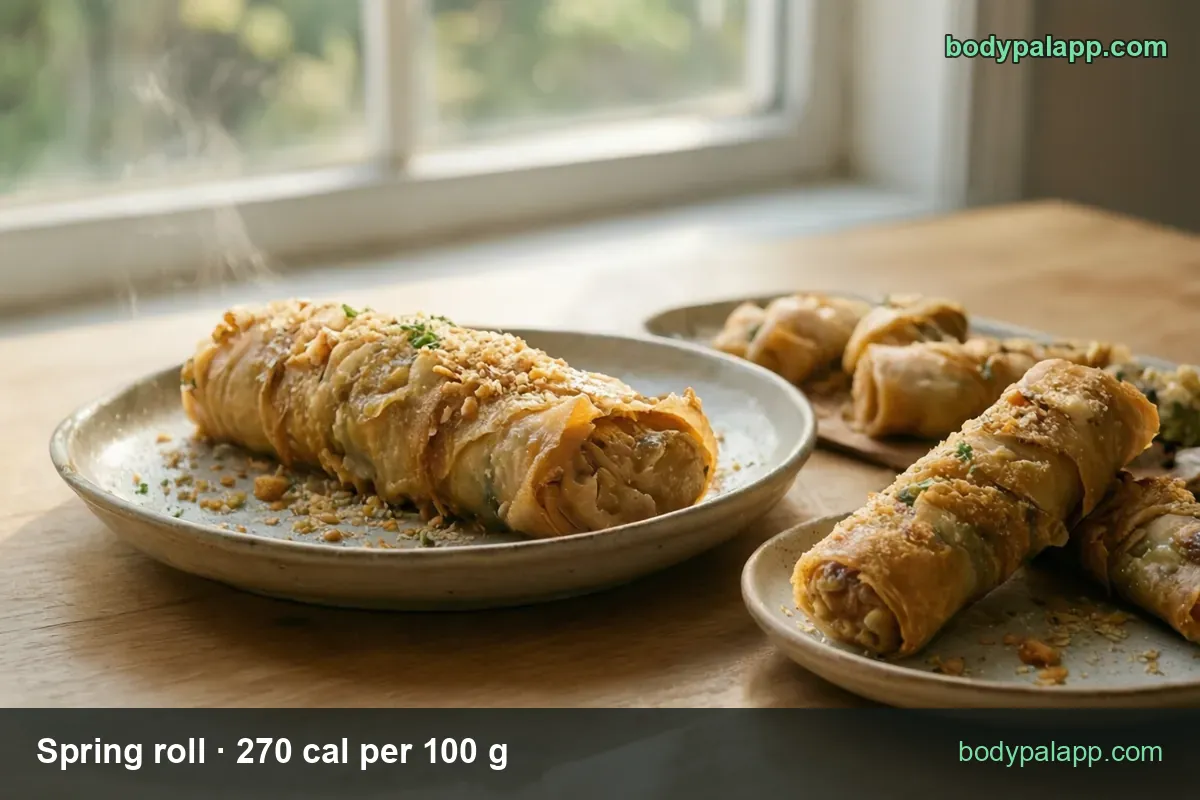
Across four fillings the spread is 165 to 174 calories per roll. Nine calories. That is less than the rounding error on most restaurant menus, and it means the vegetable roll is not the light option people assume it is. Skipping the pork saves you almost nothing, because the oil and the wrapper are doing the work.
What does change is protein. The meatless roll gives 5.62 g per 100 g; chicken or turkey pushes that to 7.59 g and pork or beef to 7.58 g, while shrimp sits at 6.68 g. If you are picking a roll to keep you full rather than to save calories, the meat fillings are the better buy at the same price in calories. Fiber goes the other way, slightly: 2.3 g per 100 g for meatless against 2.0 g for the meat versions.
The restaurant sample is listed by the ounce because portion sizes at Chinese-American restaurants are all over the map. At 250 calories per 100 g it is the leanest of the fried group, likely a mix of fillings and frying practices averaged together.
Fried, frozen or still a wrapper
| Version | Per 100 g | Typical piece | Calories |
|---|---|---|---|
| Fried, meatless | 270 kcal | 1 roll (64 g) | 173 kcal |
| Frozen vegetable roll, prepared without a fryer | 214 kcal | 1 roll (68 g) | 146 kcal |
| Egg roll wrapper, uncooked | 291 kcal | 1 oz (28 g) | 82 kcal |
This is the comparison that actually saves calories. Same vegetable filling, same wrapper, and the frozen roll finished in the oven lands at 214 calories per 100 g against 270 for the fried one. The 56-calorie gap per 100 g is oil, nothing else. Fat drops from 14.14 g to 6.97 g per 100 g at the same time, which is where you can see it happening.
Look at the wrapper row and the picture gets stranger. Raw egg roll wrapper is 291 calories per 100 g, denser than the finished fried roll, because it is dry flour dough with no vegetables in it yet. The filling dilutes the wrapper. The fryer then adds the fat back. Two opposite effects, roughly cancelling, which is why the finished roll looks so ordinary on the label.
Retail freezer brands land in the same neighborhood. Pagoda Vegetable Egg Rolls are 140 calories for one 87 g roll with its sauce packet, Pagoda Pork Egg Rolls 180 for a 78 g roll, and Health Is Wealth Vegetable Spring Rolls 70 calories for two small 45 g rolls. Read the serving weight on the box before you compare any of them to a takeout roll.
Sodium is the row that beats fat
Most people watch the fat line on a fried food. On a spring roll the sodium line moves first. One roll is 296 mg, or 13% of the FDA Daily Value of 2,300 mg, against 12% for total fat and 7% for saturated fat. In salt terms, that is roughly an eighth of a teaspoon of table salt per roll.
Two rolls take you to 592 mg, a quarter of the day, and that is before the little tub of sweet chili sauce, which runs around 1,611 mg of sodium per 100 g on its own. If you are watching sodium, the sauce is the thing to ration, not the roll.
The saturated fat number is genuinely mild: 1.3 g per roll, 7% of the Daily Value, because these are fried in vegetable oil rather than anything solid. So a spring roll is a salty, moderately fatty snack rather than a saturated-fat problem. Pairing it with vegetables and a lean protein, the way MyPlate frames a meal, turns two rolls from the meal into a side of it.
How does a spring roll compare?
| Roll | Per 100 g | US serving | Calories |
|---|---|---|---|
| Spring roll, fried, meatless | 270 kcal | one roll, 64 g | 173 kcal |
| Shrimp spring roll | 258 kcal | one roll, 64 g | 165 kcal |
| Pork roll, refrigerated, heated | 227 kcal | one roll, 85 g | 193 kcal |
| Frozen vegetable roll, prepared | 214 kcal | one roll, 68 g | 146 kcal |
Our take: the frozen vegetable roll wins on both counts, lightest per 100 g at 214 and lightest per piece at 146 calories, so if you are counting, keep a box in the freezer and skip the fryer. The refrigerated pork roll is the trap on this table. It is second-lowest per 100 g at 227 calories, yet the highest per serving at 193, purely because the roll is 85 g instead of 64. For fullness rather than a low number, that pork roll gives 9.94 g of protein per 100 g, nearly double the meatless one, and it earns its extra 20 calories.
Most popular spring roll brands in the United States
Ranked by how widely each product appears among foods sold in the United States, from the BodyPal food database of over 3.3 million products. Calories are the figures printed on each Nutrition Facts label, checked against USDA FoodData Central.
| Product | Calories (per 100 g) |
|---|---|
| Pagoda Egg Rolls | 211 cal |
| Pagoda Chicken Egg Rolls | 192 cal |
| Pagoda Pork Egg Rolls | 231 cal |
| Pagoda Vegetable Egg Rolls | 161 cal |
| Health Is Wealth Vegetable Spring Rolls | 156 cal |
| Spring Kitchen Vegetable Spring Rolls | 225 cal |
Brand popularity: BodyPal food database. Nutrition: manufacturer labels / USDA FoodData Central.
Spring roll FAQs
How many calories are in one spring roll?
One standard fried spring roll weighs 64 g and carries 173 calories, because the USDA record runs 270 calories per 100 g. A cocktail-size roll of 13 g is only 35 calories. Restaurant rolls vary a lot in size, so check what is actually on your plate before you log it.
How many calories are in 2 spring rolls?
Two full-size fried spring rolls come to 346 calories at 128 g total. That figure is our own arithmetic from the USDA 100 g number rather than a listed USDA serving. It is a light lunch on its own, before any rice, noodles or sweet dipping sauce goes alongside it.
Spring roll vs egg roll: which has fewer calories?
In USDA data they are one food at 270 calories per 100 g. There is no separate spring roll line, and fried wheat-wrapper rolls are filed as egg rolls, so a 64 g piece is 173 calories either way. Fresh Vietnamese rice-paper rolls, which never touch a fryer, are a different food altogether.
Do baked spring rolls have fewer calories than fried?
Yes, a frozen vegetable roll prepared without a fryer is 214 calories per 100 g against 270 for the fried meatless roll, a gap of 56 calories per 100 g that comes from oil alone. Per piece that is 146 calories for a 68 g roll instead of 173 for 64 g.
How many calories are in a chicken spring roll?
A chicken or turkey spring roll is 266 calories per 100 g, so a 64 g roll is 170 calories, three fewer than the meatless one. The useful difference is protein: 7.59 g per 100 g against 5.62 g for the vegetable filling, at effectively the same calorie cost per roll.
How much sodium is in a spring roll?
One 64 g roll carries 296 mg of sodium, 13% of the FDA Daily Value of 2,300 mg, or roughly an eighth of a teaspoon of table salt. Two rolls reach 592 mg, a quarter of the day, and sweet chili dipping sauce adds around 1,611 mg per 100 g on top.
How many carbs are in a spring roll?
One spring roll has 19.2 g of carbohydrate, 7% of the Daily Value, of which 1.5 g is fiber and 3.6 g is total sugars. Per 100 g the wrapper and filling together give 30.02 g. Two rolls double that to 38.4 g of carbohydrate.
Are spring rolls healthy?
One roll is 173 calories with 9.0 g of fat, 13% of the day's sodium and 1.5 g of fiber, so treat it as a snack rather than a health food. Saturated fat is mild at 1.3 g. Baked from frozen at 146 calories a roll is the lighter route if you eat two.
Similar foods
- White Bread — 74 cal per slice
- White Sandwich Bread — 74 cal per slice
- Cheese Bagel — 230 cal per bagel
- Lavash — 76 cal per ounce
- Baguette — 413 cal per mini baguette
- French Bread — 174 cal per medium slice
Count it without the math
Point the camera at the plate and BodyPal counts the rolls for you, filling and all.


How long does it take to burn off a spring roll?
One spring roll (64 g) is 173 kcal. Enter your weight and the amount you ate to see how long it takes you to burn that off:
lb
| Activity | Time to burn 173 kcal |
|---|---|
| Walking, brisk | 35 min |
| Cycling, moderate | 22 min |
| Swimming, moderate | 25 min |
| Jogging | 20 min |
| Weight training, moderate | 38 min |
Times are for a 155 lb adult at a steady pace; change the weight to see yours. The amount is set to the portion in the text (64 g); change it to what you actually ate. BodyPal works this out from your steps automatically.
This table assumes you know your daily total. If you do not, the daily calorie calculator works it out from five numbers.