Fruit bowl calories come to 40 for one 85 g bowl and 47 per 100 g. Carbs supply 91% of that energy and fat sits at 0 g, so the label is short and simple. The number worth a second look is sugar: 6 g in a single bowl, partly offset by 2 g of fiber.
40kcal
1 bowl · 85 g, packaged, per label
9%protein
1 gProtein
10 gCarbs
0 gFat
How to burn off 40 kcal
—Walking, brisk
—Jogging
—Cycling, moderate
—Swimming
Skip the math. BodyPal counts these calories from your steps and workouts automatically.
Nutrition facts
Packaged, per label · per 85 g
Calories
40 kcal
Protein
1 g
Carbohydrate
10 g
Fat
0 g
Saturated fat
0 g
Cholesterol
0 mg
Sodium
5 mg
Potassium
188 mg
Source: USDA FoodData Central
🛡️
Verified nutrition data
Numbers on this page come from USDA FoodData Central, the U.S. Department of Agriculture’s food composition database, and from manufacturer labels where a branded product is named. Last verified September 2026. How we verify our data →
Fruit bowl: calories, protein and sodium by serving
Percent of daily value uses the FDA reference of 2,000 kcal a day.
Serving
kcal
Protein
Carbs
Fat
Sodium
% DV kcal
1 bowl (85 g)
40
1 g
10 g
0 g
5 mg
2%
100 g
47
1.2 g
11.8 g
0 g
6 mg
2%
4 oz portion (113 g)
53
1.3 g
13.3 g
0 g
7 mg
3%
3 × 1 bowl (85 g)
120
3 g
15 mg
5 × 1 bowl (85 g)
200
5 g
26 mg
Even five bowls stay near 200 calories
A packaged fruit bowl is built as a snack portion. One 85 g bowl gives 40 calories, which is 2% of the daily value used on food labels. Step up to a 4 oz portion of 113 g and you reach 53 calories, still only 3% of the daily value.
Stacking bowls moves the total slowly. Two bowls (170 g) land at 80 calories, three bowls (255 g) at 120, and five bowls (425 g) at 200. That last figure is a lot of fruit to eat in one sitting, and it still costs less than many single candy bars or pastries.
The practical takeaway: the portion you grab rarely decides your day. If you are counting closely, log the actual number of cups rather than guessing, because each extra bowl adds about 40 calories and about 6 g of sugar. BodyPal can log a fruit bowl from a photo, which helps when you open a second cup without thinking about it.
Carbs supply 91% of the calories
Per 100 g, a fruit bowl holds 11.8 g of carbs, 1.2 g of protein and 0 g of fat. Run that through the calorie split and carbs account for 91% of the energy, protein for 9%, fat for 0%. Nothing here is hiding behind oil, cream or syrup thickeners on the macro line.
Protein is close to a rounding error. One bowl gives 1 g, which is 2% of the 50 g daily value. Even five bowls only add up to 5 g. If you want a snack that keeps you going until the next meal, the fruit bowl alone will not do that job.
What you do get is a light, fast source of carbohydrate. That makes it a reasonable pick before a workout, alongside a lunch that is already heavy on protein, or as a sweet finish that does not push the day's total far. The macro profile is the profile of fruit, with packaging around it.
Sugar is the row to watch, fiber softens it
Of the 11.8 g of carbs per 100 g, 7.1 g are sugars. A single 85 g bowl delivers 6 g, and the 4 oz portion reaches 8 g. The card data does not separate fruit's own sugar from any added sweetener, so if a brand packs its fruit in juice or gel, check that label for an added sugars line.
Fiber is the counterweight. Per 100 g you get 2.4 g, and one bowl gives 2 g against a daily value of 28 g. That is modest, but it is more fiber per calorie than most packaged sweet snacks offer, and it is the part of the label that separates a fruit bowl from a cup of candy.
Sodium is a non-issue: 5 mg per bowl and 0% of the 2300 mg daily value. Potassium is the quiet plus at 221 mg per 100 g. Saturated fat and cholesterol both read 0. If sugar is the number you track, a single bowl fits easily; three or more in a day is where it starts to add up.
Pair it with protein to make it last
Because a fruit bowl is almost all carbohydrate, it works best as half of a snack rather than the whole thing. Adding a protein source such as yogurt, cottage cheese, a boiled egg or a handful of nuts gives the snack staying power that 1 g of protein cannot.
Brands vary in what fills the cup. Some, like The Pick Fruit Bowl or Hannaford Mixed Fruit Bowls, lean on plain mixed fruit, while gel or juice versions such as Dole Gel Fruit Bowls change the texture and can change the sugar. Read the label of the one you buy, since the numbers on this page describe a packaged bowl per its label.
For lunch boxes and desk drawers, the format is the main advantage: portion fixed, no prep, no cutting board. If you prefer fresh fruit, a homemade bowl of the same weight will land in a similar range, though the exact count depends on which fruits you choose.
How does fruit bowl compare?
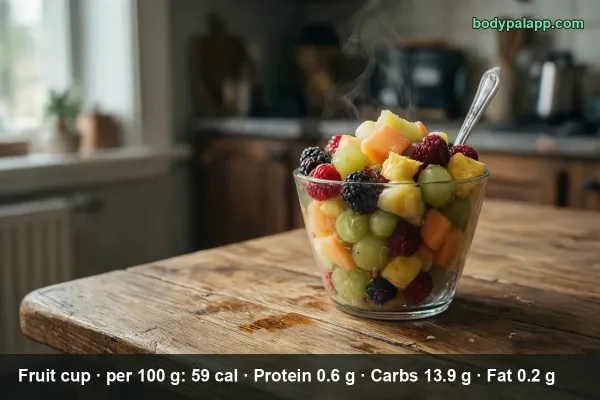
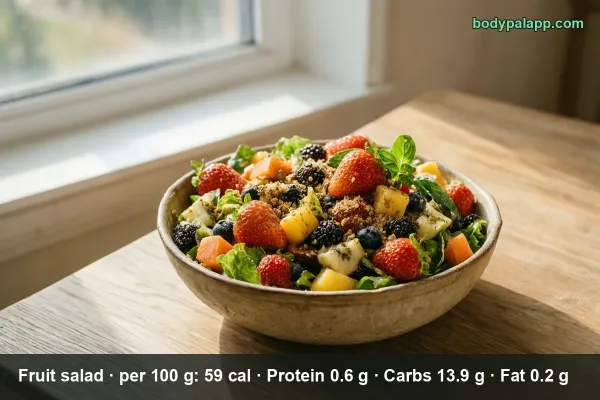
Here is how a packaged fruit bowl stacks up against fruit cup, fruit salad and fruit cocktail, per 100 g and per usual serving.
Verdict: For the lowest calories pick the fruit bowl at 47 per 100 g, since fruit cup and fruit salad come in at 59 and fruit cocktail at 73, about 1.6 times as much. Fruit cocktail is the one to portion carefully, because a 1 cup serving of 248 g reaches 181 calories with 18.9 g of carbs per 100 g.
Most popular fruit bowl brands in the United States
Ranked by popularity in the BodyPal database
# Productkcal / 100 g
1Dole 100% Fruit Juice Fruit Bowls1 cup · 113 g53 kcal
2The Pick Fruit Bowl85 g47 kcal
3Healing Md Mixed Fruit Bowl3.5 oz · 113 g35 kcal
4Crazy Fresh Target Signature Fruit Bowl1 cup · 140 g43 kcal
5Dole Gel Fruit Bowls, Black Cherry, Peach, Strawberry and Mandarin Orange1 cup · 123 g81 kcal
6Hannaford Mixed Fruit Bowls, Peaches, Pears and Cherries1 bowl · 108 g32 kcal
A fruit bowl is about 40 calories per 85 g serving, which works out to 47 calories per 100 g. A larger 113 g cup comes to 53 calories.
Is a fruit bowl good for weight loss?
At 47 calories per 100 g it is one of the lighter snacks, and an 85 g bowl has 40 calories with 2.0 g of fiber.
Fruit bowl vs fruit cup: which has fewer calories?
A fruit bowl has 47 calories per 100 g and a fruit cup 59, so the bowl is 12 calories lower for the same weight.
How much sugar is in a fruit bowl?
An 85 g fruit bowl has 6.0 g of sugar and 10.0 g of carbs. Per 100 g that is 7.1 g of sugar and 11.8 g of carbs.
How many calories are in a mixed fruit bowl?
A packaged mixed fruit bowl has 40 calories per 85 g bowl and 47 per 100 g. Nearly all of it, 91% of the calories, comes from carbs, with 0 g of fat.
How many calories are in a larger bowl of fruit?
A 4 oz portion of 113 g has 53 calories. Two standard bowls (170 g) come to 80 calories and three bowls (255 g) to 120, so even big servings stay fairly light.
How much protein and fiber does 1 bowl of mixed fruit have?
One 85 g bowl gives 1 g of protein and 2 g of fiber. That is 2% of the protein daily value, so pair it with yogurt, eggs or nuts if you want a filling snack.
Does 1 fruit bowl have any fat or sodium?
One fruit bowl has 0 g of fat and 5 mg of sodium, which is 0% of the 2300 mg daily value. Saturated fat and cholesterol also read 0.