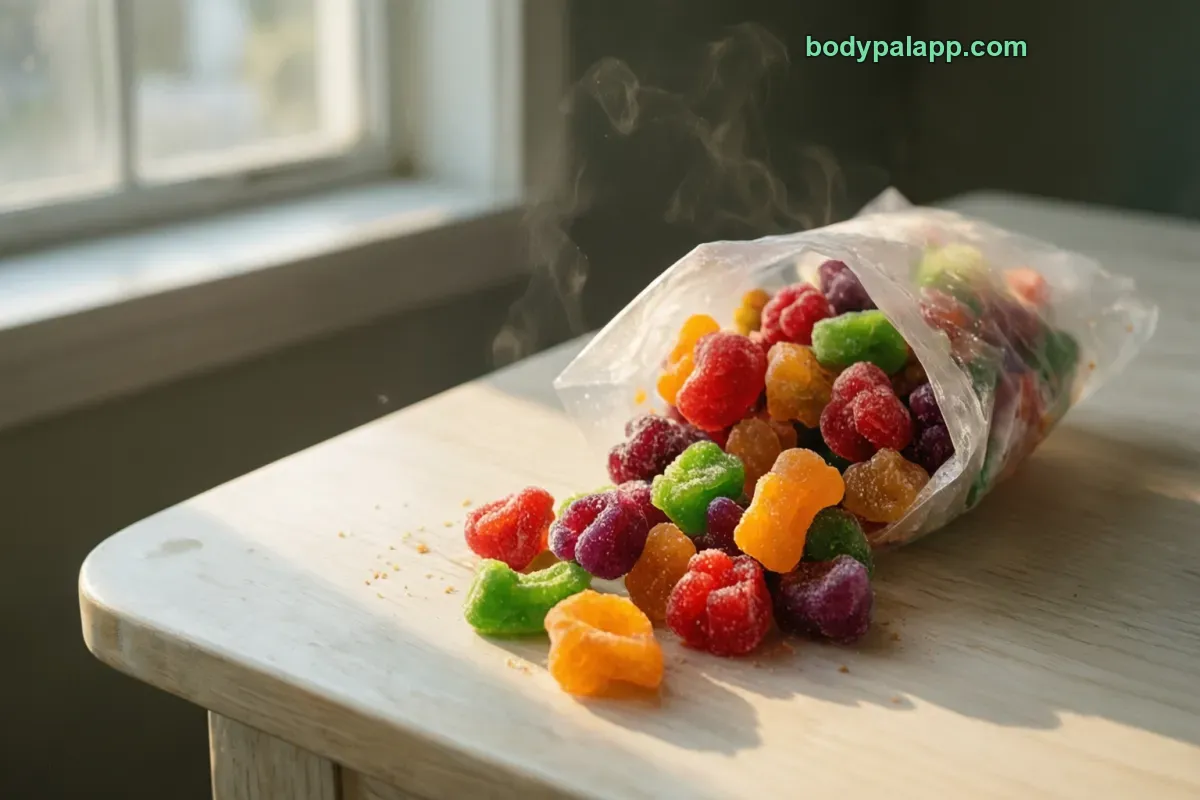
Fruit snack calories come to 89 for one 26 g pouch and 352 per 100 g. The number to notice is the split: 100% of those calories come from carbohydrate, most of it sugar, with no fat, no fiber and almost no protein. A single pouch is small, but pouches add up quickly.
89kcal
1 pouch · 26 g, ready to eat, gummy
0%protein
0 gProtein
23 gCarbs
0 gFat
How to burn off 89 kcal
—Walking, brisk
—Jogging
—Cycling, moderate
—Swimming
Skip the math. BodyPal counts these calories from your steps and workouts automatically.
Nutrition facts
Ready to eat, gummy · per 26 g
Calories
92 kcal
Protein
0 g
Carbohydrate
23 g
Fat
0 g
Saturated fat
0 g
Cholesterol
0 mg
Sodium
6 mg
Potassium
2 mg
Iron
0 mg
Source: USDA FoodData Central
🛡️
Verified nutrition data
Numbers on this page come from USDA FoodData Central, the U.S. Department of Agriculture’s food composition database, and from manufacturer labels where a branded product is named. Last verified September 2026. How we verify our data →
Fruit snack: calories, protein and sodium by serving
Percent of daily value uses the FDA reference of 2,000 kcal a day.
Serving
kcal
Protein
Carbs
Fat
Sodium
% DV kcal
1 pouch (26 g)
89
1.1 g
21 g
0 g
9 mg
4%
1 serving (44 g)
155
0 g
38.7 g
0 g
10 mg
8%
100 g
352
0.1 g
88 g
0 g
23 mg
18%
3 × 1 pouch (26 g)
275
0.1 g
18 mg
5 × 1 pouch (26 g)
458
0.1 g
30 mg
One pouch is 89 calories, five are 458
The standard 26 g pouch lands at 89 calories, about 4% of a 2000-calorie daily value. On its own that is a modest snack. The trouble is that fruit snacks are rarely eaten one pouch at a time, especially from a multipack in a lunch bag or desk drawer.
Two pouches (52 g) bring the total to 183 calories. Three pouches (78 g) reach 275. Five pouches, or 130 g, climb to 458 calories, which is closer to a meal than a snack. None of those steps adds meaningful protein: five pouches still carry only 0.1 g.
Some labels use a larger 44 g serving instead of the small pouch. That portion comes to 155 calories, or 8% of the daily value, with 38.7 g of carbohydrate. If you buy a bigger bag rather than single pouches, check which serving the label uses before you count. The gap between 26 g and 44 g is easy to miss and nearly doubles the calories.
Every calorie comes from carbohydrate
The calorie split is about as lopsided as food gets: 100% carbohydrate, 0% protein, 0% fat. Per 100 g, fruit snacks hold 88 g of carbohydrate, 0.1 g of protein and 0 g of fat. Saturated fat and cholesterol are both 0.
That profile explains why the calories are dense. At 352 per 100 g, fruit snacks pack more energy by weight than many foods that feel heavier, because there is almost no water and nothing but sugar and starch in the gummy. A pouch is gone in a minute or two, and there is little in it to slow you down.
Protein and fiber are the two nutrients most linked to feeling full after a snack, and fruit snacks offer neither in useful amounts. Fiber reads 0 g per 100 g. Potassium is only 8 mg per 100 g, so despite the fruit name, this is a candy in nutritional terms. The USDA files it under candies, with added vitamin C.
Sugar is the row to watch, not sodium
Of the 88 g of carbohydrate in 100 g of fruit snacks, 68.2 g is sugar. That means sugar makes up most of the weight of the product itself. In the larger 44 g serving, sugar comes to 30 g.
Sodium, by contrast, is barely a factor. One pouch has 9 mg, which rounds to 0% of the 2300 mg daily value, and 100 g has just 23 mg, or 1%. Even five pouches stop at 30 mg. If you track sodium closely, fruit snacks are not where your numbers will come from.
So the trade-off is simple. Fruit snacks are low in sodium and free of fat, but nearly all of what they deliver is sugar. If you are watching added sugar or carbohydrate totals, a single pouch is the portion that keeps the numbers small, and the multipack is the thing to keep out of reach.
A pouch works best as a planned treat
Fruit snacks fit most easily into a day when you treat them as candy rather than as a serving of fruit. At 89 calories a pouch, one can sit alongside a meal or after exercise without moving your total much. The risk is the second and third pouch, not the first.
Because they carry no protein, fat or fiber, pairing them helps. A pouch next to something with protein, such as yogurt, cheese or a handful of nuts, turns a quick sugar hit into a snack that lasts longer. Whole fruit is another option when you want something sweet with more volume for the calories.
Brands such as Welch's Fruit Snacks come in several flavors, including Mixed Fruit, Berries 'n Cherries and Island Fruits, and pouch sizes can differ between boxes. If you want to keep a running count without reading every label, BodyPal can log fruit snacks from a photo of the pouch.
How does fruit snack compare?
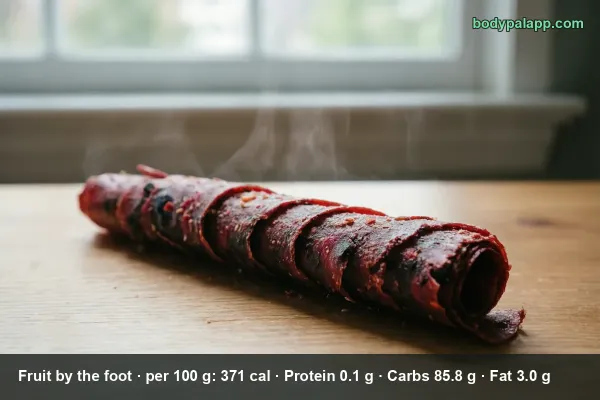
Here is how fruit snacks stack up against Fruit by the Foot, fruit cake and snack pack pudding, per 100 g and per usual serving.
Verdict: For the fewest calories by weight, snack pack pudding wins at 109 per 100 g and brings 1.1 g of protein, against 352 for fruit snacks. Between the two gummy options, pick fruit snacks over Fruit by the Foot: 352 versus 371 per 100 g, with 23 mg of sodium instead of 317 mg.
Most popular fruit snack brands in the United States
Ranked by popularity in the BodyPal database
# Productkcal / 100 g
1Welch's Fruit Snacks Mixed Fruit1 pouch · 14 g321 kcal
2Welch's Fruit Snacks Berries 'n Cherries15 pieces · 30 g300 kcal
3Welch's Fruit Snacks1 pouch · 14 g321 kcal
4Welch's Mixed Fruit Fruit Snacks1 pouch · 25.5 g314 kcal
5Welch's Island Fruits Fruit Snacks1 pouch · 25.5 g314 kcal
Pouch sizes differ by brand, from 14 g to 25.5 g, so the calories per pouch change even when the per 100 g numbers are close. Source: manufacturer labels / USDA FoodData Central.
Fruit snack FAQs
How many calories are in a pouch of fruit snacks?
A 26 g pouch is about 89 calories. A larger 44 g serving comes to 155 calories.
Are fruit snacks good for weight loss?
One 26 g pouch is 89 calories with 21 g of carbs, no fat and only 1.1 g of protein, so it adds calories without much filling power.
Fruit snacks or Fruit by the Foot: which has fewer calories?
Fruit snacks are 352 calories per 100 g and Fruit by the Foot 371, so the difference is 19 calories per 100 g.
How much sugar is in fruit snacks?
Fruit snacks carry 68.2 g of sugar per 100 g, which is about 17.7 g in a 26 g pouch.
How many calories are in two pouches of fruit snacks?
Two 26 g pouches come to 183 calories for 52 g of fruit snacks. That is about double a single pouch at 89 calories, with essentially no protein and no fat added along the way.
How many calories are in a 44 g serving of fruit snacks?
A 44 g serving has 155 calories, about 8% of the daily value, with 38.7 g of carbohydrate and 30 g of sugar. It is noticeably larger than the standard 26 g pouch at 89 calories.
Do fruit snacks have any fat, protein or fiber?
Fruit snacks have 0 g of fat and 0 g of fiber per 100 g, and only 0.1 g of protein. All of their 352 calories per 100 g come from carbohydrate, mostly sugar.
How much sodium is in fruit snacks?
One 26 g pouch has 9 mg of sodium, which is 0% of the daily value. Per 100 g the figure is 23 mg, or 1%, so sodium is not a concern with fruit snacks.