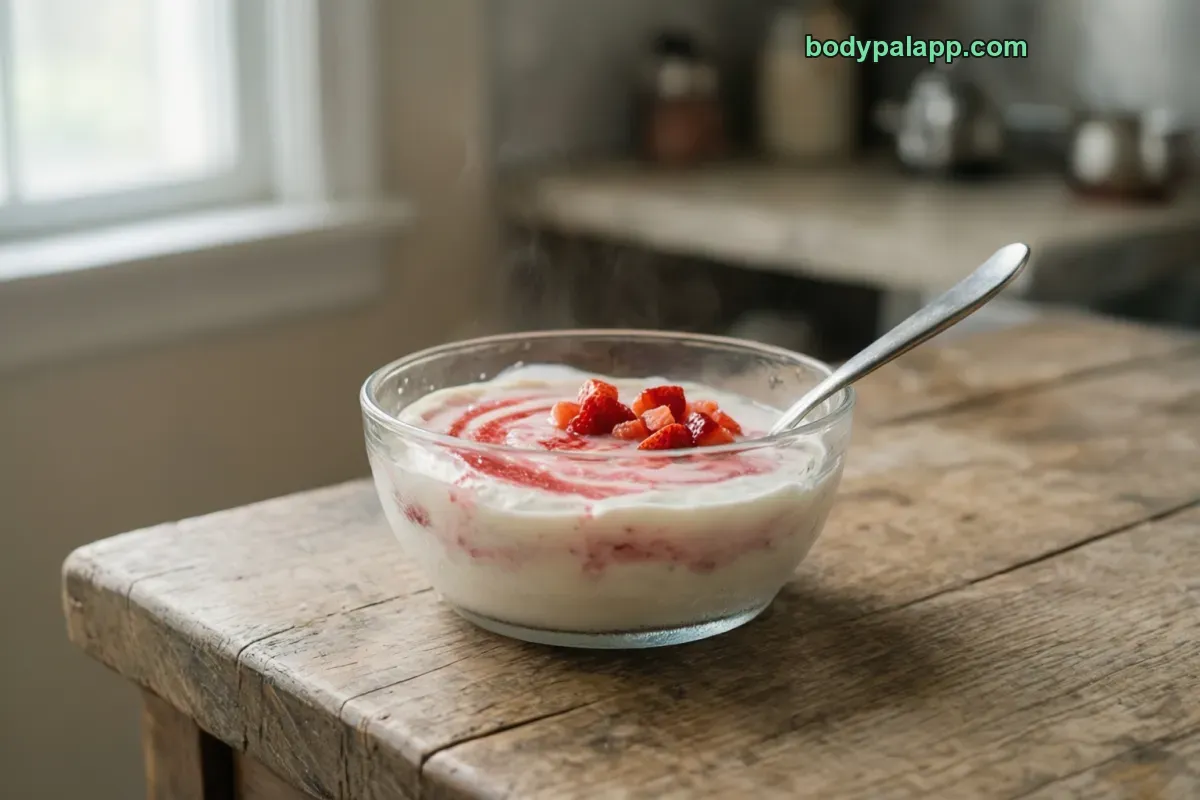
Fruit yogurt calories come to 158 for one 170 g container of low fat yogurt with fruit, or 93 per 100 g. The number to notice is sugar: 21.8 g per container, which explains why carbs supply most of the energy while protein stays modest at 7.8 g.
158kcal
1 6 oz container · 170 g, low fat, with fruit
20%protein
7.8 gProtein
27 gCarbs
2.3 gFat
How to burn off 158 kcal
—Walking, brisk
—Jogging
—Cycling, moderate
—Swimming
Skip the math. BodyPal counts these calories from your steps and workouts automatically.
Nutrition facts
Low fat, with fruit · per 170 g
Calories
158 kcal
Protein
7.8 g
Carbohydrate
27 g
Fat
2.3 g
Saturated fat
1.5 g
Cholesterol
9 mg
Sodium
111 mg
Potassium
360 mg
Iron
0.2 mg
Source: USDA FoodData Central
🛡️
Verified nutrition data
Numbers on this page come from USDA FoodData Central, the U.S. Department of Agriculture’s food composition database, and from manufacturer labels where a branded product is named. Last verified September 2026. How we verify our data →
Fruit yogurt: calories, protein and sodium by serving
Percent of daily value uses the FDA reference of 2,000 kcal a day.
Serving
kcal
Protein
Carbs
Fat
Sodium
% DV kcal
1 container (170 g)
158
7.8 g
26.7 g
2.3 g
111 mg
8%
Nonfat (170 g)
78
6.2 g
13 g
0.1 g
77 mg
4%
1 cup (245 g)
228
11.2 g
38.4 g
3.3 g
159 mg
11%
100 g
93
4.6 g
15.7 g
1.3 g
65 mg
5%
3 × 1 container (170 g)
474
23.3 g
332 mg
5 × 1 container (170 g)
791
38.8 g
553 mg
One container is a 158-calorie snack, a cup is 228
The standard 170 g container lands at 158 calories, about 8% of a 2000-calorie daily value. That is a reasonable snack on its own. The trouble starts when the portion drifts. Pour a full cup of 245 g into a bowl and you are at 228 calories, 31.5 g of sugar and 11.2 g of protein.
Containers also stack up faster than people expect. Two of them come to 316 calories and 15.5 g of protein. Three reach 474 calories, and five hit 791 calories with 553 mg of sodium. If you eat yogurt straight from a large tub, weigh one serving once so you know what a 170 g scoop looks like.
The cheapest swap is the nonfat version. The same 170 g container drops to 78 calories, roughly half of the low fat one, and still delivers 6.2 g of protein. Sugar falls to 12.1 g. If you eat fruit yogurt daily, that one change does more than shrinking the portion.
Carbs supply two thirds of every calorie
Per 100 g, low fat fruit yogurt carries 15.7 g of carbs, 4.6 g of protein and 1.3 g of fat. In calorie terms that is 67% carbs, 20% protein and 13% fat. So this is a sweet dairy snack first and a protein food second.
Nearly all of those carbs are sugar: 12.8 g out of 15.7 g per 100 g. Part of it is lactose from the milk and part comes from the fruit preparation, but the card does not split the two. Fiber is close to zero at 0.2 g per 100 g, so the fruit adds flavor, not bulk.
Fat is low. A container holds 2.3 g of fat, of which saturated fat per 100 g is only 0.9 g. Cholesterol is 5 mg per 100 g. None of these rows needs watching. Protein at 7.8 g per container covers 16% of the daily value, which is useful but not the reason to pick this food.
Sugar is the row to watch, not sodium
Sodium is mild. One container has 111 mg, just 5% of the 2300 mg daily value, and the nonfat version has 77 mg. Even a full cup stays at 159 mg, or 7%. If you track salt, fruit yogurt is not where it hides.
Sugar is a different story. A container brings 21.8 g, a cup 31.5 g. That is more sugar than protein and carbs combined in many plain yogurts, and it is the main reason the calorie count sits where it does. Compare the nonfat container at 12.1 g of sugar and the gap is obvious.
Potassium is a quiet plus at 212 mg per 100 g, a small share of the 4700 mg daily value. It is not enough to call fruit yogurt a potassium source, but it is more than most sweet snacks offer.
Pair it with protein or fiber to stay full
With 7.8 g of protein and 0.3 g of fiber per container, fruit yogurt alone digests quickly. Adding something with fiber, like oats, nuts or fresh berries, gives the snack more staying power without changing its character. A spoon of plain Greek yogurt stirred in raises protein and dilutes the sugar.
It also works as a dessert stand-in. At 158 calories, a container is lighter than most baked sweets and still tastes like a treat. If breakfast is the goal, treat it as one part of the meal rather than the whole meal.
Brands vary, and drinkable versions such as Earth's Best Organic Strawberry Banana Fruit Yogurt Smoothie sit in a different format from a spoonable cup. Check the label of the exact product you buy. BodyPal can log fruit yogurt from a photo, which helps when you eat it from a bowl rather than a container.
How does fruit yogurt compare?
Here is how low fat fruit yogurt stacks up against plain, Greek and vanilla Greek yogurt, per 100 g and per usual serving.
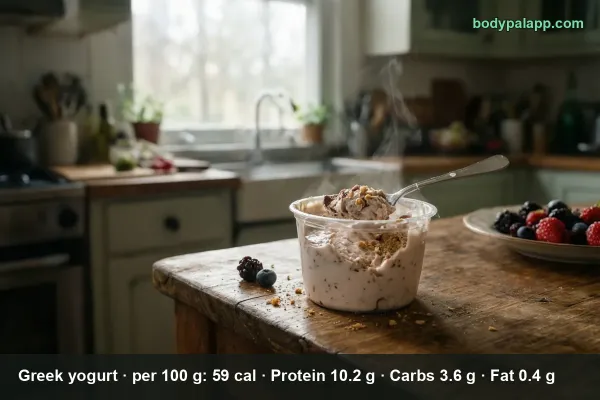
Verdict: For the fewest calories and the most protein, pick plain Greek yogurt at 59 calories and 10.2 g of protein per 100 g, against 93 calories and 4.6 g for fruit yogurt. If you want sweetness, vanilla Greek yogurt at 78 per 100 g is the better compromise.
Most popular fruit yogurt brands in the United States
Ranked by popularity in the BodyPal database
# Productkcal / 100 g
1Earth's Best Organic Strawberry Banana Fruit Yogurt Smoothie1 pouch · 120 g83 kcal
2Earth's Best Organic Pear Mango Fruit Yogurt Smoothie1 pouch · 120 g75 kcal
3Earth's Best Organic Pineapple Orange Banana Fruit Yogurt Smoothie1 pouch · 120 g75 kcal
4Earth's Best Organic Peach Banana Fruit Yogurt Smoothie1 pouch · 120 g67 kcal
5Earth's Best Organic Apple Blueberry Fruit Yogurt Smoothie1 pouch · 120 g67 kcal
6Earth's Best Organic Mixed Berry Fruit Yogurt Smoothie1 pouch · 120 g58 kcal
These are drinkable yogurt smoothie pouches, thinner than spooned fruit yogurt, so they read lower per 100 g. Source: manufacturer labels / USDA FoodData Central.
Fruit yogurt FAQs
How many calories are in a container of fruit yogurt?
A 6 oz container (170 g) of low fat fruit yogurt has 158 calories. A smaller 4 oz container has 105 calories.
Is fruit yogurt good for weight loss?
One 6 oz container is 158 calories and carries 21.8 g of sugar. The nonfat version of the same container is 78 calories with 12.1 g of sugar.
Is Greek fruit yogurt lower in calories?
Low fat Greek fruit yogurt is 91 calories per 100 g against 93 for regular fruit yogurt, but it has 9.1 g of protein per 100 g instead of 4.6 g.
How much protein is in fruit yogurt?
A 6 oz container has 7.8 g of protein, which is 4.6 g per 100 g. The same container also gives 272 mg of calcium.
How many calories are in 100 g of fruit yogurt?
Low fat fruit yogurt has 93 calories per 100 g, with 4.6 g of protein, 15.7 g of carbs, 1.3 g of fat and 12.8 g of sugar.
How many calories are in a cup of fruit yogurt?
A 245 g cup of low fat fruit yogurt has 228 calories, about 11% of a 2000-calorie daily value. It also brings 11.2 g of protein and 31.5 g of sugar.
Is 158 calories a lot for a yogurt?
Not really. A 158-calorie container is about 8% of a 2000-calorie daily value. It is higher than plain yogurt, though, because of the 21.8 g of sugar from the fruit and sweetening.
How many calories are in nonfat fruit yogurt?
A 170 g container of nonfat fruit yogurt has 78 calories, against 158 for low fat. It keeps 6.2 g of protein and cuts sugar to 12.1 g.
Does fruit yogurt have more calories than plain yogurt?
Yes. Fruit yogurt has 93 calories per 100 g, while plain cup yogurt has 61. The difference comes mostly from added fruit and sugar, since fruit yogurt carries 15.7 g of carbs per 100 g against 4.7 g.