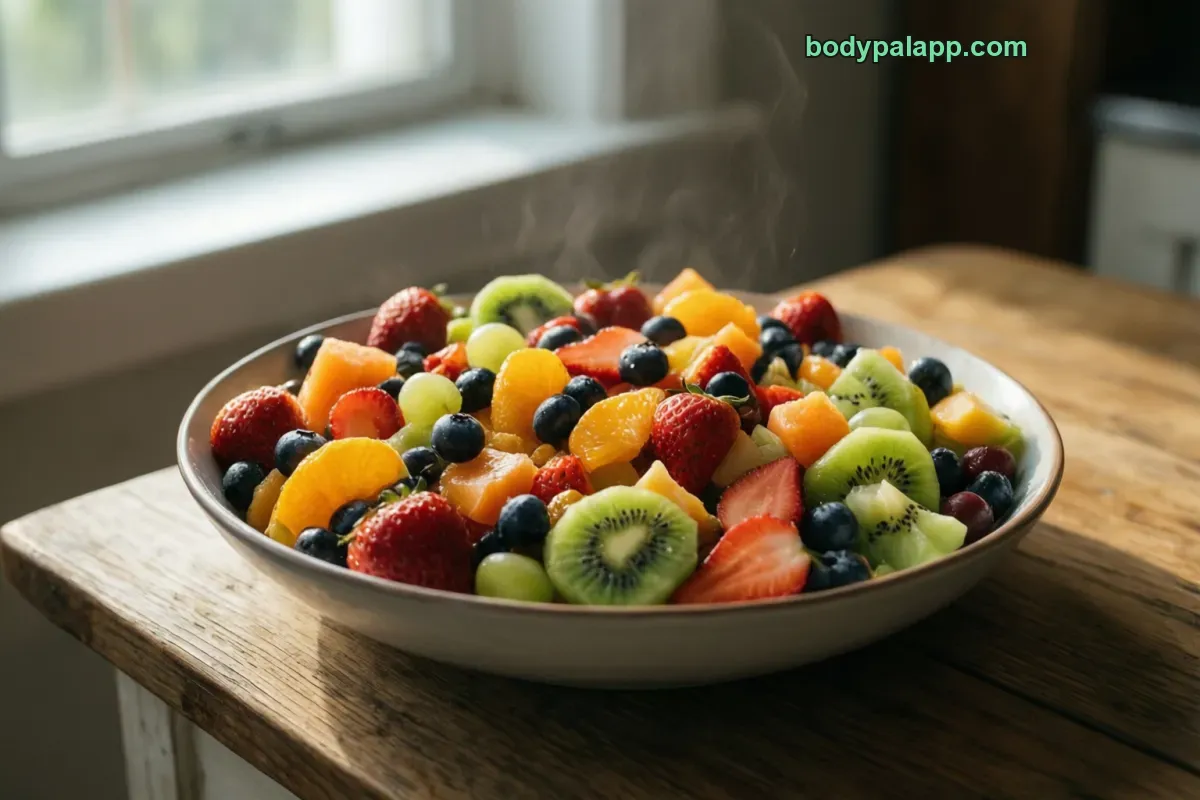
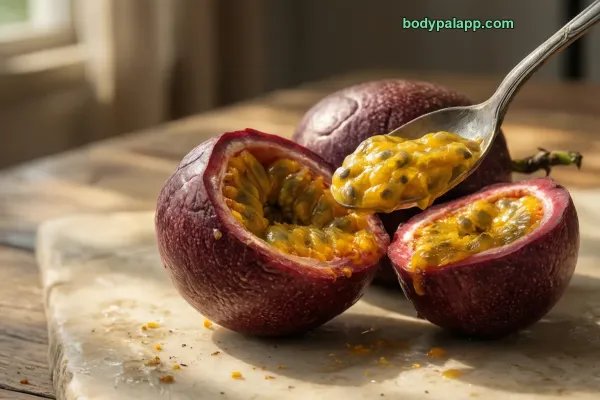
Fruit calories come to 126 for one 185 g piece and 68 per 100 g, based on a raw average across fruits. Carbs supply 93 percent of the energy, mostly as sugar: a piece carries 22.2 g of sugars alongside 3.3 g of fiber, with almost no fat or sodium.
126kcal
1 piece of fruit · 185 g, raw, average across fruits
4%protein
1.3 gProtein
30 gCarbs
0.4 gFat
How to burn off 126 kcal
—Walking, brisk
—Jogging
—Cycling, moderate
—Swimming
Skip the math. BodyPal counts these calories from your steps and workouts automatically.
Nutrition facts
Raw, average across fruits · per 185 g
Calories
126 kcal
Protein
1.3 g
Carbohydrate
30 g
Fat
0.4 g
Saturated fat
0.1 g
Cholesterol
0 mg
Sodium
2 mg
Potassium
381 mg
Iron
0.2 mg
Source: USDA FoodData Central
🛡️
Verified nutrition data
Numbers on this page come from USDA FoodData Central, the U.S. Department of Agriculture’s food composition database, and from manufacturer labels where a branded product is named. Last verified September 2026. How we verify our data →
Fruit: calories, protein and sodium by serving
Percent of daily value uses the FDA reference of 2,000 kcal a day.
Serving
kcal
Protein
Carbs
Fat
Sodium
% DV kcal
1 piece (185 g)
126
1.3 g
30 g
0.4 g
2 mg
6%
1 cup (150 g)
102
1 g
24.4 g
0.3 g
2 mg
5%
100 g
68
0.7 g
16.2 g
0.2 g
1 mg
3%
3 × 1 piece (185 g)
377
3.8 g
6 mg
5 × 1 piece (185 g)
629
6.3 g
9 mg
One piece is 126 calories, five pieces are 629
A single piece of fruit in this average weighs 185 g and lands at 126 calories, or 6 percent of the daily value. A cup of cut fruit, 150 g, comes to 102 calories, so the cup is the slightly smaller portion. Neither number is large on its own. The total only moves when pieces stack up.
Two pieces reach 252 calories, three reach 377, and five pieces, 925 g of fruit, reach 629. That last figure is roughly the size of a meal, spread across a day of snacking. Sodium barely moves along the way, just 9 mg at five pieces. Protein stays low too, at 6.3 g for the same five.
The practical lesson: count pieces, not just whether you ate fruit. A bowl on the counter can quietly add 377 calories if you reach for it three times. If you log by weight, 100 g at 68 calories is an easy baseline to scale from, and BodyPal can log the fruit from a photo if you would rather not weigh it.
Carbs supply 93 percent of the calories
Per 100 g, fruit carries 16.2 g of carbohydrate, 0.7 g of protein and 0.2 g of fat. That makes the calorie split 93 percent carbs, 4 percent protein and 3 percent fat. Few foods are this one-sided.
Most of those carbs are sugars: 12 g per 100 g, which works out to 22.2 g in a piece and 18 g in a cup. Fiber accounts for part of the rest, at 1.8 g per 100 g. Even so, the energy density stays low. At 68 calories per 100 g, a piece can be big in the hand and still modest on the log.
With 1.3 g of protein in a piece, about 3 percent of the daily value, fruit is not a protein source. Fat is close to zero at 0.4 g. If you want a snack that leans on protein or fat, fruit needs a partner rather than a bigger portion.
Sugar is the row to watch, fiber is the bonus
A piece of fruit carries 22.2 g of sugars. That is the number people tracking sugar will notice first, and it is the biggest single figure on the label after carbs. The cup is the easier portion to control here, at 18 g of sugars versus 22.2 g for a piece.
That sugar arrives with fiber attached: 3.3 g per piece and 2.7 g per cup, measured against a daily value of 28 g. Fruit also brings 206 mg of potassium per 100 g, a useful extra for a food this low in calories.
The rest of the label is quiet. Sodium is 2 mg per piece, 0 percent of the daily value. Saturated fat is 0.1 g per 100 g and cholesterol is 0. If you watch sodium or saturated fat, fruit is one of the few foods you can leave off the worry list entirely.
Fruit works best with a protein partner
Because 93 percent of its calories come from carbs, fruit pairs naturally with foods that cover what it lacks. Yogurt, cottage cheese, nuts or a slice of cheese add the protein and fat that fruit barely has. A piece at 126 calories leaves plenty of room for that partner within a modest snack.
Fruit also slots easily into breakfast. A cup at 102 calories over oatmeal or alongside eggs adds sweetness and 2.7 g of fiber without changing the total much. As a dessert stand-in, a piece covers a sweet craving for 6 percent of the daily calorie value.
Keep in mind that this page is an average. Individual fruits swing well above and below 68 calories per 100 g, and dried fruit sits far higher. For day-to-day logging the average is a solid estimate; for a fruit you eat often, its own page will be more precise.
How does fruit compare?
Here is how average fruit stacks up against dragon fruit, passion fruit and dates, per 100 g and per usual serving.
Verdict: For the lowest calorie density, average fruit and dragon fruit tie at 68 per 100 g, while dates run 4.1 times higher at 277. If you want something sweet in one small bite, a single date at 66 calories works, but if you want volume for your calories, pick a 185 g piece of fruit.
Fruit FAQs
How many calories are in one piece of fruit?
An average piece of fruit (185 g) has about 126 calories, and a cup (150 g) has 102.
Is fruit good for weight loss?
Fruit averages 68 calories per 100 g with 1.8 g of fiber and 0.2 g of fat, so a full cup comes to 102 calories.
Fruit vs dragon fruit: which has fewer calories?
They are the same: both have 68 calories per 100 g.
How much sugar is in a piece of fruit?
An average 185 g piece has about 22.2 g of sugar and 30.0 g of carbs (12 g sugar per 100 g).
How many calories are in a cup of fruit?
A cup of fruit (150 g) has 102 calories, based on a raw average across fruits. It holds 24.4 g of carbs, 18 g of sugars, 2.7 g of fiber and 1 g of protein, with only 0.3 g of fat.
How many calories are in 100 grams of fruit?
100 g of fruit has 68 calories on average. That weight carries 16.2 g of carbs, 12 g of sugars, 1.8 g of fiber, 0.7 g of protein and 0.2 g of fat, plus 1 mg of sodium.
How much fiber is in a piece of fruit?
A 185 g piece of fruit has 3.3 g of fiber. A cup has 2.7 g and 100 g has 1.8 g, all measured against a daily value of 28 g for fiber.
Does fruit have any protein or fat?
Barely: a piece has 1.3 g of protein and 0.4 g of fat. Protein supplies 4 percent of fruit's calories and fat 3 percent, so carbs make up nearly everything else.
How many calories are in three pieces of fruit?
Three pieces of fruit (555 g) total 377 calories. Two pieces come to 252 and five come to 629, while sodium stays tiny at 6 mg for three pieces.