
How many calories are in Fruity Pebbles?
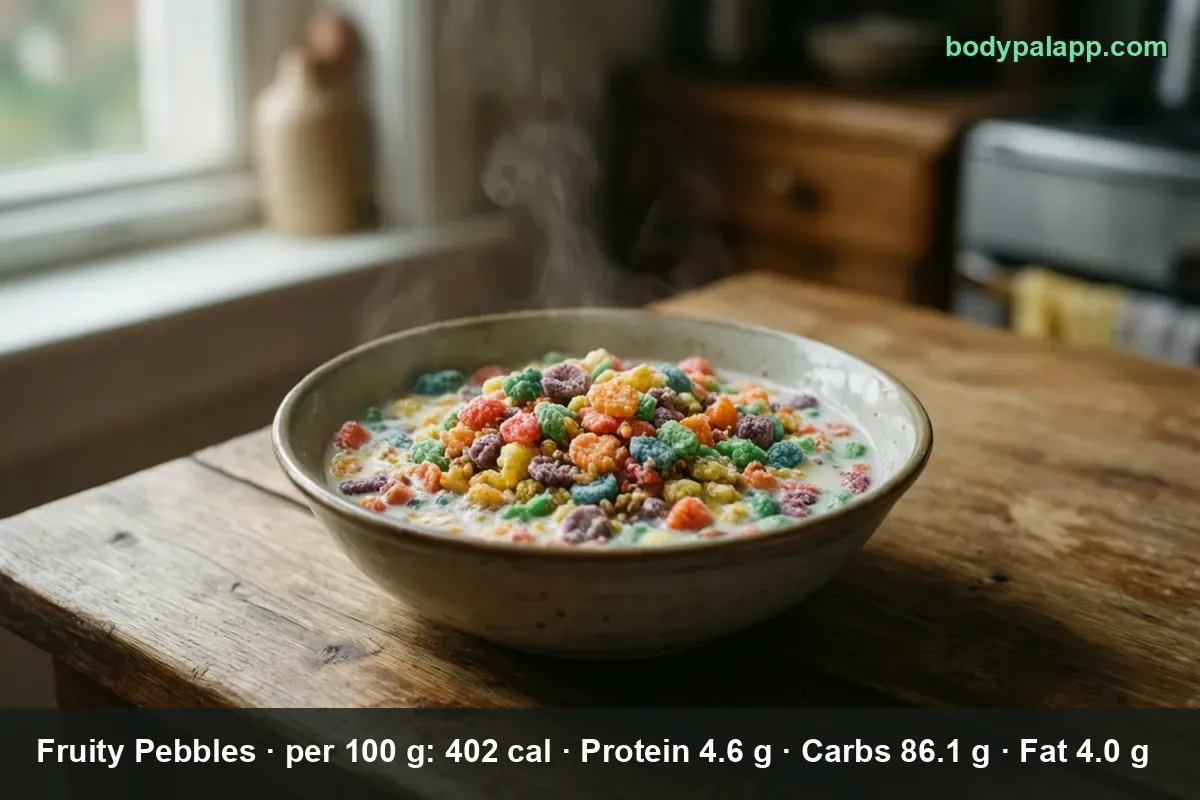
A 3/4-cup serving of Fruity Pebbles is 27 g and 109 calories. Per 100 g the dry cereal runs 402 calories. The catch is the measure, not the cereal: pour until the bowl looks full and you are closer to 54 g, which is 217 calories before a drop of milk goes in.
On this page
- Fruity Pebbles quick facts
- US servings from the box measure to a filled bowl
- Marshmallow Pebbles and the other boxes
- Sodium is the row nobody checks
- How does Fruity Pebbles compare?
- Most popular fruity pebbles brands
- Fruity Pebbles FAQs
Fruity Pebbles quick facts
The numbers below come from the USDA entry SR Legacy 171645, "Cereals ready-to-eat, POST, FRUITY PEBBLES". It is the only USDA record for the cereal itself, and it carries the official NLEA serving of 3/4 cup at 27 g, which is what the box prints. Everything else with the name on it in FoodData Central is a spin-off product: a snack pouch, a pudding cup, a baking kit.
One thing to know before reading the fat rows. Total fat is small, 4.02 g per 100 g, but 3.6 g of that is saturated. Nine calories in ten from fat in this cereal are saturated calories, which is what a tropical oil in the coating does.
| Nutrient | Per 100 g | Per 3/4 cup (27 g) | % Daily Value |
|---|---|---|---|
| Calories | 402 | 109 | — |
| Total fat | 4.02 g | 1.1 g | 1% |
| Saturated fat | 3.6 g | 1.0 g | 5% |
| Carbohydrate | 86.1 g | 23.2 g | 8% |
| Dietary fiber | 0.8 g | 0.2 g | 1% |
| Total sugars | 34.28 g | 9.3 g | — |
| Protein | 4.62 g | 1.2 g | 2% |
| Sodium | 531 mg | 143 mg | 6% |
% Daily Value is based on a 2,000-calorie diet.
Verified nutrition data
Numbers on this page come from USDA FoodData Central, the U.S. Department of Agriculture’s food composition database, and from manufacturer labels where a branded product is named. Last verified September 2026. How we verify our data →
There is no "Added sugars" row on this page because USDA does not publish added sugars for this SR Legacy record. Almost all of the 34.28 g per 100 g arrives with the recipe rather than from the rice, but the database gives no separate figure, so none is invented here. Cholesterol is 0 mg, as you would expect from a grain product, and potassium is 72 mg per 100 g, or 19 mg a serving, which rounds to 0% of the FDA Daily Value.
The row worth staring at is sugar against fiber: 34.28 g against 0.8 g per 100 g. Sugar outweighs fiber roughly forty to one, and more than a third of the dry weight of the cereal is sugar.
US servings from the box measure to a filled bowl
| Serving | Weight | Calories |
|---|---|---|
| 3/4 cup, the box serving | 27 g | 109 kcal |
| 1 oz | 28.35 g | 114 kcal |
| 1 cup | 36 g | 145 kcal |
| 1 1/2 cups, a filled bowl | 54 g | 217 kcal |
| Per 100 g | 100 g | 402 kcal |
Only the first line is a USDA serving. The ounce, the cup and the filled bowl are our own arithmetic from the USDA 100 g figure of 402 calories, not USDA servings, and the cup weight of 36 g is an average because puffed rice settles differently depending on how the box has been handled.
That first line is also the line people misread. Three quarters of a cup of a very light cereal is a shallow layer in a standard bowl. Double it, which is what a filled bowl looks like, and the 109 becomes 217 calories, 46.5 g of carbohydrate, 18.5 g of sugar and 287 mg of sodium. Nothing about the cereal changed. The measuring cup did.
If you log breakfast by eye, weighing the box for one week is the cheapest fix on this page. Pour what you normally pour, weigh it once, and you will know whether your bowl is a 109 or a 217.
Marshmallow Pebbles and the other boxes
| Version | Per 100 g | Typical serving | Calories |
|---|---|---|---|
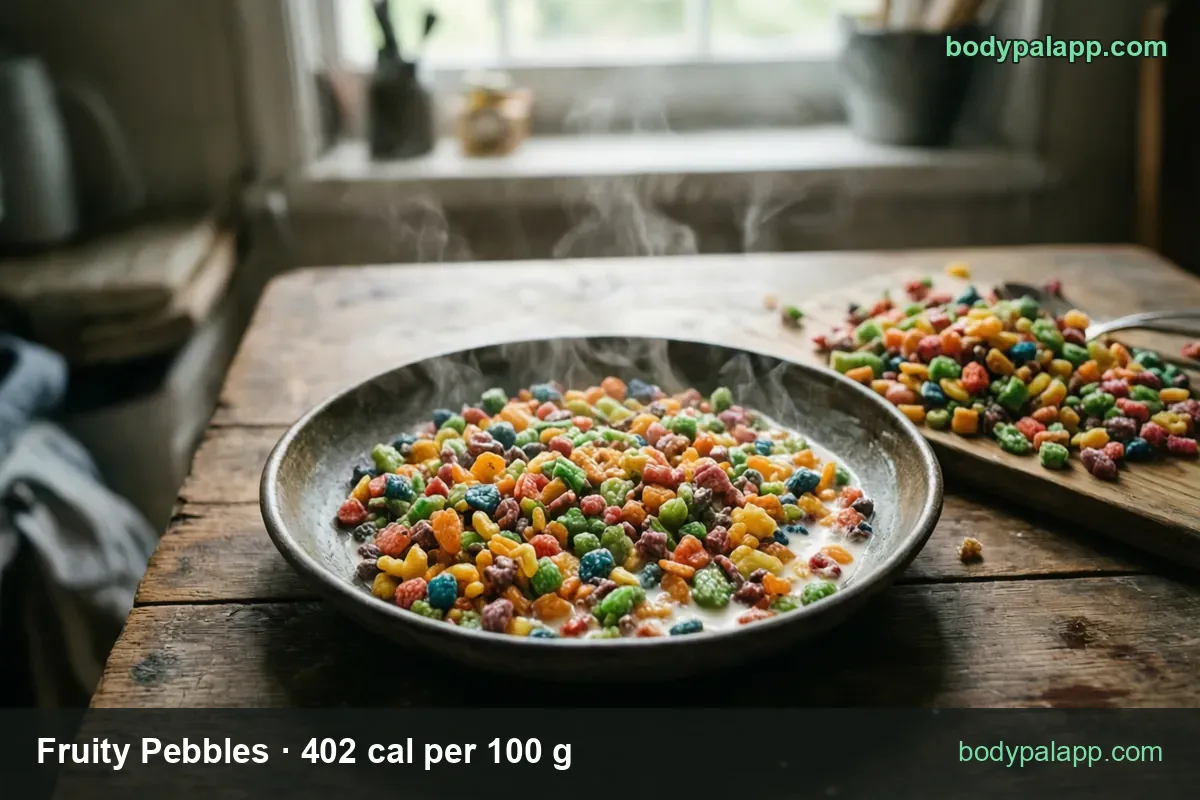
| Fruity Pebbles, original | 402 kcal | 3/4 cup (27 g) | 109 kcal |
| Marshmallow Fruity Pebbles | 379 kcal | 3/4 cup (29 g) | 110 kcal |
| Fruity Dyno-Bites, store-brand twin | 404 kcal | 1 oz (28.35 g) | 115 kcal |
| Puffed rice cereal, fortified, unsweetened | 402 kcal | 1 oz (28.35 g) | 114 kcal |
| Fruity Pebbles crispy rice snack pouch | 500 kcal | 1 pouch (28 g) | 140 kcal |
| Fruity Pebbles flavored pudding cup | 109 kcal | 1 cup (92 g) | 100 kcal |
Marshmallow Fruity Pebbles looks lighter on paper at 379 calories per 100 g against 402, and it is, per gram. But its label serving is 29 g rather than 27 g, so the bowl comes out at 110 calories against 109. Swapping boxes buys you one calorie.
Fruity Dyno-Bites is the Malt-O-Meal bag version, USDA record 173001, at 404 calories per 100 g. It runs slightly leaner on fat, 3.15 g against 4.02 g per 100 g, and heavier on carbohydrate, 90.1 g against 86.1 g. Ounce for ounce it is 115 calories against 114. That is a rounding difference, and the bag is usually the cheaper way to buy the same breakfast.
Plain fortified puffed rice, USDA record 173912, is the surprise. Unsweetened, it still lands at 402 calories per 100 g, identical to Fruity Pebbles. Taking the sugar out does not take the calories out; it swaps sugar for starch, gram for gram. What actually changes is fat, 0.5 g against 4.02 g, and protein, 6.3 g against 4.62 g, about a third more. If you want a lighter bowl, you get it by pouring less, not by buying the unsweetened box.
The two spin-offs move in opposite directions. The crispy rice snack pouch is 500 calories per 100 g, the densest item with the name on it, because the bars are bound with syrup and fat; one 28 g pouch is 140 calories. The flavored pudding cup is the lightest per gram at 109 calories per 100 g, but the cup weighs 92 g, so it still comes to 100 calories.
Sodium is the row nobody checks
Nobody buys a fruit-flavored cereal expecting a salt problem, and 143 mg per serving is not one. It is 6% of the Daily Value. The interesting part is the ratio: 109 calories bring 143 mg of sodium with them, so sodium accumulates slightly faster than calories do in this bowl. Per 100 g the cereal is 531 mg, which is real seasoning by any standard.
Scale it to the way people actually eat it. A filled 1 1/2-cup bowl is 287 mg of sodium, about an eighth of a teaspoon of table salt sprinkled over breakfast, and the Dietary Guidelines for Americans put the ceiling at 2,300 mg a day. Breakfast has taken 12% of it before the coffee.
Saturated fat behaves the same way. One gram per serving is 5% of the Daily Value, which sounds trivial, until you notice it is 5% from a food contributing 1.1 g of total fat. In the filled bowl it is 1.9 g, or 10%. Neither number is alarming on its own. Both are larger than the cereal's reputation suggests, and both double when the bowl does.
For the fiber side, MyPlate asks for half your grains to be whole grains. At 0.2 g of fiber a serving, this bowl is not one of them, which is a fair reason to keep it as the fun breakfast rather than the default one.
How does Fruity Pebbles compare?
| Cereal | Per 100 g | US serving | Calories |
|---|---|---|---|
| Fruity Pebbles | 402 kcal | 1 oz (28.35 g) | 114 kcal |
| Fruity Dyno-Bites | 404 kcal | 1 oz (28.35 g) | 115 kcal |
| Cap'n Crunch Halloween Crunch | 402 kcal | 1 oz (28.35 g) | 114 kcal |
| Puffed rice, fortified | 402 kcal | 1 oz (28.35 g) | 114 kcal |
All four sit within two calories of each other per 100 g. Dry breakfast cereal is dry breakfast cereal: strip out the water, and a cup of grain is a cup of grain no matter what color it is. What separates them is composition. Halloween Crunch is a corn and oat base and the fattiest of the four at 5.66 g per 100 g. Puffed rice is the leanest at 0.5 g and the highest in protein at 6.3 g. Fruity Pebbles sits between them, and nearly all of its small fat total is saturated, 3.6 g of 4.02 g per 100 g.
Our take: switching cereals to save calories is wasted effort, because the calorie number barely moves. Weigh the pour instead. If you want a genuinely lighter breakfast, plain puffed rice at the same 402 calories per 100 g gives you a third more protein and almost no fat for the same energy, and you control what sweetness goes on top. If you like Fruity Pebbles, keep it and measure it at 3/4 cup; the box serving is honest, most bowls are not.
Most popular fruity pebbles brands in the United States
Ranked by how widely each product appears among foods sold in the United States, from the BodyPal food database of over 3.3 million products. Calories are the figures printed on each Nutrition Facts label, checked against USDA FoodData Central.
| Product | Calories (per 100 g) |
|---|---|
| Post Marshmallow Fruity Pebbles | 379 cal |
| Fruity Pebbles Fruit Crispy Rice Snacks | 500 cal |
| Snack Pack Fruity Pebbles Flavored Pudding Cups | 109 cal |
Brand popularity: BodyPal food database. Nutrition: manufacturer labels / USDA FoodData Central.
Fruity Pebbles FAQs
How many calories are in a bowl of Fruity Pebbles?
A filled 1 1/2-cup bowl is about 54 g and 217 calories, exactly double the 109 on the box. That bowl also carries 287 mg of sodium and 18.5 g of sugar. The 54 g weight is our own arithmetic from the USDA 100 g figure, not a USDA serving.
How many calories in 1 cup of Fruity Pebbles?
One level cup weighs about 36 g and comes to 145 calories, with 31 g of carbohydrate and 12.3 g of sugar. That is a third more than the 3/4 cup on the label. Cup weights vary with how the flakes settle, so treat 36 g as a working average.
What is the serving size of Fruity Pebbles?
The Nutrition Facts serving is 3/4 cup, or 27 g, and it holds 109 calories. Poured dry it fills a cereal bowl less than halfway, which is why most people log more than one serving. USDA record 171645 puts the cereal at 402 calories per 100 g.
How much sugar is in Fruity Pebbles?
A 3/4-cup serving has 9.3 g of sugar, and 100 g has 34.28 g, so more than a third of the dry weight is sugar. Fiber is 0.8 g per 100 g, roughly forty times less. USDA does not publish added sugars for this SR Legacy record, so no split is shown here.
Are Fruity Pebbles high in sodium?
For a sweet cereal, yes: 143 mg per 3/4 cup is 6% of the Daily Value, and 100 g carries 531 mg. A filled bowl of 54 g reaches 287 mg, about an eighth of a teaspoon of table salt. The sodium climbs faster than the calories do.
How many calories in Marshmallow Fruity Pebbles?
Marshmallow Fruity Pebbles is 110 calories in its 3/4-cup serving of 29 g, and 379 calories per 100 g. It is lighter per gram than the original 402, but the label serving is 2 g heavier, so the two land within one calorie of each other in the bowl.
How many calories in Fruity Pebbles with milk?
The 109 calories cover dry cereal only. This page is built on a single USDA record for the cereal, so no milk figure is added here; check the carton you pour and add it to the 109. Whole milk and skim differ enough that guessing one number for both would mislead.
Fruity Pebbles vs Fruity Dyno-Bites: which has more calories?
They are almost identical: 404 calories per 100 g for Fruity Dyno-Bites against 402 for Fruity Pebbles, or 115 against 114 per ounce. Dyno-Bites carries slightly less fat at 3.15 g per 100 g and more carbohydrate at 90.1 g. Price is the real difference, not calories.
Similar foods
- Prime Rib — 340 cal for 3 oz slice
- Torta — 215 cal per serving
- Salami — 102 cal for 3 slices
- Summer Sausage — 203 cal for 4 slices
- Coconut — 283 cal per cup, shredded
- Brie — 95 cal per oz
Count it without the math
Point the camera at the bowl and BodyPal counts the pour for you, cereal and milk together.


How long does it take to burn off Fruity Pebbles?
A 3/4-cup (27 g) serving is 109 kcal. Enter your weight and the amount you ate to see how long it takes you to burn that off:
lb
| Activity | Time to burn 109 kcal |
|---|---|
| Walking, brisk | 22 min |
| Cycling, moderate | 14 min |
| Swimming, moderate | 16 min |
| Jogging | 13 min |
| Weight training, moderate | 24 min |
Times are for a 155 lb adult at a steady pace; change the weight to see yours. The amount is set to the portion in the text (27 g); change it to what you actually ate. BodyPal works this out from your steps automatically.
This table assumes you know your daily total. If you do not, the daily calorie calculator works it out from five numbers.