
How Many Calories Are in a Grapefruit?
Half a medium grapefruit, 123 g of pink flesh, is 52 calories. The flesh runs 42 calories per 100 g, so a whole 246 g fruit lands at 103 and a cup of loose sections at 97. Grapefruit is one of the cheapest breakfasts on a calorie sheet, and the numbers below say why.
On this page
- Grapefruit quick facts
- US servings, from one ounce to a whole fruit
- Pink, white, juiced and canned
- Fiber and potassium are the rows worth reading
- How does grapefruit compare?
- Most popular grapefruit brands
- Grapefruit FAQs
Grapefruit quick facts
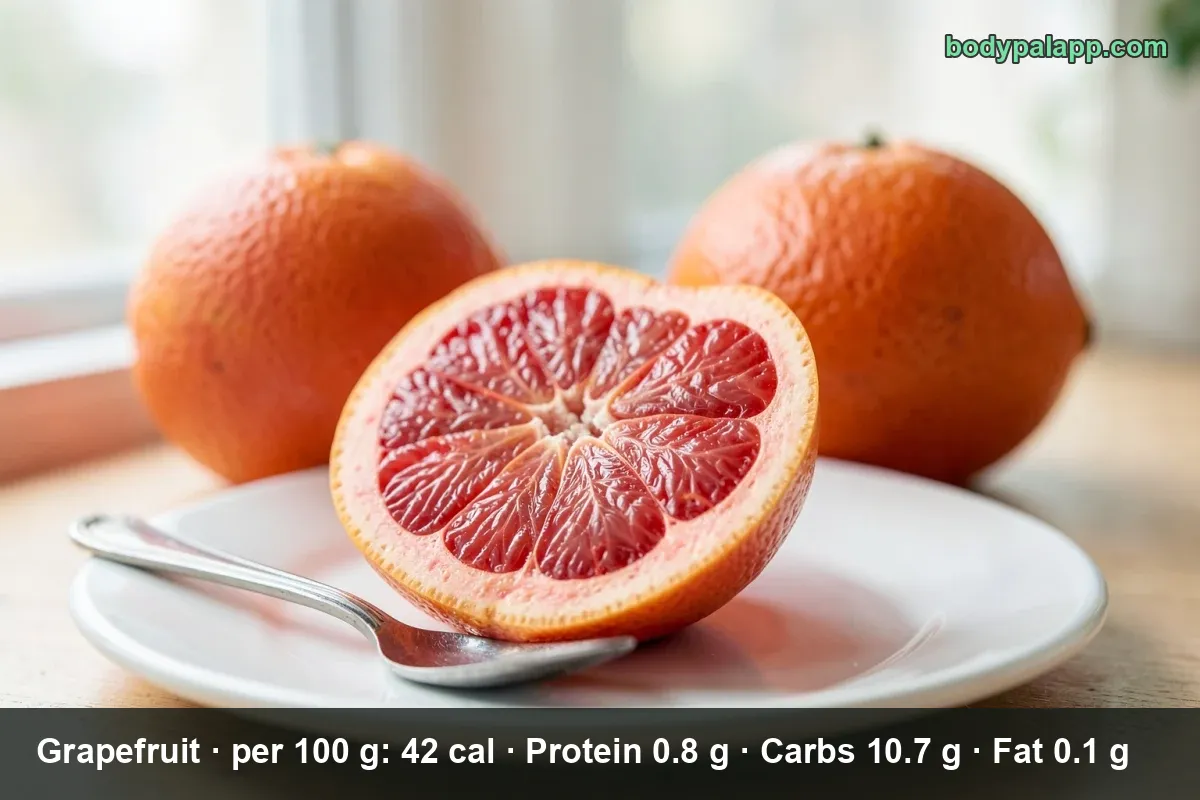
The row behind every number here is SR Legacy 174673, "Grapefruit, raw, pink and red, all areas". That choice matters more than it sounds. American produce aisles are stocked almost entirely with pink and ruby red fruit, and that is the flesh in the photo above, so the pink record is the one that matches what you are actually holding over the sink.
USDA also keeps an older mixed-variety record and a white-fleshed one, both closer to 32 calories per 100 g. Those are not corrections to the pink figure; they describe different fruit, and they get their own table further down. Added sugars are not shown at all, because the SR Legacy edition does not report them and raw fruit has none to report.
| Nutrient | Per 100 g | Per 1/2 grapefruit (123 g) | % Daily Value |
|---|---|---|---|
| Calories | 42 | 52 | — |
| Total fat | 0.14 g | 0.2 g | 0% |
| Saturated fat | 0.02 g | 0.0 g | 0% |
| Carbohydrate | 10.66 g | 13.1 g | 5% |
| Dietary fiber | 1.6 g | 2.0 g | 7% |
| Total sugars | 6.89 g | 8.5 g | — |
| Protein | 0.77 g | 0.9 g | 2% |
| Sodium | 0 mg | 0 mg | 0% |
% Daily Value is based on a 2,000-calorie diet.
Verified nutrition data
Numbers on this page come from USDA FoodData Central, the U.S. Department of Agriculture’s food composition database, and from manufacturer labels where a branded product is named. Last verified September 2026. How we verify our data →
Cholesterol is zero, as it is in every plant food. Potassium is the one mineral worth calling out: 135 mg per 100 g, so 166 mg in half a fruit, about 4% of the FDA Daily Value of 4,700 mg. Total sugars have no Daily Value on the US label, which is why that cell stays empty rather than showing a percentage.
US servings, from one ounce to a whole fruit
| Serving | Weight | Calories |
|---|---|---|
| 1 oz | 28.4 g | 12 kcal |
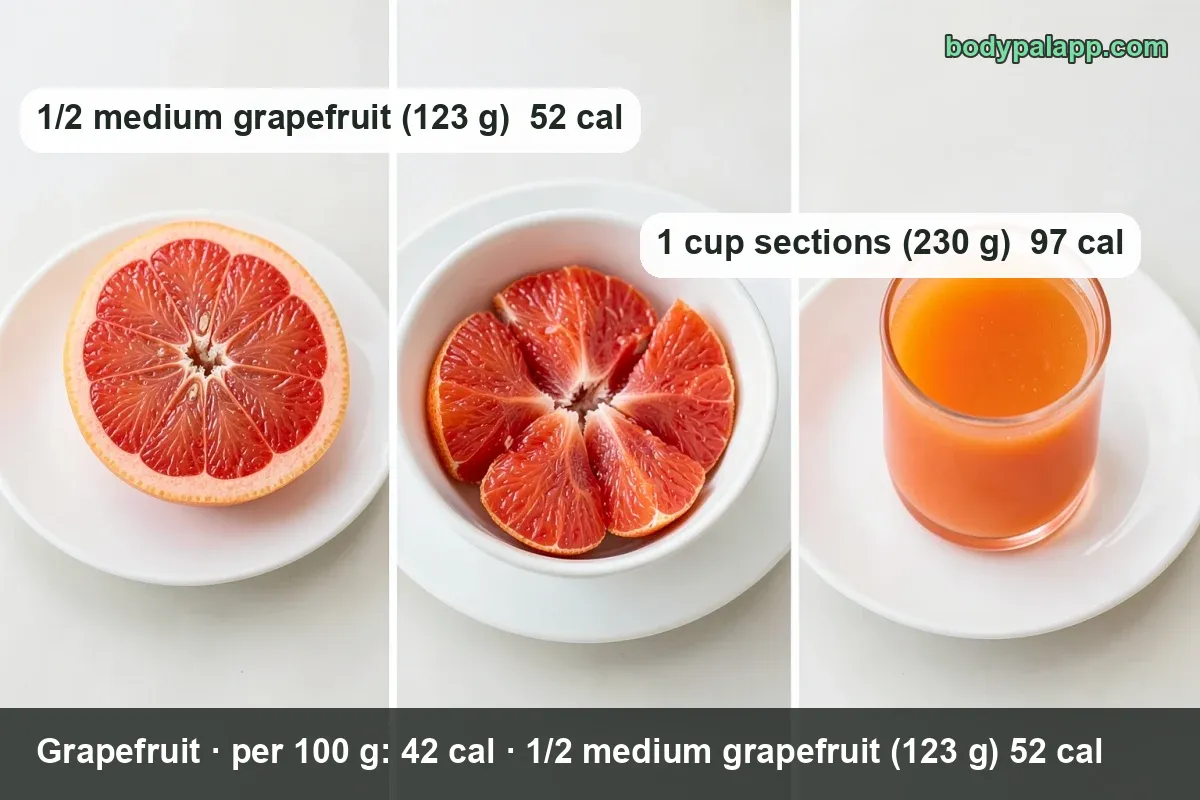
| Half a grapefruit, 3-3/4 in across | 123 g | 52 kcal |
| 1 NLEA serving | 154 g | 65 kcal |
| 1 cup sections, with juice | 230 g | 97 kcal |
| One whole grapefruit, 3-3/4 in across | 246 g | 103 kcal |
| Per 100 g | 100 g | 42 kcal |
The half fruit, the cup of sections and the 154 g NLEA serving are all USDA household measures, so those three come straight off the record. The whole fruit and the ounce are ours: they are our own arithmetic from the USDA 100 g figure, not USDA servings, doubled and scaled from the same 42 calories per 100 g.
Watch the gap between the cup and the half. A cup of sections is 230 g against 123 g for half a shell, because loose segments pack tighter than the curve of the fruit does. People log "half a grapefruit" when they have actually eaten a bowl of segments and lose about 45 calories in the swap. Small on its own, and it repeats every morning.
Pink, white, juiced and canned
| Version | Per 100 g | Typical serving | Calories |
|---|---|---|---|
| All varieties, pink, red and white | 32 kcal | 1/2 medium (128 g) | 41 kcal |
| White grapefruit, raw | 33 kcal | 1/2 fruit (118 g) | 39 kcal |
| Fresh-squeezed grapefruit juice | 39 kcal | 1 cup (247 g) | 96 kcal |
| Canned sections, water pack | 36 kcal | 100 g | 36 kcal |
| Canned sections, light syrup | 60 kcal | 100 g | 60 kcal |
| Bottled juice, unsweetened | 37 kcal | 100 g | 37 kcal |
The pink and white split is real but tiny. White flesh is 33 calories per 100 g against 42 for pink and red, which works out to 39 calories for a 118 g white half versus 52 for a 123 g pink one. Choosing by color to save 13 calories is not a strategy; choosing by which one you will finish is.
The syrup is where the arithmetic changes. Canned sections in water are 36 calories per 100 g, almost the fresh fruit. The same sections in light syrup are 60, because the packing liquid pushes sugars from 8.75 g to 15.04 g per 100 g. Draining helps, but the segments have been sitting in it, so treat the drained figure as somewhere between the two rather than as the water-pack number.
Juice deserves its own warning, covered in the next section. Branded cups follow the fruit closely: a Signature Farms Ruby Red Grapefruit cup runs 51 calories per 100 g and 101 for the 198 g container, a little above raw flesh because the segments sit in their own juice. A 100% juice like Simply Grapefruit is 42 per 100 g, which comes to about 101 calories for an 8 fl oz glass by our own scaling.
Fiber and potassium are the rows worth reading
Half a grapefruit carries 2.0 g of fiber, 7% of the 28 g Daily Value, which is respectable for something that costs 52 calories. Most Americans fall short of that 28 g target, and MyPlate counts half a grapefruit as half a cup of fruit toward the day.
Then there is the juice. A cup of fresh-squeezed grapefruit juice is 96 calories and 0.2 g of fiber. Half a fruit is 52 calories and 2.0 g. The fiber lives in the membranes, and the squeezer keeps them, so juice costs roughly double the calories for a tenth of the fiber. If you are eating grapefruit because it fills you up, the spoon beats the glass by a wide margin.
Sugar is the row people misread. Half a fruit holds 8.5 g of total sugar, which sounds like a lot next to the FDA's 50 g Daily Value for added sugars, but none of it is added sugar and none of it counts against that limit. Sodium is zero, so grapefruit is a free pick if you are watching salt.
One caveat that has nothing to do with calories: the FDA warns that grapefruit juice can interfere with a number of prescription medicines. If you take daily medication, that is a question for your pharmacist rather than your food log.
How does grapefruit compare?
| Fruit | Per 100 g | US serving | Calories |
|---|---|---|---|
| Grapefruit, raw pink and red | 42 kcal | 1 oz (28.4 g) | 12 kcal |
| Strawberries, raw | 32 kcal | 1 oz (28.4 g) | 9 kcal |
| Pineapple, canned in water | 32 kcal | 1 oz (28.4 g) | 9 kcal |
| Limes, raw | 30 kcal | 1 oz (28.4 g) | 9 kcal |
All four ounce figures are our own arithmetic from the USDA 100 g values, held at the same weight so the flesh is compared honestly rather than through four different household measures.
Our take: grapefruit is the heaviest of these four per gram, at 42 calories per 100 g against 30 to 32 for the rest, and it still barely registers. The difference across the whole table is three calories an ounce. For weight loss, pick grapefruit over the strawberries when you want something that takes ten minutes to eat with a spoon and leaves you with 2 g of fiber; pick strawberries when you want volume in a bowl. For satiety per calorie, half a grapefruit at 52 calories is one of the better trades in the produce aisle, and the version to avoid is the one poured into a glass.
Most popular grapefruit brands in the United States
Ranked by how widely each product appears among foods sold in the United States, from the BodyPal food database of over 3.3 million products. Calories are the figures printed on each Nutrition Facts label, checked against USDA FoodData Central.
| Product | Calories (per 100 g) |
|---|---|
| Signature Farms Ruby Red Grapefruit | 51 cal |
| Simply Grapefruit Juice | 42 cal |
Brand popularity: BodyPal food database. Nutrition: manufacturer labels / USDA FoodData Central.
Grapefruit FAQs
How many calories are in half a grapefruit?
Half a medium grapefruit, 123 g of flesh scooped out of a fruit 3-3/4 inches across, is 52 calories. That is the standard USDA serving and the one most people eat at breakfast. The flesh runs 42 calories per 100 g, so the number moves with the size of the half you cut.
How many calories are in a whole grapefruit?
A whole grapefruit of that size holds about 246 g of flesh and comes to 103 calories, our own arithmetic from the USDA 100 g figure rather than a listed serving. It also carries 26.2 g of carbohydrate, 17.0 g of natural sugar and 3.9 g of fiber.
Is pink grapefruit higher in calories than white grapefruit?
Yes, but barely: pink and red grapefruit is 42 calories per 100 g, white grapefruit 33, so half a pink fruit at 123 g is 52 calories against 39 for a 118 g white half. Thirteen calories is not a reason to switch varieties, so pick the one you like.
How many carbs are in a grapefruit?
Half a grapefruit has 13.1 g of carbohydrate, of which 2.0 g is fiber. A whole fruit is 26.2 g. Per 100 g the flesh is 10.66 g, more than white grapefruit at 8.41 g, even though white grapefruit is the one with slightly more sugar, at 7.31 g against 6.89 g.
How much sugar is in a grapefruit?
Half a grapefruit holds 8.5 g of total sugar and a whole one 17.0 g. All of it occurs naturally in the fruit, so none of it counts toward the FDA's 50 g Daily Value for added sugars. Canned sections in light syrup are the version that genuinely adds sugar.
How much fiber does a grapefruit have?
Half a grapefruit gives 2.0 g of fiber, 7% of the 28 g Daily Value, and a whole one 3.9 g. Juice is where it disappears: a cup of fresh-squeezed grapefruit juice has 0.2 g, because the membranes that hold the fiber stay behind in the squeezer.
Does grapefruit juice have the same calories as the fruit?
A cup of fresh-squeezed grapefruit juice, 247 g, is 96 calories, against 52 for half a fruit, because it takes more than one grapefruit to fill a cup. Per 100 g the two are close, 39 for juice and 42 for the flesh, but juice brings 0.2 g of fiber instead of 2.0 g.
How many calories are in a cup of grapefruit sections?
A cup of grapefruit sections with their juice weighs 230 g and comes to 97 calories, a USDA household measure rather than our own scaling. That is close to a whole fruit at 103 calories, because loose segments pack more flesh into a cup than half a shell holds.
Similar foods
- Red Grapefruit — 52 cal per half grapefruit
- Blackberries — 2 cal per blackberry
- Papaya — 34 cal for 1/2 small papaya
- Berries — 66 cal per cup
- Nectarine — 31 cal for 1/2 medium
- White Nectarine — 62 cal per medium nectarine
Count it without the math
Point the camera at the plate and BodyPal counts the grapefruit for you, half or whole.


How long does it take to burn off grapefruit?
Half a medium grapefruit (123 g) is 52 kcal. Enter your weight and the amount you ate to see how long it takes you to burn that off:
lb
| Activity | Time to burn 52 kcal |
|---|---|
| Walking, brisk | 10 min |
| Cycling, moderate | 6 min |
| Swimming, moderate | 7 min |
| Jogging | 6 min |
| Weight training, moderate | 12 min |
Times are for a 155 lb adult at a steady pace; change the weight to see yours. The amount is set to the portion in the text (123 g); change it to what you actually ate. BodyPal works this out from your steps automatically.
Burning it off is one side of it. The other is knowing your number: work out how many calories you need a day, with macros and a goal date.