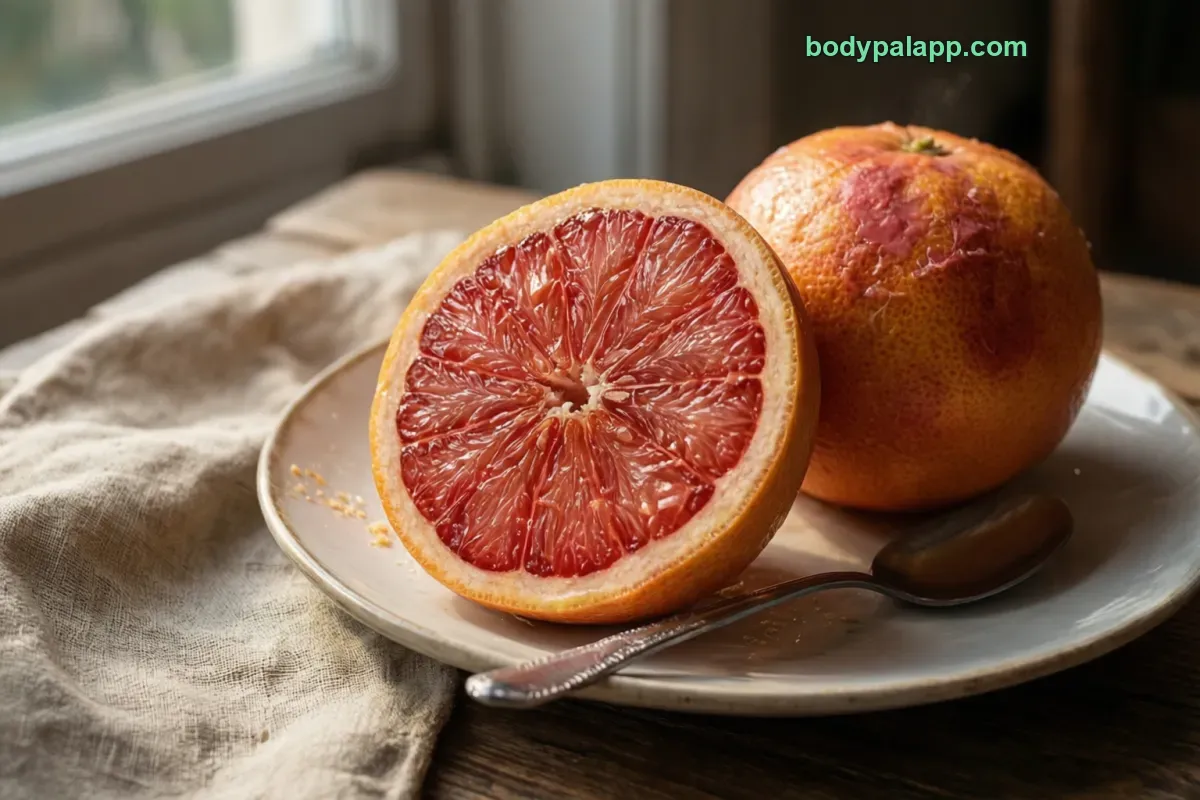
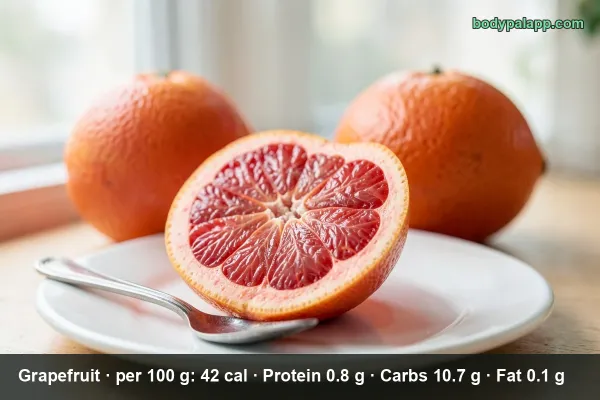
Red grapefruit calories come to 52 for half a fruit (123 g) and 42 per 100 g. Almost all of that energy is carbohydrate, 91% of calories, while fat sits at 0.1 g and sodium at 0 per 100 g. What moves your total is how many halves you eat, not the fruit itself.
52kcal
1 half grapefruit · 123 g, raw, pink and red
7%protein
0.9 gProtein
13 gCarbs
0.2 gFat
How to burn off 52 kcal
—Walking, brisk
—Jogging
—Cycling, moderate
—Swimming
Skip the math. BodyPal counts these calories from your steps and workouts automatically.
Nutrition facts
Raw, pink and red · per 123 g
Calories
52 kcal
Protein
0.9 g
Carbohydrate
13.1 g
Fat
0.2 g
Saturated fat
0 g
Cholesterol
0 mg
Sodium
0 mg
Potassium
166 mg
Iron
0.1 mg
Source: USDA FoodData Central
🛡️
Verified nutrition data
Numbers on this page come from USDA FoodData Central, the U.S. Department of Agriculture’s food composition database, and from manufacturer labels where a branded product is named. Last verified September 2026. How we verify our data →
Red grapefruit: calories, protein and sodium by serving
Percent of daily value uses the FDA reference of 2,000 kcal a day.
Serving
kcal
Protein
Carbs
Fat
Sodium
% DV kcal
Half fruit (123 g)
52
0.9 g
13.1 g
0.2 g
0 mg
3%
1 cup sections (230 g)
97
1.8 g
24.5 g
0.3 g
0 mg
5%
100 g
42
0.8 g
10.7 g
0.1 g
0 mg
2%
3 × Half fruit (123 g)
155
2.8 g
0 mg
5 × Half fruit (123 g)
258
4.7 g
0 mg
Half a fruit is a 52-calorie start
The standard serving is half a fruit, 123 g, and it comes to 52 calories. That is 3% of the daily calorie value, delivered with 13.1 g of carbs, 2 g of fiber and 0.9 g of protein. A bowl of sections is the larger everyday portion: one cup weighs 230 g and lands at 97 calories, or 5% of the daily value.
Halves stack in a straight line. Two halves, 246 g, reach 103 calories, which is the realistic number if you eat the whole fruit in one go. Three halves, 369 g, come to 155. Even five halves, 615 g of fruit, stop at 258 calories, far more grapefruit than most people eat in a sitting.
So portion size matters less here than with denser foods, but it still matters for logging. Fruit runs large and small, and a big half can sit well above 123 g on the scale. Weigh one once, note the gram count, and your entries will match what actually lands in the bowl.
Carbs supply 91% of the calories
The calorie split is lopsided: 91% from carbohydrate, 7% from protein and 3% from fat. Per 100 g that works out to 10.7 g of carbs, 0.8 g of protein and 0.1 g of fat. Saturated fat and cholesterol both read 0.
Of those 10.7 g of carbs, 6.9 g are sugars and 1.6 g are fiber. Half a fruit carries 8.5 g of sugars alongside 2 g of fiber, and a cup of sections carries 15.8 g of sugars with 3.7 g of fiber. The sweetness is real, but it comes with plenty of juicy volume, which is why 100 g still stops at 42 calories.
Protein is the weak spot. A half fruit gives 0.9 g, just 2% of the daily value, and even a full cup of sections reaches only 1.8 g. On its own, grapefruit is a light, bright start rather than a complete breakfast, so treat it as the fruit side of the plate and let something else do the heavy lifting.
Sodium reads 0, so toppings set the salt and sugar
Every serving on the card lists 0 mg of sodium, 0% of the daily value whether you eat a half, a cup or 100 g. Potassium is the mineral that does register, at 135 mg per 100 g. If you watch sodium, the fruit itself needs no accounting at all.
The salt in a grapefruit breakfast comes from what sits next to it. Toast, cheese, bacon and smoked salmon all bring sodium the fruit does not have. Some people also sprinkle salt on cut halves to tame the bitterness, and that pinch belongs in your log as its own line.
Sugar on top is the more common add-on. A spoonful sprinkled over a half lands on top of the 8.5 g of sugars already in the fruit, and a drizzle of honey does the same. If you track sugars, log the topping separately so the 52-calorie half stays a 52-calorie half in your records.
Pair it with protein and keep juice separate
At 52 calories, a half fruit leaves nearly the whole meal for something more filling. Eggs, Greek yogurt or cottage cheese cover the protein the fruit lacks, and the tart bite cuts through richer foods. Segments also work in salads with avocado or shrimp, where they add color and volume for few calories.
Juice is a different product, not a liquid version of these numbers. Bottles such as Ocean Spray Ruby Red Grapefruit Juice Drink or Tropicana's ruby red juice follow their own recipes and carry their own labels. Packaged fruit like Del Monte Red Grapefruit may also differ from fresh, so read the label before you log it.
For fresh fruit, the numbers on this page apply as they stand, and they cover pink as well as red varieties. BodyPal can log a grapefruit half from a photo, which saves weighing it at the breakfast table on busy mornings.
How does red grapefruit compare?
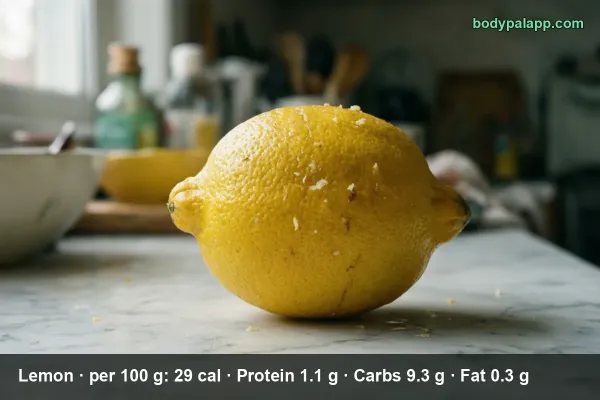
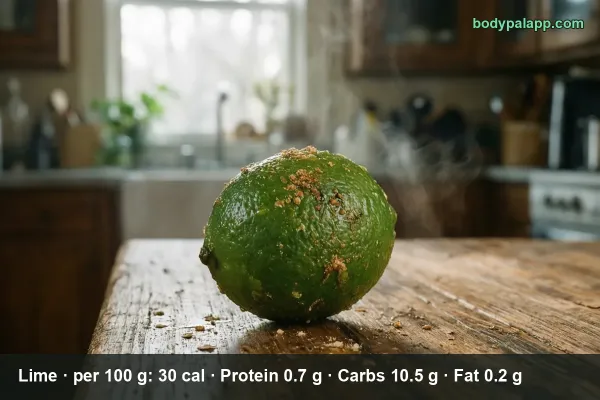
Here is red grapefruit next to regular grapefruit, lemon and lime, per 100 g and per usual serving.
Verdict: Red and regular grapefruit tie at 42 calories per 100 g, so choose by taste and color. Lemon at 29 and lime at 30 are lighter, but nobody eats them by the bowl, which makes grapefruit the low-calorie pick for a fruit you actually eat as a serving.
Most popular red grapefruit brands in the United States
Ranked by popularity in the BodyPal database
# Productkcal / 100 g
1Signature Farms Ruby Red Grapefruit1 container · 198 g51 kcal
2Ocean Spray Original Ruby Red Grapefruit Juice Drink From Concentrate8 fl oz · 240 ml42 kcal
3Ocean Spray Ruby Red Grapefruit Juice Drink8 fl oz · 240 ml46 kcal
4Ocean Spray Diet Ruby Red Grapefruit Juice Drink8 fl oz · 240 ml2 kcal
5Tropicana Ruby Red Grapefruit 100% Juice With Calcium and Vitamin D8 fl oz · 240 ml38 kcal
6Del Monte Red Grapefruit1 container · 198 g51 kcal
The refrigerated cups are packed in juice and the bottled drinks are sweetened or diluted, so their label numbers do not match the 42 calories per 100 g of the raw fruit. Source: manufacturer labels / USDA FoodData Central.
Red grapefruit FAQs
How many calories are in half a red grapefruit?
Half a fruit (123 g) is 52 calories. A full cup of sections with juice is 97 calories.
Is red grapefruit good for weight loss?
It has 42 calories per 100 g, and half a fruit is 52 calories with about 2.0 g of fiber.
Red grapefruit vs regular grapefruit: which has more calories?
They are the same, 42 calories per 100 g for pink and red fruit. Florida-grown pink and red grapefruit is lower at 30 calories per 100 g.
How much sugar is in red grapefruit?
About 6.9 g per 100 g, so half a fruit (123 g) has roughly 8.5 g of sugar and 13.1 g of carbs.
How many calories are in a whole red grapefruit?
A whole red grapefruit, counted as two halves of 123 g each, comes to 103 calories for 246 g of fruit. Larger or smaller fruit will shift that total, so weigh it once if you track closely.
What are the grapefruit nutrition facts per 100 g?
Per 100 g, red grapefruit has 42 calories, 10.7 g of carbs, 6.9 g of sugars, 1.6 g of fiber, 0.8 g of protein and 0.1 g of fat. Sodium and cholesterol are 0, and potassium is 135 mg.
How many calories are in a cup of grapefruit sections?
One cup of red grapefruit sections, 230 g, has 97 calories, which is 5% of the daily value. That cup also brings 24.5 g of carbs, 15.8 g of sugars, 3.7 g of fiber and 1.8 g of protein.
How much protein and fiber does half a red grapefruit have?
Half a red grapefruit has 0.9 g of protein, 2% of the daily value, and 2 g of fiber. Protein supplies only 7% of its calories, so pair it with eggs or yogurt if you want a fuller breakfast.
Does red grapefruit have any fat or sodium?
Barely any fat and no sodium: 100 g has 0.1 g of fat and 0 mg of sodium, with 0 saturated fat. Fat accounts for just 3% of its calories, so nearly all the energy comes from carbs.
Is pink grapefruit the same in calories as red?
Yes, the USDA groups pink and red grapefruit together at 42 calories per 100 g. Half a fruit of either color, 123 g, comes to 52 calories.