
How many calories are in halibut?
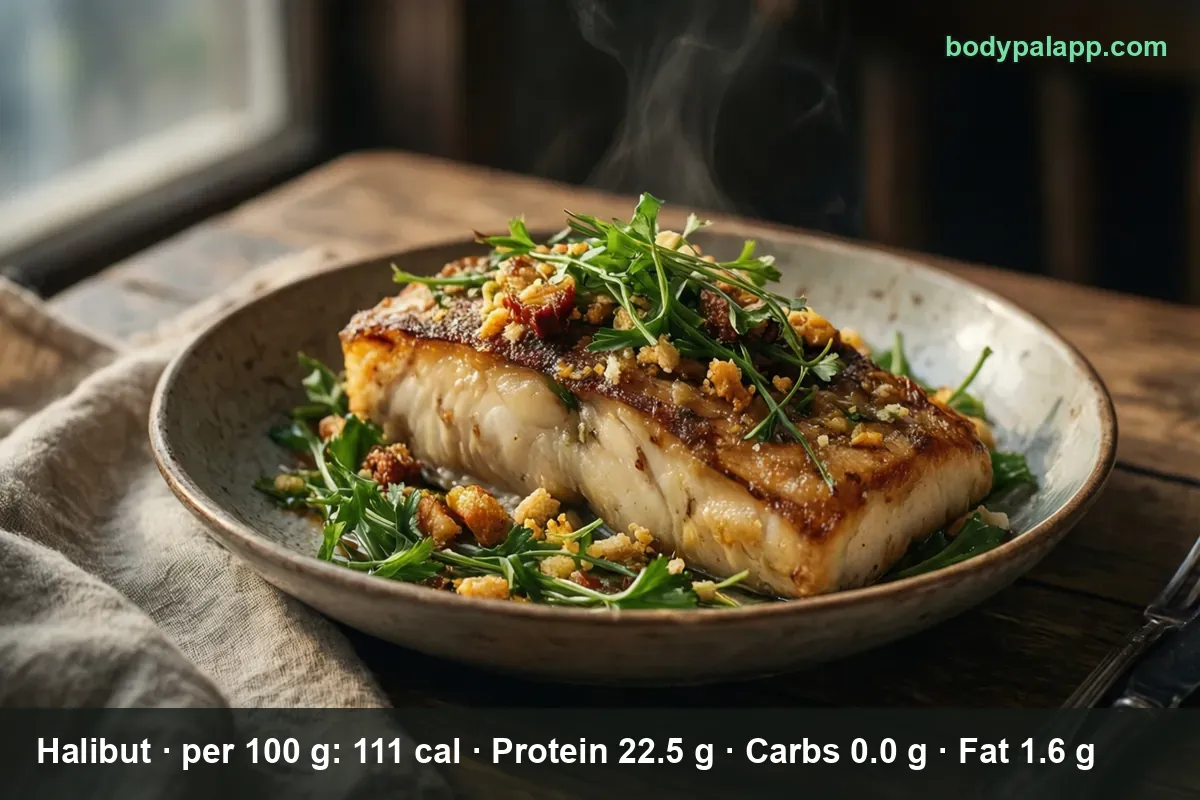
A 3 oz (85 g) cooked halibut serving carries 94 calories, and per 100 g the fish runs 111 calories. Half a fillet, the piece most people actually put on a plate, comes to 176. Nearly all of that is protein: 19.2 g in the 3 oz portion, against 1.4 g of fat.
On this page
- Halibut quick facts
- US servings, from one ounce to a whole fillet
- Raw, cooked, Greenland and breaded
- Protein is the number that stands out
- How does halibut compare?
- Most popular halibut brands
- Halibut FAQs
Halibut quick facts
The row below is SR Legacy 174201, "Fish, halibut, Atlantic and Pacific, cooked, dry heat". That is the fish on the counter at a US market and the one in the pan: Pacific or Atlantic halibut, baked, broiled or grilled with no batter and no added fat. USDA's FNDDS entry for halibut carries 7.79 g of carbohydrate per 100 g, which only happens when the fillet is breaded, so it belongs in the variants table further down rather than at the top of this page.
Greenland halibut is a different fish with a different fat number, and it gets its own row too. Everything here is the plain cooked fillet.
| Nutrient | Per 100 g | Per 3 oz (85 g) | % Daily Value |
|---|---|---|---|
| Calories | 111 | 94 | — |
| Total fat | 1.61 g | 1.4 g | 2% |
| Saturated fat | 0.35 g | 0.3 g | 2% |
| Carbohydrate | 0 g | 0 g | 0% |
| Dietary fiber | 0 g | 0 g | 0% |
| Total sugars | 0 g | 0 g | — |
| Protein | 22.54 g | 19.2 g | 38% |
| Sodium | 82 mg | 70 mg | 3% |
% Daily Value is based on a 2,000-calorie diet.
Verified nutrition data
Numbers on this page come from USDA FoodData Central, the U.S. Department of Agriculture’s food composition database, and from manufacturer labels where a branded product is named. Last verified September 2026. How we verify our data →
There is no added sugars row because USDA does not publish added sugars for this record, and plain fish has none to publish. Two rows worth pulling out of the record anyway: cholesterol is 60 mg per 100 g, or 51 mg in the 3 oz serving (17% DV), and potassium is 528 mg per 100 g, 449 mg in the serving (10% DV). For a piece of fish that costs you under 100 calories, the potassium is quietly good value.
US servings, from one ounce to a whole fillet
| Serving | Weight | Calories |
|---|---|---|
| 1 oz cooked | 28 g | 31 kcal |
| 3 oz cooked, the standard protein portion | 85 g | 94 kcal |
| Half a fillet | 159 g | 176 kcal |
| 6 oz cooked | 170 g | 189 kcal |
| One whole fillet | 318 g | 353 kcal |
| Per 100 g | 100 g | 111 kcal |
USDA lists the half fillet (159 g) and the 3 oz portion as household measures for this record. The 1 oz, 6 oz and whole-fillet lines are our own arithmetic from the USDA 100 g figure, not USDA servings.
Here is the trap in the 6 oz line, and it is the one that trips people who weigh their fish before it hits the pan. A 6 oz raw fillet is not a 6 oz cooked fillet. Raw halibut is 91 calories per 100 g, cooked is 111, and the difference is water leaving, not calories arriving. Run the arithmetic in the other direction and 170 g of raw halibut ends up around 139 g on the plate — about 4.9 oz — carrying roughly 155 calories. So "6 oz of halibut" is 189 calories if you weighed it after cooking and about 155 if you weighed it at the store. Both of those are our scaling from the USDA 100 g numbers.
Store labels sit on the raw side of that gap. Six US retail halibut packages in USDA's Branded data run from 80 to 131 calories per 100 g, with a Walmart 4 oz (113 g) fillet at 90 calories and a 7 oz (198 g) Target fillet at 259. Those are raw weights on raw labels, which is why most of them read lower per gram than the cooked row at the top of this page.
Raw, cooked, Greenland and breaded
One word on a menu covers two different fish and three different cooking outcomes. The spread is larger than most people expect.
| Version | Per 100 g | Typical serving | Calories |
|---|---|---|---|
| Halibut, cooked dry heat (this page) | 111 kcal | 3 oz (85 g) | 94 kcal |
| Halibut, raw | 91 kcal | 3 oz (85 g) | 77 kcal |
| Halibut with skin, raw (Alaska Native) | 116 kcal | 3 oz (85 g) | 99 kcal |
| Halibut with skin, cooked (Alaska Native) | 113 kcal | 3 oz (85 g) | 96 kcal |
| Greenland halibut, raw | 186 kcal | 3 oz (85 g) | 158 kcal |
| Greenland halibut, cooked | 239 kcal | 3 oz (85 g) | 203 kcal |
| Breaded halibut (FNDDS) | 175 kcal | 1 fillet (140 g) | 245 kcal |
Greenland halibut is the one to notice. Cooked, it is 239 calories per 100 g against 111 for Pacific or Atlantic halibut, and 17.74 g of fat against 1.61 g. That is more than double the calories and roughly eleven times the fat under the same four-letter name on the same menu. It is often the cheaper fish in the freezer case, sold as Greenland turbot, and it is not a swap you can make silently in a calorie log.
Skin barely moves anything. With skin on, cooked halibut is 113 calories per 100 g instead of 111 — a two-calorie difference per 100 g, which is noise next to the species question.
Breading is the other real change. The FNDDS breaded fillet is 175 calories per 100 g and brings 7.79 g of carbohydrate and 334 mg of sodium per 100 g, against 82 mg in the plain cooked fish. That is four times the sodium and, at 140 g, about 468 mg in one fillet by our own scaling from the 100 g figure.
Protein is the number that stands out
The 3 oz serving delivers 19.2 g of protein for 94 calories — 38% of the Daily Value for protein while using under 5% of a 2,000-calorie day. Against the FDA Daily Values, the fat rows barely register: 2% DV for total fat, 2% for saturated fat.
That combination is the whole argument for halibut. MyPlate counts 1 oz of cooked seafood as one ounce-equivalent of protein foods, so a 3 oz portion covers three of them and costs less than a plain bagel. If you are watching sodium, the plain fillet at 70 mg per serving is the version to buy; the breaded one is the version to think about.
Cholesterol is the row people ask about with white fish. It is 51 mg per 3 oz serving, 17% of the 300 mg Daily Value. That is real but modest, and it sits alongside 449 mg of potassium in the same portion.
How does halibut compare?
| Fish | Per 100 g | US serving | Calories | Protein per 100 g |
|---|---|---|---|---|
| Halibut, cooked | 111 kcal | 3 oz (85 g) | 94 kcal | 22.54 g |
| Tuna, cooked | 176 kcal | 3 oz (85 g) | 150 kcal | 30.31 g |
| Trout, steamed | 178 kcal | 3 oz (85 g) | 151 kcal | 25.19 g |
| Catfish, grilled | 171 kcal | 3 oz (85 g) | 145 kcal | 19.31 g |
Our take: halibut is the lightest of these four per gram and per serving, by a wide margin — 94 calories against 145 to 151 for the same 3 oz of tuna, trout or catfish. For a calorie budget, halibut wins outright. For protein per gram, tuna is the denser buy: 30.31 g per 100 g against halibut's 22.54 g, and it lands at 150 calories in a 3 oz portion. Pick halibut when the rest of the plate is doing the heavy lifting; pick tuna when the fish has to carry the protein target on its own. And check which halibut you bought before either comparison means anything.
Most popular halibut brands in the United States
Ranked by how widely each product appears among foods sold in the United States, from the BodyPal food database of over 3.3 million products. Calories are the figures printed on each Nutrition Facts label, checked against USDA FoodData Central.
| Product | Calories (per 100 g) |
|---|---|
| Alaska Seafood Halibut Fillets | 80 cal |
| Full Circle Wild Alaska Halibut Steaks | 88 cal |
| Simply Balanced Alaskan Halibut Fillet | 131 cal |
| Roundy's Fisherman's Reserve Halibut Fillets | 88 cal |
| Waterfront Bistro Halibut | 106 cal |
| Sea Best Halibut Portions | 89 cal |
Brand popularity: BodyPal food database. Nutrition: manufacturer labels / USDA FoodData Central.
Halibut FAQs
How many calories are in a 6 oz halibut fillet?
189 calories, if those 6 ounces (170 g) are weighed after cooking, at 111 calories per 100 g. If you weighed the fillet raw, it loses water in the pan and lands near 139 g cooked, carrying about 155 calories. Both figures are our arithmetic from the USDA 100 g number.
How much protein is in halibut?
19.2 g of protein in a 3 oz (85 g) cooked serving, which is 38% of the Daily Value, and 22.54 g per 100 g. It arrives with 1.4 g of fat and zero carbohydrate in that serving, so almost every one of the 94 calories comes from protein itself.
Is halibut good for weight loss?
At 94 calories and 19.2 g of protein per 3 oz serving, halibut is one of the cheapest ways to fill a protein slot. It is lighter than tuna, trout or catfish, which run 145 to 151 calories for the same 3 ounces. What you cook it in moves the total far more than the fish does.
Does baked halibut have more calories than raw?
Per 100 g, yes: 111 calories cooked against 91 raw. Nothing is added by dry heat, though. Water leaves, the fish shrinks, and the calories concentrate into fewer grams. A given fillet holds the same calories before and after baking as long as no oil or butter joins it.
How many calories in grilled halibut?
94 calories in a 3 oz (85 g) portion, the same as baked or broiled. USDA files grilling, baking and broiling together as cooked by dry heat, record 174201. Oil, butter or a marinade brushed on during grilling is extra and is not counted in that 94.
Is Greenland halibut higher in fat than Pacific halibut?
Far higher: 17.74 g of fat per 100 g cooked against 1.61 g for Atlantic and Pacific halibut. Calories follow, at 239 per 100 g against 111. A 3 oz serving of cooked Greenland halibut is 203 calories, more than double the 94 in the same weight of Pacific halibut.
How much sodium is in halibut?
70 mg in a 3 oz cooked serving, 3% of the Daily Value, and 82 mg per 100 g before anything is seasoned. That is roughly a thirtieth of a teaspoon of table salt. Breaded halibut is a different story at 334 mg per 100 g, about four times as much.
Is halibut high in cholesterol?
A 3 oz serving has 51 mg of cholesterol, 17% of the 300 mg Daily Value, and 60 mg per 100 g. That is middling for seafood and comes with only 0.3 g of saturated fat per serving, which is the row the current Nutrition Facts label puts more weight on.
Similar foods
- Mahi Mahi — 173 cal per cooked fillet
- Steamed Shrimp Dumplings — 170 cal for 6 steamed dumplings
- Raw Tuna — 93 cal per 3 oz
- Tuna Sashimi — 31 cal per piece
- Tuna Tartare — 93 cal per 3 oz
- Fish Grilled — 151 cal per fillet
Count it without the math
Point the camera at the plate and BodyPal counts the fillet for you, skin, breading and all.


How long does it take to burn off halibut?
A 3 oz (85 g) cooked serving is 94 kcal. Enter your weight and the amount you ate to see how long it takes you to burn that off:
lb
| Activity | Time to burn 94 kcal |
|---|---|
| Walking, brisk | 19 min |
| Cycling, moderate | 12 min |
| Swimming, moderate | 13 min |
| Jogging | 11 min |
| Weight training, moderate | 21 min |
Times are for a 155 lb adult at a steady pace; change the weight to see yours. The amount is set to the portion in the text (85 g); change it to what you actually ate. BodyPal works this out from your steps automatically.
Burning it off is one side of it. The other is knowing your number: work out how many calories you need a day, with macros and a goal date.