
How many calories are in a hamburger?
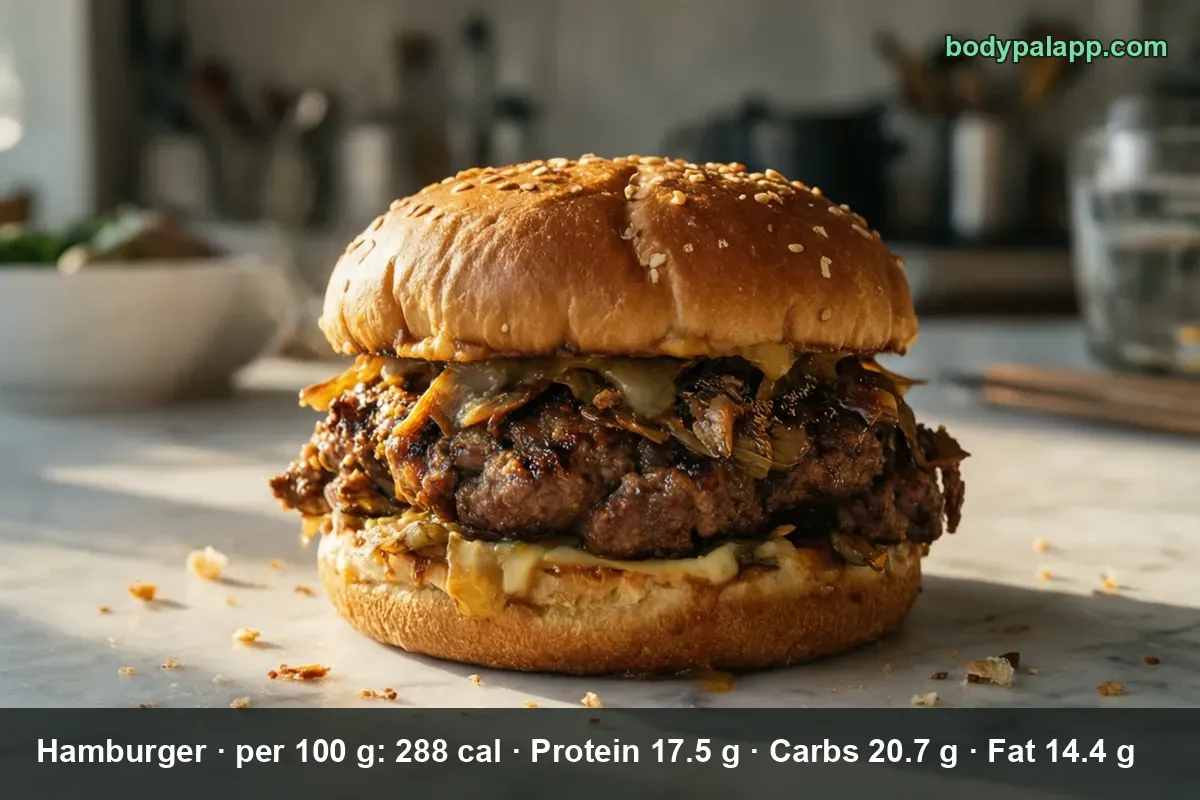
One standard hamburger weighs 145 g and carries 418 calories. Per 100 g it runs 288 calories, and that figure covers the whole sandwich: white bun, beef patty, onion and pickle. Half of one is 209 calories. Two of them, the way most people actually order, come to 835.
On this page
- Hamburger quick facts
- US servings, from one ounce to two burgers
- Buns, patty sizes and sliders
- Saturated fat is the row that outruns the calories
- How does a hamburger compare?
- Most popular hamburger brands
- Hamburger FAQs
Hamburger quick facts
Every number here comes from FNDDS 2706920, "Hamburger, NFS". NFS means not further specified, which is exactly what you want when you order a burger and nobody hands you a spec sheet. It is the assembled sandwich, and it is the only hamburger record with a documented household portion of one hamburger at 145 g.
| Nutrient | Per 100 g | Per 1 hamburger (145 g) | % Daily Value |
|---|---|---|---|
| Calories | 288 | 418 | — |
| Total fat | 14.38 g | 20.9 g | 27% |
| Saturated fat | 5.5 g | 8.0 g | 40% |
| Carbohydrate | 20.68 g | 30.0 g | 11% |
| Dietary fiber | 0.7 g | 1.0 g | 4% |
| Total sugars | 3 g | 4.4 g | — |
| Protein | 17.51 g | 25.4 g | 51% |
| Sodium | 355 mg | 515 mg | 22% |
% Daily Value is based on a 2,000-calorie diet.
Verified nutrition data
Numbers on this page come from USDA FoodData Central, the U.S. Department of Agriculture’s food composition database, and from manufacturer labels where a branded product is named. Last verified September 2026. How we verify our data →
Two rows you would see on a wrapper are missing here: added sugars and trans fat. This edition of FNDDS does not publish either value for hamburger records, so they stay off the table rather than getting guessed at. Cholesterol is 71 mg per burger, 24% of the Daily Value, and potassium is 332 mg, 7%.
The other USDA hamburger records barely argue with this one on a per-gram basis:
| USDA record | Per 100 g | What changes |
|---|---|---|
| Hamburger, NFS (2706920) | 288 kcal | the record used above |
| On a white bun, medium patty (2706932) | 288 kcal | identical profile to NFS |
| On a white bun, small patty (2706927) | 287 kcal | more bun per gram, 22.22 g carbs |
| On a white bun, large patty (2706934) | 289 kcal | more beef, only 17.12 g carbs |
| On a wheat bun, medium patty (2706933) | 281 kcal | fiber jumps to 2.2 g |
| From a school cafeteria (2706925) | 243 kcal | leaner patty, 7.36 g fat |
| Hamburger slider (2706926) | 288 kcal | same build, smaller sandwich |
| Fast foods, single patty, plain (170693) | 297 kcal | older record, bare bun and beef |
Every one of those except the school-cafeteria burger lands between 281 and 297 calories per 100 g. The spread is the preparation, not the source. So the honest answer to "how many calories in a hamburger" is a weight question, and the rest of this page is about weight.
US servings, from one ounce to two burgers
| Serving | Weight | Calories |
|---|---|---|
| 1 oz | 28 g | 81 kcal |
| Half a hamburger | 72.5 g | 209 kcal |
| 4 oz | 113 g | 325 kcal |
| One hamburger | 145 g | 418 kcal |
| Two hamburgers | 290 g | 835 kcal |
| Per 100 g | 100 g | 288 kcal |
Only the 145 g line is a USDA household measure. The ounce, half-burger, 4 oz and two-burger rows are our own arithmetic scaled from the USDA 100 g figure, not USDA servings.
That two-burger row is the one worth sitting with. A pair of plain hamburgers is 835 calories before a single fry, and 25.4 g of protein doubles to 50.8 g, which is more protein than most people need in one sitting. If you are logging a burger from a diner rather than a chain, weigh it once: patties in the wild run from 2 oz to 6 oz, and a heavy one pushes the sandwich past 200 g, which is over 570 calories on the same USDA math.
Buns, patty sizes and sliders
| Version | Per 100 g | Typical piece | Calories |
|---|---|---|---|
| Hamburger, NFS | 288 kcal | 1 hamburger (145 g) | 418 kcal |
| On a wheat bun | 281 kcal | 1 hamburger (145 g) | 407 kcal |
| Large patty | 289 kcal | 1 hamburger (145 g) | 419 kcal |
| Small patty | 287 kcal | 1 hamburger (145 g) | 416 kcal |
| Fast-food, small patty | 285 kcal | 1 hamburger (145 g) | 413 kcal |
| Fast-food slider | 285 kcal | 1 miniature burger (50 g) | 143 kcal |
| Burger King hamburger | 254 kcal | 1 hamburger (100 g) | 254 kcal |
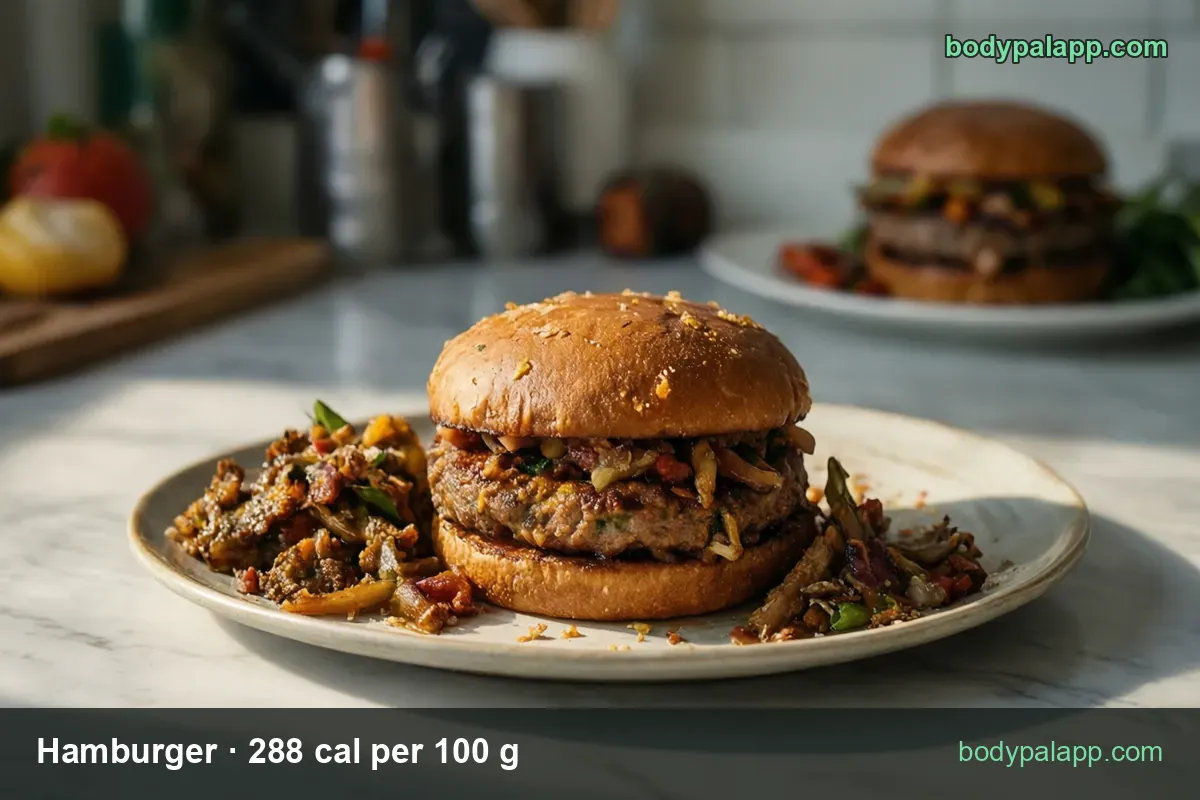
The 145 g lines in that table are our own scaling from each record's USDA 100 g figure; only the slider and Burger King rows use a USDA portion. Hold the top four rows next to each other for a second. Swapping a small patty for a large one moves a 145 g sandwich by three calories, because you are trading bun for beef inside the same weight. What the swap does change is the macro split: the large-patty record carries 18.43 g protein and 17.12 g carbohydrate per 100 g, the small-patty one 17.1 g protein and 22.22 g carbohydrate. Same calories, different sandwich.
The wheat bun is the only variant that moves anything a dietitian would care about. At 145 g it is 407 calories, eleven fewer than the white-bun version, and fiber goes from 1.0 g to 3.2 g per burger by our arithmetic from the 2.2 g per 100 g figure. Eleven calories is noise. Two extra grams of fiber is not.
Sliders are the clean case of portion, not recipe. The 50 g fast-food slider is 143 calories and the sit-down miniature burger at 70 g is 202, both at essentially the same density as a full-size burger. Three of the 50 g sliders and one hamburger land in the same neighborhood.
Packaged burgers behave the same way. USDA's Branded records list AdvancePierre Steakburgers at 490 calories for a 148 g sandwich, Great Value Mini Burgers at 350 for two (115 g) and Banquet Burger Sliders at 280 for two (95 g). Frozen patties sold on their own are denser still: a Ball Park flame-grilled burger is 310 calories for one cooked 99 g patty, with no bun in the number at all.
Saturated fat is the row that outruns the calories
One hamburger is 21% of a 2,000-calorie day but 40% of the Daily Value for saturated fat at 8.0 g. That gap is the useful fact on this page. The burger costs you twice as much of your saturated fat budget as it does of your calorie budget, which is why a burger lunch pairs badly with a cheese-heavy dinner even when the calories fit.
Sodium is the second row to watch: 515 mg, 22% of the Daily Value, roughly a fifth of a teaspoon of table salt, and that is before ketchup, pickles on the side or fries. Two burgers put you at 1,030 mg, nearly half the day.
The protein side is genuinely strong. At 25.4 g per burger, 51% of the Daily Value, one hamburger covers about half a day's protein target for a 2,000-calorie diet, and beef is on MyPlate's protein foods list for exactly that reason. If you are choosing between a burger and a similar-calorie pastry lunch, the burger is the pick that keeps you full. If you are watching saturated fat, the same burger is the one to trim.
How does a hamburger compare?
| Burger | Per 100 g | US serving | Calories |
|---|---|---|---|
| Hamburger, NFS | 288 kcal | 1 hamburger, 145 g | 418 kcal |
| Hamburger slider | 288 kcal | 1 miniature burger, 70 g | 202 kcal |
| School cafeteria hamburger | 243 kcal | 1 hamburger, 90 g | 219 kcal |
| McDonald's hamburger | 263 kcal | 1 hamburger, 100 g | 263 kcal |
Our take: only two of these are actually leaner food, the school-cafeteria burger at 243 calories per 100 g and the McDonald's one at 263. The slider is not lighter at all, it is the same 288 per 100 g in a smaller wrapper, and it comes in under half a full burger purely because it weighs half as much. For weight loss the smart move is the chain hamburger, which is a real 263-calorie sandwich you do not have to portion yourself. For fullness, the 145 g burger and its 25.4 g of protein wins outright, and you spend the extra 155 calories on purpose.
Most popular hamburger brands in the United States
Ranked by how widely each product appears among foods sold in the United States, from the BodyPal food database of over 3.3 million products. Calories are the figures printed on each Nutrition Facts label, checked against USDA FoodData Central.
| Product | Calories (per 100 g) |
|---|---|
| AdvancePierre Steakburgers | 331 cal |
| Great Value Mini Burgers | 304 cal |
| Banquet Burger Sliders | 295 cal |
| Ball Park Flame Grilled Burger | 313 cal |
| Best Yet Ground Beef Hamburgers | 304 cal |
| Marvel 100% Beef Premium Hamburgers | 310 cal |
Brand popularity: BodyPal food database. Nutrition: manufacturer labels / USDA FoodData Central.
Hamburger FAQs
How many calories are in one hamburger?
418 calories for one hamburger weighing 145 g, from the USDA's "Hamburger, NFS" record at 288 calories per 100 g. That covers the whole sandwich: white bun, beef patty and the usual onion and pickle. Half a burger is 209 calories and two are 835. Cheese, bacon and fries sit outside that figure.
How many calories in a hamburger without the bun?
A cooked beef patty on its own runs about 240 to 310 calories, going by branded US patties: 240 for a 79 g Best Yet cooked burger and 310 for a 99 g Ball Park flame-grilled one. USDA's hamburger records always include the bun, so they cannot be split into patty and bread.
Is a hamburger a good source of protein?
Yes: 25.4 g of protein per 145 g burger, which is 51% of the Daily Value in a single sandwich. That comes alongside 20.9 g of fat, so the burger is a strong protein source rather than a lean one. A wheat-bun version delivers about the same protein for eleven fewer calories.
How much sodium is in a hamburger?
515 mg of sodium in one 145 g hamburger, 22% of the 2,300 mg Daily Value, or roughly a fifth of a teaspoon of table salt. Two burgers reach 1,030 mg. The wheat-bun record is slightly lower at 333 mg per 100 g, about 483 mg for the same size sandwich by our arithmetic.
Hamburger vs cheeseburger: which has fewer calories?
The hamburger, at 418 calories for 145 g, because a cheeseburger is the same sandwich plus a slice of cheese. USDA files cheeseburgers as a separate food with its own records, so we will not put a number on that slice here. What we can say: nothing else about the build changes.
How many calories in a double hamburger?
Two full hamburgers are 835 calories for 290 g, our own arithmetic from the USDA 100 g figure. A true double stacks a second patty on one bun, so it lands under that total, and USDA publishes no separate double-hamburger record in this set. Weigh yours if you want a real number.
Does a wheat bun make a hamburger healthier?
Slightly: 407 calories versus 418 for the same 145 g sandwich, and fiber rises from 1.0 g to about 3.2 g per burger. Eleven calories is not worth changing your order for. The extra fiber, plus a little less sodium at 333 mg per 100 g, is the reason to pick it.
How many calories in a hamburger slider?
202 calories for a 70 g miniature hamburger, or 143 for the 50 g fast-food slider. Per 100 g a slider is 288 calories, identical to a full-size burger, so it is smaller food rather than lighter food. Three of the 50 g sliders roughly match one 145 g hamburger.
Similar foods
- Chicken Quesadilla — 402 cal per quesadilla
- Sausage Pizza — 342 cal per slice
- Empanada — 378 cal per empanada
- Salmon Burger — 242 cal per patty
- Salmon Croquette — 242 cal per croquette
- Salmon Patty — 242 cal per patty
Count it without the math
Point the camera at the plate and BodyPal counts the burger for you, bun and all.


How long does it take to burn off hamburger?
One hamburger (145 g) is 418 kcal. Enter your weight and the amount you ate to see how long it takes you to burn that off:
lb
| Activity | Time to burn 418 kcal |
|---|---|
| Walking, brisk | 1 hr 24 min |
| Cycling, moderate | 52 min |
| Swimming, moderate | 1 hr |
| Jogging | 49 min |
| Weight training, moderate | 1 hr 33 min |
Times are for a 155 lb adult at a steady pace; change the weight to see yours. The amount is set to the portion in the text (145 g); change it to what you actually ate. BodyPal works this out from your steps automatically.
One food is easy to picture; a whole day is harder. See how many calories you need a day and what a deficit actually looks like.