
How many calories are in a hash brown?
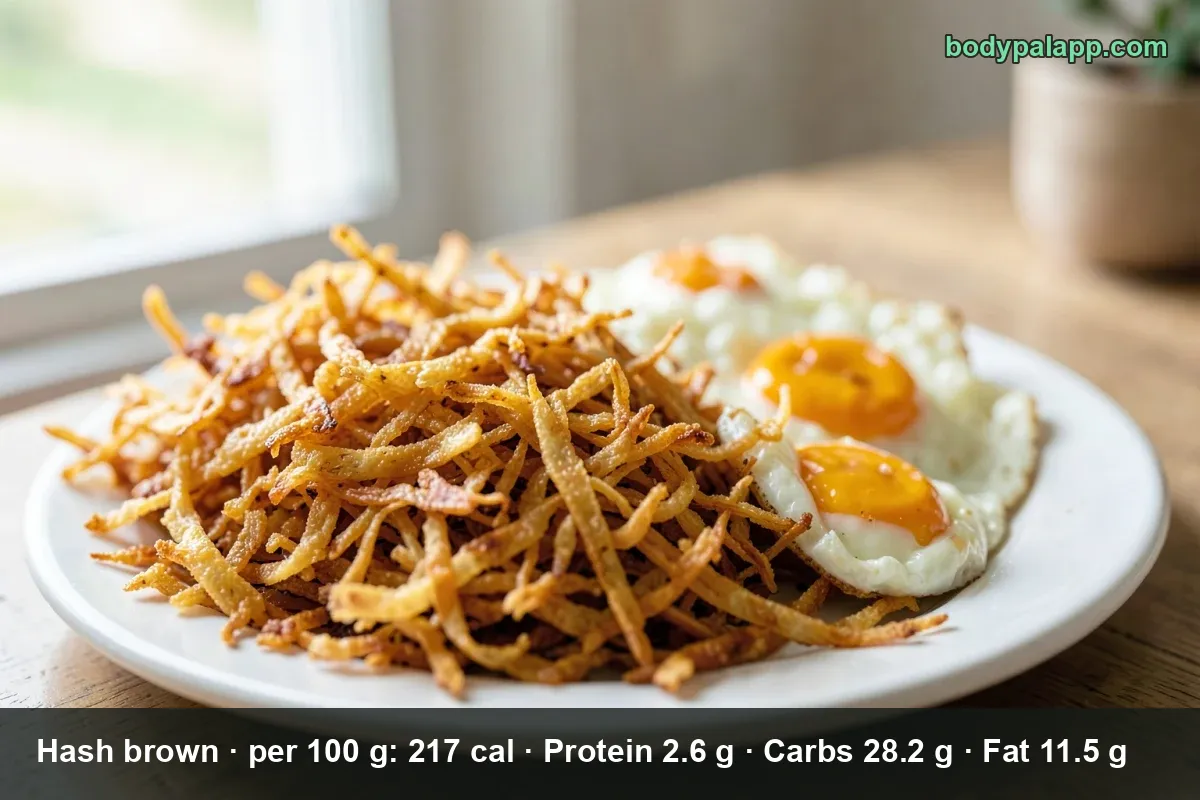
One hash brown patty weighs 55 g and carries 119 calories. Per 100 g, hash browns run 217 calories, so a full cup of loose shredded potato — 160 g — reaches 347. Fat is what drives that: 11.48 g per 100 g, against only 2.62 g of protein and 3.2 g of fiber.
On this page
- Hash brown quick facts
- US servings from one patty to a full cup
- How the version changes the number
- The oil does the damage not the potato
- Sodium is the row to watch
- How do hash browns compare
- Most popular hash brown brands
- Hash brown FAQs
Hash brown quick facts
The row used here is FNDDS 2709477, "Potato, hash brown, NFS" from the USDA Survey 2021-2023 release. NFS means "not further specified," and it is the weighted average of the hash brown Americans actually eat: a frozen or ready-to-heat patty or a bag of shreds, browned in fat on a home stove. It is also the only record that ships with the two household measures people search for, one patty at 55 g and one cup at 160 g.
Restaurant and chain versions sit higher and get their own section further down. They are not a different source, only a different pan.
| Nutrient | Per 100 g | Per 1 patty (55 g) | % Daily Value |
|---|---|---|---|
| Calories | 217 | 119 | — |
| Total fat | 11.48 g | 6.3 g | 8% |
| Saturated fat | 0.93 g | 0.5 g | 3% |
| Carbohydrate | 28.23 g | 15.5 g | 6% |
| Dietary fiber | 3.2 g | 1.8 g | 6% |
| Total sugars | 0.27 g | 0.1 g | — |
| Protein | 2.62 g | 1.4 g | 3% |
| Sodium | 398 mg | 219 mg | 10% |
% Daily Value is based on a 2,000-calorie diet.
Verified nutrition data
Numbers on this page come from USDA FoodData Central, the U.S. Department of Agriculture’s food composition database, and from manufacturer labels where a branded product is named. Last verified September 2026. How we verify our data →
Two label rows are missing on purpose. FNDDS does not publish added sugars or trans fat for mixed dishes, so quoting either one here would mean inventing it. Cholesterol is 0 mg, since nothing in a plain hash brown comes from an animal, and potassium is 491 mg per 100 g — 270 mg in a patty, 6% of the Daily Value. Sugars are so low, 0.27 g per 100 g, that they round to a tenth of a gram in a patty and have no Daily Value to compare against anyway.
The saturated fat row is the pleasant surprise. At 0.93 g per 100 g, a patty gives 0.5 g, 3% of the day. Hash browns are fatty, but the fat is mostly the liquid oil they were cooked in, not the hard fat on a nutrition label's warning line.
US servings from one patty to a full cup
| Serving | Weight | Calories |
|---|---|---|
| 1 oz | 28 g | 61 kcal |
| One patty | 55 g | 119 kcal |
| Two patties | 110 g | 239 kcal |
| One cup, loose shreds | 160 g | 347 kcal |
| Three patties | 165 g | 358 kcal |
| Per 100 g | 100 g | 217 kcal |
The patty and the cup are USDA household measures attached to the record itself. The ounce, the two-patty plate and the three-patty plate are our own arithmetic from the USDA 100 g figure, not USDA servings.
Look at the last two rows next to each other. A cup of shredded hash browns is 347 calories and three patties are 358 — eleven calories apart. Most people would call a cup a side dish and three patties a meal, but the plate does not know the difference. That is the single most useful thing on this page: if you scoop hash browns rather than counting patties, you are almost certainly logging a main course.
A cup also packs unevenly. Loosely piled shreds and a pressed-down cup can differ by a good fraction, which is why the weight in grams beats the cup every time. Weigh the pan once, and you will never have to guess again.
How the version changes the number
| Version | Per 100 g | Typical serving | Calories |
|---|---|---|---|
| Frozen, plain, unprepared | 82 kcal | 1 oz (28 g) | 23 kcal |
| From fresh potatoes | 190 kcal | 1 oz (28 g) | 53 kcal |
| Frozen, pan-fried in canola oil | 219 kcal | 1 oz (28 g) | 61 kcal |
| Ready-to-heat with cheese | 249 kcal | 1 patty (55 g) | 137 kcal |
| Home-prepared from raw potatoes | 265 kcal | 1 oz (28 g) | 74 kcal |
| Fast-food hash brown patty | 272 kcal | 1 patty (55 g) | 150 kcal |
The fast-food patty is the one that catches people out. Same shape, same 55 g in the hand, but 150 calories instead of 119, because a deep fryer soaks a hash brown far more thoroughly than a skillet does. Its saturated fat is 2.54 g per 100 g, nearly three times the 0.93 g of the everyday record.
Cheese changes a different row. The ready-to-heat cheesy version is 249 calories per 100 g, only 32 above plain, yet its protein jumps from 2.62 g to 6.04 g and its saturated fat from 0.93 g to 3.94 g. For roughly 18 extra calories in a 55 g piece you get more than double the protein — an unusually fair trade in the frozen aisle.
Making them from scratch is not the light option. Home-prepared hash browns from raw potatoes read 265 calories per 100 g, above both the frozen version and the "from fresh" record at 190, because raw shredded potato drinks oil while it browns. Refrigerated shreds pan-fried in canola oil land at 242 per 100 g, between the two.
Store brands split along the same line. McCain Mini Potato Hash Browns are 188 calories per 100 g and Best Choice Hash Brown Patties 219, because both are par-fried before they are frozen. Ore-Ida's shredded and diced bags read 71 per 100 g for the simple reason that they are still raw potato that has never met oil — the label number and the plate number are two different things.
The oil does the damage not the potato
Put the two frozen records side by side and the whole story of this food falls out. Plain frozen hash browns, unprepared, are 82 calories per 100 g. The identical product, pan-fried in canola oil, is 219. The potato did not change. The pan nearly tripled the calories.
Fat follows the same arc: 0.62 g per 100 g raw, 11.59 g fried. Carbohydrate climbs far less steeply, 17.72 g to 28.51 g, and most of that shift is water cooking off rather than starch appearing. If you want fewer calories from hash browns, the lever is the oil, the pan and the heat — not the variety of potato or the brand on the bag.
That is also why potato has an odd reputation. Plain potato is a starchy vegetable, and MyPlate counts it in the vegetable group; the fryer is what turns it into a 217-calorie-per-100 g breakfast. A patty still brings 1.8 g of fiber, 6% of the Daily Value, which is more than most breakfast breads of the same weight.
Sodium is the row to watch
A single patty carries 219 mg of sodium, 10% of the FDA Daily Value of 2,300 mg. That is roughly a tenth of a teaspoon of table salt. Two patties and a strip of bacon and you are a quarter of the way through the day before 9 a.m.
The fast-food version is worse: 566 mg per 100 g works out to 311 mg for the same 55 g patty, 14% of the Daily Value. And here is the number that shows where salt actually comes from — plain frozen hash browns pan-fried without seasoning are just 15 mg of sodium per 100 g. The potato contributes almost nothing. Every milligram above that was added by a factory, a line cook, or you.
The Dietary Guidelines for Americans keep the adult ceiling at 2,300 mg a day. If you are watching sodium, buying plain shreds and salting them yourself is the cheapest fix available on this page.
How do hash browns compare
| Potato side | Per 100 g | US serving | Calories |
|---|---|---|---|
| Hash brown | 217 kcal | one patty, 55 g | 119 kcal |
| French fries | 225 kcal | 1 oz, 28 g | 63 kcal |
| Home fries | 213 kcal | 1 oz, 28 g | 60 kcal |
| Potato skins | 199 kcal | 1 oz, 28 g | 56 kcal |
Ounce for ounce there is barely a food here: hash browns 61 calories, fries 63, home fries 60, potato skins 56. Four ways of putting the same vegetable in hot fat, spread across 26 calories per 100 g.
Our take: hash browns are the leanest of the four on fat, 11.48 g per 100 g against 12.4 g for potato skins, 14.07 g for fries and 15.2 g for home fries. They are also the weakest on protein, 2.62 g, where potato skins give 6.07 g — more than double. So if you are choosing a side to keep calories down, hash browns are a defensible pick and potato skins the most filling per calorie. The problem was never which one. It is that nobody eats an ounce of any of them, and the cup-sized scoop at 347 calories is what actually moves the day.
Most popular hash brown brands in the United States
Ranked by how widely each product appears among foods sold in the United States, from the BodyPal food database of over 3.3 million products. Calories are the figures printed on each Nutrition Facts label, checked against USDA FoodData Central.
| Product | Calories (per 100 g) |
|---|---|
| McCain Mini Potato Hash Browns | 188 cal |
| McCain Shredded Hash Browns Potatoes | 82 cal |
| Best Choice Hash Brown Patties | 219 cal |
| Ore-Ida Diced Hash Brown Potatoes | 71 cal |
| Ore-Ida Shredded Hash Brown Potatoes | 71 cal |
| Cavendish Farms Original Hash Brown Patties | 200 cal |
Brand popularity: BodyPal food database. Nutrition: manufacturer labels / USDA FoodData Central.
Hash brown FAQs
How many calories are in one hash brown patty?
One patty is 119 calories at a weight of 55 g, which comes from the USDA figure of 217 calories per 100 g. That is the frozen or ready-to-heat patty most people brown at home. A fast-food hash brown of the same size runs 150 calories, because a deep fryer puts more oil into it.
How many calories are in a cup of hash browns?
A cup of loose shredded hash browns weighs 160 g and carries 347 calories, which is close to three patties at 358. By calories that cup is not a side dish, it is most of a breakfast. Weigh shreds rather than scooping them, since a packed cup and a loose cup are not the same food.
Are hash browns healthier than french fries?
Barely: hash browns are 217 calories per 100 g and french fries 225, a gap of eight calories that vanishes the moment either one sits in more oil. Hash browns do carry less fat, 11.48 g against 14.07 g, and more fiber. Portion size decides this comparison, not the shape of the potato.
How many carbs are in hash browns?
A 55 g patty has 15.5 g of carbohydrate, 6% of the Daily Value, and 100 g of hash browns has 28.23 g. Fiber accounts for 3.2 g of that 100 g, so the usable figure is lower than the headline. Sugars are negligible at 0.27 g per 100 g, or 0.1 g in a patty.
How much sodium is in hash browns?
One patty carries 219 mg of sodium, 10% of the 2,300 mg Daily Value. The fast-food version is saltier: 566 mg per 100 g works out to 311 mg for the same 55 g patty, or 14%. Plain frozen hash browns pan-fried with no seasoning come in at just 15 mg per 100 g.
Do hash browns have protein?
Not much: a patty gives 1.4 g of protein and 100 g gives 2.62 g, about 3% of the Daily Value. The ready-to-heat version with cheese more than doubles that, at 6.04 g per 100 g. If you want protein at breakfast, it has to come from the eggs sitting next to them.
Are frozen hash browns lower in calories than restaurant hash browns?
Yes: the USDA fast-food record is 272 calories per 100 g against 217 for the general hash brown, so the same 55 g patty is 150 calories instead of 119. Deep frying explains the gap. Cooking frozen patties at home also lets you decide how much oil goes into the pan.
Do air-fried hash browns have fewer calories?
USDA publishes no air-fried hash brown record, so the closest verified anchor is 82 calories per 100 g for plain frozen shreds before cooking. What the data does show is how large the oil effect is: pan frying that same product in canola oil takes it to 219 calories per 100 g.
Similar foods
- Skirt Steak — 187 cal for 3 oz cooked
- Chicken Taco — 222 cal per taco
- Dosa — 326 cal per large dosa
- Flat iron steak — 391 cal per steak
- Chuck Steak — 360 cal per steak
- Chile relleno — 326 cal per chile relleno
Count it without the math
Point the camera at the plate and BodyPal counts the hash browns for you, patties or scoop.


How long does it take to burn off hash browns?
One patty (55 g) is 119 kcal. Enter your weight and the amount you ate to see how long it takes you to burn that off:
lb
| Activity | Time to burn 119 kcal |
|---|---|
| Walking, brisk | 24 min |
| Cycling, moderate | 15 min |
| Swimming, moderate | 17 min |
| Jogging | 14 min |
| Weight training, moderate | 26 min |
Times are for a 155 lb adult at a steady pace; change the weight to see yours. The amount is set to the portion in the text (55 g); change it to what you actually ate. BodyPal works this out from your steps automatically.
One food is easy to picture; a whole day is harder. See how many calories you need a day and what a deficit actually looks like.