
How many calories are in jelly beans?
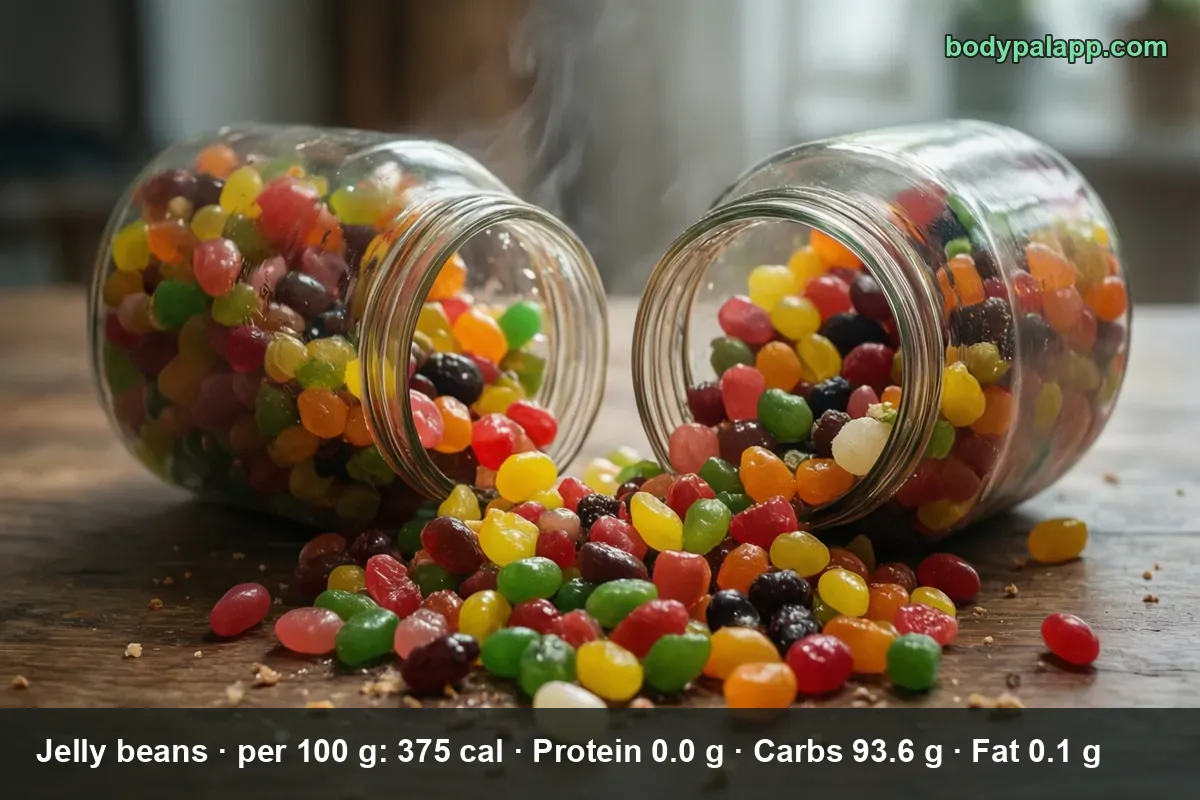
Ten large jelly beans weigh one ounce, 28 g, and carry 105 calories. Per 100 g the candy runs 375 calories, which is dense for something that disappears in three bites. There is no fat and no protein doing any of that work. Carbohydrate does all of it: 93.55 g per 100 g.
On this page
- Jelly bean quick facts
- US servings from one bean to a handful
- Jelly Belly vs Starburst vs sour jelly beans
- Sugar is the whole label
- How do jelly beans compare?
- Most popular jelly beans brands
- Jelly bean FAQs
Jelly bean quick facts
The number below comes from USDA SR Legacy 167991, "Candies, jellybeans". It is the only USDA record for the plain bean itself, and it is the one worth anchoring to: the 2,600-odd branded jelly bean entries in FoodData Central are all label transcriptions of the same product, and they cluster tightly around it.
USDA's household measure for this record is unusually helpful. It says ten large beans are one ounce and weighs that ounce at 28 g, so the serving in the table below is a real USDA serving, not something scaled from the 100 g row.
| Nutrient | Per 100 g | Per 1 oz (28 g) | % Daily Value |
|---|---|---|---|
| Calories | 375 | 105 | — |
| Total fat | 0.05 g | 0.0 g | 0% |
| Saturated fat | 0 g | 0.0 g | 0% |
| Carbohydrate | 93.55 g | 26.2 g | 10% |
| Dietary fiber | 0.2 g | 0.1 g | 0% |
| Total sugars | 70 g | 19.6 g | — |
| Protein | 0 g | 0.0 g | 0% |
| Sodium | 50 mg | 14 mg | 1% |
% Daily Value is based on a 2,000-calorie diet.
Verified nutrition data
Numbers on this page come from USDA FoodData Central, the U.S. Department of Agriculture’s food composition database, and from manufacturer labels where a branded product is named. Last verified September 2026. How we verify our data →
Two rows you would see on a candy bag are missing here on purpose. The SR Legacy edition of this record does not publish added sugars or trans fat, so rather than borrow those figures from somewhere else, they stay off the table. Cholesterol is 0 mg. Potassium is 37 mg per 100 g, which works out to 10 mg in an ounce, or 0% of the Daily Value. Percentages follow the FDA Daily Values printed on US labels.
US servings from one bean to a handful
| Serving | Weight | Calories |
|---|---|---|
| One large jelly bean | 2.8 g | 11 kcal |
| 10 small jelly beans | 11 g | 41 kcal |
| 10 large jelly beans, 1 oz | 28 g | 105 kcal |
| 1 oz | 28.35 g | 106 kcal |
| Small handful, typical label serving | 40 g | 150 kcal |
| Per 100 g | 100 g | 375 kcal |
Two of those lines are USDA household measures: ten large beans at 28 g and ten small beans at 11 g. The rest are our own arithmetic from the USDA 100 g figure rather than USDA servings — the single bean, the exact 28.35 g ounce, and the 40 g handful that most bags print as one serving.
That first pair is the trap. Ten beans is not a quantity. Ten small ones are 41 calories, ten large ones are 105, and the difference between the two is two and a half times over — from nothing more than which bowl you reached into. A gourmet bean and a classic penny-candy bean can sit in the same dish and be 2.5x apart per piece.
If you log jelly beans by count, you are guessing. If you log the bag by weight once and divide, you are not. A 40 g handful is the practical unit for most people: it is one label serving, it is 150 calories, and it takes about fourteen large beans to get there.
Jelly Belly vs Starburst vs sour jelly beans
| Version | Per 100 g | Typical serving | Calories |
|---|---|---|---|
| Jelly Belly gourmet | 350 kcal | 40 g | 140 kcal |
| Starburst original | 357 kcal | 28 g, 20 pieces | 100 kcal |
| Warheads sour jelly beans | 366 kcal | 41 g, 12 pieces | 150 kcal |
| Gourmet beans from a bulk bin | 366 kcal | 41 g, 20 pieces | 150 kcal |
| Jelly bean flavored gum | 208 kcal | 2.4 g | 5 kcal |
Here is the thing nobody says out loud: not one of the six US brand labels in FoodData Central reaches the 375 of the USDA generic record. They run 350 to 370 per 100 g. The two Jelly Belly labels are actually the lowest of the group at 350, because a Jelly Belly bean carries more water and flavoring in its center than a hard old-fashioned bean does.
The gap between brands is small enough to ignore. The gap between servings is not. Starburst prints 28 g and lands at 100 calories; Jelly Belly prints 40 g and lands at 140; a sour bean at 41 g lands at 150. Same candy, three different answers, and the only thing that moved was the size of the box on the back of the bag.
Sour beans are not lighter, either. The sour coating is more sugar with acid in it, so Warheads sits at 366 per 100 g — above Jelly Belly, above the original Starburst bag. The pucker is not a discount.
The last row is a different product entirely. Jelly bean flavored gum runs 208 calories per 100 g, but a stick weighs 2.4 g, so a piece is about 5 calories. It is chewing gum with a candy name on it, and it does not belong in the same count as the beans.
Sugar is the whole label
Jelly beans are the cleanest example in the candy aisle of calories with nothing attached. Per 100 g: 93.55 g of carbohydrate, of which 70 g is sugar, 0 g protein, 0.2 g fiber, 0.05 g fat. An ounce gives you 10% of the Daily Value for carbohydrate and, rounded, 0% of everything else on the label.
A 40 g handful carries 37.4 g of carbohydrate and 28 g of sugars. The FDA sets the Daily Value for added sugars at 50 g, and the Dietary Guidelines for Americans keep added sugars under 10% of daily calories. The USDA record does not split added from total sugars, so there is no honest percentage to print against that 28 g — but a jelly bean contains no fruit and no dairy, so there is no naturally occurring sugar in it to subtract either. Read the 28 g as what it is.
Sodium is the surprise in the other direction. Fifty milligrams per 100 g sounds like nothing, and at 14 mg per ounce it is nothing — 1% of the Daily Value, about a fiftieth of a teaspoon of table salt across a whole 100 g bag. Candy that tastes purely sweet still gets salted; here the amount is too small to matter.
For anyone building a day around real meals, MyPlate treats this category as calories to spend deliberately rather than to graze on. If you are watching your intake, the 40 g handful measured once beats the open bowl on the desk, because 150 calories of jelly beans leaves you exactly as hungry as before you ate them.
How do jelly beans compare?
| Candy or sweet | Per 100 g | US serving | Calories |
|---|---|---|---|
| Jelly beans | 375 kcal | 1 oz, 28.35 g | 106 kcal |
| Fondant | 373 kcal | 1 oz, 28.35 g | 106 kcal |
| Fruit leather rolls | 371 kcal | 1 oz, 28.35 g | 105 kcal |
| Vanilla pudding, instant dry mix | 377 kcal | 1 oz, 28.35 g | 107 kcal |
All four are held at the same exact ounce here so the density is comparable; USDA's own jelly bean serving is the 28 g one, at 105 calories. Look at the spread: from 371 to 377, six calories separates the lightest from the heaviest per 100 g. Only the pudding mix is denser than jelly beans, and only by two calories per 100 g.
Our take: stop shopping for a lighter sugar. Anything that is essentially dry sugar lands near 375 calories per 100 g, and swapping jelly beans for fruit leather saves you one calorie an ounce while sounding healthier — fruit leather actually carries more sodium, 205 mg per 100 g against 50 mg. The only lever that works with this food is weight. Pour 40 g into your hand, put the bag away, and take the 150. Chasing a better bean is chasing nothing.
Most popular jelly beans brands in the United States
Ranked by how widely each product appears among foods sold in the United States, from the BodyPal food database of over 3.3 million products. Calories are the figures printed on each Nutrition Facts label, checked against USDA FoodData Central.
| Product | Calories (per 100 g) |
|---|---|
| Jelly Belly Holiday Favorites Jelly Beans | 350 cal |
| Starburst Original Jelly Beans | 357 cal |
| Starburst Original Jelly Beans Share Pack | 370 cal |
| Too Good Gourmet Jelly Beans | 366 cal |
| Jelly Belly Draft Beer Jelly Bean | 350 cal |
| Warheads Sour Jelly Beans | 366 cal |
Brand popularity: BodyPal food database. Nutrition: manufacturer labels / USDA FoodData Central.
Jelly bean FAQs
How many calories are in one jelly bean?
About 11 calories for one large bean. USDA weighs 10 large beans at 28 g, so a single one is roughly 2.8 g — our own arithmetic from the 375 calories per 100 g figure, not a USDA serving. A small bean is closer to 1.1 g and 4 calories.
How many calories in 10 jelly beans?
105 calories if they are large, 41 if they are small. USDA lists both measures: 10 large beans weigh 28 g, 10 small ones only 11 g. Same count, two and a half times the calories. Judging this candy by the piece is the single biggest logging error people make.
How many calories in a handful of jelly beans?
About 150 calories for a 40 g handful, which is also the serving most jelly bean bags print on the back. That is 37.4 g of carbohydrate and 28 g of sugars, with no fat and no protein alongside. The 40 g figure is our scaling of the USDA 100 g row, not a USDA serving.
How much sugar is in jelly beans?
70 g of sugars per 100 g, so a 28 g ounce carries 19.6 g and a 40 g handful 28 g. Total carbohydrate is 93.55 g per 100 g, meaning nearly everything else in the bean is syrup solids and starch. USDA's SR Legacy record does not split added from total sugars.
Do jelly beans have fat?
No: jelly beans hold 0.05 g of fat per 100 g, which rounds to 0.0 g in a 28 g serving, and no saturated fat at all. Cholesterol is 0 mg. This is pure sugar candy: every calorie comes from carbohydrate, and there is nothing on the fat line to manage.
How many jelly beans are in a 1 oz serving?
Ten large beans, by USDA's own household measure, weighing 28 g and carrying 105 calories. A precise ounce is 28.35 g and works out to 106 calories. Small beans weigh about 1.1 g each, so an ounce of those runs to roughly 25 pieces instead of ten.
Are Jelly Belly beans lower in calories than Starburst jelly beans?
Per 100 g, yes, but barely: Jelly Belly is 350 calories against Starburst's 357. Per label serving the ranking flips, because Jelly Belly prints 40 g at 140 calories and Starburst prints 28 g at 100. Both sit below the 375 of the USDA generic record.
Do jelly beans have any protein or fiber?
Effectively none: the USDA record lists 0 g of protein and 0.2 g of fiber per 100 g, which is 0.0 g and 0.1 g in a 28 g serving, or 0% of the Daily Value for both. Potassium is 37 mg per 100 g. Jelly beans are calories and sugar, and that is the whole list.
Similar foods
- Salami — 102 cal for 3 slices
- Summer Sausage — 203 cal for 4 slices
- Torta — 215 cal per serving
- Coconut — 283 cal per cup, shredded
- Prime Rib — 340 cal for 3 oz slice
- Brie — 95 cal per oz
Count it without the math
Point the camera at the dish and BodyPal counts the jelly beans for you, large or small.


How long does it take to burn off jelly beans?
A 1 oz (28 g) serving, about 10 large beans is 105 kcal. Enter your weight and the amount you ate to see how long it takes you to burn that off:
lb
| Activity | Time to burn 105 kcal |
|---|---|
| Walking, brisk | 21 min |
| Cycling, moderate | 13 min |
| Swimming, moderate | 15 min |
| Jogging | 12 min |
| Weight training, moderate | 23 min |
Times are for a 155 lb adult at a steady pace; change the weight to see yours. The amount is set to the portion in the text (28 g); change it to what you actually ate. BodyPal works this out from your steps automatically.
Burning it off is one side of it. The other is knowing your number: work out how many calories you need a day, with macros and a goal date.