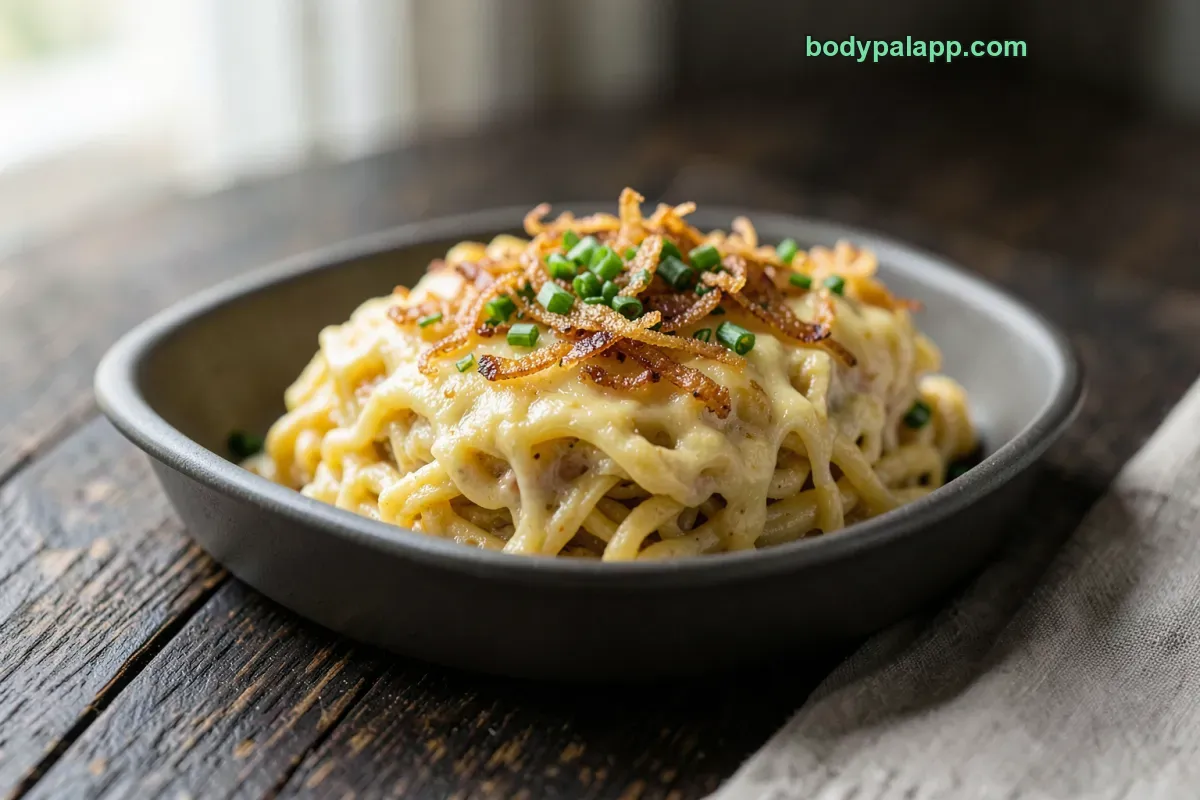
Cheese spaetzle calories come to 234 for a 6 Tbsp (60 g) serving and 390 per 100 g, based on the package label for a cheese spaetzle with roasted onions. Look at sodium before anything else: that small serving already carries 696 mg, or 30% of the daily value.
234kcal
1 label serving · 60 g, packaged, per label
16%protein
9 gProtein
37 gCarbs
5 gFat
How to burn off 234 kcal
—Walking, brisk
—Jogging
—Cycling, moderate
—Swimming
Skip the math. BodyPal counts these calories from your steps and workouts automatically.
Nutrition facts
Packaged, per label · per 60 g
Calories
234 kcal
Protein
9 g
Carbohydrate
37 g
Fat
5 g
Saturated fat
2 g
Cholesterol
0 mg
Sodium
696 mg
Source: USDA FoodData Central
🛡️
Verified nutrition data
Numbers on this page come from USDA FoodData Central, the U.S. Department of Agriculture’s food composition database, and from manufacturer labels where a branded product is named. Last verified September 2026. How we verify our data →
Cheese spaetzle: calories, protein and sodium by serving
Percent of daily value uses the FDA reference of 2,000 kcal a day.
Serving
kcal
Protein
Carbs
Fat
Sodium
% DV kcal
6 Tbsp (60 g)
234
9 g
37 g
5 g
696 mg
12%
100 g
390
15 g
61.7 g
8.3 g
1,160 mg
20%
3 × 6 Tbsp (60 g)
702
27 g
2,088 mg
5 × 6 Tbsp (60 g)
1,170
45 g
3,480 mg
A real plate is two or three label servings
The label serving is 6 Tbsp (60 g), worth 234 calories and 12% of a 2,000-calorie daily value. That is a side dish portion. Spaetzle is usually served as the main event, in a deep bowl, and the numbers climb quickly once you eat it that way.
Two servings (120 g) come to 468 calories. Three servings (180 g), closer to a typical dinner bowl, reach 702 calories with 27 g of protein. A large 300 g helping, the kind you get when the pan goes straight to the table, lands at 1,170 calories. Same food, five times the total.
If you are counting, weigh the cooked portion once so you know what your usual bowl looks like. Eyeballing a dense, cheesy noodle dish tends to undercount. BodyPal can also log it from a photo, which helps when you are eating it at a restaurant or a friend's table.
Carbs supply about two thirds of the calories
Per 100 g you get 61.7 g of carbs, 15 g of protein and 8.3 g of fat. In calorie terms that is 65% from carbs, 16% from protein and 20% from fat. This is a flour-and-egg noodle first and a cheese dish second.
Fat is lower than the name suggests. At 8.3 g per 100 g, with 3.3 g saturated, it sits well below mac and cheese on fat. The protein is decent for a pasta: 9 g in one 60 g serving, or 18% of the daily value, and 15 g per 100 g.
Fiber and sugar are both modest at 3.3 g per 100 g, and the label lists 0 mg of cholesterol. The takeaway is simple. Calories here come from dense starch, so portion size moves the total far more than any single topping.
Sodium is the row to watch
Each 6 Tbsp (60 g) serving holds 696 mg of sodium, 30% of the daily value. Per 100 g it is 1,160 mg, or 50%. Few pasta dishes in our database come close to that density.
Scale it up and the problem is obvious. Two servings carry 1,392 mg. Three servings reach 2,088 mg, most of a day's sodium in one bowl. The 300 g plate hits 3,480 mg, which is past the full daily value before you have eaten anything else.
If you watch sodium, keep the portion to one or two servings and keep the rest of the meal low in salt. Skip extra salted cheese on top and choose a plain side instead of cured meat or pickles. The roasted onions add flavor, so the dish rarely needs more seasoning.
Treat it as the starch, then add volume
Think of cheese spaetzle as the starch on the plate rather than the whole plate. One or two label servings, at 234 or 468 calories, leave room for a protein and a big pile of vegetables without pushing the meal into four figures.
A green salad with a light vinegar dressing is the classic partner, and it fits the numbers well: low in calories, no added sodium if you go easy on the salt. Steamed or roasted vegetables do the same job. A lean protein next to it adds staying power that the noodles alone do not offer.
If spaetzle is the centerpiece of a heavier day, balance the other meals around it. Lighter, lower-sodium choices at breakfast and lunch make a full bowl easier to fit.
How does cheese spaetzle compare?
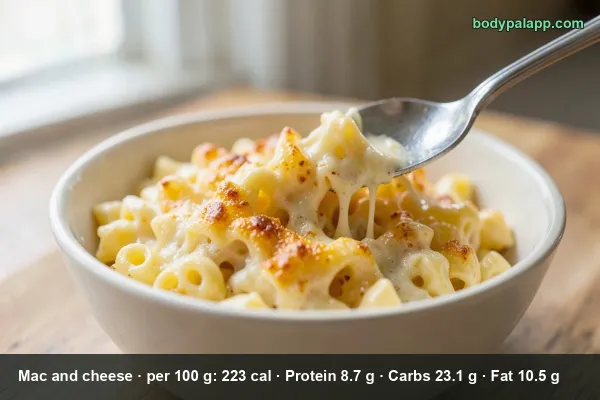
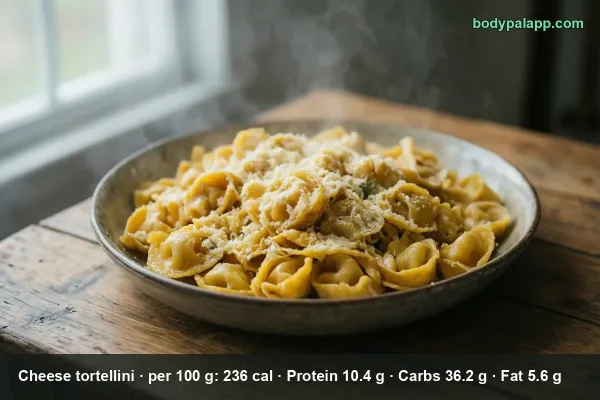
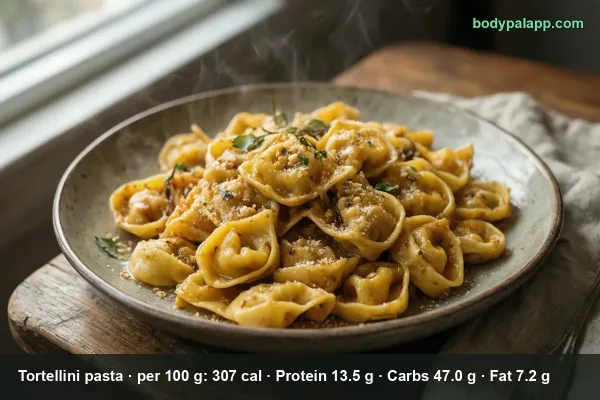
Here is how cheese spaetzle stacks up against mac and cheese, cheese tortellini and tortellini pasta, per 100 g and per usual serving.
Verdict: For fewer calories pick mac and cheese at 223 per 100 g or cheese tortellini at 236, both about 0.6 of the 390 in cheese spaetzle, and tortellini also wins on sodium at 156 mg. Choose cheese spaetzle when you want the most protein per 100 g at 15 g, but keep the portion small because of its 1,160 mg of sodium.
Cheese spaetzle FAQs
How many calories are in a serving of cheese spaetzle?
The label serving of 6 Tbsp (60 g) has 234 calories, which is 390 calories per 100 g.
Is cheese spaetzle good for weight loss?
One 60 g serving has 234 calories, 5.0 g fat and 37.0 g carbs. It also carries 696 mg of sodium per serving.
Cheese spaetzle vs mac and cheese: which has fewer calories?
Per 100 g as listed, mac and cheese has 223 calories and packaged cheese spaetzle has 390.
How much protein is in cheese spaetzle?
A 60 g serving has 9.0 g of protein, or 15 g per 100 g.
How many calories are in 100 g of spaetzle?
Cheese spaetzle has 390 calories per 100 g, which is 20% of the daily value. That 100 g also brings 61.7 g of carbs, 15 g of protein and 8.3 g of fat.
What are the nutrition facts for cheese spaetzle?
One 6 Tbsp (60 g) serving has 234 calories, 9 g protein, 37 g carbs, 5 g fat, 2 g fiber, 2 g sugars and 696 mg sodium, according to the package label.
How many calories are in a big bowl of spaetzle?
A 180 g bowl, three label servings, has 702 calories. A large 300 g plate reaches 1,170 calories, so the bowl size matters more than anything else on the label.
How much sodium is in spaetzle?
Cheese spaetzle has 696 mg of sodium per 6 Tbsp (60 g) serving, 30% of the daily value. Per 100 g it rises to 1,160 mg, half the daily value.
How many carbs are in cheese spaetzle?
One 60 g serving has 37 g of carbs, and 100 g has 61.7 g. Carbs supply 65% of the calories, with only 3.3 g of fiber per 100 g.