
How many calories are in mac and cheese?
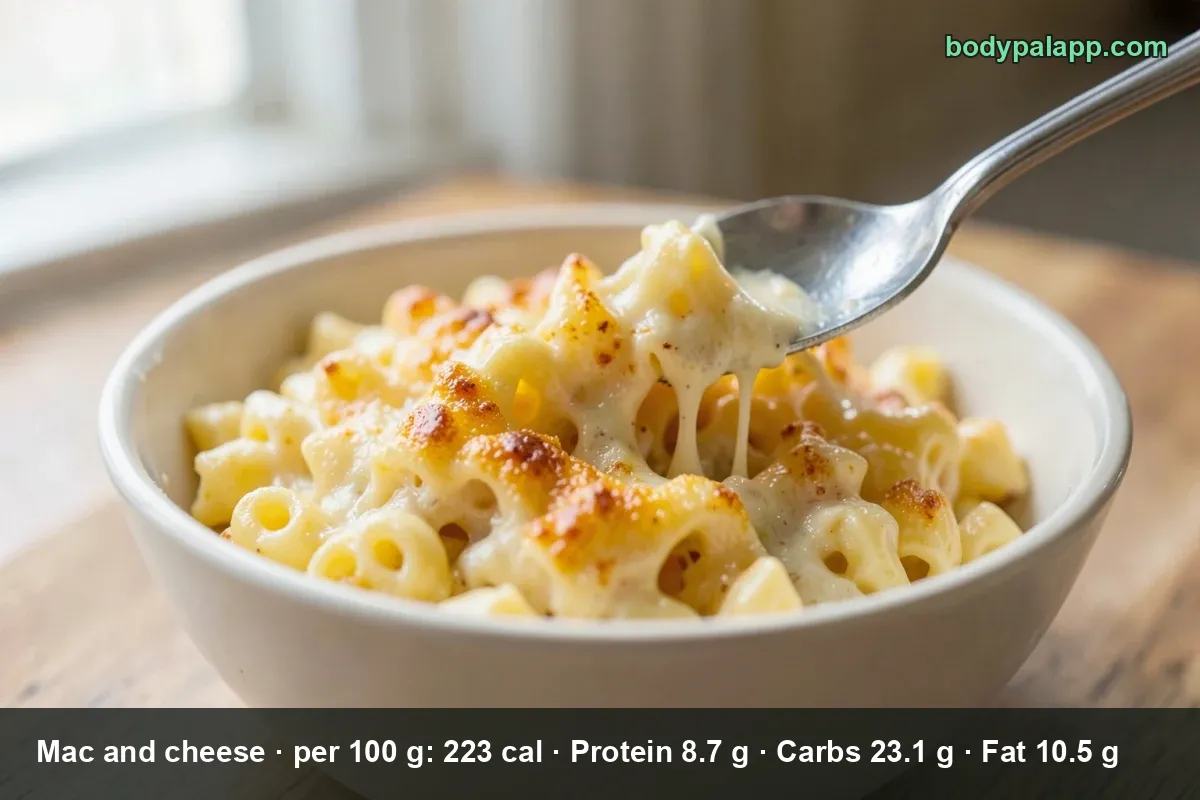
A 1-cup (230 g) serving of mac and cheese carries 513 calories, and the dish runs 223 calories per 100 g. That cup is the creamy, baked, made-at-home kind, the version most people picture. Boxed and canned versions land far lower, and the reason is the sauce rather than the pasta.
On this page
- Mac and cheese quick facts
- US servings, from one ounce to a full cup
- Boxed, canned and the microwave cup
- Mac and cheese with meat in it
- Whole grain macaroni and the fiber gap
- Sodium is the row to watch
- How does mac and cheese compare?
- Most popular mac and cheese brands
- Mac and cheese FAQs
Mac and cheese quick facts
The row behind every number on this page is FNDDS 2708811, "Macaroni or noodles with cheese", from the 2021-2023 survey release. It describes the prepared, home-style dish: elbows, a real cheese sauce, baked or stirred on the stove. That is the plate a person is actually holding when they look this up, so it sets the headline figure.
USDA carries seven other macaroni-and-cheese records, and they are not competing sources. They are different preparations of the same food, which is why a canned serving and a homemade serving can differ by more than 250 calories without either number being wrong.
| Nutrient | Per 100 g | Per 1 cup (230 g) | % Daily Value |
|---|---|---|---|
| Calories | 223 | 513 | — |
| Total fat | 10.5 g | 24.2 g | 31% |
| Saturated fat | 5.15 g | 11.8 g | 59% |
| Carbohydrate | 23.08 g | 53.1 g | 19% |
| Dietary fiber | 1.2 g | 2.8 g | 10% |
| Total sugars | 2.44 g | 5.6 g | — |
| Protein | 8.68 g | 20.0 g | 40% |
| Sodium | 358 mg | 823 mg | 36% |
| Cholesterol | 25 mg | 58 mg | 19% |
| Potassium | 103 mg | 237 mg | 5% |
% Daily Value is based on a 2,000-calorie diet.
Verified nutrition data
Numbers on this page come from USDA FoodData Central, the U.S. Department of Agriculture’s food composition database, and from manufacturer labels where a branded product is named. Last verified September 2026. How we verify our data →
Two rows you would see on a box are missing here: added sugars and trans fat. The FNDDS release does not publish either value for mixed dishes, so rather than guess, the lines are left out. Total sugars stay in the table but carry no %DV, because the FDA sets a Daily Value for added sugars only.
US servings, from one ounce to a full cup
A cup is the standard USDA household measure for this dish, and at 230 g it is heavier than most people expect. That weight is what makes the calorie count climb so fast: mac and cheese is dense, and a casserole scoop that looks modest on a dinner plate is often a full cup.
| Serving | Weight | Calories |
|---|---|---|
| 1 oz | 28 g | 62 kcal |
| 1/2 cup | 115 g | 256 kcal |
| 3/4 cup | 173 g | 386 kcal |
| 1 cup | 230 g | 513 kcal |
| Per 100 g | 100 g | 223 kcal |
Only the 1-cup line and the per-100-g line come straight from USDA. The half cup, three-quarter cup and ounce are our own arithmetic from the USDA 100 g figure, not USDA servings, scaled by weight.
There is a trap worth naming. Per 100 g looks like a normal serving, but 100 g is under half a cup. If you log "100 g" because that is what the nutrition panel shows, and you actually ate a cup, you have under-counted by 290 calories in one entry. Weighing the bowl once, then remembering roughly what your usual scoop weighs, fixes it permanently.
Boxed, canned and the microwave cup
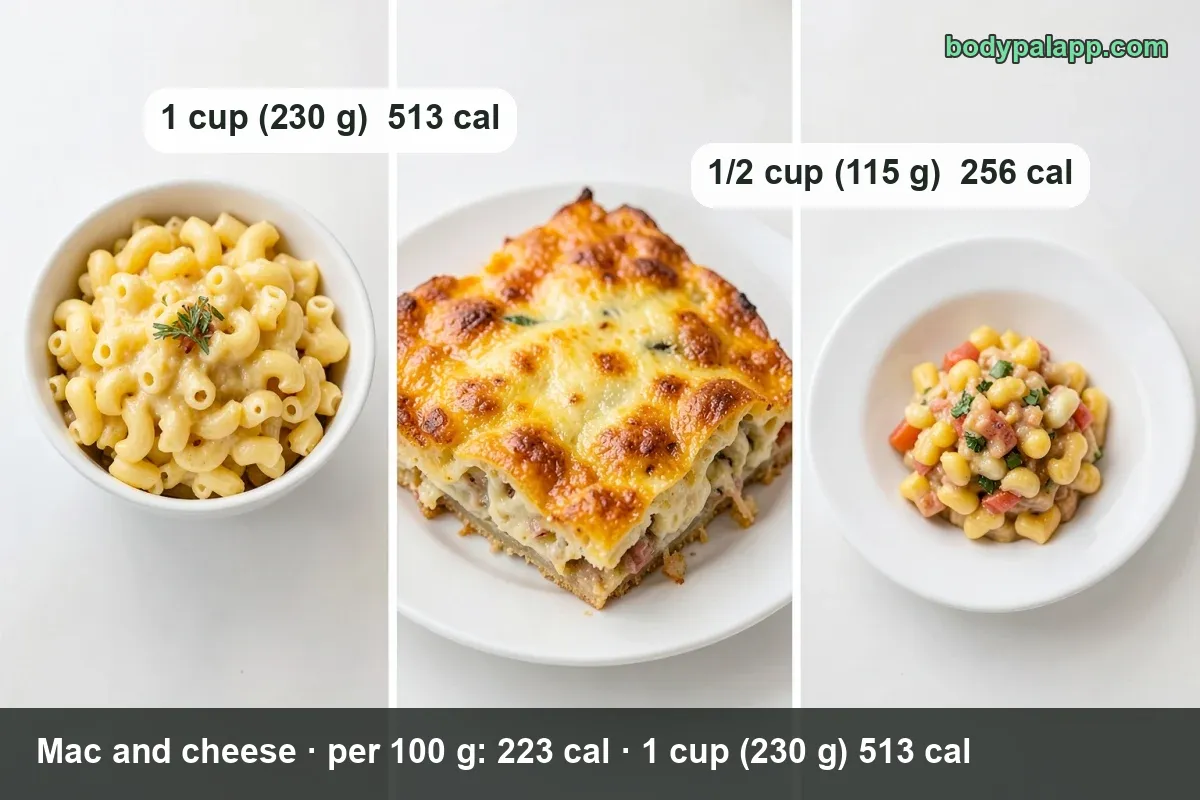
This is where the numbers separate. A microwavable cup is mostly water and starch by the time it is ready, and the canned version is thinner still at 82 calories per 100 g, the lowest of the eight USDA records. Homemade sauce, made with butter, milk and shredded cheese, roughly triples that density.
| Version | Per 100 g | Typical portion | Calories |
|---|---|---|---|
| Homemade or baked, prepared | 223 kcal | 1 cup (230 g) | 513 kcal |
| Boxed mix, powdered cheese sauce, prepared | 179 kcal | 1 cup (230 g) | 412 kcal |
| Boxed mix, liquid cheese sauce, prepared | 164 kcal | 1 cup (230 g) | 377 kcal |
| Restaurant side dish | 151 kcal | 1 cup (230 g) | 347 kcal |
| Reduced-fat boxed mix, prepared | 131 kcal | 1 cup (230 g) | 301 kcal |
| Microwave cup, regular size | 110 kcal | 1 package (215 g) | 237 kcal |
| Large microwavable tub | 110 kcal | 1 tub (423 g) | 465 kcal |
| Canned | 82 kcal | 1 cup (230 g) | 189 kcal |
The per-cup figures for the boxed, reduced-fat and restaurant rows are our own arithmetic from each USDA 100 g value, scaled to 230 g; the microwave package, the tub and the canned cup are USDA portions. Brand names sit inside these categories rather than outside them, so a store box of Kraft, Annie's or Velveeta lands on one of the two boxed-mix lines depending on whether the sauce comes as powder or as a pouch.
The single most useful comparison on this page: the same 230 g cup is 513 calories homemade and 189 calories from a can, a 324-calorie gap created entirely by how thick the sauce is. The large microwavable tub is the quiet one. At 465 calories it is nearly a homemade cup, not because it is rich, but because it is 423 g of food.
Mac and cheese with meat in it
Add ground beef and the dish stops behaving like a side. It keeps nearly all of the protein and loses some of its carbohydrate share, but the calories per cup stay under the homemade version, because the meat sauce dilutes the cheese.
| Version | Per 100 g | Portion | Calories | Protein |
|---|---|---|---|---|
| Macaroni and cheese with meat, Hamburger Helper style | 144 kcal | 1 cup (230 g) | 331 kcal | 19.0 g |
| Beef and macaroni with cheese sauce | 137 kcal | 1 cup (246 g) | 337 kcal | — |
The Hamburger Helper cup delivers 19.0 g of protein, our own arithmetic from the USDA 8.24 g per 100 g figure, against 20.0 g for the homemade cup, and it does it for 182 fewer calories. If a boxed dinner has to be the meal, that is the better-value version of it.
Whole grain macaroni and the fiber gap
Swapping in whole grain elbows barely moves the calories and roughly doubles the fiber. USDA lists the whole grain preparation at 219 calories per 100 g against 223 for the standard one, with 2.2 g of fiber per 100 g instead of 1.2 g. Over a 230 g cup that is 5.1 g of fiber by our own arithmetic from the USDA 100 g figure, 18% of the Daily Value, from a dish nobody thinks of as a fiber source.
Set that against the microwave cup at 0.5 g per 100 g and the spread is more than fourfold. Whole grain macaroni is also the only record in the set with slightly more protein than the homemade version, 8.77 g per 100 g against 8.68 g. MyPlate counts it toward the whole-grain half of your daily grains, which the white-pasta version does not.
Sodium is the row to watch
A cup of homemade mac and cheese carries 823 mg of sodium, about a third of a teaspoon of table salt. That is 36% of the FDA Daily Value of 2,300 mg, a larger share than the fat contributes at 31%, and the Dietary Guidelines put 2,300 mg a day as the ceiling for adults.
Boxed mixes are not the safe harbor here. The box-with-liquid-sauce record is the saltiest prepared version per 100 g at 460 mg, which works out to 1,058 mg for a 230 g cup by our own arithmetic, 46% of the Daily Value in one bowl for 377 calories.
Saturated fat is the sharper number. The homemade cup holds 11.8 g, 59% of the Daily Value, from cheese and butter. If you are watching either figure, the reduced-fat boxed mix at 1.68 g of saturated fat per 100 g is the meaningfully different choice, and stretching the same pan across four half-cup servings rather than two full ones does most of the rest.
How does mac and cheese compare?
| Dish | Per 100 g | US serving | Calories |
|---|---|---|---|
| Mac and cheese, homemade | 223 kcal | 1 cup (230 g) | 513 kcal |
| Mac and cheese with meat | 144 kcal | 1 cup (230 g) | 331 kcal |
| Microwave cup, Easy Mac type | 110 kcal | 1 cup (230 g) | 253 kcal |
| Canned mac and cheese | 82 kcal | 1 cup (230 g) | 189 kcal |
Our take: if you are cutting calories, the choice that matters is not the brand, it is the sauce. A canned or microwave cup gets you a hot bowl of mac and cheese for 189 to 253 calories against 513, and that is a real option on a busy night. If you want the meal to hold you until dinner, go the other way. The homemade cup delivers 20.0 g of protein and 2.8 g of fiber, and the meat version gives you nearly the same protein for 182 fewer calories. The canned and microwave cups are the weakest on both counts, at 3.38 g and 3.26 g of protein per 100 g, so treat them as a light side rather than a meal.
Most popular mac and cheese brands in the United States
Ranked by how widely each product appears among foods sold in the United States, from the BodyPal food database of over 3.3 million products. Calories are the figures printed on each Nutrition Facts label, checked against USDA FoodData Central.
| Product | Calories (per 100 g) |
|---|---|
| Kraft Original Macaroni & Cheese Dinner | 357 cal |
| Market Pantry Macaroni & Cheese Dinner | 357 cal |
| Market Pantry Deluxe Shells Macaroni & Cheese | 327 cal |
| Big Win Macaroni & Cheese Dinner | 379 cal |
Brand popularity: BodyPal food database. Nutrition: manufacturer labels / USDA FoodData Central.
Mac and cheese FAQs
How many calories are in 1 cup of mac and cheese?
A 1-cup serving weighs 230 g and holds 513 calories, based on the USDA record for prepared macaroni or noodles with cheese at 223 calories per 100 g. That cup also carries 24.2 g of fat, 53.1 g of carbohydrate and 20.0 g of protein, so it eats like a main course rather than a side dish.
How many calories in half a cup of mac and cheese?
Half a cup is 115 g and works out to 256 calories, our own arithmetic from the USDA figure of 223 calories per 100 g rather than a USDA serving. That half portion brings 5.9 g of saturated fat and 412 mg of sodium with it, which is 18% of the 2,300 mg Daily Value.
How many calories are in a box of mac and cheese?
Prepared boxed mac and cheese runs 179 calories per 100 g with a powdered sauce and 164 with a liquid cheese pouch, so a 230 g cup lands at 412 or 377 calories by our own arithmetic. A single-serve microwave package of 215 g is a USDA portion at 237 calories, and the large tub of 423 g is 465.
How many calories in canned mac and cheese?
Canned mac and cheese is 82 calories per 100 g, which makes a 1-cup serving of 230 g just 189 calories. That is the lowest of the eight USDA macaroni-and-cheese records and 324 calories below the homemade cup. The trade-off is protein, at 3.38 g per 100 g against 8.68 g for the homemade version.
Is mac and cheese high in protein?
A 1-cup serving supplies 20.0 g of protein, which is 40% of the Daily Value, so yes by the standards of a pasta dish. The protein comes from the cheese and milk rather than the macaroni. Boxed and canned versions are much weaker, at 4.64 g and 3.38 g per 100 g against 8.68 g for homemade.
How much sodium is in mac and cheese?
A 1-cup serving holds 823 mg of sodium, 36% of the FDA Daily Value of 2,300 mg and about a third of a teaspoon of table salt. Boxed versions can run higher: the box-with-liquid-sauce record is 460 mg per 100 g, which is roughly 1,058 mg per cup by our own arithmetic.
How many carbs are in mac and cheese?
A 1-cup serving has 53.1 g of carbohydrate, 19% of the Daily Value, of which 5.6 g is total sugars and 2.8 g is fiber. Per 100 g the figure is 23.08 g. The canned version is lower at 11.52 g per 100 g, but only because it holds far less pasta in the same weight.
Is homemade mac and cheese healthier than boxed?
Homemade is 223 calories per 100 g against 179 for a boxed mix, so it is not lighter. It does carry more protein, 8.68 g per 100 g versus 4.64 g, and less sodium than the box-with-liquid-sauce record at 358 mg versus 460 mg. Boxed wins on calories, homemade wins on protein.
Similar foods
- Prosciutto — 55 cal for 3 thin slices
- Maple Syrup — 216 cal for 1/4 cup
- Baba ganoush — 110 cal for 1/4 cup
- Penne pasta — 169 cal per cup
- Pasta — 168 cal per cup penne
- Wonton wrapper — 23 cal per wonton wrapper
Count it without the math
Point the camera at the bowl and BodyPal counts the scoop for you, sauce and all.


How long does it take to burn off 513 kcal of mac and cheese?
A 1-cup (230 g) serving is 513 kcal. Enter your weight and the amount you ate to see how long it takes you to burn that off:
lb
| Activity | Time to burn 513 kcal |
|---|---|
| Walking, brisk | 1 hr 43 min |
| Cycling, moderate | 1 hr 4 min |
| Swimming, moderate | 1 hr 13 min |
| Jogging | 1 hr |
| Weight training, moderate | 1 hr 54 min |
Times are for a 155 lb adult at a steady pace; change the weight to see yours. The amount is set to the portion in the text (230 g); change it to what you actually ate. BodyPal works this out from your steps automatically.
This table assumes you know your daily total. If you do not, the daily calorie calculator works it out from five numbers.