
How many calories are in cheese tortellini?
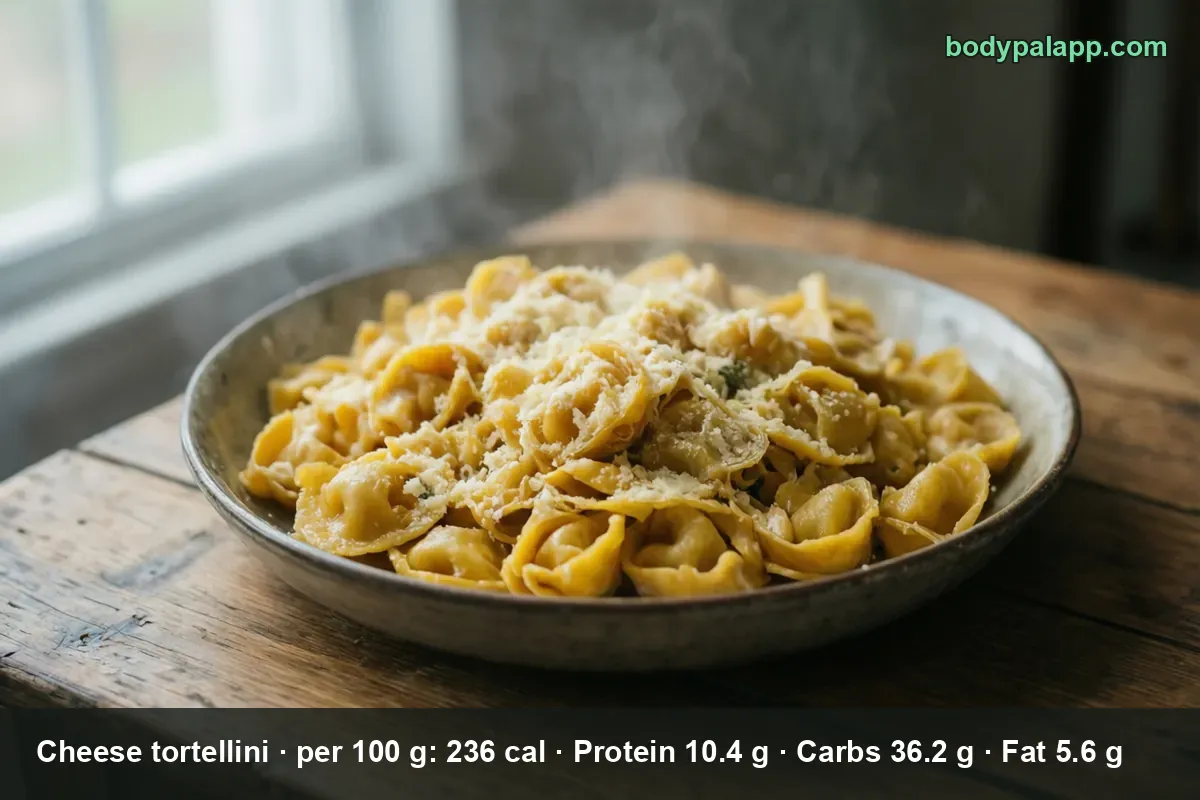
A 1-cup serving of cooked cheese tortellini with no sauce is 354 calories, and the pasta runs 236 calories per 100 g. That cup also brings 15.6 g of protein and 54.2 g of carbohydrate. Half a cup is 177. Add cream sauce and the same measure climbs to 383.
On this page
- Cheese tortellini quick facts
- US servings from one piece to a full cup
- Sauce moves the number more than the pasta does
- Cooked versus as purchased on the package
- Saturated fat and sodium are the rows to watch
- How does cheese tortellini compare
- Most popular cheese tortellini brands
- Cheese tortellini FAQs
Cheese tortellini quick facts
The number most people want is for the tortellini on the plate: boiled, drained, nothing poured over it. That is FNDDS 2708792, "Tortellini, cheese-filled, no sauce", and every figure below comes from that record. The other tortellini records in FoodData Central are dishes rather than the pasta itself, and they appear further down with their own numbers.
One point of confusion is worth clearing up first. There is a second USDA entry, SR Legacy 172094, that reads much heavier at 307 calories per 100 g. It is not a different pasta. It is the same food weighed as purchased, before the water goes in.
| Nutrient | Per 100 g | Per 1 cup (150 g) | % Daily Value |
|---|---|---|---|
| Calories | 236 | 354 | — |
| Total fat | 5.56 g | 8.3 g | 11% |
| Saturated fat | 2.77 g | 4.2 g | 21% |
| Carbohydrate | 36.15 g | 54.2 g | 20% |
| Dietary fiber | 1.5 g | 2.3 g | 8% |
| Total sugars | 0.73 g | 1.1 g | — |
| Protein | 10.38 g | 15.6 g | 31% |
| Sodium | 156 mg | 234 mg | 10% |
% Daily Value is based on a 2,000-calorie diet.
Verified nutrition data
Numbers on this page come from USDA FoodData Central, the U.S. Department of Agriculture’s food composition database, and from manufacturer labels where a branded product is named. Last verified September 2026. How we verify our data →
Two rows you would see on a package are missing here: added sugars and trans fat. USDA does not publish either value for this record, so they are left out rather than guessed. Cholesterol is 32 mg per 100 g, which works out to 48 mg in a cup, 16% of the Daily Value. Potassium is low for a starch at 21 mg per 100 g, 32 mg a cup, barely 1%.
US servings from one piece to a full cup
| Serving | Weight | Calories |
|---|---|---|
| 1 piece | 4.8 g | 11 kcal |
| 1 oz | 28.35 g | 67 kcal |
| 1/2 cup | 75 g | 177 kcal |
| 1 cup | 150 g | 354 kcal |
| 4 oz cooked | 113 g | 267 kcal |
| Per 100 g | 100 g | 236 kcal |
The 1-cup and per-piece lines are USDA household measures for this record. The half cup, the ounce and the 4 oz plateful are our own arithmetic from the USDA 100 g figure, not USDA servings, which is why they land on tidy fractions of it.
The per-piece number is the one worth remembering. At roughly 11 calories a tortellino, a cup holds about 31 of them, and the handful you eat straight from the colander while the sauce reduces is not free: six pieces is 66 calories. People who log the bowl and forget the tasting usually undercount by a snack.
A cup is also less food than a restaurant portion. A trattoria plate is commonly two cups or more, which puts the pasta alone past 700 calories before anything is spooned over it.
Sauce moves the number more than the pasta does
| Version | Per 100 g | Typical serving | Calories |
|---|---|---|---|
| Cheese tortellini, no sauce | 236 kcal | 1 cup (150 g) | 354 kcal |
| With cream sauce | 153 kcal | 1 cup (250 g) | 383 kcal |
| With tomato sauce | 149 kcal | 1 cup (250 g) | 373 kcal |
| Canned in tomato sauce | 91 kcal | 1 cup (247 g) | 225 kcal |
| Tortellini salad with vinaigrette | 193 kcal | 1 cup (169 g) | 326 kcal |
| Fresh refrigerated, as purchased | 307 kcal | 0.75 cup (81 g) | 249 kcal |
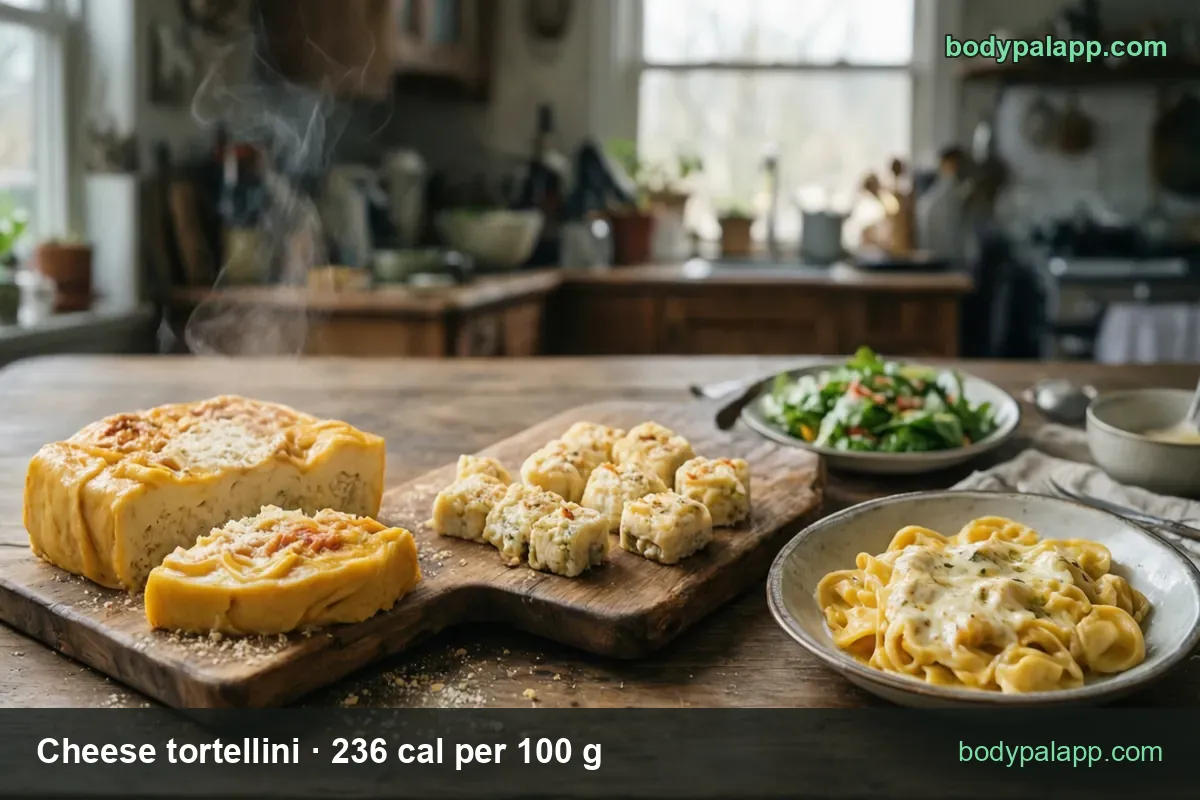
Read that table down the "per 100 g" column and the sauced versions look like diet food. They are not. Sauce is mostly water, so it drags the density down while the cup gets heavier, and the cup is what you eat. A cup of tortellini in cream sauce weighs 250 g and comes to 383 calories, 29 more than the plain cup that weighs 100 g less.
Tomato sauce lands at 373 a cup, close enough to cream that calories alone will not decide it. Sodium will. The cream version carries 1,440 mg in that cup against 698 mg for tomato.
The canned version is the outlier at 91 calories per 100 g and 225 a cup. It is the most diluted of the set, with more liquid and less pasta per spoonful, and it shows in the protein: 3.48 g per 100 g against 10.38 g for the drained pasta.
Tortellini salad with vinaigrette sits at 326 calories a cup and reads like the light choice on a deli counter. At 1,080 mg of sodium in that cup, 47% of the Daily Value, it is the saltiest option here after cream sauce.
Retail refrigerated packages run from 220 to 311 calories per 100 g, straddling the USDA as-purchased figure of 307. Buitoni Three Cheese Tortellini is 283 calories per 100 g and 300 per its 1-cup (106 g) label serving; Giovanni Rana 5 Cheese is 274 per 100 g and 260 a cup; Signature Select Five Cheese is the lightest at 220 per 100 g. Those label servings are dry weights, so they cook up to a larger plate than the number suggests.
Cooked versus as purchased on the package
This is where most tortellini logs go wrong. The refrigerated package is labeled as purchased: SR Legacy 172094 puts that at 307 calories per 100 g, 13.5 g of protein and 406 mg of sodium. Once boiled, the same pasta reads 236 calories per 100 g. Nothing burned off. Water went in, and every gram got diluted.
The practical version: 4 oz scooped out of the package is 113 g and 347 calories, our own scaling of the 307 per 100 g as-purchased figure. Four ounces weighed off your plate after cooking is 267 calories. Same food, an 80-calorie gap, decided entirely by when you put it on the scale.
The USDA package serving of 0.75 cup (81 g) is 249 calories and 329 mg of sodium. That same 249 calories is about 105 g on the plate once cooked, so a package serving that looks small in the tray fills a real bowl. Weigh after cooking whenever you can, and if you must weigh dry, use the as-purchased record rather than this page's main table.
Saturated fat and sodium are the rows to watch
Total fat in a cup is modest, 8.3 g or 11% of the Daily Value. Saturated fat is the surprise: 4.2 g, 21% of the FDA Daily Value of 20 g. That is nearly double the 11% the total fat carries, and it comes from the cheese in the filling rather than the dough. Plain semolina pasta contributes almost none of it.
Protein is the reason to keep tortellini in the rotation. At 15.6 g a cup, 31% of the Daily Value, it does more than a comparable bowl of plain pasta, and the fiber at 2.3 g is not nothing for a refined-grain product. MyPlate still counts it as a refined grain, so it works better alongside a vegetable than as the whole plate.
Sodium is fine until sauce arrives. Plain, a cup is 234 mg, 10% of the Daily Value. In cream sauce it is 1,440 mg, 63%, in a single bowl, against the 2,300 mg daily limit the Dietary Guidelines set for adults. If you are watching sodium, jarred tomato sauce over drained tortellini is the better pick by a wide margin.
How does cheese tortellini compare
| Version | Per 100 g | US serving | Calories |
|---|---|---|---|
| Cheese tortellini, no sauce | 236 kcal | 1 cup (150 g) | 354 kcal |
| With cream sauce | 153 kcal | 1 cup (250 g) | 383 kcal |
| With tomato sauce | 149 kcal | 1 cup (250 g) | 373 kcal |
| Fresh refrigerated, as purchased | 307 kcal | 0.75 cup (81 g) | 249 kcal |
Our take: for weight loss, a cup of the tomato-sauce version is 373 calories with 698 mg of sodium, the lowest of the sauced options; measuring a cup of drained tortellini at 354 calories and spooning tomato sauce over it keeps you in that range. For fullness on the same calories, the plain cup wins outright, since it packs 15.6 g of protein into 150 g instead of spreading it across 250 g of sauce. The as-purchased row is the only one in this table that is not a plate of food, and it is the number printed on the package you bought.
Most popular cheese tortellini brands in the United States
Ranked by how widely each product appears among foods sold in the United States, from the BodyPal food database of over 3.3 million products. Calories are the figures printed on each Nutrition Facts label, checked against USDA FoodData Central.
| Product | Calories (per 100 g) |
|---|---|
| Buitoni Three Cheese Tortellini | 283 cal |
| Buitoni Whole Wheat Three Cheese Tortellini | 311 cal |
| Perfect Pasta Cheese Tortellini | 239 cal |
| Durante's Pasta Cheese Tortellini | 260 cal |
| Signature Select Five Cheese Tortellini | 220 cal |
| Giovanni Rana 5 Cheese Tortellini | 274 cal |
Brand popularity: BodyPal food database. Nutrition: manufacturer labels / USDA FoodData Central.
Cheese tortellini FAQs
How many calories are in 1 cup of cheese tortellini?
One cup of cooked cheese tortellini without sauce is 354 calories, from 236 calories per 100 grams at a cup weight of 150 grams. That cup also carries 15.6 grams of protein and 54.2 grams of carbohydrate, so it lands like a full starch course rather than a side dish.
How many calories in cheese tortellini with cream sauce?
A cup of cheese tortellini in cream sauce is 383 calories, only 29 more than the plain cup, because the sauce weighs 250 grams instead of 150. Sodium is the real jump: 1,440 milligrams against 234, which is 63 percent of the FDA Daily Value in one bowl.
Is cheese tortellini high in protein?
Moderately, yes: 15.6 grams of protein in a 1-cup serving, 31 percent of the Daily Value, from 10.38 grams per 100 grams. That beats most plain pasta because the cheese filling counts. It is not a protein food on its own, but it is a respectable base with a lean side.
How many carbs are in cheese tortellini?
A 1-cup serving has 54.2 grams of carbohydrate, 20 percent of the Daily Value, plus 2.3 grams of fiber and 1.1 grams of total sugars. Per 100 grams that is 36.15 grams. Most of it is the semolina wrapper; the cheese filling adds fat and protein, not starch.
How many calories in 4 oz of cheese tortellini?
Four ounces of cooked cheese tortellini is 267 calories, our own arithmetic from the USDA 100-gram figure of 236. Weigh the same four ounces straight from the refrigerated package and it is 347 calories, because the uncooked pasta has not taken on water yet. Weigh it after cooking.
Does cheese tortellini have a lot of sodium?
A plain 1-cup serving has 234 milligrams of sodium, 10 percent of the Daily Value, which is mild for a filled pasta. Sauce changes that fast: a cup with cream sauce reaches 1,440 milligrams and the vinaigrette salad version 1,080. The Dietary Guidelines cap adults at 2,300 milligrams a day.
Cooked versus uncooked cheese tortellini, what changes?
Cooked tortellini is 236 calories per 100 grams; the same pasta as purchased, fresh-refrigerated, is 307. Nothing burns off in the pot, water goes in, so each gram is diluted. A 0.75-cup package serving of 81 grams is 249 calories, which is roughly 105 grams once cooked.
Is cheese tortellini healthy?
It is a reasonable base: 354 calories a cup, 15.6 grams of protein, 2.3 grams of fiber and 234 milligrams of sodium when plain. The saturated fat is the flag at 4.2 grams, 21 percent of the Daily Value, from the cheese. Add vegetables and tomato sauce rather than cream.
Similar foods
- Mac And Cheese — 513 cal per cup
- Maple Syrup — 216 cal for 1/4 cup
- Prosciutto — 55 cal for 3 thin slices
- Baba ganoush — 110 cal for 1/4 cup
- Wonton wrapper — 23 cal per wonton wrapper
- Cheeseburger — 488 cal per cheeseburger
Count it without the math
Point the camera at the bowl and BodyPal counts the tortellini and the sauce separately.


How long does it take to burn off 354 kcal of cheese tortellini?
A 1-cup (150 g) serving is 354 kcal. Enter your weight and the amount you ate to see how long it takes you to burn that off:
lb
| Activity | Time to burn 354 kcal |
|---|---|
| Walking, brisk | 1 hr 11 min |
| Cycling, moderate | 44 min |
| Swimming, moderate | 51 min |
| Jogging | 42 min |
| Weight training, moderate | 1 hr 19 min |
Times are for a 155 lb adult at a steady pace; change the weight to see yours. The amount is set to the portion in the text (150 g); change it to what you actually ate. BodyPal works this out from your steps automatically.
This table assumes you know your daily total. If you do not, the daily calorie calculator works it out from five numbers.