
How many calories are in tortellini pasta?
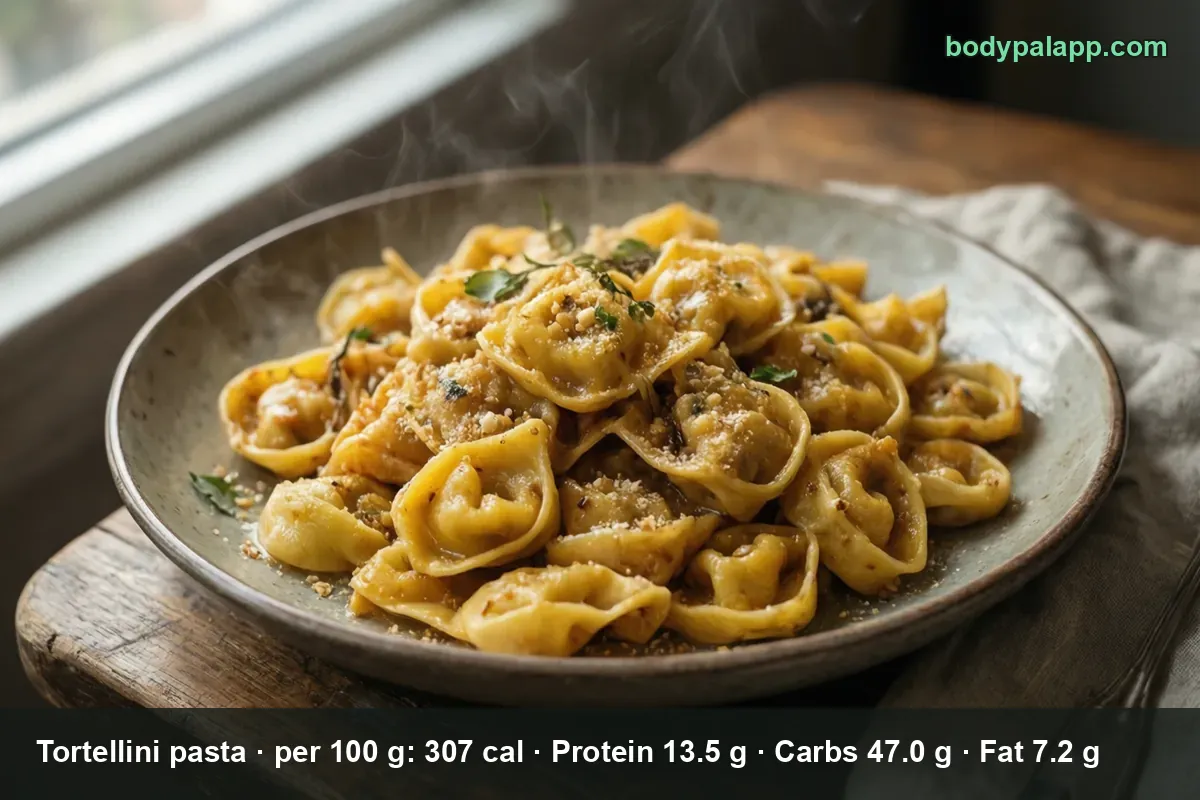
A 1-cup (108 g) serving of fresh cheese tortellini carries 332 calories, and per 100 g the refrigerated pasta runs 307. That is the weight straight from the package, before boiling. The cheese filling is doing most of that work, and it brings sodium and saturated fat along with the calories.
On this page
- Tortellini quick facts
- US servings, from one ounce to a full cup
- Cheese, meat, spinach and dry tortellini
- Sodium is the row to watch
- How does tortellini compare?
- Most popular tortellini pasta brands
- FAQ
Tortellini quick facts
The reference record here is SR Legacy 172094, "Tortellini, pasta with cheese filling, fresh-refrigerated, as purchased". It is the only tortellini entry in FoodData Central that is not a scanned package label, and it is exactly the product most people are holding: the fresh pillows from the refrigerated case, sold in a tub next to the pesto.
"As purchased" is the part worth reading twice. The 307 figure describes the pasta at package weight, not after it has spent three minutes in boiling water. Everything in the table below scales from that state, which is also how the package tells you to measure.
| Nutrient | Per 100 g | Per 1 cup (108 g) | % Daily Value |
|---|---|---|---|
| Calories | 307 | 332 | — |
| Total fat | 7.23 g | 7.8 g | 10% |
| Saturated fat | 3.6 g | 3.9 g | 19% |
| Carbohydrate | 47 g | 50.8 g | 18% |
| Dietary fiber | 1.9 g | 2.1 g | 7% |
| Total sugars | 0.95 g | 1.0 g | — |
| Protein | 13.5 g | 14.6 g | 29% |
| Sodium | 406 mg | 438 mg | 19% |
% Daily Value is based on a 2,000-calorie diet.
Verified nutrition data
Numbers on this page come from USDA FoodData Central, the U.S. Department of Agriculture’s food composition database, and from manufacturer labels where a branded product is named. Last verified September 2026. How we verify our data →
Two rows you would see on a package are missing here on purpose. The SR Legacy edition of this record does not carry added sugars or trans fat at all, so putting a number in either row would mean inventing one. Cholesterol and potassium do exist in the record: a cup gives 45 mg of cholesterol (15% DV) and 96 mg of potassium, which is only 2% of the 4,700 mg Daily Value. Tortellini is not a potassium food.
The 1-cup (108 g) column is our own arithmetic from the USDA 100 g figure, scaled up from the agency's own 3/4-cup portion of 81 g rather than taken from a package label. Daily Values follow the FDA reference amounts for a 2,000-calorie day.
US servings, from one ounce to a full cup
| Serving | Weight | Calories |
|---|---|---|
| 1 oz | 28 g | 86 kcal |
| 1/2 cup | 54 g | 166 kcal |
| 3/4 cup, the USDA portion | 81 g | 249 kcal |
| 1 cup | 108 g | 332 kcal |
| 2 oz | 57 g | 175 kcal |
| Per 100 g | 100 g | 307 kcal |
Only one line in that table is a USDA household measure: the 3/4 cup at 81 g, 249 calories. The half cup, the full cup and both ounce weights are our own arithmetic from the USDA 100 g figure, which is how you get from a published record to the amount actually sitting in your bowl.
The cup is where people lose track. A cup of dry tortellini off a shelf, a cup of fresh tortellini out of the refrigerated tub, and a cup of cooked tortellini after boiling are three different weights of food wearing the same word. Fresh pillows at 108 g per cup is the honest middle. If you own a kitchen scale, weigh the package portion before it goes in the pot and you never have to guess again.
Cheese, meat, spinach and dry tortellini
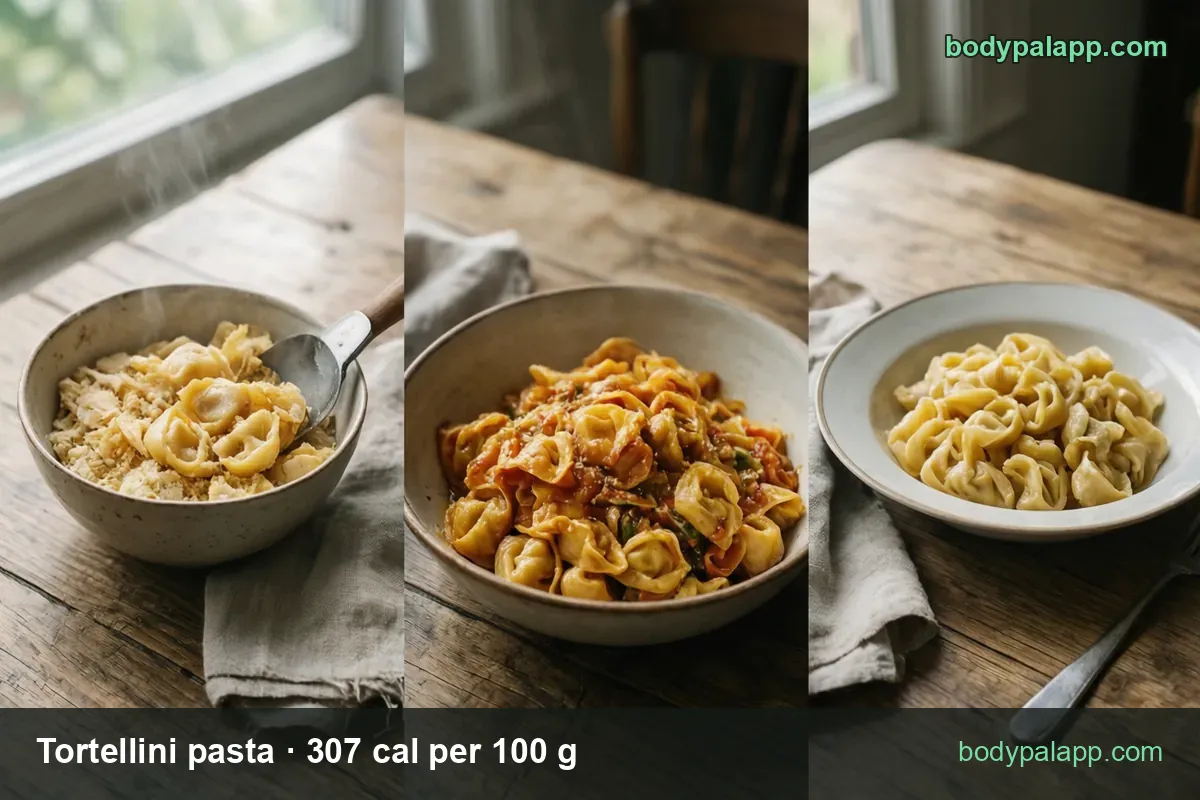
| Version | Per 100 g | Typical serving | Calories |
|---|---|---|---|
| Cheese tortellini, fresh refrigerated | 307 kcal | 1 cup (108 g) | 332 kcal |
| Meat tortellini | 210 kcal | 1 cup (100 g) | 210 kcal |
| Spinach and cheese tortellini | 260 kcal | 1 cup (100 g) | 260 kcal |
| Rainbow tortellini | 290 kcal | 1 cup (100 g) | 290 kcal |
| Dry three cheese tortellini, uncooked | 357 kcal | 2/3 cup dry (56 g) | 200 kcal |
| Mushroom tortellini, dry | 400 kcal | 3/4 cup (65 g) | 260 kcal |
The spread across those six versions runs from 210 to 400 calories per 100 g, and a good part of that gap is not about the filling being rich. It is about water. Dry tortellini has had its moisture driven off, so 100 g of it is 100 g of concentrated pasta and cheese; fresh tortellini is carrying water that boiling will only add to. Compare dry with dry and fresh with fresh, or the comparison means nothing.
Meat filling comes out lighter than cheese filling on a per-100-g basis, at 210 against 307, which surprises most people. Ground meat is mostly water and protein; a cheese blend is fat. Spinach versions sit between at 260, and the spinach itself is a rounding error next to what it displaces from the cheese.
Store labels tell the same story from a different angle. A cup of Buitoni Three Cheese is listed at 300 calories for 106 g, while a cup of the lighter-filled Wegmans cheese tortellini is 270 for 125 g and Seviroli comes in at 230 for 127 g. Same shape, same aisle, a 70-calorie swing per cup.
Sodium is the row to watch
A cup of fresh cheese tortellini is 438 mg of sodium, 19% of the 2,300 mg Daily Value, and that is before a spoonful of sauce or a shake of Parmesan touches it. Two cups, which is an ordinary dinner portion for an adult, is 876 mg and 38% of the day. Dry versions are worse per 100 g: the Barilla three cheese record lands at 643 mg and the mushroom one at 923 mg.
The calorie side is friendlier. Saturated fat at 3.9 g per cup is 19% DV, high enough to notice when the Dietary Guidelines ask you to keep saturated fat under 10% of calories, but nothing like a cheeseburger. Protein at 14.6 g is 29% DV, genuinely good for a pasta course, and that is the strongest argument for tortellini over a plain noodle: you get a protein number that lets you skip a second protein on the plate.
Fiber is the weak spot. At 2.1 g a cup, or 7% DV, refined semolina pasta with a cheese filling gives you very little, which is why MyPlate keeps pushing at least half your grains toward whole grains. A cup of tortellini with a pile of broccoli next to it fixes the fiber and the potassium in one move.
How does tortellini compare?
| Food | Per 100 g | US serving | Calories |
|---|---|---|---|
| Cheese tortellini, fresh | 307 kcal | 1 cup (108 g) | 332 kcal |
| Macaroni and cheese, reduced-fat mix, unprepared | 297 kcal | 1 serving (99 g) | 294 kcal |
| Pizza rolls, frozen, unprepared | 328 kcal | 6 rolls (85 g) | 279 kcal |
| Taquitos, frozen, beef and cheese, oven-heated | 287 kcal | 1 piece (28 g) | 80 kcal |
Our take: on a per-100-g basis these four are close enough to be interchangeable, all between 287 and 328, so the deciding factor is the serving you actually eat and what comes with it. Tortellini wins on protein, at 13.5 g per 100 g against 8.73 for pizza rolls and 9.4 for taquitos, and that is the number that decides whether you are hungry an hour later. Where it loses is sodium and the sauce you will inevitably add on top. If you are counting calories, a 3/4-cup portion at 249 leaves room for real sauce and a vegetable; if you are counting sodium, keep the portion at one cup and go light on Parmesan.
Most popular tortellini pasta brands in the United States
Ranked by how widely each product appears among foods sold in the United States, from the BodyPal food database of over 3.3 million products. Calories are the figures printed on each Nutrition Facts label, checked against USDA FoodData Central.
| Product | Calories (per 100 g) |
|---|---|
| Buitoni Three Cheese Tortellini | 283 cal |
| Buitoni Mixed Cheese Tortellini | 283 cal |
| Barilla Classic Three Cheese Tortellini | 357 cal |
| Barilla Classic Cheese & Spinach Tortellini | 375 cal |
| Wegmans Cheese Tortellini | 216 cal |
| Seviroli Cheese Tortellini | 181 cal |
Brand popularity: BodyPal food database. Nutrition: manufacturer labels / USDA FoodData Central.
Tortellini FAQs
How many calories are in a cup of tortellini?
A 1-cup (108 g) serving of fresh cheese tortellini is 332 calories, scaled from the USDA figure of 307 calories per 100 g. That cup also carries 14.6 g of protein, 50.8 g of carbohydrate and 438 mg of sodium, which is 19% of a 2,000-calorie day's Daily Value.
How many calories in cheese tortellini?
Fresh refrigerated cheese tortellini is 307 calories per 100 g, or 332 per 1-cup serving of 108 g. Store brands vary a lot: a Buitoni cup is listed at 300 calories, a Wegmans cup at 270 and a Seviroli cup at 230, because the amount of cheese filling differs.
Do cooked and uncooked tortellini have the same calories?
A 1-cup (108 g) portion is 332 calories cooked or uncooked, but the same weight is not the same food. Boiling adds water, so cooked tortellini weighs more per calorie. Dry three cheese tortellini is 357 calories per 100 g against 307 for fresh refrigerated, purely because the dry product has less water in it.
How much protein is in tortellini?
A 1-cup (108 g) serving gives 14.6 g of protein, which is 29% of the Daily Value, and 100 g gives 13.5 g. That comes from the cheese filling on top of the semolina pasta, and it is the main reason a bowl of tortellini holds off hunger better than a plain noodle dish.
Is tortellini high in sodium?
Yes, moderately: 438 mg per 1-cup serving, or 19% of the 2,300 mg Daily Value, before any sauce. Two cups reaches 876 mg, 38% of the day. Dry versions are saltier per 100 g, with the Barilla record at 643 mg and a mushroom-filled one at 923 mg.
How many carbs are in tortellini?
A 1-cup (108 g) serving has 50.8 g of carbohydrate, 18% of the Daily Value, of which only 2.1 g is fiber and 1.0 g is sugars. Per 100 g the numbers are 47 g of carbohydrate and 1.9 g of fiber, so this is refined pasta with very little fiber behind it.
What is a serving size of tortellini?
USDA uses 3/4 cup, 81 g, which is 249 calories. Most packages label a full cup instead, around 106 to 127 g depending on brand. A practical dinner portion is one to two cups of fresh tortellini, or 332 to 664 calories before sauce, cheese or oil.
How many calories in tortellini with sauce?
The pasta alone is 332 calories per 1-cup serving. USDA publishes no record for tortellini already sauced, so the sauce has to be counted as its own item rather than guessed at. Butter and Parmesan add far more than a tomato sauce does, so log the fat separately.
Similar foods
- Cheese Tortellini — 354 cal per cup
- Cheese Spaetzle — 234 cal per serving
- Mac And Cheese — 513 cal per cup
- Macaroni Salad — 451 cal per cup
- Chicken And Pasta — 435 cal per cup
- Chicken Alfredo — 515 cal per cup
Count it without the math
Point the camera at the bowl and BodyPal counts the tortellini for you, filling and sauce included.


How long does it take to burn off tortellini?
A 1-cup (108 g) serving is 332 kcal. Enter your weight and the amount you ate to see how long it takes you to burn that off:
lb
| Activity | Time to burn 332 kcal |
|---|---|
| Walking, brisk | 1 hr 6 min |
| Cycling, moderate | 42 min |
| Swimming, moderate | 47 min |
| Jogging | 39 min |
| Weight training, moderate | 1 hr 14 min |
Times are for a 155 lb adult at a steady pace; change the weight to see yours. The amount is set to the portion in the text (108 g); change it to what you actually ate. BodyPal works this out from your steps automatically.
One food is easy to picture; a whole day is harder. See how many calories you need a day and what a deficit actually looks like.