
How many calories are in macaroni salad?
A full cup of deli-style macaroni salad weighs 204 g and carries 451 calories. Per 100 g the same salad runs 221 calories — the highest of the seven dressing styles USDA publishes for this salad. The pasta is not the problem. The mayonnaise is: 23.5 g of fat in that cup.
On this page
- Macaroni salad quick facts
- US servings, from one ounce to a full cup
- Light mayo, creamy dressing, Italian and fat-free
- Egg, chicken and the loaded versions
- Where the fat and the sodium actually land
- How does macaroni salad compare?
- Most popular macaroni salad brands
- Macaroni salad FAQs
Macaroni salad quick facts
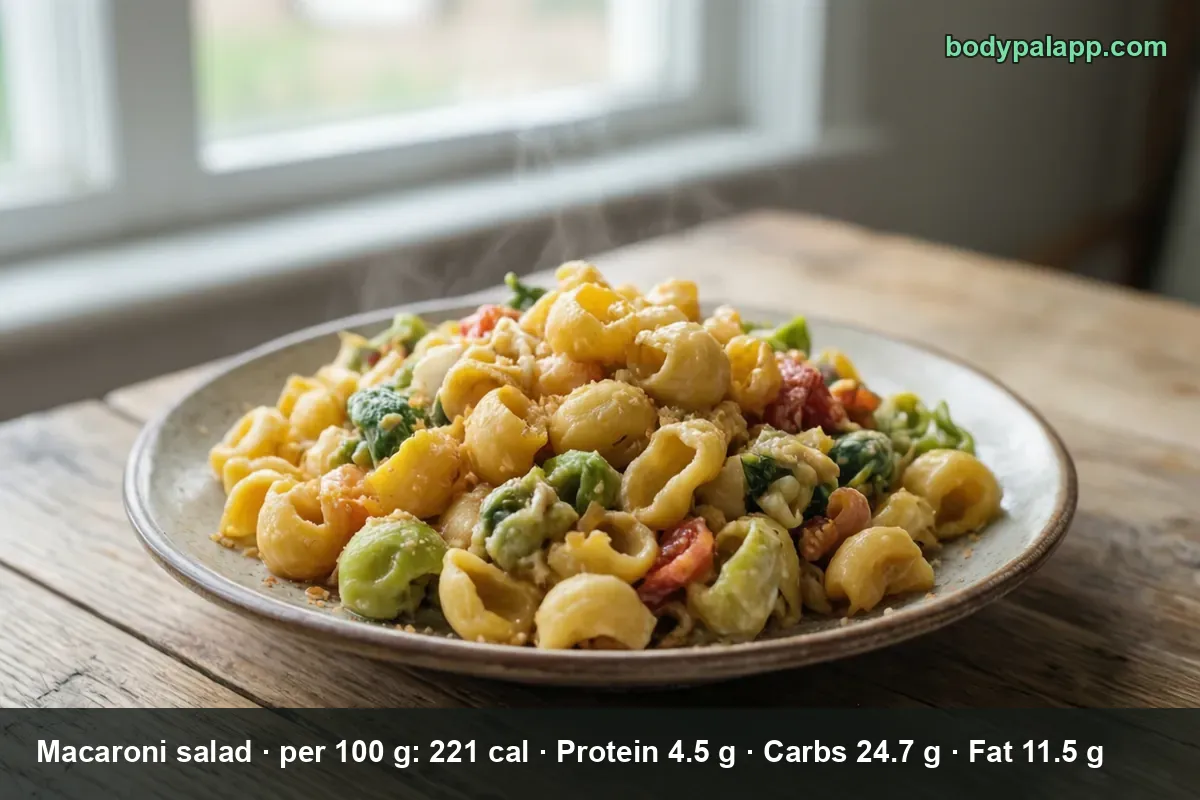
The record that matches what people actually eat is FNDDS 2708932, "Macaroni or pasta salad, made with mayonnaise", from the 2021–2023 survey release. It is the plain version — cooked short pasta, real mayonnaise, a little celery and onion, nothing folded in. That matters, because the moment you add tuna, cheese or ham the record changes and so does every number below.
It also sits in the middle of what supermarket delis print. Store tubs run from about 200 to 250 calories per 100 g, and the USDA figure of 221 lands square in that band. The shape of the pasta is irrelevant to the arithmetic: shells, elbows or rotini, the salad weighs and counts the same.
| Nutrient | Per 100 g | Per 1 cup (204 g) | % Daily Value |
|---|---|---|---|
| Calories | 221 | 451 | — |
| Total fat | 11.52 g | 23.5 g | 30% |
| Saturated fat | 1.82 g | 3.7 g | 19% |
| Carbohydrate | 24.65 g | 50.3 g | 18% |
| Dietary fiber | 1.4 g | 2.9 g | 10% |
| Total sugars | 1.85 g | 3.8 g | — |
| Protein | 4.46 g | 9.1 g | 18% |
| Sodium | 204 mg | 416 mg | 18% |
% Daily Value is based on a 2,000-calorie diet.
Verified nutrition data
Numbers on this page come from USDA FoodData Central, the U.S. Department of Agriculture’s food composition database, and from manufacturer labels where a branded product is named. Last verified September 2026. How we verify our data →
Two rows are missing on purpose. USDA does not publish added sugars or trans fat for this record, so there is nothing honest to put in those cells. Cholesterol is low for a mayonnaise dish — 6 mg per 100 g, 12 mg in a cup, 4% of the Daily Value — and potassium is 49 mg per 100 g, 100 mg a cup, which is 2%. The Daily Values used here are FDA's.
US servings, from one ounce to a full cup
| Serving | Weight | Calories |
|---|---|---|
| 1 oz | 28.4 g | 63 kcal |
| 1/2 cup | 102 g | 225 kcal |
| 4 oz | 113 g | 250 kcal |
| Portion, quantity not specified (USDA) | 136 g | 301 kcal |
| 1 cup | 204 g | 451 kcal |
| Per 100 g | 100 g | 221 kcal |
Only two of those are USDA household measures: the 1-cup serving at 204 g and the "portion, quantity not specified" at 136 g, which is USDA's stand-in for an average helping when nobody measured. The half cup, the 4 oz and the single ounce are our own arithmetic from the USDA 100 g figure, not USDA servings.
Here is the trap. A cup of macaroni salad is 204 g, which is dense, heavy and much more than most people picture — two heaped serving spoons, not one. Deli tubs, meanwhile, print a friendlier serving: Ahold's Homestyle Picnic label calls half a cup 120 g for 300 calories, and a Kroger Fresh Foods Market tub calls three-quarters of a cup 140 g for 280. Ahold's half cup weighs 120 g, more than the 102 g our USDA arithmetic gives. If you scoop by eye and log "half a cup," you are probably eating closer to 250 calories than 225.
The rest of the shelf clusters tightly: Market Pantry at Target is 204 calories per 100 g, Kroger's King Soopers salad 214, 365 by Whole Foods 220, Publix 247. Publix sells it by the 227 g container, and that whole container is 561 calories.
Light mayo, creamy dressing, Italian and fat-free
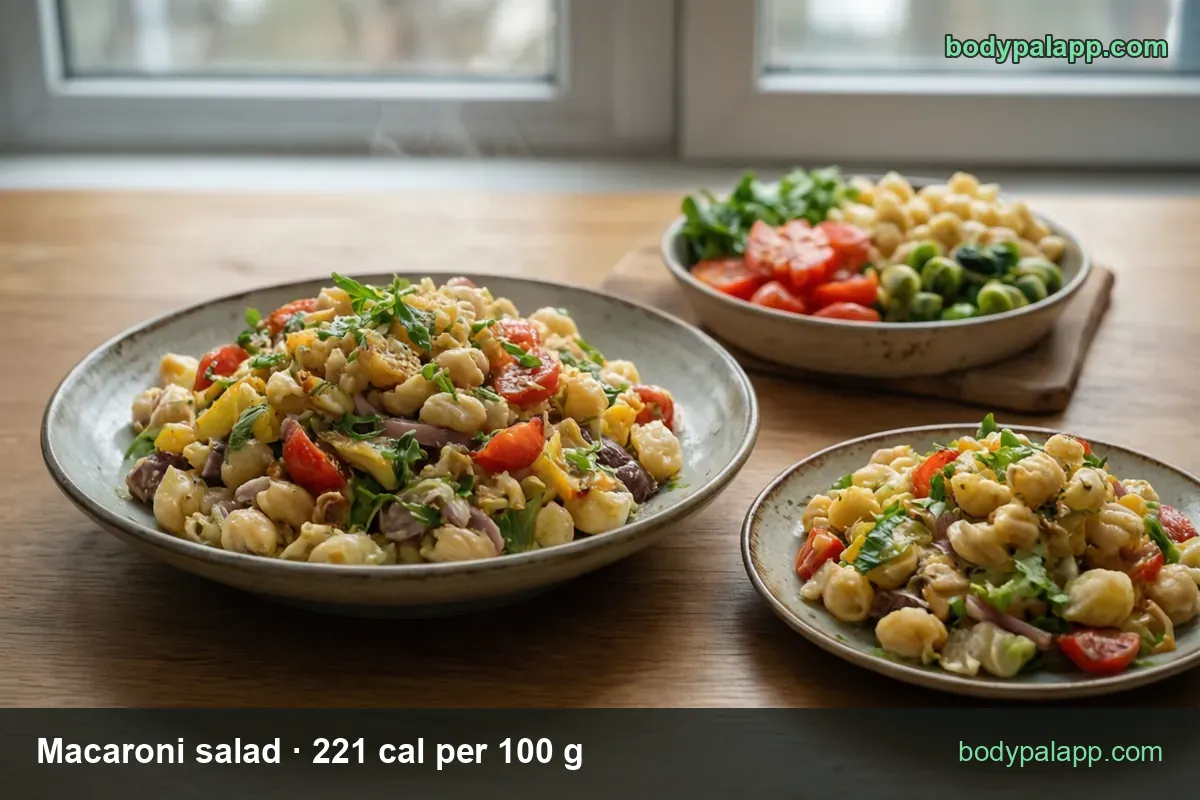
This is the single most useful table on the page, because the dressing moves the number more than the portion does. Same pasta, same vegetables, seven different jars.
| Version | Per 100 g | 1 cup (204 g) | fdc_id |
|---|---|---|---|
| Made with mayonnaise | 221 kcal | 451 kcal | 2708932 |
| Made with mayonnaise-type salad dressing | 160 kcal | 326 kcal | 2708934 |
| Made with light mayonnaise | 159 kcal | 324 kcal | 2708933 |
| Made with creamy dressing | 156 kcal | 318 kcal | 2708938 |
| Made with any fat-free dressing | 134 kcal | 273 kcal | 2708940 |
| Made with Italian dressing | 133 kcal | 271 kcal | 2708936 |
| Made with light creamy dressing | 123 kcal | 251 kcal | 2708939 |
Swapping full-fat mayonnaise for light mayonnaise takes 127 calories out of a cup. Going all the way to a light creamy dressing takes 200 out — a cup drops from 451 to 251, barely more than a plain half cup of the original at 225. The fat is where it happens: 11.52 g per 100 g becomes 4.16 g with light mayo and 2.92 g with light creamy dressing.
The lighter versions are not free, though. Carbohydrate goes up, not down, when the fat comes out: the fat-free-dressing salad is 26.54 g of carbs per 100 g against 24.65 g for the mayonnaise one, and its sugars nearly double, 3.42 g against 1.85 g. Sodium also creeps up in almost every light version — 239 mg per 100 g for both the light-mayo and the fat-free salads against 204 mg for the original. That is the standard trade when a manufacturer pulls oil out of a dressing.
The Italian-dressing version at 133 calories per 100 g is the outlier worth knowing about, because it is not trying to imitate mayonnaise at all. It is oil and vinegar on cold pasta, it holds better in a cooler, and a full cup is 271 calories.
Egg, chicken and the loaded versions
Add something to the bowl and the salad stops being a side.
| Version | Per 100 g | 1 cup (204 g) | Protein per 100 g |
|---|---|---|---|
| With egg | 215 kcal | 439 kcal | 5.18 g |
| With chicken | 213 kcal | 435 kcal | — |
| Plain, made with mayonnaise | 221 kcal | 451 kcal | 4.46 g |
Both add-ins land slightly below the plain salad per gram, which surprises people. Chopped egg and diced chicken are less calorie-dense than the mayonnaise they displace, so the per-100-g figure drifts down even as the bowl gets more substantial. The egg version carries 5.18 g of protein per 100 g against 4.46 g, and its cholesterol jumps to 39 mg per 100 g — about 80 mg in a cup by our own arithmetic from that figure, a bit over a quarter of the Daily Value.
If you are eating macaroni salad as lunch rather than as a side, the egg version is the better buy: 5.18 g of protein per 100 g against 4.46 g, at marginally fewer calories per gram.
Where the fat and the sodium actually land
The fat row is the loud one. A cup delivers 23.5 g of total fat, 30% of the Daily Value, which is a lot for something served next to the main dish. But the saturated fat row is quieter than you would expect: 3.7 g, or 19% of the Daily Value. Commercial mayonnaise is mostly soybean oil, so the fat here is largely unsaturated. The Dietary Guidelines for Americans cap saturated fat at under 10% of calories, and one cup of this salad does not come close to blowing that on its own.
Sodium is the row that scales badly. At 204 mg per 100 g it looks modest, but a cup is 416 mg — 18% of the 2,300 mg Daily Value, roughly a fifth of a teaspoon of table salt. Load the salad with meat and it changes character entirely: that version runs 378 mg of sodium per 100 g, which works out to 771 mg in a cup, 34% of the Daily Value, before you have touched the sandwich it came with.
Fiber is the disappointment. Cooked white pasta plus a little celery gives 1.4 g per 100 g, 2.9 g a cup, 10% of the Daily Value. That is refined grain doing what refined grain does; MyPlate asks for half your grains to be whole, and this salad is not one of them.
How does macaroni salad compare?
| Salad | Per 100 g | US serving | Calories | Protein per cup |
|---|---|---|---|---|
| Macaroni salad, mayonnaise | 221 kcal | 1 cup, 204 g | 451 kcal | 9.1 g |
| With tuna | 200 kcal | 1 cup, 204 g | 408 kcal | 13.6 g |
| With meat | 211 kcal | 1 cup, 204 g | 430 kcal | 15.6 g |
| With cheese | 246 kcal | 1 cup, 204 g | 502 kcal | 14.1 g |
Protein per cup is our own arithmetic from the USDA 100 g figures, not a USDA serving.
Our take: the plain mayonnaise salad is the worst deal on this table. It is the second-heaviest per gram and it gives you the least protein by a wide margin — 9.1 g against 13.6 g for tuna and 15.6 g for the meat version, which are both lighter per gram than plain. If macaroni salad is a side next to a burger, take the smallest scoop you can live with, or take the Italian-dressing version at 271 a cup. If it is the meal, take tuna: 43 fewer calories in a cup and half again the protein. Cheese is the one to skip — 502 calories a cup is dinner money spent on a side dish.
Most popular macaroni salad brands in the United States
Ranked by how widely each product appears among foods sold in the United States, from the BodyPal food database of over 3.3 million products. Calories are the figures printed on each Nutrition Facts label, checked against USDA FoodData Central.
| Product | Calories (per 100 g) |
|---|---|
| Publix Macaroni Salad | 247 cal |
| Kroger King Soopers Macaroni Salad | 214 cal |
| Market Pantry Macaroni Salad | 204 cal |
| Kroger Fresh Foods Market Macaroni Salad | 200 cal |
| 365 by Whole Foods Mom's Macaroni Salad | 220 cal |
| Ahold Homestyle Picnic Macaroni Salad | 250 cal |
Brand popularity: BodyPal food database. Nutrition: manufacturer labels / USDA FoodData Central.
Macaroni salad FAQs
How many calories are in macaroni salad?
Macaroni salad made with mayonnaise runs 221 calories per 100 g, so a 1-cup (204 g) serving is 451 calories. A half-cup scoop is about 225. The dressing decides almost everything: the same pasta with a light creamy dressing is 123 calories per 100 g, or 251 a cup.
How many calories in 1 cup of macaroni salad?
A 1-cup serving weighs 204 g and carries 451 calories, with 23.5 g of fat, 50.3 g of carbohydrate and 9.1 g of protein. That is 30% of the Daily Value for total fat in one side dish. A cup is a genuinely large scoop — two heaped serving spoons.
How many calories in a scoop of deli macaroni salad?
USDA's unspecified portion is 136 g, which comes to 301 calories. Deli labels usually print a smaller serving: Ahold's Homestyle Picnic tub calls 1/2 cup 120 g and 300 calories, while a whole 227 g Publix container is 561. Weigh the container, not the scoop, if you want the real number.
Is macaroni salad healthy?
It is a 451-calorie cup with 2.9 g of fiber and 9.1 g of protein, so it eats like a starchy side rather than a vegetable dish. Sodium is 416 mg, 18% of the Daily Value. If you're watching calories, the Italian-dressing version at 271 a cup does the same job.
How many carbs are in macaroni salad?
A cup holds 50.3 g of carbohydrate, 18% of the Daily Value, of which 2.9 g is fiber and only 3.8 g is sugar. Per 100 g that is 24.65 g. The fat-free-dressing version is actually higher in carbs, 26.54 g per 100 g, because the dressing is sweetened.
How much sodium is in macaroni salad?
204 mg per 100 g, or 416 mg in a 1-cup serving — 18% of the 2,300 mg Daily Value, roughly a fifth of a teaspoon of table salt. The versions with meat are far saltier, 378 mg per 100 g, which works out to 771 mg and 34% of the Daily Value per cup.
Does light mayonnaise really cut the calories?
Yes — 159 calories per 100 g against 221, so a cup falls from 451 to 324. The fat drops from 11.52 g to 4.16 g per 100 g while the pasta and the carbs stay put. A light creamy dressing cuts deeper still, to 123 per 100 g and 251 a cup.
How many calories in tuna macaroni salad?
Tuna macaroni salad is 200 calories per 100 g, so a 1-cup (204 g) serving is 408 calories — lighter than the plain mayonnaise version at 451. The tuna also lifts protein from 4.46 g to 6.69 g per 100 g, about 13.6 g in a cup by our own arithmetic.
Similar foods
- Potato wedges — 138 cal for 3 oz
- Ear of Corn — 99 cal per medium ear
- Sweet Potato — 103 cal per medium, baked
- Papaya salad — 190 cal per plate
- Cornmeal — 581 cal per cup
- Carrot — 53 cal per cup chopped
Count it without the math
Point the camera at the bowl and BodyPal counts the scoop for you, dressing and all.


How long does it take to burn off macaroni salad?
A 1-cup (204 g) serving is 451 kcal. Enter your weight and the amount you ate to see how long it takes you to burn that off:
lb
| Activity | Time to burn 451 kcal |
|---|---|
| Walking, brisk | 1 hr 30 min |
| Cycling, moderate | 56 min |
| Swimming, moderate | 1 hr 4 min |
| Jogging | 53 min |
| Weight training, moderate | 1 hr 40 min |
Times are for a 155 lb adult at a steady pace; change the weight to see yours. The amount is set to the portion in the text (204 g); change it to what you actually ate. BodyPal works this out from your steps automatically.
Want the bigger picture? Calculate your daily calorie needs — your maintenance figure, a target for losing or gaining, and the date you get there.