
Calories in Sweet Potato
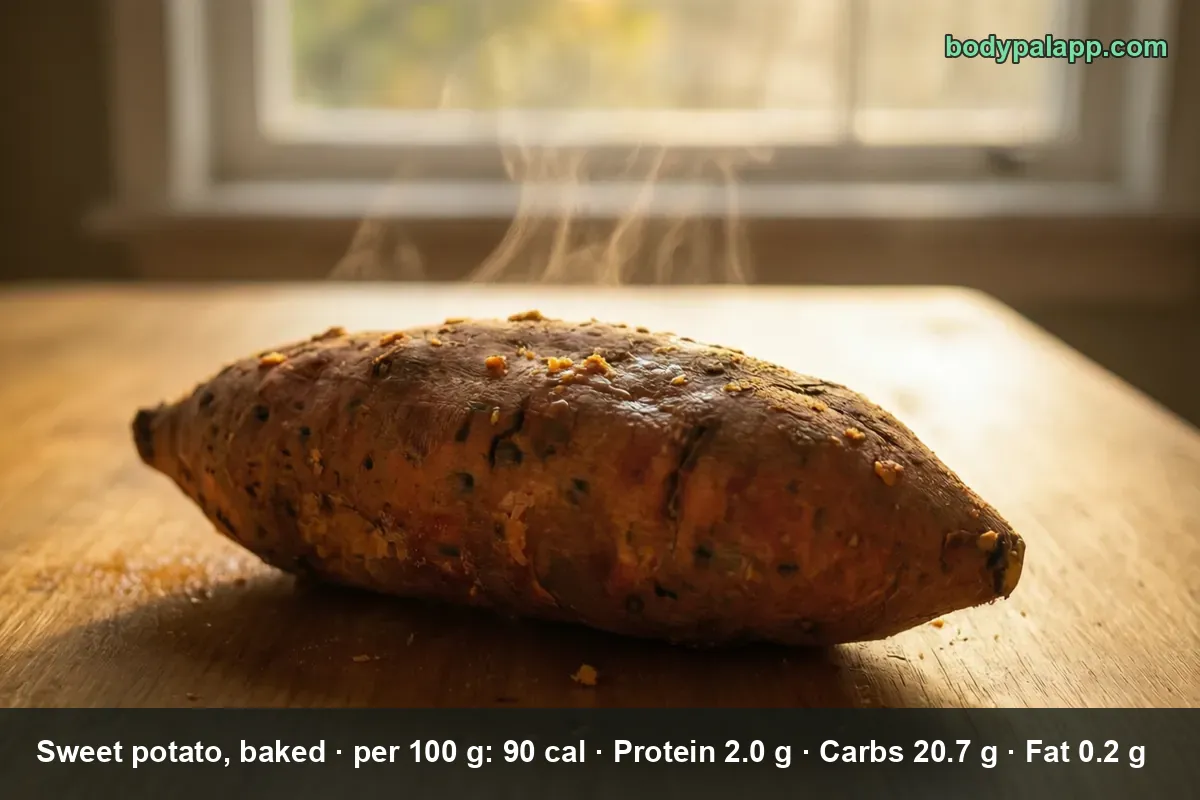
103 calories. That is one medium sweet potato baked in its skin, 114 g of flesh, and it is the figure behind almost every search for calories in sweet potato. Grab a small one instead and you are at 54. Grab a large one and you are at 162. Per 100 g, baked sweet potato runs 90 calories.
On this page
- One potato, three answers
- Nutrition facts for one medium sweet potato
- Cups, halves and ounces
- Baked, boiled, raw and canned
- Sweet potato fries are three different foods
- Canned yams, casserole and pie
- White, purple and Japanese sweet potatoes
- Sweet potato against a russet, corn and rice
- Most popular sweet potato fries brands
- FAQ
One potato, three answers
The question has no single answer because the vegetable has no single size. USDA pins "1 medium" to a tuber about 2 inches across and 5 inches long, which comes out at 114 g of baked flesh. Small is 60 g. Large is 180 g.
| Size | Weight | Calories |
|---|---|---|
| Small | 60 g | 54 |
| Half a medium | 57 g | 51 |
| Medium | 114 g | 103 |
| Large | 180 g | 162 |
| One cup, baked and cubed | 200 g | 180 |
Three times the calories from the same shelf, same bin, same price per pound. That spread of 54 to 162 is why calorie charts disagree with each other so loudly, and it is worth one weigh on a kitchen scale to learn which end your grocery store sells.
One detail explains why this page reads lower than charts you may have seen: USDA measures the baked flesh alone, at 90 calories per 100 g (SR Legacy 168483), and calls 114 g a medium, while charts built on skin-and-all figures with a 180 g potato land near 200.
Nutrition facts for one medium sweet potato
| Nutrient | Per 100 g | Per 1 medium (114 g) | % Daily Value |
|---|---|---|---|
| Calories | 90 | 103 | 5% |
| Total fat | 0.15 g | 0.2 g | 0% |
| Saturated fat | 0.05 g | 0.06 g | 0% |
| Carbohydrate | 20.7 g | 23.6 g | 9% |
| Dietary fiber | 3.3 g | 3.8 g | 13% |
| Total sugars | 6.5 g | 7.4 g | – |
| Protein | 2.0 g | 2.3 g | 5% |
| Sodium | 36 mg | 41 mg | 2% |
| Potassium | 475 mg | 542 mg | 12% |
| Vitamin A | 961 µg RAE | 1,096 µg RAE | 122% |
| Vitamin C | 19.6 mg | 22.3 mg | 25% |
% Daily Value is based on a 2,000-calorie diet.
Verified nutrition data
Numbers on this page come from USDA FoodData Central, the U.S. Department of Agriculture’s food composition database, and from manufacturer labels where a branded product is named. Last verified September 2026. How we verify our data →
Read that table from the bottom and the story changes. Calories are a rounding error in anyone's day at 5%, fiber is respectable at 13%, and then vitamin A arrives at 122% of the Daily Value from a single medium potato. One vegetable, 103 calories, and the day's requirement is finished. The FDA sets the adult Daily Value at 900 µg RAE, and the NIH fact sheet on vitamin A explains why orange-fleshed vegetables carry so much of it: beta-carotene, which the body converts as needed.
Sodium is the other line worth a glance, because it is not really a property of the potato. The unsalted baked figure is 36 mg per 100 g. USDA's salted version of the identical food (SR 170134) reads 246 mg — that pinch during roasting takes one medium potato from 41 mg to 280 mg, from 2% of the Daily Value to 12%. The vegetable is not salty. The cook is.
Cups, halves and ounces
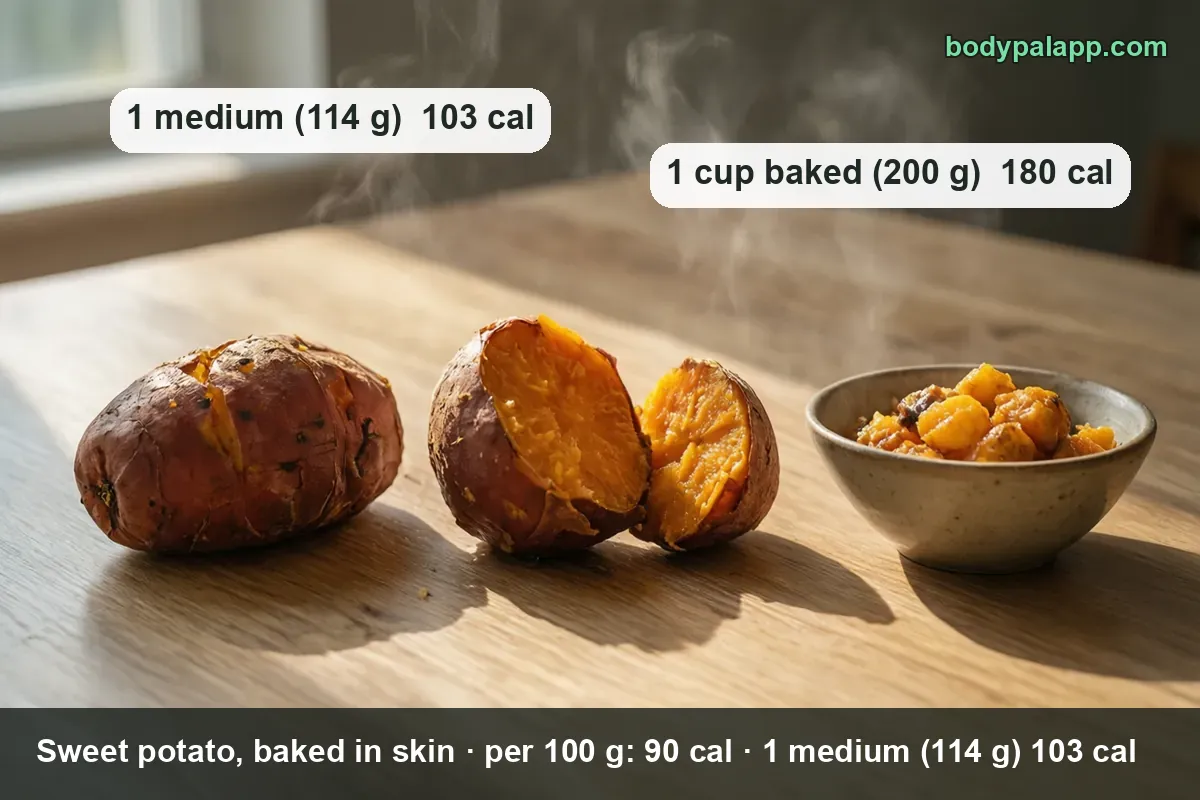
American recipes measure in cups, and this is where sweet potato logging goes wrong, because a cup of sweet potato weighs anything from 133 g to 328 g depending on what happened to it first.
| Measure | Form | Weight | Calories |
|---|---|---|---|
| 1 cup, cubes | Raw | 133 g | 114 |
| 1 cup, cubed | Baked in skin | 200 g | 180 |
| 1 cup, mashed | Boiled, no skin | 328 g | 249 |
| 1 oz | Baked in skin | 28 g | 26 |
| Half a medium | Baked in skin | 57 g | 51 |
Mash is the trap. Crushing the flesh drives the air out, so a measuring cup holds two and a half times as much food as it does when the same potato is sitting in raw cubes — 328 g against 133 g. Nothing was added, nothing was cooked in fat, and the cup went from 114 calories to 249 anyway.
The half-potato answer is the easy one: 51 calories, because half of 103 is half of 103. Sweet potato is one of the few foods where cutting the portion in two really does cut the number in two, since there is no dressing, no skin-to-flesh ratio to argue about and no crust doing anything.
Baked, boiled, raw and canned
| USDA row | fdc_id | Calories per 100 g | Fiber | Sodium |
|---|---|---|---|---|
| Baked in skin, flesh, no salt | 168483 | 90 | 3.3 g | 36 mg |
| Baked in skin, flesh, salted | 170134 | 90 | 3.3 g | 246 mg |
| Boiled, without skin | 168484 | 76 | 2.5 g | 27 mg |
| Raw | 168482 | 86 | 3.0 g | 55 mg |
| Frozen, then baked | 169307 | 100 | 1.8 g | 8 mg |
| Canned, vacuum pack | 168485 | 91 | 1.8 g | 53 mg |
Boiling gives the lowest number on this list at 76 calories per 100 g, and the reason is water rather than virtue: the flesh absorbs it, so every gram carries less potato. Baking pushes water off and concentrates what remains, which is how a food can gain calories per 100 g while losing them per potato.
Roasting and baking are the same row here. If a recipe says roasted at 400°F with nothing but the skin on, use 90 calories per 100 g and stop looking for a separate figure — the difference is browning, not energy.
Raw deserves a footnote. SR Legacy puts it at 86 calories per 100 g, while USDA's newer Foundation Foods analysis of orange-fleshed raw sweet potato (fdc 2346404) calculates 79. Both are real measurements of real potatoes from different harvests, and the honest reading is that raw sweet potato sits in the high 70s to mid 80s. Nobody eats it raw by the pound anyway; the number matters mainly for weighing before the oven.
Sweet potato fries are three different foods
Here is the fact that reframes the whole search: the sweet potato is not what makes sweet potato fries caloric. The fryer is. USDA's survey database keeps three separate rows, and they are 149 calories per 100 g apart.
| Version | fdc_id | Per 100 g | 1 cup (60 g) | 90 g serving |
|---|---|---|---|---|
| Cut from fresh, home-cooked | 2709712 | 156 | 94 | 140 |
| Frozen, prepared | 2709711 | 192 | 115 | 173 |
| Restaurant or fast food | 2709713 | 305 | 183 | 274 |
Note what USDA calls a cup: 60 g of fries. That is roughly a dozen. The basket that arrives next to a restaurant burger is two to three of those cups, so the realistic order is 274 calories and up, not 183.
Saturated fat is where the gap really opens. A cup of frozen fries baked at home carries 4% of the Daily Value; 90 g of the restaurant version carries 28%, along with 10% of the day's sodium. Same vegetable, seven times the saturated fat.
Two more shapes off the same shelf. Sweet potato tots run 15 calories per piece and 248 for a full cup (130 g), which makes them denser than they look. Sweet potato chips are a different category entirely at 532 calories per 100 g — a 1 oz snack bag is 151 calories, because thin slices in hot oil absorb far more of it per gram than a thick-cut fry ever does.
Canned yams, casserole and pie
Nothing labeled "yam" in an American supermarket is a yam. True yams are a different genus, rarely stocked outside specialty markets, and the cans stacked up every November hold sweet potatoes under a name that stuck in the 1930s.
| Dish | fdc_id | Portion | Calories |
|---|---|---|---|
| Canned, vacuum pack | 168485 | 1 cup pieces (200 g) | 182 |
| Canned in syrup, drained | 170084 | 1 cup (196 g) | 212 |
| Candied, home-prepared | 170088 | 1 piece (105 g) | 172 |
| Casserole or mashed | 2709708 | 1 cup (250 g) | 248 |
| Sweet potato pie | 2708012 | 1 slice (150 g) | 404 |
The vegetable arrives at the table at 90 calories per 100 g and leaves it at 164 once it has been candied (SR 170088) — an 82% increase with no change to the potato itself. Sugar does most of that work: raw sweet potato holds 4.2 g of sugar per 100 g and zero added sugar, while one candied-yam label in USDA's Branded database lists 26.3 g of added sugar per 100 g, which is 35 g in a 133 g serving, or 70% of the Daily Value in one side dish.
A cup of casserole at 248 calories is not a disaster on a holiday plate. It carries 21% of the day's fiber and 17% of its saturated fat, and it is a smaller number than most people fear. The pie is the honest splurge at 404 calories a slice, and it is a dessert wearing a vegetable's name.
If you want the MyPlate vegetable serving rather than the dessert, a plain baked medium at 103 calories does the job and keeps the vitamin A.
White, purple and Japanese sweet potatoes
USDA does not break sweet potato down by variety. There is no Foundation, SR Legacy or survey row for Japanese, Murasaki, Okinawan or Beauregard, so anyone quoting a precise figure for one of them is quoting a guess. What does exist is grower label data in USDA's Branded database, measured on real produce:
| Variety | fdc_id | Per 100 g | Label serving | Calories |
|---|---|---|---|---|
| White sweet potato | 576975 | 91 | 113 g | 103 |
| White sweet potato | 579541 | 90 | 4.1 oz (114 g) | 103 |
| Purple sweet potato | 1161232 | 85 | 4.6 oz (130 g) | 111 |
Two independent white-fleshed labels land on 90 and 91 calories per 100 g, within a rounding error of the generic orange figure. Purple comes in slightly lower at 85 with less sugar, 3.85 g against 6.48 g. The practical conclusion is dull and useful: color changes the pigment, not the calorie count, so use 90 per 100 g for any of them and spend the attention on size instead.
Sweet potato against a russet, corn and rice
| Food | fdc_id | Per 100 g | Typical portion | Calories | P / C / F per 100 g |
|---|---|---|---|---|---|
| Sweet potato, baked in skin | 168483 | 90 | 1 medium (114 g) | 103 | 2.0 / 20.7 / 0.2 |
| Russet potato, baked | 170030 | 95 | 1 medium (173 g) | 164 | 2.6 / 21.4 / 0.1 |
| Corn on the cob, boiled | 169999 | 96 | 1 medium ear (103 g) | 99 | 3.4 / 21.0 / 1.5 |
| Brown rice, cooked | 169704 | 123 | 1 cup (202 g) | 248 | 2.7 / 25.6 / 1.0 |
| Butternut squash, baked | 169296 | 40 | 1 cup cubes (205 g) | 82 | 0.9 / 10.5 / 0.1 |
Look at the first two rows twice, because they say opposite things. Per 100 g the russet is the heavier food, 95 against 90. Per potato it is not close: 164 calories against 103, because a medium russet weighs 173 g and a medium sweet potato weighs 114 g. Grocery stores sell potatoes, not grams.
Our call: for a starchy side with the smallest number attached, butternut squash wins outright at 82 calories a cup and nothing else here comes near it. For a whole-food dinner base, the sweet potato takes it — 103 calories, 3.8 g of fiber and a full day of vitamin A, against 164 calories and essentially no vitamin A from the russet, which carries 1 µg RAE per 100 g. Brown rice is the one to watch: it looks modest per 100 g and lands at 248 calories a cup, more than two medium sweet potatoes.
Most popular sweet potato fries brands in the United States
Ranked by how widely each product appears among foods sold in the United States, from the BodyPal food database of over 3.3 million products. Calories are the figures printed on each Nutrition Facts label, checked against USDA FoodData Central.
| Product | Calories (per 100 g) |
|---|---|
| Alexia Crinkle Cut Sweet Potato Fries with Sea Salt | 167 cal |
| Alexia Organic Sweet Potato Fries | 131 cal |
| Great Value Sweet Potato Fries | 179 cal |
| Good & Gather Straight Cut Sweet Potato Fries (Target) | 165 cal |
| 365 Everyday Value Crinkle Cut Sweet Potato Fries | 167 cal |
| Simple Truth Thin Cut Sweet Potato Fries (Kroger) | 167 cal |
Brand popularity: BodyPal food database. Nutrition: manufacturer labels / USDA FoodData Central.
Sweet potato FAQs
How many calories in a sweet potato?
103 calories for one medium sweet potato, 114 g of flesh baked in its skin, at 90 calories per 100 g. A small one at 60 g is 54 calories and a large one at 180 g is 162. USDA sizes a medium tuber at about 2 inches across and 5 inches long.
How many calories in a baked sweet potato?
90 calories per 100 g of baked flesh, so 103 for a medium potato. Roasted is the same row — browning changes flavor, not energy. Salting during baking leaves calories untouched but takes sodium from 41 mg to 280 mg per medium potato.
How many calories in a large sweet potato?
162 calories for a large one, which USDA weighs at 180 g of baked flesh. The small end of the same bin, 60 g, is 54 calories. That three-fold spread is the single biggest source of error when logging this vegetable, and one weigh settles it.
How many calories in half of a sweet potato?
51 calories for half a medium, about 57 g of baked flesh. Half of a large potato is 81 and half of a small one is 27. Sweet potato splits cleanly because there is no filling, dressing or crust to make the halves uneven.
How many calories in raw sweet potato?
86 calories per 100 g raw, which makes a cup of raw cubes (133 g) 114 calories and a whole 5-inch tuber (130 g) 112. USDA's newer Foundation analysis of orange-fleshed raw sweet potato calculates 79 per 100 g, so the raw figure sits in a band rather than on a point.
How many calories in sweet potato fries?
115 calories for a cup of frozen fries baked at home (60 g), 94 if cut from fresh, and 183 for the same cup from a restaurant fryer at 305 calories per 100 g. Frozen bags list 3 oz servings at roughly 110 to 150 calories. The cooking oil sets the number, not the vegetable.
How many calories in a Japanese sweet potato?
USDA does not publish separate values for Japanese, Murasaki or Okinawan varieties, so no measured figure exists to quote. The generic rows are the honest answer: 86 calories per 100 g raw and 90 baked. Skin color and flesh color vary more than energy does across varieties.
How many calories in a white or purple sweet potato?
White sweet potatoes run 90 to 91 calories per 100 g on grower labels in USDA's Branded database (fdc 576975 and 579541), which is 103 for a 113 to 114 g serving. Purple runs a little lower at 85 per 100 g, or 111 for a 4.6 oz (130 g) potato.
Similar foods
- Japanese Sweet Potato — 103 cal per medium
- Bread And Butter Pickles — 7 cal per chip
- Gold Potato — 159 cal per medium potato
- Golden Potato — 159 cal per medium potato
- Cobb Salad — 98 cal per cup
- Potato — 161 cal per medium potato
Skip the measuring cups
Point the camera at the plate and BodyPal reads the size of the potato for you, fries and casserole included.


How long does it take to burn off sweet potato?
A medium baked sweet potato is 103 kcal. Enter your weight to see how long it takes you to burn that off:
lb
| Activity | Time to burn 103 kcal |
|---|---|
| Walking, brisk | 21 min |
| Cycling, moderate | 13 min |
| Swimming, moderate | 15 min |
| Jogging | 12 min |
| Weight training, moderate | 23 min |
Times are for a 155 lb adult at a steady pace; change the weight to see yours. BodyPal works this out from your steps automatically.
Burning it off is one side of it. The other is knowing your number: work out how many calories you need a day, with macros and a goal date.