
How many calories are in potato wedges?
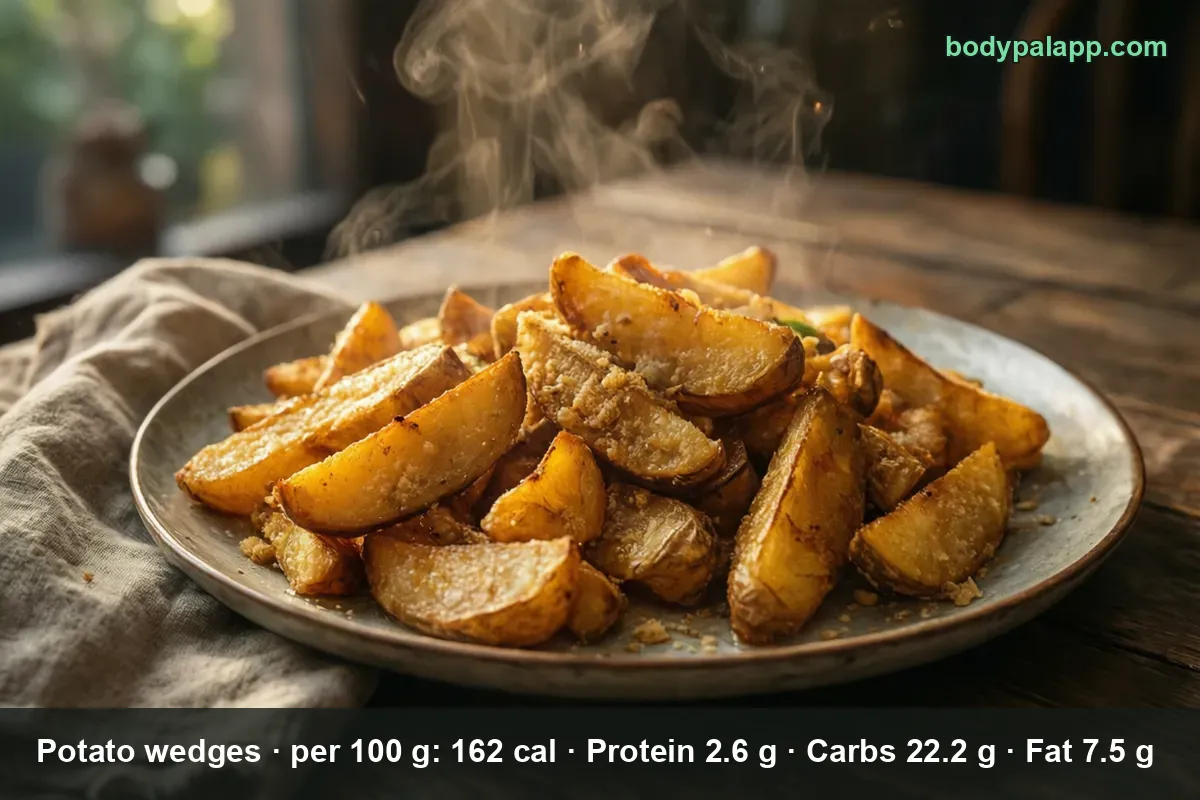
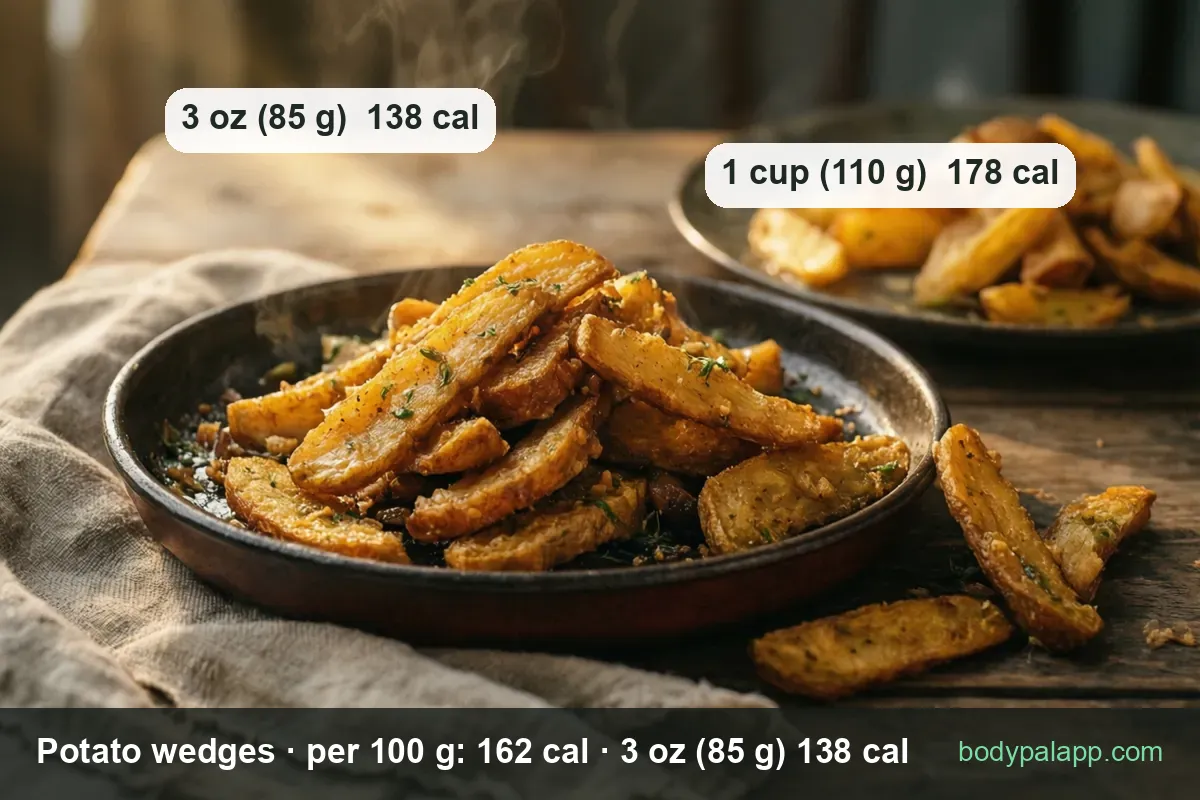
A 3 oz (85 g) serving of potato wedges is 138 calories, or 162 calories per 100 g. Measure the same wedges by volume instead and one cup (110 g) comes to 178. The calories in potato wedges are ordinary for a starchy side. The sodium is not: 380 mg per 100 g, against 49 mg for the identical potato left unsalted.
On this page
- Potato wedge quick facts
- Portions, from one wedge to a full cup
- The cup that adds 40 calories
- Why the bag already counts as cooked
- Baked, plain and restaurant wedges
- Sodium is the number that moves
- Thick cut does not mean less fat
- How do potato wedges compare?
- Most popular potato wedges brands
- FAQ
Potato wedge quick facts
Every figure here traces to SR Legacy 168946, "Potatoes, french fried, wedge cut, frozen, unprepared". It is the only USDA record that is literally wedge cut rather than a strip, a crinkle or a steak fry, and its fat and sodium match what American freezer bags actually print.
The serving column is 3 oz. That is not a convenient round number: USDA documents 3 oz (85 g) as the portion for this record, and Kroger, Hy-Vee and Hannaford all print 85 g on the bag. Ore-Ida rounds it to 84 g.
| Nutrient | Per 100 g | Per 3 oz (85 g) | % Daily Value |
|---|---|---|---|
| Calories | 162 cal | 138 cal | — |
| Total fat | 7.47 g | 6.3 g | 8% |
| Saturated fat | 1.843 g | 1.6 g | 8% |
| Carbohydrate | 22.22 g | 18.9 g | 7% |
| Dietary fiber | 2.4 g | 2.0 g | 7% |
| Total sugars | 0.34 g | 0.3 g | — |
| Protein | 2.56 g | 2.2 g | 4% |
| Sodium | 380 mg | 323 mg | 14% |
% Daily Value is based on a 2,000-calorie diet.
Verified nutrition data
Numbers on this page come from USDA FoodData Central, the U.S. Department of Agriculture’s food composition database, and from manufacturer labels where a branded product is named. Last verified September 2026. How we verify our data →
One row a packaged label carries is missing on purpose. USDA publishes no added sugars value at all for this record, so writing a zero there would turn "not measured" into "none present". Total sugars carry no Daily Value on a US label either, which is why that cell is blank.
Three figures sit outside the core label and come from the same record. Trans fat is 0.147 g per 100 g, small but not zero — a trace of the frying oil the wedges were par-fried in before freezing. Cholesterol is 0 mg. Potassium is 381 mg per 100 g, which is the one number where the potato underneath the coating still shows through.
Read the %DV column and the pattern is clear. Fat, carbs, fiber and protein all land between 4% and 8% of the day. Sodium alone is 14%, nearly double the next-highest row, from a food that arrives seasoned before you touch it.
Portions, from one wedge to a full cup
| Serving | Weight | Calories |
|---|---|---|
| 1 oz | 28 g | 45 |
| 3 oz, the bag serving | 85 g | 138 |
| 10 wedges | 106 g | 172 |
| 1 cup | 110 g | 178 |
| Per 100 g reference | 100 g | 162 |
The ten-wedge row is the useful one, and it is the only household count anyone publishes: Bob Evans prints "10 pieces (106 g)" on its label. Divide it out and a single potato wedge is roughly 17 calories. That is the figure to keep in your head, because wedges are eaten by the piece and logged by the bag.
Which makes the gap between rows one and four the whole story. An ounce is 45 calories and reads as nothing. A cup is 178 and reads as a side. Nobody eats an ounce of wedges.
The cup that adds 40 calories
Here is the trap, and it is specific to wedges rather than to potatoes in general.
The number on the bag is 3 oz, which weighs 85 g. The number most people reach for when they log by volume is one cup, which Wegmans weighs at 110 g. Those two look like the same handful. They are 25 g apart, and 25 g of wedge is 40 calories.
Wedges make the illusion worse than fries do. A wedge is a thick, awkward shape that packs badly, so a cup of them looks half empty next to a cup of thin fries. The eye reads air and assumes a small portion. The scale disagrees: at 162 calories per 100 g, the cup is 178 and the bag serving is 138.
The fix is unglamorous. Weigh the wedges once, count them, and use the count afterwards. Ten wedges is 172 calories and takes two seconds to verify on a plate. A cup takes a measuring cup you will not fetch.
Why the bag already counts as cooked
The USDA record says "unprepared", and that word misleads almost everyone who finds it. It does not mean raw potato calories.
Frozen wedges are par-fried at the plant before they are frozen — that is where the 7.47 g of fat came from, not from your oven. So the bag is already carrying its fat when you open it. What the oven does is drive off water.
The evidence is in the neighboring records. Baked-from-frozen potatoes sit at 148, 158 and 161 calories per 100 g depending on the cut. The unprepared wedge is 162. If baking added calories, the oven-heated records would be the high ones. They are the low ones, because per 100 g of drier food you are comparing different amounts of water, not different amounts of food.
USDA even weighs the shrinkage. Ten steak-fry strips weigh 153 g before the oven and 133 g after — about 13% of the mass gone as steam. The calories on the plate never changed. Only the denominator did.
Practical version: log the weight you tipped out of the bag, not the weight that came off the tray. Do it the other way around and you will undercount by roughly an eighth.
Baked, plain and restaurant wedges
| Version | Per 100 g | Fat per 100 g | Sodium per 100 g | Serving | Calories |
|---|---|---|---|---|---|
| Frozen wedges, straight from the bag | 162 cal | 7.47 g | 380 mg | 3 oz (85 g) | 138 |
| Oven-baked thick-cut, from frozen | 148 cal | 3.76 g | 373 mg | 10 wedges (133 g) | 197 |
| Plain unsalted wedges, commodity pack | 129 cal | 2.2 g | 49 mg | 3 oz (85 g) | 110 |
| Thick-cut fries, unsalted | 134 cal | 3.42 g | 30 mg | 3 oz (85 g) | 114 |
| Frozen roasted potatoes, not wedges | 127 cal | 1.81 g | 298 mg | 3 oz (85 g) | 108 |
| Restaurant-style fried wedges | 289 cal | 14.04 g | — | 1 medium order (145 g) | 419 |
The last row is a different food wearing the same name. Restaurant fries and wedges go into deep oil rather than a hot tray, and 289 calories per 100 g is close to 1.8 times the home-baked version. A medium order at 419 calories is three bag servings.
The plain unsalted pack is the quiet one. Same potato, same shape, 129 calories per 100 g — and 110 in a 3 oz serving, 28 fewer than the seasoned bag. Some of that is the missing oil and none of it is magic.
Frozen roasted potato pieces are worth knowing about because they sell alongside wedges in the same freezer aisle and look similar in the bag. At 127 calories per 100 g and 1.81 g of fat they are barely par-fried at all, which is exactly why they never crisp the same way. That is the trade, stated plainly.
Sodium is the number that moves
Take the same wedge-cut potato and remove one processing step, and this happens.
- Frozen wedges from a supermarket bag: 380 mg of sodium per 100 g
- The same wedges in the unsalted USDA commodity pack: 49 mg per 100 g
That is roughly eight times, and none of the difference is the potato. Salt is added during processing, before the bag is sealed, which is why rinsing or skipping the salt shaker at the table changes nothing. Thick-cut fries sold without added salt land at 30 mg per 100 g, confirming the same point from a different record.
In a real serving the seasoned wedges bring 323 mg, which is 14% of the 2,300 mg Daily Value. That is one side dish. Double the portion and you are at more than a quarter of the day before the main course, the sauce or anything you dip into.
If sodium is the number you watch, the unsalted pack is not a compromise: it is 110 calories and a fraction of the salt for a side that behaves the same in the oven. Season it yourself and you decide the amount. The Dietary Guidelines for Americans treat sodium as the nutrient most Americans overshoot, and packaged sides are a large part of the reason.
Fiber goes the other way and deserves a mention. A 3 oz serving carries 2.0 g, or 7% of the day, because the skin stays on a wedge. MyPlate counts white potatoes in the vegetable group as a starchy vegetable — the skin is what earns the fiber, and it is the one thing wedges keep that peeled fries throw away.
Thick cut does not mean less fat
There is a comfortable theory about wedges: a fat chunk of potato has less surface area per gram, so it soaks up less oil than a skinny fry does. It sounds like physics. The records disagree.
Wedge-cut frozen potatoes carry 7.47 g of fat per 100 g. Steak fries — thicker again, sold in the same freezer — carry 3.76 g after baking and 3.39 g in the bag. That is roughly double for the shape that was supposed to win.
Geometry is not the variable. Par-frying is. How long the plant runs the piece through the oil, and in what, sets the fat number, and the wedge products are par-fried harder because that is what gives the crust its snap. Buy the crispier bag and you have bought the fattier one. The label will tell you which is which; the shape of the potato will not.
Saturated fat follows the same path: 1.843 g per 100 g in the wedges, 1.6 g in a 3 oz serving, 8% of the day. Not alarming, and not the number the thickness was supposed to protect you from.
How do potato wedges compare?
| Item | Per 100 g | Protein | Carbs | Fat | US serving | Calories |
|---|---|---|---|---|---|---|
| Potato wedges, frozen wedge cut | 162 cal | 2.56 g | 22.22 g | 7.47 g | 3 oz (85 g) | 138 |
| Steak fries, oven-heated | 148 cal | 2.57 g | 26.98 g | 3.76 g | 10 strips (133 g) | 197 |
| French fries from frozen, oven-baked | 158 cal | 2.75 g | 25.55 g | 5.48 g | 10 fries (76 g) | 120 |
| Roasted potatoes, ready-to-heat | 126 cal | 1.87 g | 20.45 g | 4.25 g | 1 cup (160 g) | 202 |
| French fries, restaurant | 289 cal | 3.49 g | 37.20 g | 14.04 g | 1 medium order (145 g) | 419 |
Per 100 g the wedges are the densest of the frozen potatoes and nowhere near the restaurant row. Per serving they are the second-lightest thing in the table, and that is entirely because 3 oz is a small pile. Ready-to-heat roasted potatoes are the lightest food per gram at 126 calories and the second-heaviest serving at 202, because a cup of them packs densely.
Our take: for the fewest calories on a plate, oven-baked french fries win on the serving column at 120, but only because ten thin fries is a genuinely small amount of food — you will eat twenty. For the best return on the calories, the wedges take it. They carry 2.0 g of fiber and the skin in a 138-calorie serving, and unlike the restaurant order they cost you nothing in oil you did not choose. Anything from a fryer is a different question entirely: at 419 calories, a medium order is not a side dish, it is a second course.
Most popular potato wedges brands in the United States
Ranked by how widely each product appears among foods sold in the United States, from the BodyPal food database of over 3.3 million products. Calories are the figures printed on each Nutrition Facts label, checked against USDA FoodData Central.
| Product | Calories (per 100 g) |
|---|---|
| Earthbound Farm Roasted Organic Yellow Potato Wedges | 100 cal |
| Ore-Ida Homestyle Potato Wedges Olive Oil & Sea Salt | 143 cal |
| Ore-Ida Texas Crispers Potato Wedges | 179 cal |
| Simply Potatoes Red Potato Wedges | 62 cal |
| Kroger Natural Cut Potato Wedges | 129 cal |
| Wegmans Potato Wedges with Butter, Olive Oil & Rosemary | 145 cal |
Brand popularity: BodyPal food database. Nutrition: manufacturer labels / USDA FoodData Central.
Potato wedge FAQs
How many calories are in potato wedges?
138 calories in a 3 oz (85 g) serving, at 162 calories per 100 g. That serving carries 6.3 g of fat, 18.9 g of carbohydrate, 2.2 g of protein and 323 mg of sodium. A full cup (110 g) is 178 calories.
How many calories are in one potato wedge?
About 17 calories. USDA publishes no per-piece weight, but Bob Evans prints "10 pieces (106 g)" on its label, and 10 wedges come to 172 calories. Piece size varies with the potato, so treat 17 as a working average rather than a label figure.
How many calories are in potato wedges per 100 g?
162 calories per 100 g for frozen wedge-cut potatoes straight from the bag. Baked thick-cut versions run 148 and oven-baked fries 158, so the whole frozen category sits in a narrow band. Restaurant fried wedges are the outlier at 289.
How many calories are in oven-baked potato wedges?
148 calories per 100 g for baked thick-cut potatoes from frozen, which is 197 for 10 wedges at 133 g. Baking does not add calories; it removes water, which is why the per-100 g figure can read lower than the 162 on the unbaked bag.
Are potato wedges healthier than french fries?
Not automatically. Frozen wedges carry 7.47 g of fat per 100 g against 3.76 g for baked steak fries, roughly double, because wedges are par-fried harder at the plant. Where wedges win is the skin: 2.4 g of fiber per 100 g, which peeled fries do not have.
How much sodium is in potato wedges?
323 mg in a 3 oz serving, 14% of the 2,300 mg Daily Value, from 380 mg per 100 g. The unsalted commodity pack of the same wedges is 49 mg per 100 g, roughly eight times lower, so nearly all the sodium is added during processing.
How many carbs and how much protein are in potato wedges?
18.9 g of carbohydrate and 2.2 g of protein in a 3 oz serving, from 22.22 g and 2.56 g per 100 g. Of those carbs, 2.0 g is fiber and just 0.3 g is sugar. Potatoes are a starch, not a protein source, and the numbers say so plainly.
How many calories are in a cup of potato wedges?
178 calories for one cup, which Wegmans weighs at 110 g. That is 40 more than the 3 oz (85 g) serving printed on most bags. Wedges pack loosely, so a cup looks half empty and still holds a quarter more food than the label portion.
Similar foods
- Ear of Corn — 99 cal per medium ear
- Sweet Potato — 103 cal per medium, baked
- Papaya salad — 190 cal per plate
- Carrot — 53 cal per cup chopped
- Onion — 46 cal per cup sliced
- Broccoli — 55 cal per cup chopped
Count it without the math
Point the camera at the tray and BodyPal works out the wedges, the oil they came par-fried in and the sodium, before you decide on a second handful.


How long does it take to burn off potato wedges?
A 3 oz (85 g) serving is 138 kcal. Enter your weight and the amount you ate to see how long it takes you to burn that off:
lb
| Activity | Time to burn 138 kcal |
|---|---|
| Walking, brisk | 28 min |
| Cycling, moderate | 17 min |
| Swimming, moderate | 20 min |
| Jogging | 16 min |
| Weight training, moderate | 31 min |
Times are for a 155 lb adult at a steady pace; change the weight to see yours. The amount is set to the portion in the text (85 g); change it to what you actually ate. BodyPal works this out from your steps automatically.
One food is easy to picture; a whole day is harder. See how many calories you need a day and what a deficit actually looks like.