
How many calories are in cornmeal?
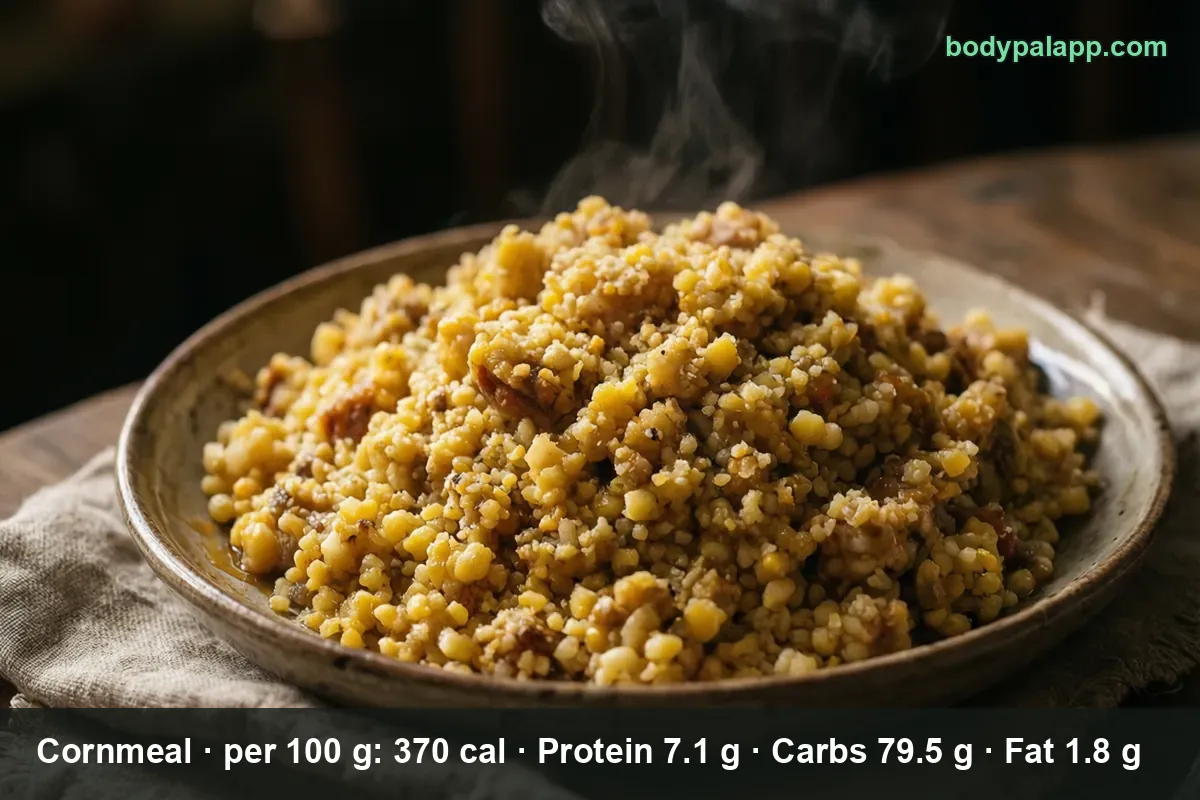
A cup of dry yellow cornmeal weighs 157 g and carries 581 calories, or 370 calories per 100 g. That is the meal measured straight from the bag. Cook it into mush and water takes over the weight: 100 g of the finished pot is 58 calories.
On this page
- Cornmeal quick facts
- US servings from a tablespoon to a full cup
- Whole-grain and self-rising cornmeal
- Dry cornmeal vs cooked cornmeal mush
- Sodium and fiber are the rows to watch
- How does cornmeal compare?
- Most popular cornmeal brands
- FAQ
Cornmeal quick facts
The bag most Americans reach for is degermed, enriched, yellow cornmeal, and that is the record used here: USDA SR Legacy 168867, "Cornmeal, degermed, enriched, yellow". USDA also publishes a household measure for that same record — 1 cup at 157 g — so the cup you scoop and the cup in the table are the same cup, with no guessing in between.
Everything below is the meal dry. If your bag says whole-grain, self-rising or blue, skip ahead; those get their own rows further down, and two of them move the numbers a long way.
| Nutrient | Per 100 g | Per 1 cup (157 g) | % Daily Value |
|---|---|---|---|
| Calories | 370 | 581 | — |
| Total fat | 1.75 g | 2.7 g | 4% |
| Saturated fat | 0.22 g | 0.3 g | 2% |
| Carbohydrate | 79.45 g | 124.7 g | 45% |
| Dietary fiber | 3.9 g | 6.1 g | 22% |
| Total sugars | 1.61 g | 2.5 g | — |
| Protein | 7.11 g | 11.2 g | 22% |
| Sodium | 7 mg | 11 mg | 0% |
% Daily Value is based on a 2,000-calorie diet.
Verified nutrition data
Numbers on this page come from USDA FoodData Central, the U.S. Department of Agriculture’s food composition database, and from manufacturer labels where a branded product is named. Last verified September 2026. How we verify our data →
There is no added sugars row on this page because the SR Legacy edition does not publish that figure for this record; the 1.61 g of total sugars per 100 g is what the corn brings itself. Cholesterol is 0 mg, as you would expect from a plain grain, and a cup delivers 223 mg of potassium, about 5% of the Daily Value. The reference amounts behind those percentages come from the FDA Daily Value tables.
US servings from a tablespoon to a full cup
| Serving | Weight | Calories |
|---|---|---|
| 1 Tbsp | 9.8 g | 36 kcal |
| 1 oz | 28.4 g | 105 kcal |
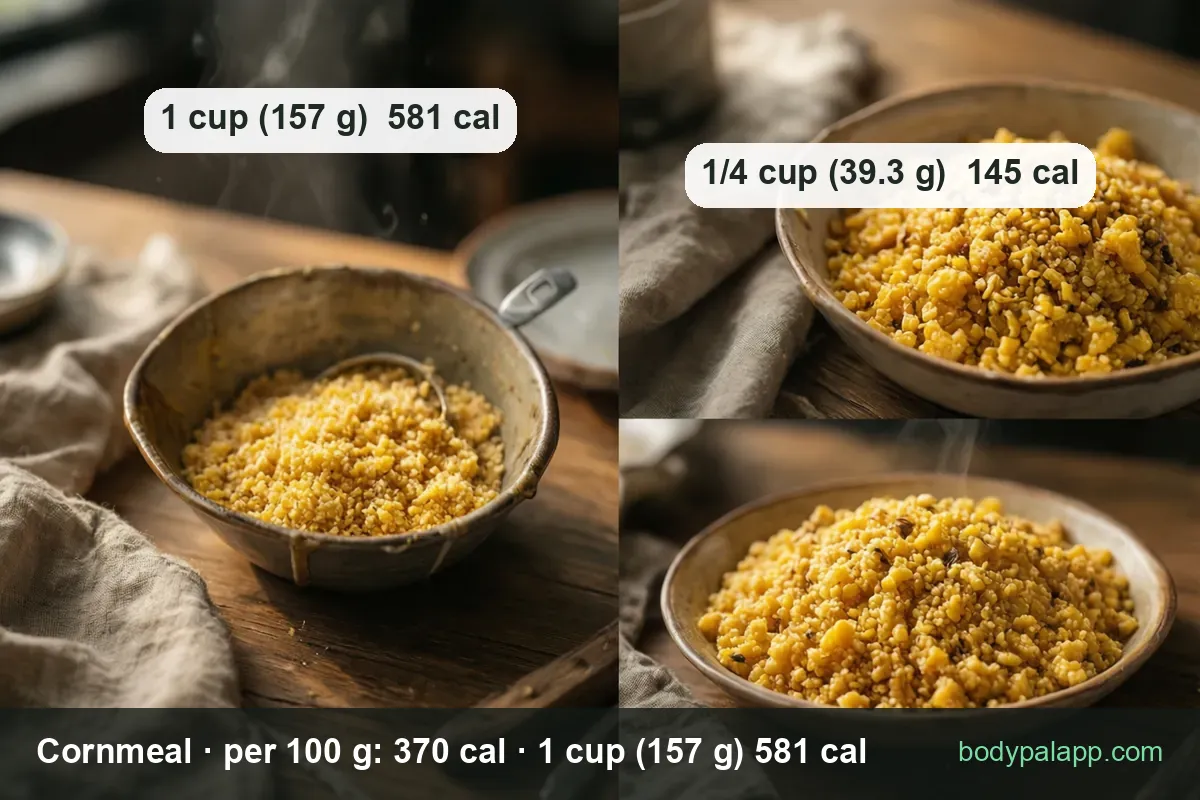
| 1/4 cup | 39.3 g | 145 kcal |
| 1/2 cup | 78.5 g | 290 kcal |
| 1 cup | 157 g | 581 kcal |
| Per 100 g | 100 g | 370 kcal |
Only the 1-cup line and the 100 g line are USDA's own; the tablespoon, the ounce and the two fractional cups are our own arithmetic from the USDA cup weight and the 100 g figure, not USDA servings.
Here is the trap. Your box of cornmeal almost certainly prints a 1/4 cup serving, but the gram weight behind that quarter cup varies by mill: 30 g on one blue cornmeal, 33 g on a fine grind, 35 g on an instant polenta, 38 g on a standard yellow. USDA's cup weight implies 39.3 g. So the same phrase — a quarter cup — can mean 110 calories on one label and 145 by USDA's measure. If you log by cups, you are logging a volume that four different bags define four different ways. Weigh it once on a kitchen scale and the argument disappears.
Cornbread, hushpuppies and a pot of grits all start here, and the meal is measured dry every time. That is the number you log at the mixing bowl, before eggs, buttermilk and oil join it.
Whole-grain and self-rising cornmeal
| Version | Per 100 g | Typical serving | Calories |
|---|---|---|---|
| Degermed enriched yellow (the standard bag) | 370 kcal | 1 cup (157 g) | 581 kcal |
| Whole-grain yellow | 362 kcal | 1 cup (122 g) | 442 kcal |
| Degermed enriched white | 370 kcal | 1 cup (157 g) | 581 kcal |
| Self-rising yellow degermed | 355 kcal | 1 oz (28.4 g) | 101 kcal |
| Self-rising yellow bolted | 334 kcal | 1 oz (28.4 g) | 95 kcal |
| Blue cornmeal | 398 kcal | 1 oz (28.4 g) | 113 kcal |
The whole-grain line is the one worth staring at. Per 100 g it is actually lighter than the degermed grind — 362 against 370 — but a cup of it weighs only 122 g rather than 157 g, so the same measuring cup holds 442 calories instead of 581. That is a 139-calorie gap created almost entirely by how the meal packs, not by how rich it is. Two cooks with identical recipes and identical cups can be 139 calories apart before anything hits the pan.
Yellow and white are a non-event: USDA keeps separate records for both, and every macro is identical, 370 calories included. Enriched and unenriched are identical too — enrichment adds B vitamins and iron back after degerming, and adds nothing to the calorie count. Blue cornmeal is the densest of the dry grinds at 398 per 100 g, roughly 8% above the standard bag.
The self-rising rows carry baking powder and salt already blended in, which is why their calories per 100 g fall while something else climbs sharply. The ounce figures for the self-rising and blue rows are our own scaling from the USDA 100 g values, not USDA servings.
Bagged brands land close to the USDA row, as plain milled corn should: an instant polenta cornmeal at 371 per 100 g, two standard yellow meals at 368, an organic blue at 367, a stone-ground white at 379. One fine grind reads 333, low enough that it is worth checking its own label rather than assuming.
Dry cornmeal vs cooked cornmeal mush
| Version | Per 100 g | Typical serving | Calories |
|---|---|---|---|
| Dry degermed cornmeal | 370 kcal | 1 oz (28.4 g) | 105 kcal |
| Cooked mush, no fat added | 58 kcal | 1 oz (28.4 g) | 16 kcal |
| Cooked mush, fat added | 71 kcal | 1 oz (28.4 g) | 20 kcal |
Dry meal is 6.4 times the calories of cooked mush gram for gram — 370 against 58 — and none of that gap is nutrition. It is water. The corn does not change; the pot just gets heavier. This is the single most common logging error with grits, polenta and mush: someone weighs a 250 g bowl of finished porridge and logs it against the dry-meal row, and the entry comes back six times too high.
Butter, oil or bacon drippings show up clearly in the numbers. USDA's fat-added mush runs 71 calories per 100 g against 58 plain, and saturated fat jumps from 0.04 g to 0.71 g per 100 g. Sodium also rises, from 71 mg to 82 mg per 100 g, because salt tends to arrive with the fat.
Practical rule: if you cooked it, find a cooked row. If you are still at the mixing bowl, use the dry row.
Sodium and fiber are the rows to watch
Plain cornmeal is one of the lowest-sodium things in a pantry: 7 mg per 100 g, 11 mg in a full cup, which rounds to 0% of the Daily Value. Self-rising cornmeal is 1,348 mg per 100 g — 59% of the Daily Value in 100 g of dry mix, before a single pinch of salt is added at the stove. That is more than half a teaspoon of table salt. Swapping one bag for the other, without changing a recipe, changes the sodium in your cornbread by a factor of nearly 200. If you are watching sodium, buy plain and salt it yourself.
Fiber goes the other way and rewards the whole-grain bag. Degermed cornmeal holds 3.9 g per 100 g, whole-grain 7.3 g — close to double, because degerming strips the bran and the germ that carry it. A cup of the degermed meal already supplies 6.1 g, 22% of the Daily Value, so cornbread is not a fiber desert; whole-grain simply makes it a better one. The Dietary Guidelines for Americans and MyPlate both push toward making at least half your grains whole, and cornmeal is an easy place to do it: the swap costs nothing in flavor and, per cup, actually lowers the calorie count.
Protein is the modest row. A cup gives 11.2 g, 22% of the Daily Value, which is respectable for a grain but not a reason to treat cornmeal as a protein food.
How does cornmeal compare?
| Food | Per 100 g | US serving | Calories |
|---|---|---|---|
| Cornmeal, degermed enriched yellow | 370 kcal | 1 oz (28.4 g) | 105 kcal |
| Cake flour, white, enriched | 362 kcal | 1 oz (28.4 g) | 103 kcal |
| Whole-grain pasta, dry | 362 kcal | 1 oz (28.4 g) | 103 kcal |
| Brown rice, medium-grain, raw | 362 kcal | 1 oz (28.4 g) | 103 kcal |
Our take: dry starches are boringly similar, and that is the useful finding. All three neighbors sit at exactly 362 calories per 100 g, cornmeal at 370 — an 8-calorie spread across four staples, or 2 calories per ounce. Choosing cornmeal over flour, dry pasta or raw rice will not move your day. What moves it is the protein and fiber you get for those calories: dry whole-grain pasta carries 13.51 g of protein per 100 g against cornmeal's 7.11 g, nearly double, so pasta is the better anchor for a meal that has to keep you full. Cornmeal earns its place differently — it is nearly fat-free at 1.75 g per 100 g, costs almost nothing per pound, and the whole-grain version brings 7.3 g of fiber. Pick it for texture and thrift, and buy the whole-grain bag while you are there.
Most popular cornmeal brands in the United States
Ranked by how widely each product appears among foods sold in the United States, from the BodyPal food database of over 3.3 million products. Calories are the figures printed on each Nutrition Facts label, checked against USDA FoodData Central.
| Product | Calories (per 100 g) |
|---|---|
| Colavita Instant Polenta Cornmeal | 371 cal |
| Bob's Red Mill Cornmeal | 368 cal |
| Bob's Red Mill Organic Cornmeal | 368 cal |
| Bob's Red Mill Fine Grind Cornmeal | 333 cal |
| Woodland Organic Blue Cornmeal | 367 cal |
| Marsh Hen Mill Unicorn Cornmeal | 379 cal |
Brand popularity: BodyPal food database. Nutrition: manufacturer labels / USDA FoodData Central.
Cornmeal FAQs
How many calories are in 1 cup of cornmeal?
581 calories in 1 cup of dry degermed yellow cornmeal, which USDA weighs at 157 g. That is the meal before any water, milk or oil goes in. Whole-grain cornmeal is lighter by the cup: USDA lists it at 122 g, so the same measure is 442 calories.
How many calories in 1/4 cup of cornmeal?
145 calories in a quarter cup, using USDA's cup weight of 157 g scaled down to 39.3 g — our own arithmetic, not a USDA serving. Package labels call a quarter cup anywhere from 30 g to 38 g, so a box label may read 110 to 140 calories instead.
How many carbs are in cornmeal?
79.45 g of carbohydrate per 100 g, and 124.7 g in a 1-cup (157 g) measure — 45% of the Daily Value in one cup. Fiber accounts for 3.9 g per 100 g. Whole-grain cornmeal sits slightly lower on carbs at 76.89 g and nearly doubles the fiber at 7.3 g.
Does whole-grain cornmeal have more fiber than degermed?
Yes — 7.3 g per 100 g against 3.9 g, because degerming strips the bran and germ. A cup of whole-grain cornmeal (122 g) works out to 8.9 g of fiber, 32% of the Daily Value, against 6.1 g and 22% from a cup of the degermed grind.
How much sodium is in self-rising cornmeal?
1,348 mg per 100 g, or 59% of the Daily Value — against 7 mg in plain degermed cornmeal. One ounce (28.4 g) carries about 383 mg, our own scaling from the USDA 100 g row. The salt and leavening are already mixed in, so recipes usually skip both.
How many calories in cooked cornmeal mush?
58 calories per 100 g cooked with water and no added fat, which is 6.4 times lighter than the 370 of the dry meal. An ounce is 16 calories. Stir in butter or oil and USDA's fat-added row rises to 71 per 100 g, or 20 per ounce.
Is cornmeal gluten free?
Corn carries no gluten, and the USDA row behind the 370 calories per 100 g is plain milled corn with nothing else in it. Self-rising versions add leavening and salt but still no wheat. Mills that also grind wheat can cross-contaminate, so check the bag for a gluten-free label.
Is yellow cornmeal different from white cornmeal in calories?
No — both sit at 370 calories per 100 g. USDA keeps separate records for degermed enriched yellow and white cornmeal, and every macro matches: 7.11 g protein, 79.45 g carbohydrate, 1.75 g fat, 3.9 g fiber. The difference is the corn's color and a faint shift in flavor, not the count.
Similar foods
- Potato wedges — 138 cal for 3 oz
- Ear of Corn — 99 cal per medium ear
- Sweet Potato — 103 cal per medium, baked
- Papaya salad — 190 cal per plate
- Carrot — 53 cal per cup chopped
- Onion — 46 cal per cup sliced
Count it without the math
Point the camera at the bowl and BodyPal counts the cornmeal for you, dry or cooked.


How long does it take to burn off cornmeal?
A 1-cup (157 g) serving is 581 kcal. Enter your weight and the amount you ate to see how long it takes you to burn that off:
lb
| Activity | Time to burn 581 kcal |
|---|---|
| Walking, brisk | 1 hr 56 min |
| Cycling, moderate | 1 hr 13 min |
| Swimming, moderate | 1 hr 23 min |
| Jogging | 1 hr 8 min |
| Weight training, moderate | 2 hr 9 min |
Times are for a 155 lb adult at a steady pace; change the weight to see yours. The amount is set to the portion in the text (157 g); change it to what you actually ate. BodyPal works this out from your steps automatically.
Want the bigger picture? Calculate your daily calorie needs — your maintenance figure, a target for losing or gaining, and the date you get there.