
How many calories are in kale?
One cup of chopped raw kale weighs 21 g and carries 7 calories. Per 100 g the leaves run 35 calories, with 4.1 g of fiber and 2.92 g of protein. The gap between a cup and 100 g is the whole story here: it takes almost five cups of raw leaves to reach that 100 g.
On this page
- Kale quick facts
- US servings, from one cup to one ounce
- Raw, boiled, frozen and sauteed kale
- Fiber and sodium are the rows that move
- How does kale compare?
- Most popular kale brands
- FAQ
Kale quick facts
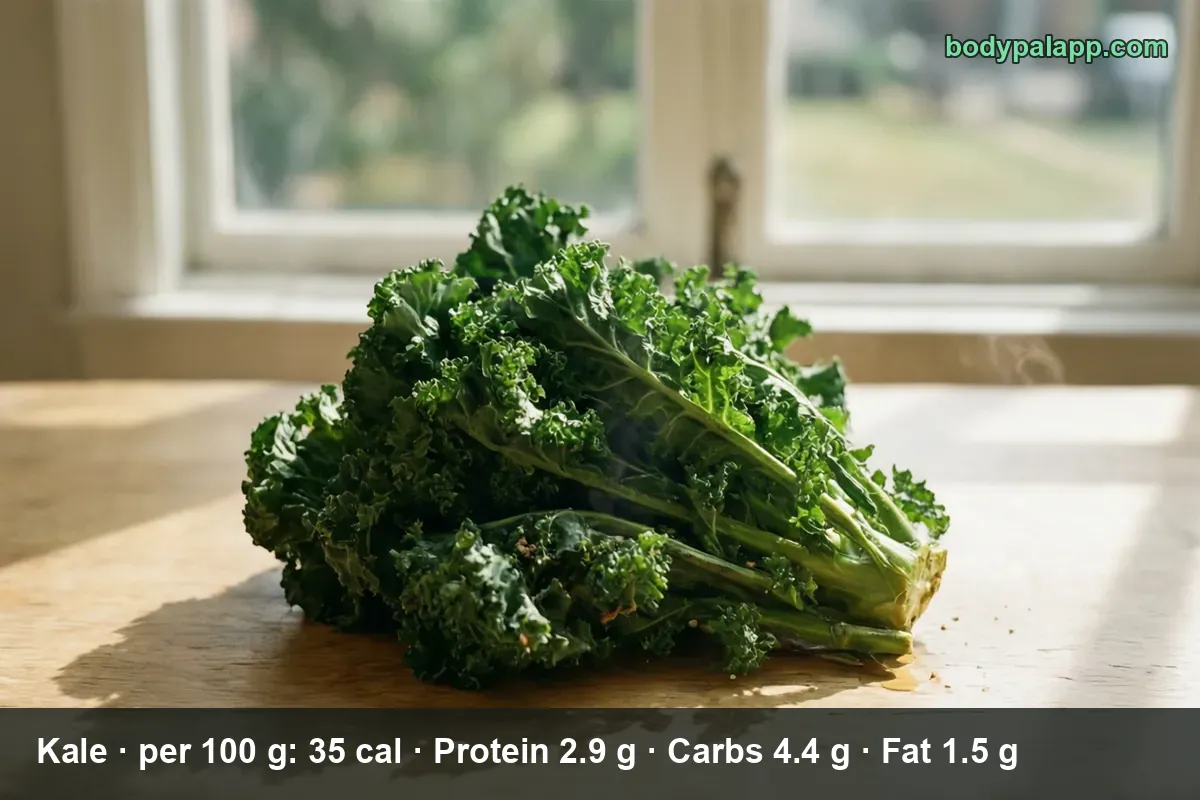
The numbers below come from SR Legacy 168421, "Kale, raw". That is the bunch you actually hold — a head of curly leaves on the cutting board, before anything happens to it. USDA also publishes a Foundation record for raw kale (323505) with the same 35 calories and the same macros, but its panel stops short of sugars and saturated fat, so the older SR Legacy edition is the only complete label for raw kale. The household measure in the table, 1 cup chopped at 21 g, comes from that same record rather than from our own weighing.
| Nutrient | Per 100 g | Per 1 cup chopped (21 g) | % Daily Value |
|---|---|---|---|
| Calories | 35 | 7 | — |
| Total fat | 1.49 g | 0.3 g | 0% |
| Saturated fat | 0.18 g | 0.0 g | 0% |
| Carbohydrate | 4.42 g | 0.9 g | 0% |
| Dietary fiber | 4.1 g | 0.9 g | 3% |
| Total sugars | 0.99 g | 0.2 g | — |
| Protein | 2.92 g | 0.6 g | 1% |
| Sodium | 53 mg | 11 mg | 0% |
% Daily Value is based on a 2,000-calorie diet.
Verified nutrition data
Numbers on this page come from USDA FoodData Central, the U.S. Department of Agriculture’s food composition database, and from manufacturer labels where a branded product is named. Last verified September 2026. How we verify our data →
There is no added sugars row on this page. The SR Legacy edition does not publish added sugars at all, and a bunch of raw kale has none to publish. Cholesterol is 0 mg, as it is for every plant food. Potassium is the one line worth pulling out of the fine print: 348 mg per 100 g, which is 73 mg and 2% of the Daily Value in a 21 g cup.
US servings, from one cup to one ounce
| Serving | Weight | Calories |
|---|---|---|
| 1 cup chopped | 21 g | 7 kcal |
| 1 oz | 28 g | 10 kcal |
| 2 cups chopped | 42 g | 15 kcal |
| 3 cups chopped, a salad base | 63 g | 22 kcal |
| Per 100 g | 100 g | 35 kcal |
Only the first line is a USDA household measure. The ounce and the two- and three-cup rows are our own arithmetic from the USDA 100 g figure, not USDA servings — kale scales cleanly, so multiplying is safe here in a way it is not for a food with a crust or a filling.
Two things fall out of this table. Raw kale is so light that the cup is a poor unit for it: three heaped cups, enough to fill a dinner plate, still land at 22 calories. And an ounce of raw kale is a lot of leaf. If you weigh your food, 28 g of curly kale packs the bowl in a way 28 g of almost anything else does not.
Raw, boiled, frozen and sauteed kale
| Version | Per 100 g | Typical serving | Calories |
|---|---|---|---|
| Raw | 35 kcal | 1 cup chopped, 21 g | 7 kcal |
| Boiled and drained, no salt | 36 kcal | 1 cup, 118 g | 42 kcal |
| Boiled in salted water | 44 kcal | 1 cup, 118 g | 52 kcal |
| Frozen, unprepared | 28 kcal | 1/3 cup, 67 g | 19 kcal |
| Frozen, then boiled, no salt | 36 kcal | 1 cup, 118 g | 42 kcal |
| Cooked with fat added | 69 kcal | 100 g | 69 kcal |
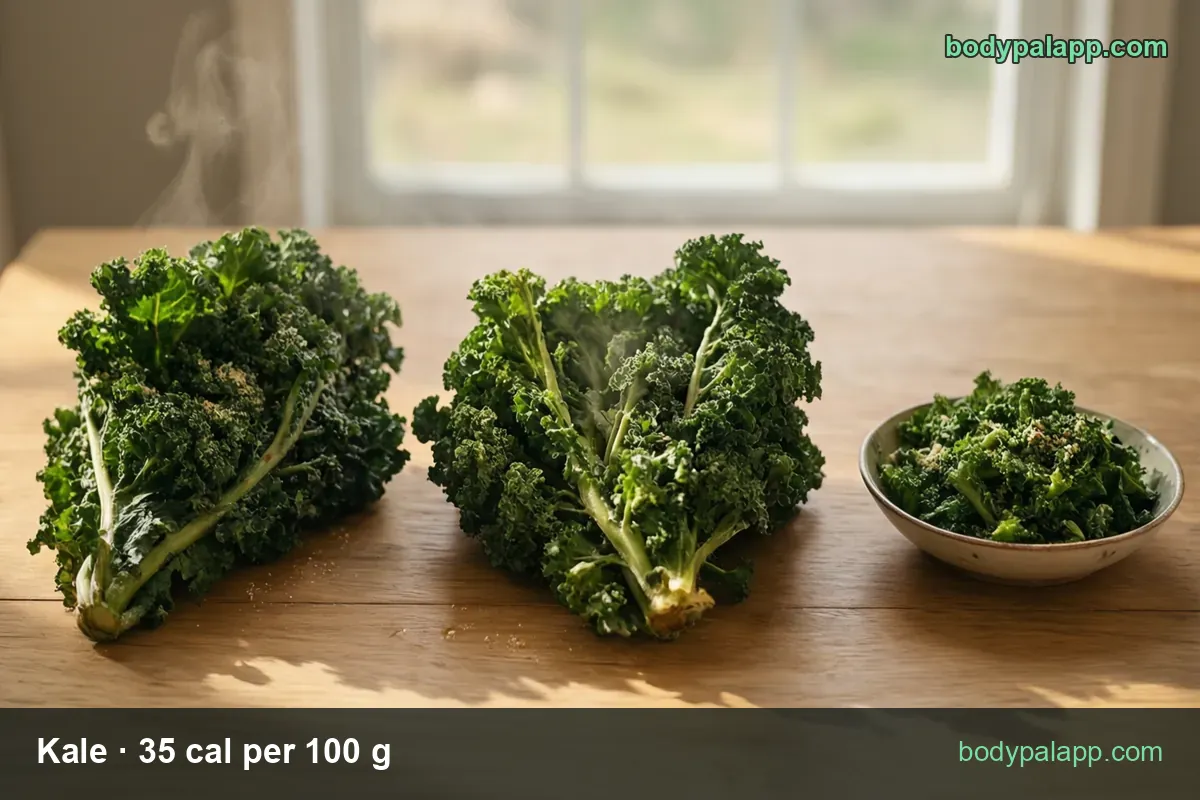
Boiling barely touches the calories per gram — 36 against 35 — but it changes what a cup means. Heat collapses the leaves, so a measuring cup that held 21 g of raw kale holds 118 g of the cooked stuff. That is the single most useful fact on this page: 7 calories versus 42, from the same measuring cup.
Salted cooking water is the second surprise. The salted record reads 44 calories per 100 g against 36 for the unsalted one, which looks like the salt added calories. It did not. USDA measured two different pots, and the salted one also came out lower in fiber, 2.3 g against 4 g. Treat the calorie difference as pot-to-pot variation, not as a rule about salt.
Frozen kale is the lightest version at 28 calories per 100 g. Blanching before freezing takes most of the fat with it, from 1.49 g down to 0.46 g, and the fiber falls from 4.1 g to 2 g. Cook that frozen kale and it lands back at 36 calories per 100 g, identical to fresh boiled.
Then there is the pan. Kale cooked with fat added runs 69 calories per 100 g, just under double the raw leaf, with 4.29 g of fat instead of 1.49 g. Nothing about the vegetable changed. The oil did.
Bagged blends are worth a word, since most supermarket kale is sold that way. A Marketside Baby Kale and Spinach Blend reads 24 calories per 100 g, or 20 for the 85 g label serving; Wegmans Organic Super Greens with kale, spinach and chard reads 41 per 100 g, 35 for the same 85 g. Both are mixes rather than straight kale, which is why they straddle the 35 of the pure leaf.
Fiber and sodium are the rows that move
Fiber is where kale earns its reputation, and where the serving size quietly takes it back. The 4.1 g per 100 g is 15% of the FDA Daily Value of 28 g — a real number. Your actual cup of raw leaves delivers 0.9 g, or 3%. Getting to 15% from raw kale means eating close to five cups in one sitting.
Cooking fixes that in one step. A 118 g cup of boiled kale carries about 4.7 g of fiber, roughly 17% of the Daily Value, which is our own arithmetic from the USDA 100 g figure rather than a published serving. Protein moves the same way: 0.6 g in the raw cup, about 3.5 g and 7% of the DV in the cooked one.
Sodium is the row that can go wrong. Boiled and drained without salt, kale sits at 16 mg per 100 g — around 19 mg in a cup, under 1% of the 2,300 mg Daily Value. Boil it in salted water and the record reads 252 mg per 100 g, so a cup lands near 297 mg, about 13% (again our arithmetic from the 100 g figure). That is roughly an eighth of a teaspoon of table salt hiding in a vegetable side. If you are watching sodium, salt the plate instead of the pot.
One footnote for anyone comparing databases. The FNDDS survey edition lists raw kale at 43 calories per 100 g rather than 35, with identical protein, carbohydrate and fat. The difference is the energy factor the survey edition applies, not a different vegetable. We use the SR Legacy figure throughout because it matches the full nutrient panel above.
How does kale compare?
| Vegetable | Per 100 g | US serving | Calories |
|---|---|---|---|
| Kale, raw | 35 kcal | 1 cup chopped, 21 g | 7 kcal |
| Broccoli, flower clusters, raw | 28 kcal | 1 oz, 28 g | 8 kcal |
| Turnips, raw | 28 kcal | 1 oz, 28 g | 8 kcal |
| Hearts of palm, canned | 28 kcal | 1 oz, 28 g | 8 kcal |
Our take: kale is the heaviest of these four per gram, at 35 calories per 100 g against 28 for the other three, and ounce for ounce it comes to 10 calories against 8. That difference is not worth a decision. What separates them is protein and fiber — kale's 2.92 g of protein per 100 g beats turnips at 0.9 g and hearts of palm at 2.52 g, and its 4.1 g of fiber is the reason a cooked cup does real work in a meal. If you are building volume on a plate, all four are effectively free; pick kale when you want the fiber, broccoli when you want it cooked fast, hearts of palm when you want texture without chewing. MyPlate counts a cup of raw leafy greens as half a cup of vegetables, which is the one place kale's lightness works against it.
Most popular kale brands in the United States
Ranked by how widely each product appears among foods sold in the United States, from the BodyPal food database of over 3.3 million products. Calories are the figures printed on each Nutrition Facts label, checked against USDA FoodData Central.
| Product | Calories (per 100 g) |
|---|---|
| Marketside Baby Kale & Spinach Blend | 24 cal |
| Wegmans Organic Super Greens Kale, Spinach & Chard | 41 cal |
Brand popularity: BodyPal food database. Nutrition: manufacturer labels / USDA FoodData Central.
Kale FAQs
How many calories are in a cup of kale?
Seven calories in one cup of chopped raw kale, which USDA weighs at 21 g. A cup of cooked kale is a different animal: the leaves collapse, so 118 g fit in the same cup and it lands at 42 calories. Same word, six times the food.
How many calories are in cooked kale?
Boiled and drained kale runs 36 calories per 100 g, so a standard 118 g cup comes to 42 calories. Boiled in salted water, the USDA record reads 44 per 100 g, or 52 a cup. Cooked with fat added, kale reaches 69 calories per 100 g.
How much protein is in kale?
Kale carries 2.92 g of protein per 100 g, which works out to just 0.6 g in a 21 g cup of raw leaves, about 1% of the Daily Value. A cup of boiled kale does far better at roughly 3.5 g, or 7%, because 118 g fit in that cup.
How much fiber is in a cup of kale?
0.9 g of fiber in a 21 g cup of raw chopped kale, which is 3% of the 28 g Daily Value. The headline 4.1 g per 100 g needs almost five cups of raw leaves. A cup of boiled kale is the shortcut at about 4.7 g, near 17%.
Does frozen kale have the same calories as fresh?
Frozen unprepared kale reads 28 calories per 100 g against 35 for fresh raw kale. Blanching before freezing explains most of the gap: fat falls from 1.49 g to 0.46 g and fiber from 4.1 g to 2 g. Boiled from frozen, it matches fresh cooked kale at 36.
Raw vs cooked kale: which has more calories?
Per 100 g cooked kale is barely higher, 36 against 35, because boiling drives off water and a gram of cooked leaf is denser. Per serving the gap is enormous: a measuring cup holds 21 g of raw kale and 118 g of cooked, so 7 calories against 42.
How many calories are in a kale salad?
The greens are the cheap part: three cups of chopped raw kale weigh 63 g and total 22 calories. Everything after that sets the number — dressing, cheese, nuts, croutons. USDA publishes no record for a dressed kale salad, so those add-ons are not costed on this page.
Is kale good for weight loss?
At 35 calories per 100 g, kale is one of the lightest ways to fill a plate, and a raw cup is 7. The Dietary Guidelines put vegetables at the center of the plate for exactly this reason. If sodium matters to you, boil it unsalted: 16 mg per 100 g against 252 mg.
Similar foods
- Broccoli — 55 cal per cup chopped
- Cooked Broccoli — 27 cal per half cup
- Broccoli Steamed — 27 cal per half cup
- Cooked Carrots — 27 cal per half cup
- Green Beans — 44 cal per cup
- White Onion — 40 cal per medium onion
Count it without the math
Point the camera at the bowl and BodyPal counts the kale for you, raw cup or cooked.


This table assumes you know your daily total. If you do not, the daily calorie calculator works it out from five numbers.