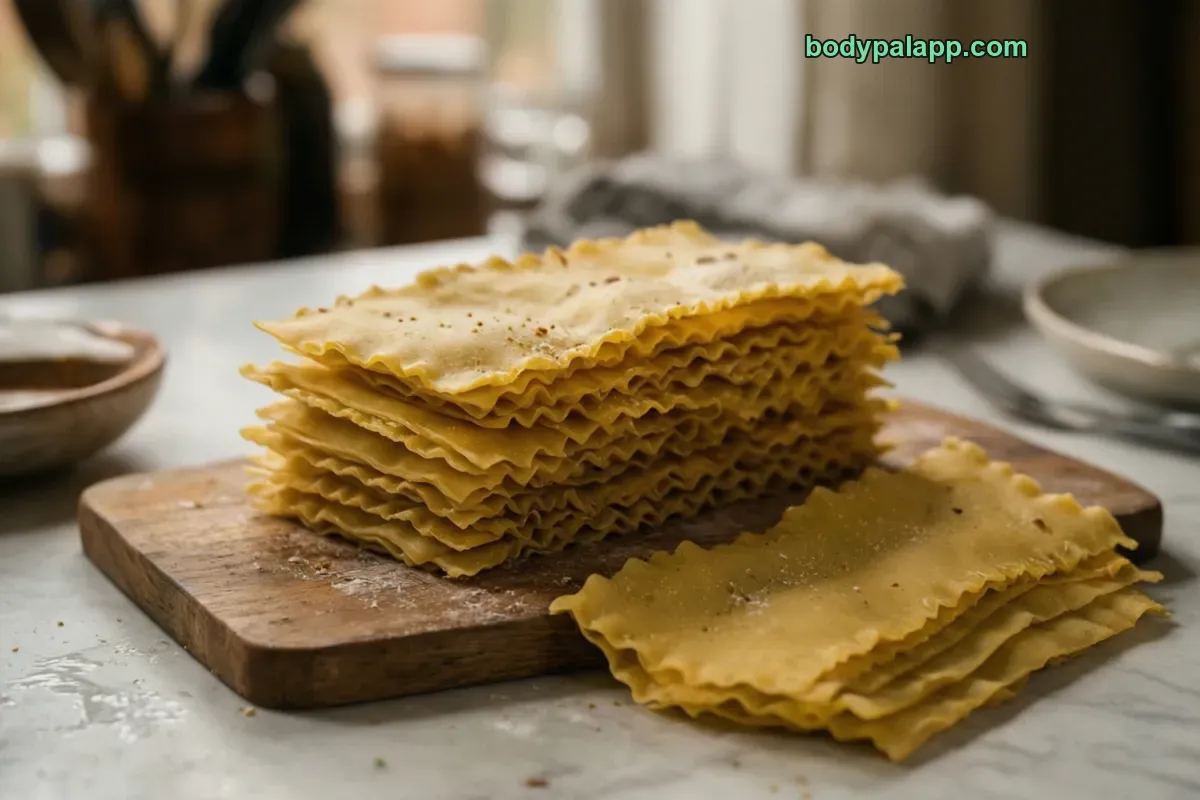
Lasagna noodles calories come to 221 for one cup (160 g) of cooked egg pasta, or 138 per 100 g. Carbs supply 73% of those calories, and the noodles are close to sodium-free at 8 mg a cup. The real total of a lasagna depends far more on the sauce and cheese than on the pasta.
221kcal
1 cup of cooked noodles · 160 g, egg pasta, cooked
13%protein
7.3 gProtein
40 gCarbs
3.3 gFat
How to burn off 221 kcal
—Walking, brisk
—Jogging
—Cycling, moderate
—Swimming
Skip the math. BodyPal counts these calories from your steps and workouts automatically.
Nutrition facts
Egg pasta, cooked · per 160 g
Calories
221 kcal
Protein
7.3 g
Carbohydrate
40 g
Fat
3.3 g
Saturated fat
0.7 g
Cholesterol
46 mg
Sodium
8 mg
Potassium
61 mg
Iron
2.4 mg
Source: USDA FoodData Central
🛡️
Verified nutrition data
Numbers on this page come from USDA FoodData Central, the U.S. Department of Agriculture’s food composition database, and from manufacturer labels where a branded product is named. Last verified September 2026. How we verify our data →
Lasagna noodles: calories, protein and sodium by serving
Percent of daily value uses the FDA reference of 2,000 kcal a day.
Serving
kcal
Protein
Carbs
Fat
Sodium
% DV kcal
1 cup (160 g)
221
7.3 g
40.3 g
3.3 g
8 mg
11%
3 oz portion (85 g)
117
3.9 g
21.4 g
1.8 g
4 mg
6%
100 g
138
4.5 g
25.2 g
2.1 g
5 mg
7%
3 × 1 cup (160 g)
662
21.8 g
24 mg
5 × 1 cup (160 g)
1,104
36.3 g
40 mg
One cup of cooked noodles is a 221-calorie base
A cup of cooked lasagna noodles weighs 160 g and holds 221 calories, 7.3 g of protein and 40.3 g of carbs. That cup covers 11% of the daily value for calories and 15% of the daily value for protein. A 3 oz portion (85 g) drops to 117 calories, which is the more realistic amount of pasta inside a single modest slice.
The math scales in a straight line, so stacking layers adds up fast. Two cups come to 442 calories, three cups to 662, and five cups reach 1,104 calories with 36.3 g of protein. That last figure is the kind of pasta load a big family pan calls for, before any meat, ricotta or mozzarella goes in.
Sheets differ in width, length and thickness between packages, so counting noodles is a weak way to log them. Weighing the cooked pasta, or dividing the total by the number of slices you cut, gives a much steadier number. If weighing is a chore, BodyPal can log the food from a photo.
Carbs make up nearly three quarters of every bite
The calorie split is lopsided: 73% from carbs, 14% from fat and 13% from protein. Per 100 g that works out to 25.2 g of carbs, 2.1 g of fat and 4.5 g of protein. This is a starch food first, with a modest protein contribution from the egg in the dough.
Very little of that carbohydrate is sugar. There are only 0.4 g of sugars per 100 g and 0.6 g in a full cup, so the carbs are almost entirely starch. Fiber is light too, at 1.2 g per 100 g and 1.9 g per cup, a small slice of the 28 g daily value used here.
The protein is worth noting but not worth leaning on. A cup gives 7.3 g, which is 15% of the 50 g daily value, so the noodles help without carrying the meal. If you want a lasagna that keeps you full, the protein has to come from the filling rather than the pasta.
Sodium and fat stay low until the sauce arrives
Plain cooked noodles are nearly free of sodium. There are 5 mg per 100 g and 8 mg in a cup, which rounds to 0% of the daily value. Even five cups only add up to 40 mg. If you watch sodium, the salt in a finished lasagna comes from the cooking water, the sauce and the cheese, not from the pasta itself.
Fat is low as well, at 2.1 g per 100 g with just 0.4 g saturated against a daily value of 20 g. A cup carries 3.3 g of fat in total. That leaves plenty of room for the fattier layers, which is exactly where most of the calories in a baked lasagna tend to hide.
Cholesterol is the one row that shows the egg. Egg pasta has 29 mg per 100 g, measured against a daily value of 300 mg. Potassium is minor at 38 mg per 100 g. None of these numbers is high on its own, but they explain why egg noodles read slightly differently from eggless pasta.
The noodles are the smaller part of a lasagna
Think of the noodles as a fixed, predictable base and the filling as the variable. At 138 calories per 100 g, the pasta is moderate, and its count barely moves between recipes. The swing between a light lasagna and a heavy one comes from how much cheese, fatty meat and oil sit between the sheets.
If you want more volume for the same calories, push vegetables into the layers. Spinach, zucchini, mushrooms and peppers add bulk and fiber that the noodles lack. A lean meat sauce or extra ricotta lifts the protein share well above the 13% the pasta brings on its own.
Portion is the other lever. Cutting the pan into more slices trims both pasta and filling at once, and a side salad fills the plate without much added energy. Log the slice you actually ate, not the recipe card, and the day's total stays honest.
How does lasagna noodles compare?
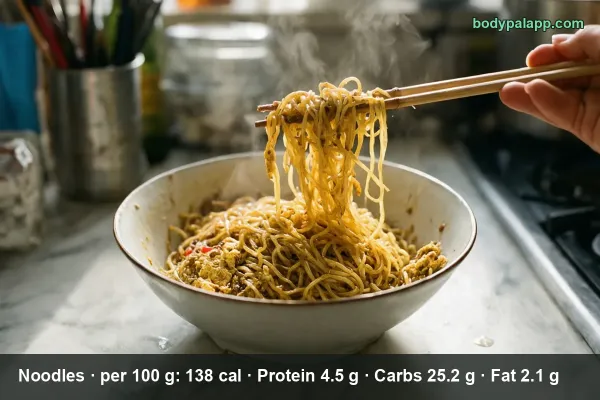
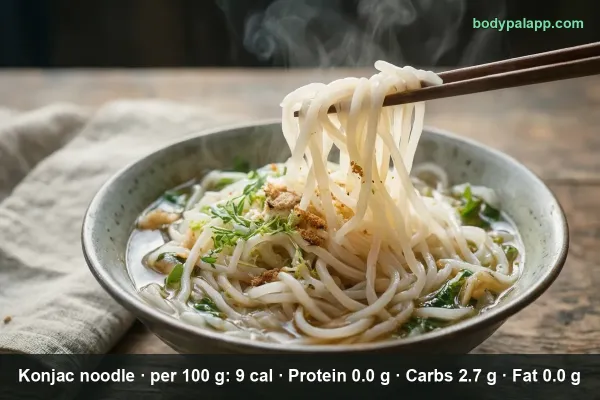
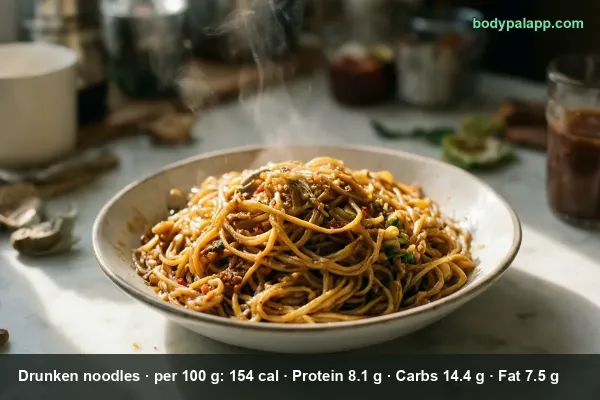
Here lasagna noodles sit next to plain noodles, konjac noodles and drunken noodles, compared per 100 g and per usual serving.
Verdict: For the fewest calories, konjac noodle wins outright at 9 per 100 g, about 0.1 times the lasagna noodle figure, though it brings 0 g of protein. Plain noodles match lasagna noodles at 138 calories, while drunken noodle adds 7.5 g of fat and 384 mg of sodium per 100 g, so choose plain pasta and control the sauce yourself.
Lasagna noodles FAQs
How many calories are in lasagna noodles?
A cup of cooked lasagna noodles (160 g) is about 221 calories. A 3 oz (85 g) portion is about 117 calories.
Are lasagna noodles good for weight loss?
A cup of cooked lasagna noodles is 221 calories, with 7.3 g protein and 40.3 g carbs, so the portion size matters more than the noodles themselves.
Lasagna noodles vs noodles: are the calories different?
No. Both are about 138 calories per 100 g, so a cooked cup of either comes to roughly 221 calories.
How much protein and carbs are in lasagna noodles?
A cup of cooked lasagna noodles (160 g) has about 7.3 g protein and 40.3 g carbs. Per 100 g that is 4.5 g protein and 25.2 g carbs.
How many carbs are in a cup of lasagna noodles?
A cup of cooked lasagna noodles (160 g) has 40.3 g of carbs. Only 0.6 g of that is sugar and 1.9 g is fiber, so nearly all of it is starch, and carbs supply 73% of the calories.
How many calories are in a 3 oz serving of lasagna noodles?
A 3 oz portion (85 g) of cooked lasagna noodles has 117 calories. It also brings 3.9 g of protein, 21.4 g of carbs and 1.8 g of fat, with only 4 mg of sodium.
What is the nutrition of lasagna noodles per 100 g?
Per 100 g, cooked lasagna noodles have 138 calories, 4.5 g of protein, 25.2 g of carbs and 2.1 g of fat. Fiber is 1.2 g, sugars 0.4 g and sodium 5 mg.
Are lasagna noodles high in sodium or fat?
No. Cooked lasagna noodles have 5 mg of sodium and 2.1 g of fat per 100 g, with 0.4 g saturated. Most of the sodium and fat in a lasagna comes from the sauce and cheese.