
How many calories are in drunken noodles?
A 1-cup serving of drunken noodles weighs 200 g and carries 308 calories, or 154 calories per 100 g. That is a modest bowl. The plate a Thai restaurant sets in front of you is closer to a cup and a half, which pushes the same noodles to 462. Restaurants pour heavier than home cooks.
On this page
- Drunken noodle quick facts
- US servings, from one ounce to a takeout box
- Chicken, beef, shrimp and tofu versions
- Sodium is the row to watch
- How do drunken noodles compare?
- Most popular drunken noodles brands
- FAQ
Drunken noodle quick facts
There is no USDA record filed under the words "drunken noodles." Pad kee mao is a Thai wok dish: rice noodles, fish sauce and soy, oil, chili, holy basil and a protein, stir-fried hot and fast. The closest complete profile in the database is FNDDS 2708806, "Pad Thai with chicken", which is built from the same rice noodles, the same fish-sauce base and the same amount of wok oil, and which comes with a household measure of 1 cup. That is the row this page is priced from. Retail packs actually named Drunken Noodles land between 100 and 148 calories per 100 g, every one of them lighter per gram than that record.
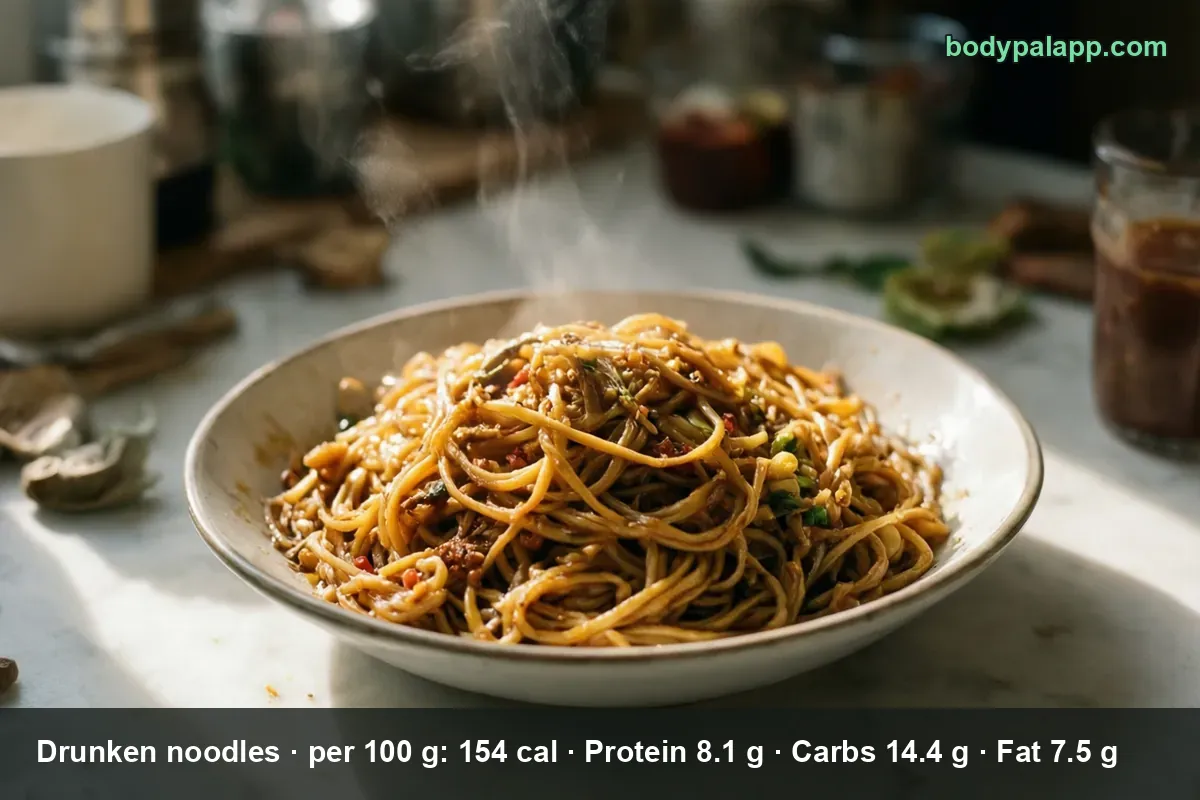
One difference worth naming: the bowl in the photo above uses thin rice noodles, while a purist's pad kee mao uses the wide, flat sheets. The noodles weigh the same either way, so the calories do not move.
| Nutrient | Per 100 g | Per 1 cup (200 g) | % Daily Value |
|---|---|---|---|
| Calories | 154 | 308 | — |
| Total fat | 7.5 g | 15.0 g | 19% |
| Saturated fat | 1.3 g | 2.6 g | 13% |
| Carbohydrate | 14.36 g | 28.7 g | 10% |
| Dietary fiber | 1.2 g | 2.4 g | 9% |
| Total sugars | 4.06 g | 8.1 g | — |
| Protein | 8.13 g | 16.3 g | 33% |
| Sodium | 384 mg | 768 mg | 33% |
% Daily Value is based on a 2,000-calorie diet.
Verified nutrition data
Numbers on this page come from USDA FoodData Central, the U.S. Department of Agriculture’s food composition database, and from manufacturer labels where a branded product is named. Last verified September 2026. How we verify our data →
There is no added-sugars row and no trans-fat row here, because this edition of FNDDS does not publish either for the record. Cholesterol and potassium do exist: a cup gives 96 mg of cholesterol (32% of the Daily Value) and 304 mg of potassium (6%). The Daily Values used throughout are the FDA reference amounts printed on the Nutrition Facts label.
US servings, from one ounce to a takeout box
| Serving | Weight | Calories |
|---|---|---|
| 1 oz | 28 g | 44 kcal |
| 1 cup | 200 g | 308 kcal |
| 1.5 cups, restaurant plate | 300 g | 462 kcal |
| 2 cups, takeout box | 400 g | 616 kcal |
| Per 100 g | 100 g | 154 kcal |
Only the 1-cup line is a USDA household measure. The ounce, the cup-and-a-half plate and the two-cup box are our own arithmetic from the USDA 100 g figure, not USDA servings, and they exist because almost nobody eats exactly one cup of stir-fried noodles.
This is where the counting usually goes wrong. A cup of noodles is a small side bowl, not a dinner. Scoop a Thai restaurant plate into measuring cups and you get a cup and a half most of the time, two cups when the kitchen is generous, and the calorie count climbs by a third between the smallest and largest of those. If you log "drunken noodles, 1 cup" after a sit-down dinner, you are probably 150 to 300 calories light.
Chicken, beef, shrimp and tofu versions
| Version | Per 100 g | Typical serving | Calories |
|---|---|---|---|
| With chicken (the main record) | 154 kcal | 1 cup (200 g) | 308 kcal |
| Meat not specified | 154 kcal | 1 cup (200 g) | 308 kcal |
| With beef or pork | 160 kcal | 1 cup (200 g) | 320 kcal |
| With shrimp | 147 kcal | 1 cup (200 g) | 294 kcal |
| Vegetarian, with tofu | 165 kcal | 1 cup (200 g) | 330 kcal |
| Frozen Ling Ling Drunken Noodles with Chicken | 148 kcal | 1 bag (283 g) | 419 kcal |
The spread across the meat and seafood versions is 26 calories per cup, which is less than most people expect and less than the difference between a level cup and a heaped one. Shrimp is the lightest at 294, because shrimp brings protein without much fat. Beef or pork is 320.
The surprise is the meatless version at 330 per cup, the highest of the five. Tofu absorbs oil the way meat does not, and the kitchen usually adds more of it to keep the noodles from sticking. Ordering the vegetarian plate to save calories does not work here; it saves cholesterol instead, not energy.
Frozen retail packs are their own category. A Ling Ling bag is 283 g and 419 calories, a Central Market tray is 350 g and 431, and both P.F. Chang's Home Menu versions are lighter per gram than the restaurant dish, at 100 and 101 calories per 100 g, which works out to 290 and 289 for the pack. Frozen bowls are watered down with more vegetables and sauce, so they cost less per gram and more per package.
Sodium is the row to watch
Calories are not the problem with this dish. Sodium is. One cup carries 768 mg, a third of the 2,300 mg Daily Value, and that is before rice, spring rolls or a second scoop. A cup-and-a-half restaurant plate is around 1,150 mg. A whole Ling Ling bag, eaten as one dinner the way the pack invites you to, is 1,010 mg, or 44% of the day from a single meal.
To picture it: the sodium in one cup is roughly what you would get from a third of a teaspoon of table salt. The CDC's guidance on sodium and blood pressure puts most American adults well above the limit already, and fish sauce plus soy sauce is one of the fastest ways to get there. If you are watching sodium, this is a dish to have with plain rice and water rather than with soup and a salty appetizer.
The good news in the same table is protein. A dish that looks like pure carbohydrate delivers 16.3 g of protein per cup, 33% of the Daily Value, against only 10% of the carbohydrate allowance. Saturated fat is mild too, 2.6 g and 13%, because the wok uses vegetable oil rather than butter or cream. By the MyPlate protein foods framing, one cup of this covers a meaningful share of a day's protein group, which is not something you can say about most noodle dishes.
How do drunken noodles compare?
| Dish | Per 100 g | US serving | Calories |
|---|---|---|---|
| Drunken noodles, with chicken | 154 kcal | 1 cup (200 g) | 308 kcal |
| Lo mein, with pork | 138 kcal | 1 cup (200 g) | 276 kcal |
| Pork chow mein with noodles | 143 kcal | 1 cup (200 g) | 286 kcal |
| Rice, fried, with chicken | 173 kcal | 1 cup (200 g) | 346 kcal |
Our take: for a takeout order, the whole noodle-and-rice aisle sits inside a 70-calorie band per cup, from lo mein at 276 to chicken fried rice at 346, so the dish you pick matters far less than the size of the plate. Drunken noodles are second heaviest of the four and carry the most fat per 100 g at 7.5 g, but they also carry about half the carbohydrate of fried rice, 14.36 g against 27.62 g per 100 g. If you are cutting calories, order drunken noodles and eat one cup with a side of vegetables rather than ordering lo mein and finishing two cups. If you want the meal to hold you until bedtime, chow mein and lo mein edge ahead on protein per cup, at 20.8 g and 19.0 g against 16.3 g here, while fried rice trails all three.
Most popular drunken noodles brands in the United States
Ranked by how widely each product appears among foods sold in the United States, from the BodyPal food database of over 3.3 million products. Calories are the figures printed on each Nutrition Facts label, checked against USDA FoodData Central.
| Product | Calories (per 100 g) |
|---|---|
| Ling Ling Drunken Noodles with Chicken | 148 cal |
| P.F. Chang's Home Menu Drunken Noodles Rice Noodle Bowl | 100 cal |
| P.F. Chang's Home Menu Drunken Noodles with Chicken | 101 cal |
| Central Market Drunken Noodles with Chicken | 123 cal |
Brand popularity: BodyPal food database. Nutrition: manufacturer labels / USDA FoodData Central.
Drunken noodle FAQs
How many calories are in drunken noodles?
308 calories in a 1-cup serving of 200 g, at 154 calories per 100 g. That is the USDA figure for Thai wok noodles with chicken, the closest published match. An ounce is 44 calories, and two cups, the size of a takeout box, come to 616.
How many calories in a plate of drunken noodles from a restaurant?
Roughly 462 to 616 calories, because a restaurant plate measures a cup and a half to two cups rather than the single cup USDA lists. Scooping a normal dinner portion into measuring cups usually gives 300 g. That is our own arithmetic from the USDA 100 g figure of 154 calories.
How much sodium is in drunken noodles?
768 mg of sodium per cup, which is 33% of the 2,300 mg Daily Value and about a third of a teaspoon of table salt. A restaurant plate of a cup and a half lands near 1,150 mg. A whole 283 g bag of frozen Ling Ling drunken noodles is 1,010 mg.
How many carbs are in drunken noodles?
28.7 g of carbohydrate per cup, or 14.36 g per 100 g, which is 10% of the Daily Value. Fiber accounts for 2.4 g of that and total sugars for 8.1 g, mostly from the sweetened sauce. Chicken fried rice carries nearly twice the carbohydrate per gram.
Do drunken noodles have alcohol in them?
No alcohol appears in the recipe, and the USDA record shows 0 g of it. The name is folklore rather than an ingredient list, usually explained as a dish spicy enough to sober you up or one thrown together late at night. The heat comes from chili, not liquor.
How many calories in vegetarian drunken noodles with tofu?
330 calories per cup, at 165 per 100 g, which makes the meatless version the highest of the five protein options rather than the lowest. Tofu soaks up wok oil that meat would not, so fat rises to 9.2 g per 100 g. It does cut cholesterol sharply.
How many calories in P.F. Chang's frozen drunken noodles?
Between 289 and 290 calories for a whole pack, since both Home Menu drunken noodle products run 100 to 101 calories per 100 g across a 286 g pack and a 290 g bowl. That is lighter per gram than restaurant noodles, mainly because the frozen bowls carry more sauce and vegetables.
Are drunken noodles healthier than pad thai?
They are close enough that USDA prices them from the same record, 154 calories per 100 g, so 308 per cup either way. The real differences are in the sauce: pad thai leans on tamarind and sugar, drunken noodles on soy and fish sauce, which pushes sodium up rather than calories.
Similar foods
- Guacamole — 47 cal for 2 tablespoons
- Alfredo Sauce — 390 cal per cup
- Balsamic Dressing — 47 cal per 2 Tbsp
- Garlic Clove — 4 cal per clove
- Avocado Spread — 80 cal per 2 tbsp
- Lasagna Noodles — 221 cal per cup
Count it without the math
Point the camera at the plate and BodyPal counts the noodles for you, sauce and protein and all.


How long does it take to burn off 308 kcal of drunken Noodles?
A 1-cup (200 g) serving is 308 kcal. Enter your weight and the amount you ate to see how long it takes you to burn that off:
lb
| Activity | Time to burn 308 kcal |
|---|---|
| Walking, brisk | 1 hr 2 min |
| Cycling, moderate | 38 min |
| Swimming, moderate | 44 min |
| Jogging | 36 min |
| Weight training, moderate | 1 hr 8 min |
Times are for a 155 lb adult at a steady pace; change the weight to see yours. The amount is set to the portion in the text (200 g); change it to what you actually ate. BodyPal works this out from your steps automatically.
This table assumes you know your daily total. If you do not, the daily calorie calculator works it out from five numbers.