
How many calories are in guacamole?
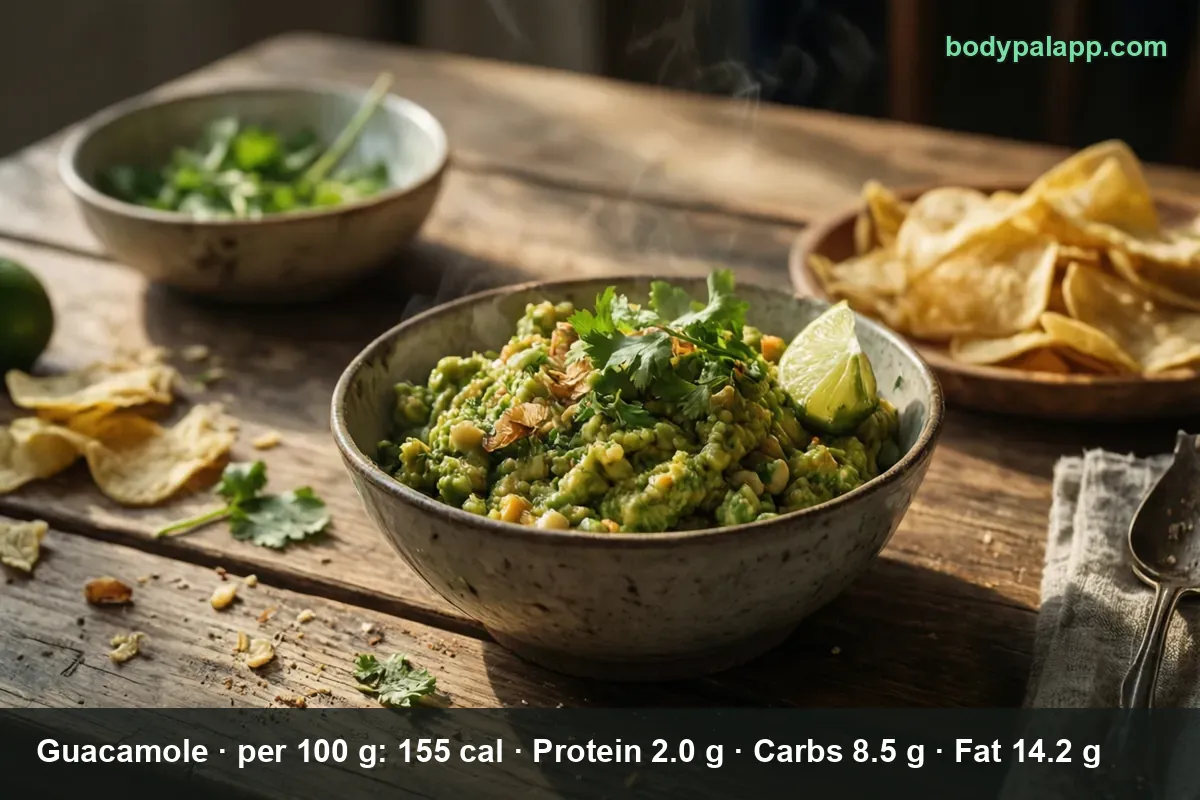
Two tablespoons of guacamole, the serving printed on the back of the tub, is 47 calories, and per 100 g guacamole runs 155 calories. Almost all of that is avocado fat: 14.18 g per 100 g, with only 2.06 g of it saturated. The bowl empties faster than the number suggests, which is where the counting goes wrong.
On this page
- Guacamole quick facts
- US servings, from one tablespoon to the whole tub
- Store-bought, tomato-heavy and single-serve cups
- Fiber is the surprise, sodium is the cost
- How does guacamole compare to other dips?
- Most popular guacamole brands
- FAQ
Guacamole quick facts
The number on this page is the USDA's FNDDS record 2709307, "Guacamole, NFS" — the unspecified version, which is exactly what most people mean by guacamole: avocado, onion, lime, salt, whatever heat the cook felt like. It covers the homemade bowl and the restaurant side dish equally well. The other FNDDS entry adds tomatoes, which dilutes the avocado rather than replacing it, so it gets its own section further down instead of being blended into the main figure.
The 30 g column is our own arithmetic from the USDA 100 g figure, scaled to the 2-tablespoon serving that appears on nearly every US label. It is not a USDA household measure, but it is the number people actually look for.
| Nutrient | Per 100 g | Per 2 tablespoons (30 g) | % Daily Value |
|---|---|---|---|
| Calories | 155 | 47 | — |
| Total fat | 14.18 g | 4.3 g | 5% |
| Saturated fat | 2.06 g | 0.6 g | 3% |
| Carbohydrate | 8.45 g | 2.5 g | 1% |
| Dietary fiber | 6.5 g | 2.0 g | 7% |
| Total sugars | 0.72 g | 0.2 g | — |
| Protein | 1.95 g | 0.6 g | 1% |
| Sodium | 344 mg | 103 mg | 4% |
| Cholesterol | 0 mg | 0 mg | 0% |
| Potassium | 472 mg | 142 mg | 3% |
% Daily Value is based on a 2,000-calorie diet.
Verified nutrition data
Numbers on this page come from USDA FoodData Central, the U.S. Department of Agriculture’s food composition database, and from manufacturer labels where a branded product is named. Last verified September 2026. How we verify our data →
Two rows a packaged label would carry are missing here: added sugars and trans fat. This edition of FNDDS does not publish either value for mixed dishes, so nothing is estimated in their place. What the record does give is a clean zero for cholesterol and a genuinely useful potassium figure — 472 mg per 100 g, 142 mg in a 2-tablespoon scoop, which is more potassium than most things people dip.
US servings, from one tablespoon to the whole tub
| Serving | Weight | Calories |
|---|---|---|
| 1 tablespoon | 15 g | 23 kcal |
| 2 tablespoons, label serving | 30 g | 47 kcal |
| 1 oz | 28.4 g | 44 kcal |
| USDA typical serving | 60 g | 93 kcal |
| 1 individual container | 70 g | 109 kcal |
| Per 100 g | 100 g | 155 kcal |
The 60 g and 70 g lines are USDA portion sizes attached to the record itself — the survey's typical serving and the single-serve cup sold at the deli counter. The tablespoon, the 2-tablespoon serving and the ounce are our own arithmetic from the USDA 100 g figure.
Look at the spread. The label serving and the container are the same food eight minutes apart, and one is more than twice the other: 47 calories against 109. A single-serve cup gets logged as "2 tbsp" more often than any other guacamole mistake, and it costs 62 calories every time.
One thing this page does not do is add the chips. Tortilla chips are a separate USDA record with their own weight and their own fat, and combining two records into one number invents a portion nobody measured. Weigh the dip, count the chips separately, and the total holds up.
Store-bought, tomato-heavy and single-serve cups
| Version | Per 100 g | Typical portion | Calories |
|---|---|---|---|
| Guacamole, NFS | 155 kcal | 2 tablespoons (30 g) | 47 kcal |
| Guacamole with tomatoes | 145 kcal | 2 tablespoons (30 g) | 44 kcal |
| Guacamole with tomatoes, tub | 145 kcal | 1 container (70 g) | 102 kcal |
| Store-bought mild, Old El Paso | 167 kcal | 2 Tbsp (30 g) | 50 kcal |
| Store-bought medium, Old El Paso | 133 kcal | 2 Tbsp (30 g) | 40 kcal |
| Single-serve cup, Yucatan | 175 kcal | 2 oz (57 g) | 100 kcal |
Tomatoes are the cheapest way to make guacamole lighter. Chopped into the same bowl they add water and almost nothing else, and the record drops to 145 calories per 100 g — a 10-calorie saving per 100 g, or three calories on a 2-tablespoon scoop. Barely worth chasing, but it is the direction every restaurant recipe with pico stirred through it moves.
Packaged guacamole is a wider band than the fresh stuff. Two products from the same brand sit at 167 and 133 calories per 100 g, a 34-calorie gap that comes down to how much avocado is in the jar versus everything else. The single-serve Yucatan cup is the heaviest at 175 per 100 g, and because its label serving is 2 oz rather than 2 tbsp, one cup is 100 calories — more than double the 47 most people assume they are logging. Read the serving size before the calorie count; on guacamole the serving size is what changes.
Fiber is the surprise, sodium is the cost
Guacamole is one of the few fatty foods with a fiber number worth reading. Per 100 g it carries 6.5 g of dietary fiber against 8.45 g of total carbohydrate. Subtract one from the other and under 2 g of carbohydrate is anything but fiber. That 6.5 g is 23% of the FDA's Daily Value of 28 g, from a food most people file under "fat".
The fat itself is less alarming than it looks. Of 14.18 g total, 2.06 g is saturated — under a sixth. A 2-tablespoon serving contributes 3% of the saturated fat Daily Value, which leaves plenty of room under the Dietary Guidelines advice to keep saturated fat below 10% of daily calories. Avocado is also the one place MyPlate counts a fruit as a fat source rather than a produce serving.
Sodium is where the bowl gets expensive. 344 mg per 100 g is roughly a seventh of a teaspoon of table salt, and a 70 g tub carries about 241 mg before a single salted chip goes into it. The avocado brings almost none of that; the cook does. If sodium is the number being watched, guacamole made at home with lime doing the work is a different food from the tub.
How does guacamole compare to other dips?
| Dip | Per 100 g | US serving | Calories |
|---|---|---|---|
| Guacamole | 155 kcal | 1 tablespoon (15 g) | 23 kcal |
| Layer dip | 146 kcal | 1 tablespoon (15 g) | 22 kcal |
| Cheese dip | 163 kcal | 1 tablespoon (15 g) | 24 kcal |
| Spinach dip, yogurt based | 159 kcal | 1 tablespoon (15 g) | 24 kcal |
Per-tablespoon figures here are our arithmetic from each record's 100 g value, so the four are compared on identical terms.
Our take: on calories alone these four are the same food — 22 to 24 per tablespoon, and only the layer dip is lighter per 100 g than guacamole. The separation is in what comes with the calories. Guacamole is the only one of the four bringing 6.5 g of fiber and 472 mg of potassium per 100 g, and its 1.95 g of protein is the lowest of the group, a little over a quarter of what the yogurt-based spinach dip carries. For a plate that needs filling out, take the guacamole. For a dip doing protein work, it is not the one.
Most popular guacamole brands in the United States
Ranked by how widely each product appears among foods sold in the United States, from the BodyPal food database of over 3.3 million products. Calories are the figures printed on each Nutrition Facts label, checked against USDA FoodData Central.
| Product | Calories (per 100 g) |
|---|---|
| Old El Paso Mild Guacamole | 167 cal |
| Old El Paso Medium Guacamole | 133 cal |
| Yucatan Guacamole | 175 cal |
| Yucatan Guacamole Mild | 167 cal |
| Yucatan Guacamole Spicy | 167 cal |
| Yucatan Organic Guacamole | 167 cal |
Brand popularity: BodyPal food database. Nutrition: manufacturer labels / USDA FoodData Central.
Guacamole FAQs
How many calories are in guacamole?
Guacamole is 155 calories per 100 g, so the 2-tablespoon label serving is 47 calories and a 70 g single-serve tub is 109. Most of it is avocado fat, 14.18 g per 100 g, and the numbers come from the USDA's Guacamole, NFS record for the plain, unspecified version.
How many calories in 2 tablespoons of guacamole?
Two tablespoons is 47 calories at 30 g. That is the serving printed on most US tubs, and it is smaller than it looks on a plate: 4.3 g fat, 2.5 g carbohydrate, 2.0 g fiber and 103 mg sodium. Two loaded chips and the serving is gone.
How many carbs are in guacamole?
Guacamole has 8.45 g of carbohydrate per 100 g, and 6.5 g of that is fiber, leaving under 2 g of anything else. The 2-tablespoon serving lands at 2.5 g of total carbohydrate with 2.0 g of fiber. Few savory dips come out that low once the fiber is subtracted.
Is guacamole good for weight loss?
At 47 calories per 2 tablespoons, guacamole is a cheap way to make plain vegetables worth eating, and 6.5 g of fiber per 100 g helps a plate feel finished. The trap is volume rather than density: a 70 g tub is 109 calories, and dip almost never gets measured.
Is guacamole keto friendly?
Per 100 g guacamole carries 8.45 g of carbohydrate against 6.5 g of fiber, which leaves 1.95 g of everything else, about 0.6 g in a 2-tablespoon serving. Fat is 14.18 g per 100 g. On carbohydrate count alone it fits a low-carb day with room to spare.
How much protein is in guacamole?
Guacamole has 1.95 g of protein per 100 g, which is 0.6 g in the 2-tablespoon serving, or 1% of the Daily Value. It is a fat-and-fiber food, not a protein food. A yogurt-based spinach dip carries 7.02 g per 100 g, roughly three and a half times as much.
How much sodium is in guacamole?
A 2-tablespoon serving has 103 mg of sodium, 4% of the Daily Value, and 100 g has 344 mg. That is about a seventh of a teaspoon of table salt per 100 g. The salt goes in at the bowl, not the tree, so a homemade batch is the one place to move that number.
Is store-bought guacamole as healthy as homemade?
Store-bought mild guacamole runs 167 calories per 100 g against 155 for the USDA's plain record, so 50 calories per 2-tablespoon serving instead of 47. One medium version is lighter still at 133. The gap is the recipe, not the aisle: how much avocado is in the jar sets the number.
Similar foods
- Drunken Noodles — 308 cal per cup
- Balsamic Dressing — 47 cal per 2 Tbsp
- Alfredo Sauce — 390 cal per cup
- Avocado Spread — 80 cal per 2 tbsp
- Garlic Clove — 4 cal per clove
- Lasagna Noodles — 221 cal per cup
Count it without the math
Point the camera at the bowl and BodyPal counts the guacamole for you, scoop by scoop.


How long does it take to burn off guacamole?
A 2-tablespoon (30 g) serving is 47 kcal. Enter your weight and the amount you ate to see how long it takes you to burn that off:
lb
| Activity | Time to burn 47 kcal |
|---|---|
| Walking, brisk | 9 min |
| Cycling, moderate | 6 min |
| Swimming, moderate | 7 min |
| Jogging | 6 min |
| Weight training, moderate | 10 min |
Times are for a 155 lb adult at a steady pace; change the weight to see yours. The amount is set to the portion in the text (30 g); change it to what you actually ate. BodyPal works this out from your steps automatically.
Want the bigger picture? Calculate your daily calorie needs — your maintenance figure, a target for losing or gaining, and the date you get there.