
How many calories are in noodles?
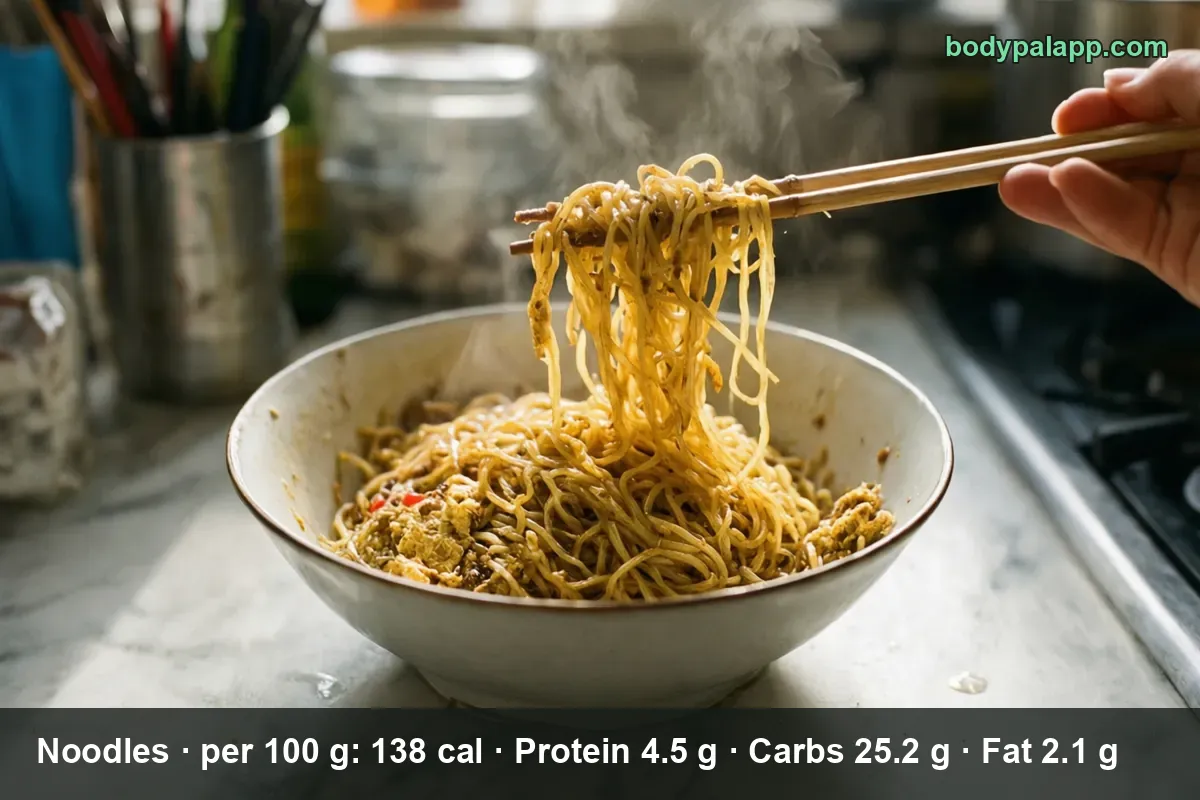
A 1-cup serving of cooked egg noodles, 160 g, is 221 calories, and per 100 g cooked noodles come to 138 calories. That cup brings 40.3 g of carbohydrate and 7.3 g of protein. The number moves far more with what you measure — dry strands or the boiled bowl — than with the brand on the bag.
On this page
- Noodle quick facts
- US servings, from one ounce to two cups
- Dry noodles vs cooked noodles
- Soba, rice noodles and crispy chow mein
- Sodium hides in the packet, not the noodle
- How do noodles compare?
- Most popular noodles brands
- FAQ
Noodle quick facts
The record behind the numbers on this page is SR Legacy 169732, "Noodles, egg, enriched, cooked". That is the noodle most people are actually holding: boiled, drained, sitting in a bowl. USDA also publishes a cooked-with-salt version of the same noodle and a survey average called "Noodles, cooked," but both carry the cook's salt water in the sodium column, and salting the pot is a choice, not part of the food.
Plain cooked noodles are also the base layer. The stir-fried bowls further down this page arrive with sauce, oil and meat on them; those calories sit on top of the numbers below, not inside them.
| Nutrient | Per 100 g | Per 1 cup (160 g) | % Daily Value |
|---|---|---|---|
| Calories | 138 | 221 | — |
| Total fat | 2.07 g | 3.3 g | 4% |
| Saturated fat | 0.42 g | 0.7 g | 3% |
| Carbohydrate | 25.16 g | 40.3 g | 15% |
| Dietary fiber | 1.2 g | 1.9 g | 7% |
| Total sugars | 0.4 g | 0.6 g | — |
| Protein | 4.54 g | 7.3 g | 15% |
| Sodium | 5 mg | 8 mg | 0% |
% Daily Value is based on a 2,000-calorie diet.
Verified nutrition data
Numbers on this page come from USDA FoodData Central, the U.S. Department of Agriculture’s food composition database, and from manufacturer labels where a branded product is named. Last verified September 2026. How we verify our data →
There is no added sugars row here because the SR Legacy edition does not publish that field at all; total sugars are 0.4 g per 100 g, which is what wheat and egg bring on their own. Two rows worth pulling out of the label: cholesterol, 29 mg per 100 g and 46 mg in a cup, or 15% of the Daily Value, which comes from the egg in the dough; and potassium, 38 mg per 100 g, 61 mg per cup, a rounding error against the 4,700 mg Daily Value.
US servings, from one ounce to two cups
| Serving | Weight | Calories |
|---|---|---|
| 1 oz cooked | 28 g | 39 kcal |
| 1/2 cup cooked | 80 g | 110 kcal |
| Per 100 g | 100 g | 138 kcal |
| 4 oz cooked | 113 g | 156 kcal |
| 1 cup cooked | 160 g | 221 kcal |
| 2 cups cooked | 320 g | 442 kcal |
Only one line here is a USDA household measure: the 1 cup at 160 g. The half cup, the two cups and both ounce weights are our own arithmetic from the USDA 100 g figure, not USDA servings. If you scoop rather than weigh, the cup is the honest unit — noodles pack loosely, and a heaped cup of short egg noodles can run 10 to 15 percent over 160 g, which is 20 to 30 calories you never see.
Two cups is where a noodle side quietly becomes the meal: 442 calories before a spoonful of sauce.
Dry noodles vs cooked noodles
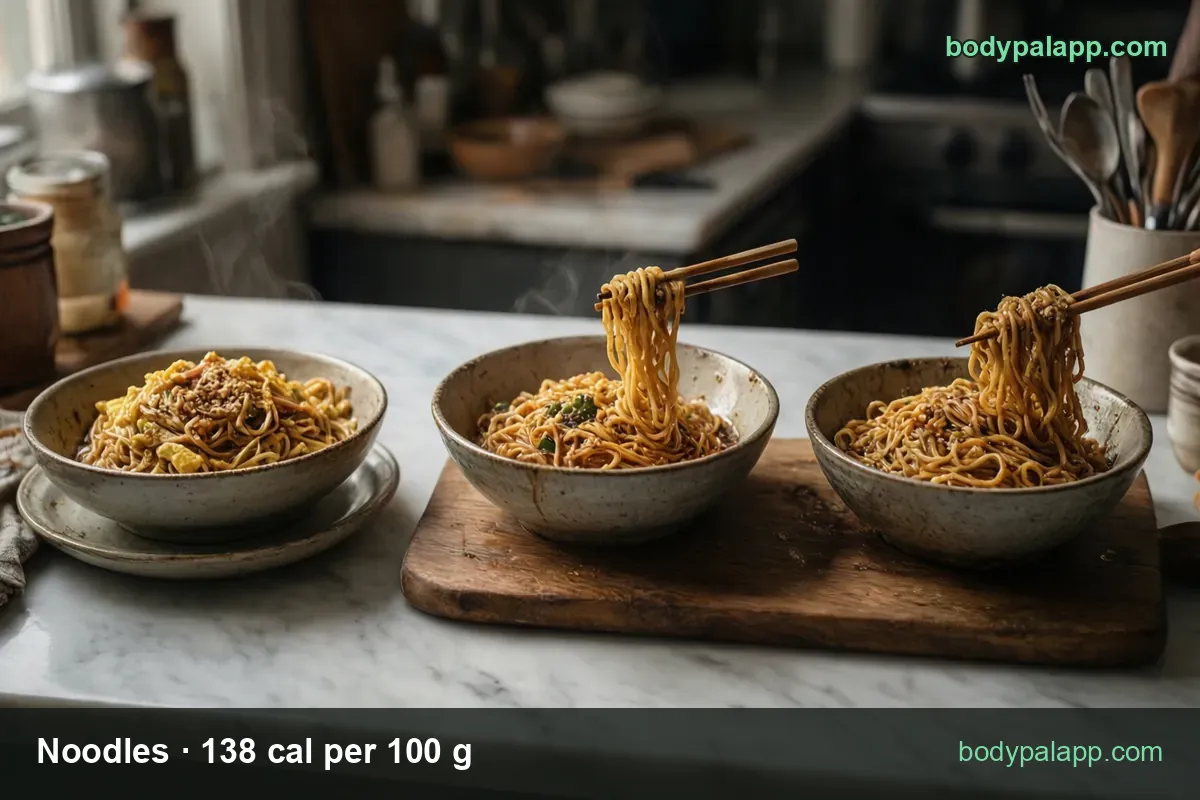
This is the trap that ruins more noodle entries than any other. Dry egg noodles are 384 calories per 100 g. Cooked, the same noodle reads 138. Nothing burned off — the strands absorbed water, so the calories now spread across 2.8 times more grams.
| Form | Per 100 g | Typical serving | Calories |
|---|---|---|---|
| Egg noodles, dry | 384 kcal | 1 cup dry (38 g) | 146 kcal |
| Egg noodles, dry | 384 kcal | 2 oz dry (57 g) | 219 kcal |
| Egg noodles, cooked | 138 kcal | 1 cup (160 g) | 221 kcal |
Read the last two lines together. Two ounces of dry noodles, 219 calories, boils up into roughly one cup cooked, 221 calories. Same food, same energy, wildly different weight — and the 2 oz dry figure is our own arithmetic from the USDA 100 g number.
So the rule is simple: log dry weight against a dry record, cooked weight against a cooked record. Weigh 160 g of boiled noodles and enter it against the 384-calorie dry line and you have just logged 614 calories for a 221-calorie bowl.
Soba, rice noodles and crispy chow mein
Noodle is a family, not a food, and the spread inside it is enormous — 99 calories per 100 g at one end, 471 at the other.
| Noodle | Per 100 g | Typical serving | Calories |
|---|---|---|---|
| Egg noodles, cooked | 138 kcal | 1 cup (160 g) | 221 kcal |
| Spinach egg noodles, cooked | 132 kcal | 1 cup (160 g) | 211 kcal |
| Soba (buckwheat), cooked | 99 kcal | 4 oz (113 g) | 112 kcal |
| Rice noodles, cooked | 108 kcal | 4 oz (113 g) | 122 kcal |
| Chow mein noodles, crispy | 471 kcal | 1/2 cup (28 g) | 132 kcal |
| Instant ramen, dry | 440 kcal | 1 oz (28 g) | 123 kcal |
Spinach in the dough buys you 10 calories a cup. It is a color, not a diet move.
Soba is the interesting one. At 99 calories per 100 g it is the lightest cooked noodle on this page, and it still carries 5.06 g of protein per 100 g against 4.54 g for egg noodles. Buckwheat brings that on its own. Rice noodles sit at 108 but drop to 1.79 g of protein — a bowl of pho noodles is close to pure starch, at 0.2 g of fat per 100 g.
The crispy noodles are a different animal entirely. Chow mein noodles are deep-fried, which is why they land at 471 calories and 21.24 g of fat per 100 g. Half a cup of them, 28 g, is 132 calories — more than half a cup of boiled noodles at 80 g and 110 calories, off a third of the weight. The handful scattered over a salad is not a garnish.
Retail packs follow the same logic. Nissin Cup Noodles Beef is 453 calories per 100 g, 290 for the 64 g cup; Maruchan Ramen Noodle Soup is 442 per 100 g, 190 for the half block the label calls a serving; Hakubaku Organic Soba is 361 per 100 g dry, 202 for a 2 oz portion. Both fried blocks land above 440 because the frying is how the noodle is dried.
Sodium hides in the packet, not the noodle
Boiled noodles are one of the lowest-sodium starches you can put on a plate: 5 mg per 100 g, 8 mg in a cup, 0% of the 2,300 mg Daily Value. Salt the cooking water and USDA's salted record climbs to 165 mg per 100 g — about 264 mg a cup by our own arithmetic, or 11% of the Daily Value, which is roughly an eighth of a teaspoon of table salt reaching the food.
Then there is the seasoning packet. Dry instant ramen, block and packet together, is 1,855 mg of sodium per 100 g. A single ounce is 519 mg, 23% of the day, and Nissin's beef cup at 1,719 mg per 100 g delivers around 1,100 mg — 48% of the Daily Value — in a 64 g cup you eat in four minutes. Crispy chow mein noodles are no better per bite: 866 mg per 100 g means 242 mg in that half-cup handful, 11% of the day.
Nothing about the noodle did that. If you are watching sodium, the noodle is fine and the flavor packet is the decision. On fiber, the Dietary Guidelines point the same way as MyPlate's grains advice: a cup of regular egg noodles gives 1.9 g of fiber, 7% of the 28 g Daily Value, so the whole grain version is the easier swap than eating less.
How do noodles compare?
All four lines below use a 4 oz cooked portion, 113 g, because USDA does not publish cup weights for soba, rice or whole grain noodles.
| Noodle | Per 100 g | US serving | Calories |
|---|---|---|---|
| Soba, cooked | 99 kcal | 4 oz (113 g) | 112 kcal |
| Rice noodles, cooked | 108 kcal | 4 oz (113 g) | 122 kcal |
| Egg noodles, cooked | 138 kcal | 4 oz (113 g) | 156 kcal |
| Whole grain noodles, cooked | 148 kcal | 4 oz (113 g) | 167 kcal |
Our take: for weight loss, soba is the pick — it is the lightest of the four at 99 calories per 100 g and still the second-highest in protein at 5.06 g, so you give up nothing to save 44 calories on a 4 oz portion against egg noodles. For staying full, whole grain noodles are the pick despite being the highest-calorie line at 148 per 100 g, because 5.96 g of protein per 100 g is the best on the table. Rice noodles are the one to be careful with: they read cheap at 108, but with 1.79 g of protein they leave the fastest.
Most popular noodles brands in the United States
Ranked by how widely each product appears among foods sold in the United States, from the BodyPal food database of over 3.3 million products. Calories are the figures printed on each Nutrition Facts label, checked against USDA FoodData Central.
| Product | Calories (per 100 g) |
|---|---|
| Nissin Cup Noodles Beef | 453 cal |
| Indomie Chicken Instant Noodles | 429 cal |
| Hakubaku Organic Udon Wheat Noodles | 361 cal |
| Hakubaku Organic Soba Buckwheat Noodles | 361 cal |
| Maruchan Ramen Noodle Soup | 442 cal |
| Thai Kitchen Stir-Fry Rice Noodles | 357 cal |
Brand popularity: BodyPal food database. Nutrition: manufacturer labels / USDA FoodData Central.
Noodle FAQs
How many calories are in 1 cup of cooked noodles?
A 1-cup serving of cooked egg noodles, 160 g, comes to 221 calories, since USDA record 169732 puts cooked noodles at 138 calories per 100 g. That cup also carries 40.3 g of carbohydrate and 7.3 g of protein. Half a cup, 80 g, is 110 calories by our own arithmetic.
How many calories in 2 oz of dry egg noodles?
Two ounces of dry egg noodles, 57 g, is about 219 calories, our own arithmetic from the USDA figure of 384 calories per 100 g for the dry product. Boiled, that same 2 oz swells into roughly one cup of cooked noodles, 160 g and 221 calories.
Do noodles gain calories when you boil them?
No. Noodles gain water, not calories. Dry egg noodles are 384 calories per 100 g; cooked, the same product reads 138 per 100 g. The calories per gram fall because every gram now holds water. Two ounces dry, 219 calories, becomes about a cup cooked at 221 calories.
Are soba noodles lower in calories than egg noodles?
Yes. Cooked soba runs 99 calories per 100 g against 138 for cooked egg noodles, so a 4 oz portion, 113 g, is 112 calories versus 156. Soba also carries more protein per 100 g, 5.06 g against 4.54 g, because buckwheat brings its own.
How many calories in rice noodles?
Cooked rice noodles are 108 calories per 100 g, so a 4 oz portion, 113 g, is 122 calories. They are the lowest-protein noodle on this page at 1.79 g per 100 g, against 4.54 g for egg noodles, and they carry almost no fat at 0.2 g.
Are chow mein noodles fried?
Yes. Crispy chow mein noodles are deep-fried, which is why USDA record 168905 lists 471 calories and 21.24 g of fat per 100 g. Half a cup, 28 g, is 132 calories, more than half a cup of boiled noodles at 80 g and 110 calories.
How much sodium is in instant ramen noodles?
A lot. Dry instant ramen, block plus seasoning packet, carries 1,855 mg of sodium per 100 g, so a single ounce, 28 g, is 519 mg, or 23% of the 2,300 mg Daily Value. Plain cooked noodles are 5 mg per 100 g.
How much protein is in a cup of noodles?
A 1-cup serving, 160 g, gives 7.3 g of protein, 15% of the 50 g Daily Value. Cooked egg noodles are 4.54 g per 100 g. Soba is a little higher at 5.06 g, and cooked whole grain noodles higher again at 5.96 g per 100 g.
Similar foods
- Lasagna Noodles — 221 cal per cup
- Coffee Creamer — 20 cal per tablespoon
- Evaporated Milk — 338 cal per cup
- Basmati Rice — 205 cal per cup
- Cooked Jasmine Rice — 205 cal per cup
- Cocktail Sauce — 77 cal per 1/4 cup
Count it without the math
Point the camera at the bowl and BodyPal counts the noodles for you, sauce and all.


How long does it take to burn off Noodles?
A 1-cup (160 g) serving is 221 kcal. Enter your weight and the amount you ate to see how long it takes you to burn that off:
lb
| Activity | Time to burn 221 kcal |
|---|---|
| Walking, brisk | 44 min |
| Cycling, moderate | 28 min |
| Swimming, moderate | 32 min |
| Jogging | 26 min |
| Weight training, moderate | 49 min |
Times are for a 155 lb adult at a steady pace; change the weight to see yours. The amount is set to the portion in the text (160 g); change it to what you actually ate. BodyPal works this out from your steps automatically.
This table assumes you know your daily total. If you do not, the daily calorie calculator works it out from five numbers.