Low fat Greek yogurt calories come to 146 for a 7 oz container (200 g) and 73 per 100 g. The number to notice is protein. That container holds 19.9 g, which is 40% of the daily value, and protein supplies 55% of its calories. Few dairy foods give you that much protein for so few calories.
146kcal
1 7 oz container · 200 g, plain, lowfat
55%protein
19.9 gProtein
8 gCarbs
3.8 gFat
How to burn off 146 kcal
—Walking, brisk
—Jogging
—Cycling, moderate
—Swimming
Skip the math. BodyPal counts these calories from your steps and workouts automatically.
Nutrition facts
Plain, lowfat · per 200 g
Calories
146 kcal
Protein
19.9 g
Carbohydrate
7.9 g
Fat
3.8 g
Saturated fat
2.5 g
Cholesterol
20 mg
Sodium
68 mg
Potassium
282 mg
Iron
0.1 mg
Source: USDA FoodData Central
🛡️
Verified nutrition data
Numbers on this page come from USDA FoodData Central, the U.S. Department of Agriculture’s food composition database, and from manufacturer labels where a branded product is named. Last verified October 2026. How we verify our data →
Low fat Greek yogurt: calories, protein and sodium by serving
Percent of daily value uses the FDA reference of 2,000 kcal a day.
Serving
kcal
Protein
Carbs
Fat
Sodium
% DV kcal
7 oz container (200 g)
146
19.9 g
7.9 g
3.8 g
68 mg
7%
6 oz container (170 g)
124
16.9 g
6.7 g
3.3 g
58 mg
6%
100 g
73
10 g
3.9 g
1.9 g
34 mg
4%
3 × 7 oz container (200 g)
438
59.7 g
204 mg
5 × 7 oz container (200 g)
730
99.5 g
340 mg
A 6 oz cup is 124 calories, a 7 oz tub is 146
Plain lowfat Greek yogurt is mostly sold in two sizes, and the gap between them is small. The 6 oz container (170 g) lands at 124 calories with 16.9 g of protein. Step up to the 7 oz container (200 g) and you get 146 calories and 19.9 g of protein. Either one is a modest share of a 2,000-calorie day: 6% for the smaller cup, 7% for the larger.
The total climbs steadily once you scoop from a big tub instead. Two 7 oz servings (400 g) reach 292 calories and 39.8 g of protein. Three servings (600 g) come to 438 calories. A full 1,000 g tub, eaten over a week, holds 730 calories and 99.5 g of protein in total.
Spooning straight from a large tub is where people lose track. A heaping bowl can easily match two containers without looking like much. If you log your food, weigh the bowl once and you will know what your usual scoop really is. BodyPal can also log a bowl of yogurt from a photo, which beats guessing.
More than half the calories are protein
Break down the 73 calories in 100 g and protein carries the load: 55% of the energy comes from 10 g of protein. Fat supplies 24% from 1.9 g, and carbs supply 22% from 3.9 g. That is an unusual balance for a dairy food, and it is the reason Greek yogurt shows up in so many high-protein meal plans.
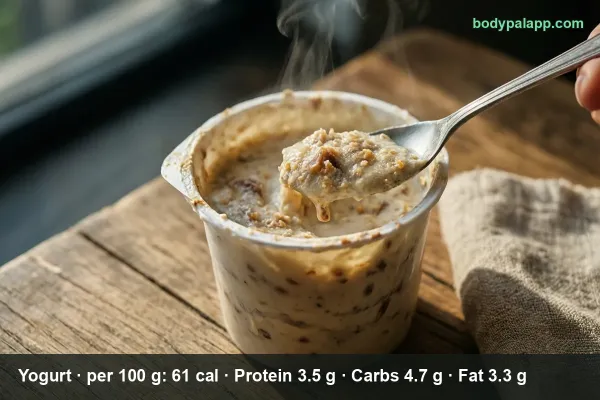
Compare it with the regular cup yogurt on our site. That one has 61 calories per 100 g but only 3.5 g of protein, with more fat at 3.3 g and more carbs at 4.7 g. You pay a few more calories for the Greek version and get almost three times the protein in return.
The lowfat label matters here too. Fat stays at 1.9 g per 100 g, so a 7 oz container carries just 3.8 g of fat. Saturated fat is 1.2 g per 100 g against a daily value of 20 g. If you are trimming fat, this is already a lean choice, and the nonfat style trims it further.
Sugar and sodium barely register in the plain version
Plain lowfat Greek yogurt has 3.6 g of sugars per 100 g, so a 7 oz container carries 7.1 g and a 6 oz container 6.1 g. Carbs total 7.9 g in the larger cup, and fiber is 0. For a dairy food, that is a low sugar count.
Sodium is just as quiet. The 7 oz container has 68 mg, only 3% of the 2,300 mg daily value, and 100 g has 34 mg. Cholesterol sits at 10 mg per 100 g against a 300 mg daily value, and potassium adds 141 mg per 100 g.
These numbers apply to the plain cup. Flavored lines such as Chobani Chocolate Low-Fat Greek Yogurt or the fruit-on-the-bottom raspberry and blackberry cups are different products with their own labels. Log them as their own entries rather than as plain yogurt, and read the sugars row before you assume they match.
It works best as the protein anchor of a snack or breakfast
At 124 to 146 calories with 16.9 to 19.9 g of protein, one container handles the protein part of a meal on its own. What it lacks is fiber, which reads 0. Adding fruit, oats or a spoon of seeds fills that gap and makes a bowl that feels like a real breakfast.
Toppings are where the calories pile up. Granola, honey and nut butter can each match or beat the yogurt itself, so the yogurt is rarely the problem in a heavy parfait. If you want the bowl to stay light, measure the toppings and let the yogurt be the bulk.
It also works in savory food. Use it in place of sour cream on tacos, as a base for a dip, or stirred into a sauce at the end of cooking. You keep the creamy texture and add protein, with sodium low enough that it will not move your daily total much.
How does low fat Greek yogurt compare?
Here is how low fat Greek yogurt stacks up against nonfat Greek yogurt, Fage 2% and regular yogurt, per 100 g and per usual serving.
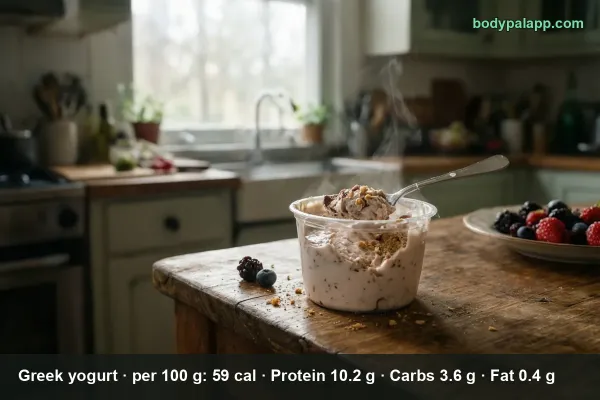
Verdict: For the fewest calories, pick the cup greek yogurt at 59 per 100 g, which keeps 10.2 g of protein while cutting fat to 0.4 g. Regular cup yogurt looks close at 61 calories but carries only 3.5 g of protein, so for staying full, lowfat Greek yogurt or Fage 2% at 73 calories per 100 g is the better buy.
Most popular low fat Greek yogurt brands in the United States
6Chobani Plain Low-Fat Greek Yogurt3/4 cup · 170 g71 kcal
Flavored products contain fruit or added sugar, so most of their label numbers read higher than the plain yogurt above. Source: manufacturer labels / USDA FoodData Central.
Low fat Greek yogurt FAQs
How many calories are in a container of low fat Greek yogurt?
A 7 oz container (200 g) of plain low fat Greek yogurt has 146 calories, and a 6 oz container (170 g) has 124.
Is low fat Greek yogurt good for weight loss?
A 7 oz container gives 19.9 g of protein for 146 calories, with 3.8 g of fat and 7.1 g of sugar.
Low fat vs nonfat Greek yogurt: which has fewer calories?
Plain low fat Greek yogurt has 73 calories per 100 g, nonfat has 59 and whole milk Greek yogurt has 94.
How much protein is in low fat Greek yogurt?
It has 9.95 g of protein per 100 g, which is 19.9 g in a 7 oz container and 16.9 g in a 6 oz container.
How many calories are in a cup of low fat Greek yogurt?
Low fat Greek yogurt has 73 calories per 100 g, so the total depends on how much your cup weighs. A 6 oz container is 124 calories and a 7 oz container is 146. Weigh your cup once to get an exact number.
How much sugar is in plain low fat Greek yogurt?
A 7 oz container of plain lowfat Greek yogurt has 7.1 g of sugars, and a 6 oz container has 6.1 g. Per 100 g it is 3.6 g. Flavored and fruit-on-the-bottom cups carry their own, different numbers.
Is low fat Greek yogurt high in sodium?
No. A 7 oz container has 68 mg of sodium, just 3% of the 2,300 mg daily value. Per 100 g it is 34 mg, slightly less than the 46 mg in regular yogurt.
Does Greek yogurt have more protein than regular yogurt?
Yes, by a wide margin. Low fat Greek yogurt has 10 g of protein per 100 g, against 3.5 g in regular cup yogurt. The Greek version costs 73 calories per 100 g versus 61.