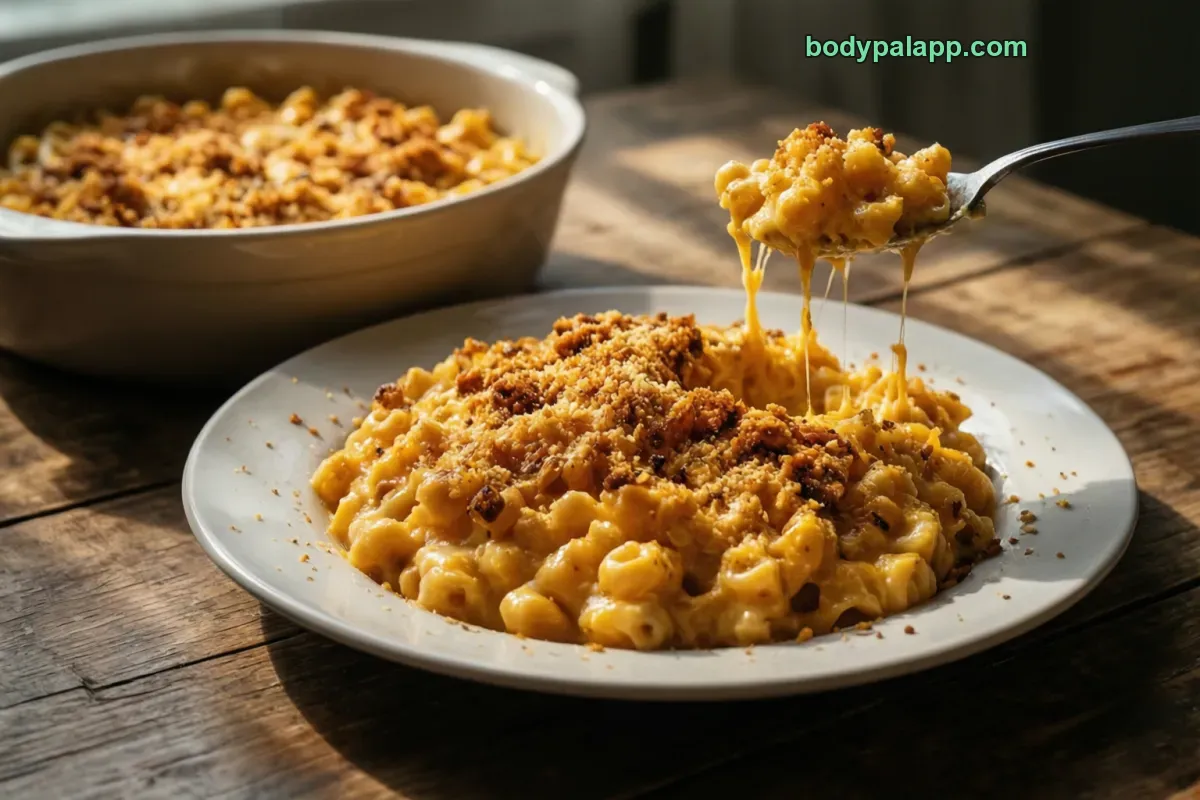
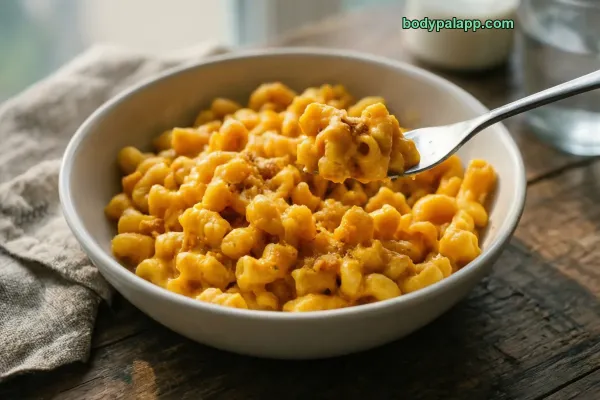
Homemade mac and cheese calories come to 513 for 1 cup (230 g), or 223 per 100 g. The part to notice is how evenly the energy splits: fat supplies 43% and carbs 42%. That same cup also carries 823 mg of sodium, 36% of the daily value, so the portion you scoop decides almost everything.
513kcal
1 cup · 230 g, homemade, prepared
16%protein
20 gProtein
53 gCarbs
24 gFat
How to burn off 513 kcal
—Walking, brisk
—Jogging
—Cycling, moderate
—Swimming
Skip the math. BodyPal counts these calories from your steps and workouts automatically.
Nutrition facts
Homemade, prepared · per 230 g
Calories
513 kcal
Protein
20 g
Carbohydrate
53 g
Fat
24 g
Saturated fat
11.8 g
Cholesterol
58 mg
Sodium
823 mg
Potassium
237 mg
Iron
2.4 mg
Source: USDA FoodData Central
🛡️
Verified nutrition data
Numbers on this page come from USDA FoodData Central, the U.S. Department of Agriculture’s food composition database, and from manufacturer labels where a branded product is named. Last verified September 2026. How we verify our data →
Homemade mac and cheese: calories, protein and sodium by serving
Percent of daily value uses the FDA reference of 2,000 kcal a day.
Serving
kcal
Protein
Carbs
Fat
Sodium
% DV kcal
1 cup (230 g)
513
20 g
53.1 g
24.2 g
823 mg
26%
Box mix, 1 cup (230 g)
412
10.7 g
51 g
18.5 g
370 mg
21%
Whole grain, 1 cup (230 g)
504
20.2 g
52.2 g
25 g
828 mg
25%
100 g
223
8.7 g
23.1 g
10.5 g
358 mg
11%
3 × 1 cup (230 g)
1,539
59.9 g
2,470 mg
5 × 1 cup (230 g)
2,565
99.8 g
4,117 mg
A second cup takes the total to 1,026 calories
One cup of homemade mac and cheese is 513 calories, about 26% of the daily value for energy. That is already a full meal for many people, and it rarely stops at one cup. A second scoop brings the plate to 1,026 calories, 1,647 mg of sodium and 39.9 g of protein.
Three cups, a common amount when it is the only thing on the table, land at 1,539 calories and 2,470 mg of sodium. That sodium figure is past the full daily value in a single sitting. Five cups, roughly a family baking dish, reach 2,565 calories and 4,117 mg of sodium.
The practical move is to measure once. Spoon 1 cup into a bowl and look at it, because a heaped serving from the pan often holds far more than you think. If you want a bigger plate, add volume with vegetables instead of a second cup of pasta.
Fat and carbs split the calories almost evenly
Per 100 g, homemade mac and cheese has 23.1 g of carbs, 10.5 g of fat and 8.7 g of protein. In calorie terms that works out to 43% fat, 42% carbs and 16% protein. The pasta brings the carbs; the cheese, butter and milk bring nearly all of the fat.
Saturated fat is the detail inside that fat number: 5.2 g per 100 g, against a daily value of 20 g. A full cup holds 24.2 g of total fat, which is why this dish feels so filling and why it climbs so quickly in calories.
Protein is better than its reputation. One cup gives 20 g, or 40% of the daily value, thanks to the cheese and milk. That is a real contribution, though you pay for it with 513 calories, so it is not an efficient protein source compared with lean meat or fish.
Sodium is the row to watch
Cheese is salty, and a cheese sauce concentrates it. Homemade mac and cheese carries 358 mg of sodium per 100 g, 16% of the daily value. Scale that to 1 cup and you reach 823 mg, or 36% of the day in one bowl.
Swapping in whole grain pasta does not change this: the whole grain version lists 828 mg per cup, also 36%. The box mix is lower on this row at 370 mg per cup, 16% of the daily value, though it is lower in protein too.
If you watch sodium, plan the rest of the day around the bowl. Pair it with unsalted vegetables, skip salty sides like chips or cured meat, and keep the portion to 1 cup. Cholesterol is modest by comparison, at 25 mg per 100 g against a daily value of 300 mg.
Whole grain adds fiber, not fewer calories
The three versions on this page sit close together on calories. Homemade is 513 per cup, whole grain is 504 and box mix is 412. The box mix saves calories, but it also drops protein to 10.7 g per cup against 20 g for homemade.
Whole grain pasta earns its place on fiber. A cup has 5.1 g of fiber against 2.8 g for the classic recipe and 2.3 g for the box mix. Sugars stay low across the board, at 5.6 g for homemade, 5.8 g for whole grain and 7.9 g for box mix.
Treat a cup as the anchor of a meal and build around it. Steamed broccoli, a green salad or roasted vegetables add volume and fiber without much sodium, and a lean protein side makes the plate more balanced. BodyPal can log the bowl from a photo if you want to track the portion you actually served.
How does homemade mac and cheese compare?
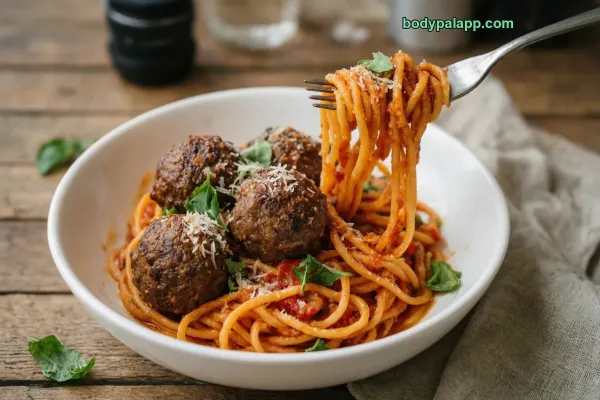
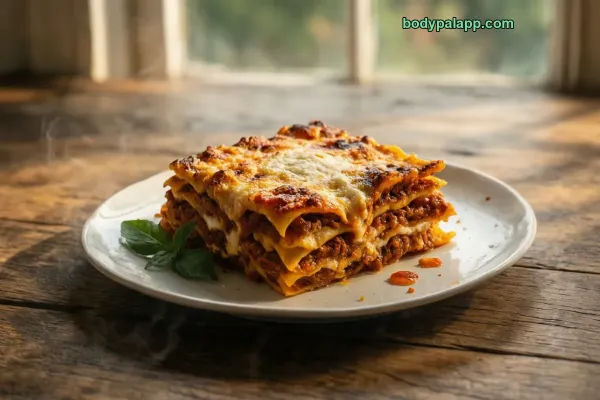
Here is how homemade mac and cheese stacks up against Kraft mac and cheese, meatballs and pasta, and homemade lasagna, per 100 g and per usual serving.
Verdict: For the lightest pasta plate pick meatballs and pasta at 170 calories per 100 g, well under the 223 of homemade mac and cheese. For more protein per bite choose homemade lasagna, which gives 13.6 g per 100 g against 8.7 g here.
Homemade mac and cheese FAQs
How many calories are in a cup of homemade mac and cheese?
About 513 calories in one cup (230 g), or 223 calories per 100 g.
Is mac and cheese good for weight loss?
It is calorie dense at 223 calories per 100 g, with 10.5 g fat, 23.1 g carbs and 8.7 g protein per 100 g.
Homemade mac and cheese vs box mac and cheese: which has more calories?
Homemade has about 513 calories per cup, while mac and cheese made from a packaged mix has about 412 per cup.
How much protein is in homemade mac and cheese?
One cup (230 g) has about 20 g of protein, which is 8.7 g per 100 g.
How much sodium is in a cup of homemade mac and cheese?
One cup (230 g) of homemade mac and cheese has 823 mg of sodium, 36% of the daily value. Per 100 g it is 358 mg. The whole grain version is similar at 828 mg per cup.
How many calories are in 2 cups of homemade mac and cheese?
Two cups (460 g) come to 1,026 calories. That portion also carries 1,647 mg of sodium and 39.9 g of protein, so a double serving makes up a large share of a day's intake.
How much fat is in homemade mac and cheese?
One cup has 24.2 g of fat, and 100 g has 10.5 g, of which 5.2 g is saturated. Fat supplies 43% of the dish's calories, slightly more than carbs at 42%.
Does whole grain pasta make mac and cheese lower in calories?
Barely. A cup made with whole grain pasta has 504 calories versus 513 for the classic recipe. The real gain is fiber: 5.1 g per cup compared with 2.8 g.
How many carbs are in a cup of homemade mac and cheese?
A cup of homemade mac and cheese has 53.1 g of carbs, including 2.8 g of fiber and 5.6 g of sugars. Per 100 g that is 23.1 g of carbs.