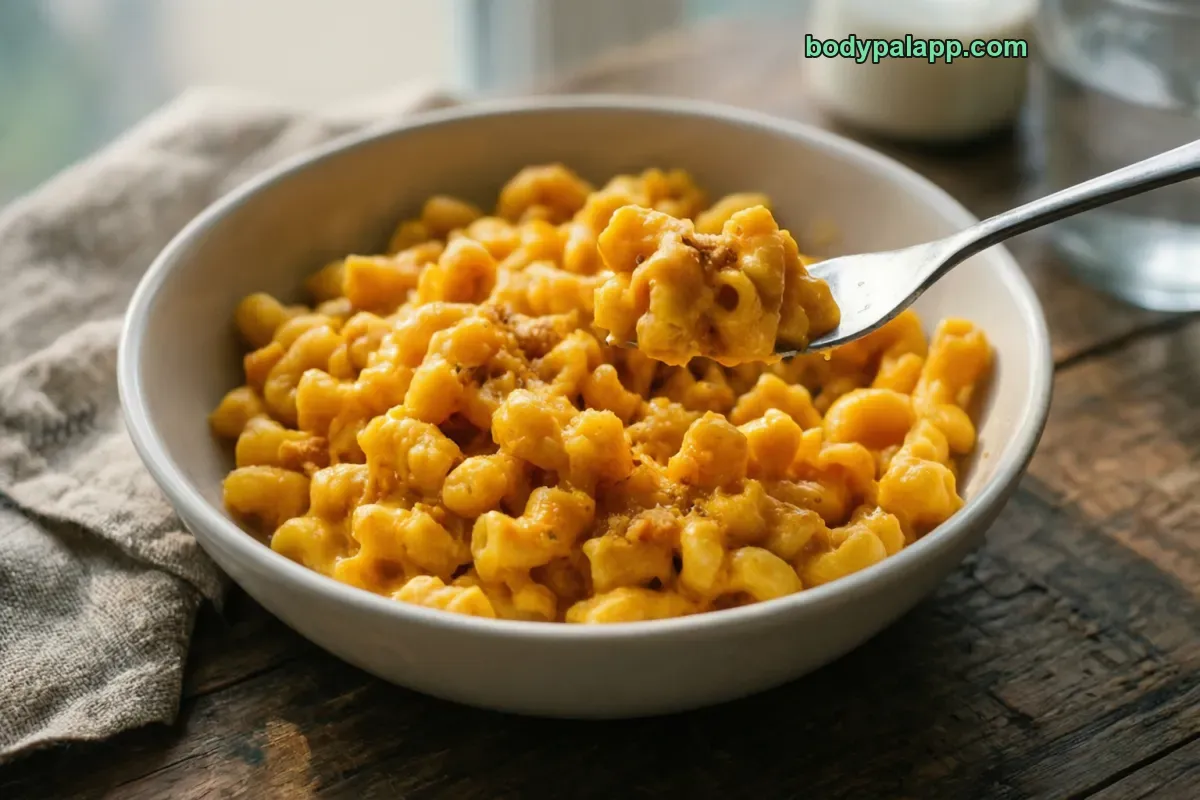
Kraft mac and cheese calories come to 210 for one 55 g package, or 382 per 100 g. Carbs supply 75% of those calories, so this is a pasta dish first. Sodium matters most: one package carries 460 mg, which is 20% of the daily value, and it climbs fast as portions grow.
210kcal
1 package · 55 g, packaged, per label
12%protein
6 gProtein
39 gCarbs
3 gFat
How to burn off 210 kcal
—Walking, brisk
—Jogging
—Cycling, moderate
—Swimming
Skip the math. BodyPal counts these calories from your steps and workouts automatically.
Nutrition facts
Packaged, per label · per 55 g
Calories
210 kcal
Protein
6 g
Carbohydrate
39 g
Fat
3 g
Saturated fat
1.5 g
Cholesterol
5 mg
Sodium
460 mg
Source: USDA FoodData Central
🛡️
Verified nutrition data
Numbers on this page come from USDA FoodData Central, the U.S. Department of Agriculture’s food composition database, and from manufacturer labels where a branded product is named. Last verified September 2026. How we verify our data →
Kraft mac and cheese: calories, protein and sodium by serving
Percent of daily value uses the FDA reference of 2,000 kcal a day.
Serving
kcal
Protein
Carbs
Fat
Sodium
% DV kcal
1 package (55 g)
210
6 g
39 g
3 g
460 mg
11%
100 g
382
10.9 g
70.9 g
5.5 g
836 mg
19%
Dry mix for 1 cup (70 g)
265
9.7 g
49.1 g
3.4 g
476 mg
13%
3 × 1 package (55 g)
630
18 g
1,379 mg
5 × 1 package (55 g)
1,051
30 g
2,299 mg
Two packages make a 420-calorie bowl
One 55 g package of Kraft mac and cheese lists 210 calories, 6 g of protein and 460 mg of sodium. That is 11% of the daily calorie value and 20% of the sodium value. On paper that makes a modest side. The catch is that a single package rarely matches the bowl people actually serve themselves.
Double it and you reach 420 calories, 12 g of protein and 920 mg of sodium. Three packages, or 165 g, come to 630 calories and 1,379 mg of sodium. Eat the equivalent of five packages, 275 g, and the total climbs to 1,051 calories with 2,299 mg of sodium. That is almost a full day's sodium value in one sitting.
The USDA also lists dry mix for one cup at 70 g, which comes to 265 calories, 9.7 g of protein and 476 mg of sodium. If you cook by the cup rather than by the package, log that row instead. Weighing the dry pasta and powder before cooking is the simplest way to keep the count honest.
Carbs supply three quarters of the calories
The calorie split is 75% carbs, 12% protein and 13% fat. Per 100 g that means 70.9 g of carbohydrate against 10.9 g of protein and 5.5 g of fat. In boxed form, the pasta does most of the work and the cheese plays a supporting role.
Sugars reach 10.9 g per 100 g, or 6 g per package. Fiber is thin at 1.8 g per 100 g and 1 g per package. That leaves the bowl with little bulk for its calories, which is worth knowing if you count on a meal to hold you until the next one.
Fat is the smallest share. Saturated fat sits at 2.7 g per 100 g and cholesterol at 9 mg, both low numbers for a dish with cheese in the name. Protein at 12% of calories is respectable for pasta. On its own, though, the package still falls short of a full meal.
Sodium is the row to watch
At 836 mg per 100 g, sodium is the standout number on this label. That equals 36% of the daily value in 100 g. A single 55 g package already carries 460 mg, or 20%. For a 210-calorie side, that is a big share of the day.
Sodium scales with the portion, and it adds up faster than the calories seem to. Two packages bring 920 mg and three bring 1,379 mg. Five packages reach 2,299 mg. If you watch sodium, the amount you scoop matters more than anything you stir in afterward.
The practical fix is to let the rest of the plate stay plain. Unsalted vegetables, fresh fruit or a simply cooked protein add volume without stacking more salt on top of that 460 mg. Skip salty extras like bacon bits or extra cheese if the package is the main event.
Treat the package as a base, not a meal
One package gives 210 calories and 6 g of protein, which makes it more of a starting point than a complete dinner. Adding a lean protein raises the protein share without changing the carb-heavy core much. A side of vegetables brings some of the fiber the box lacks at 1 g per package.
If you want a bigger bowl, bulk it up with vegetables rather than reaching for a second package. The second package adds another 210 calories and 460 mg of sodium. A heap of steamed greens or roasted peppers adds far less of both and makes the bowl look generous.
Tracking it is quick. Weigh the dry mix, choose the package or the dry mix row, and log it. BodyPal can also log the food from a photo if you would rather snap the bowl than weigh it.
How does Kraft mac and cheese compare?
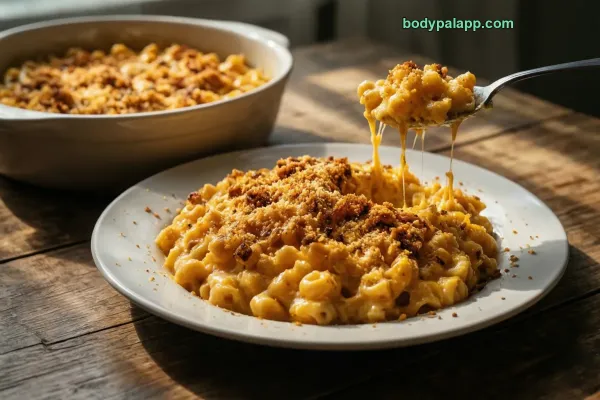
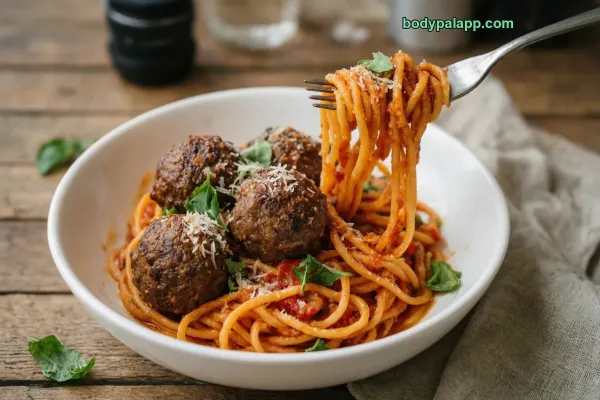
Here is how Kraft mac and cheese stacks up against homemade mac and cheese, meatballs and pasta, and a cheese calzone, per 100 g and per usual serving.
Verdict: For the smallest calorie hit, a 210-calorie package of Kraft beats a 513-calorie cup of homemade mac and cheese, though homemade carries far less sodium at 358 mg per 100 g. For a fuller plate at fewer calories per bite, meatballs and pasta at 170 calories and 7.8 g of protein per 100 g is the better pick, and the 1,649-calorie cheese calzone is the one to split.
Kraft mac and cheese FAQs
How many calories are in Kraft mac and cheese?
One 55 g package of the dry mix has 210 calories, and 100 g has 382.
Is Kraft mac and cheese good for weight loss?
A 55 g package of the dry mix has 210 calories, 39.0 g carbs and 3.0 g fat, before any milk or butter is added.
Kraft mac and cheese vs cheese calzone: which has more calories?
Per 100 g, the Kraft dry mix has 382 calories and a cheese calzone has 389.
How much protein is in Kraft mac and cheese?
A 55 g package has 6.0 g protein, 39.0 g carbs and 6.0 g sugars.
How much sodium is in Kraft mac and cheese?
One 55 g package has 460 mg of sodium, which is 20% of the daily value. Per 100 g it reaches 836 mg, or 36%, so sodium rises quickly when you serve more than one package.
How many carbs are in Kraft mac and cheese?
One package has 39 g of carbs, and 100 g has 70.9 g. Carbs supply 75% of the calories, far more than protein at 12% or fat at 13%.
How much sugar is in Kraft mac and cheese?
A 55 g package lists 6 g of sugars, and 100 g lists 10.9 g. Fiber is low next to that, at 1 g per package and 1.8 g per 100 g.
How many calories are in the dry mix for one cup of Kraft mac and cheese?
The dry mix for one cup, 70 g, has 265 calories. It also brings 9.7 g of protein and 476 mg of sodium, which is 13% of the daily calorie value and 21% of the sodium value.
How many calories are in two packages of Kraft mac and cheese?
Two packages, 110 g in total, come to 420 calories. They also add up to 12 g of protein and 920 mg of sodium, close to double what a single package gives you.