
How many calories are in a mandarin?
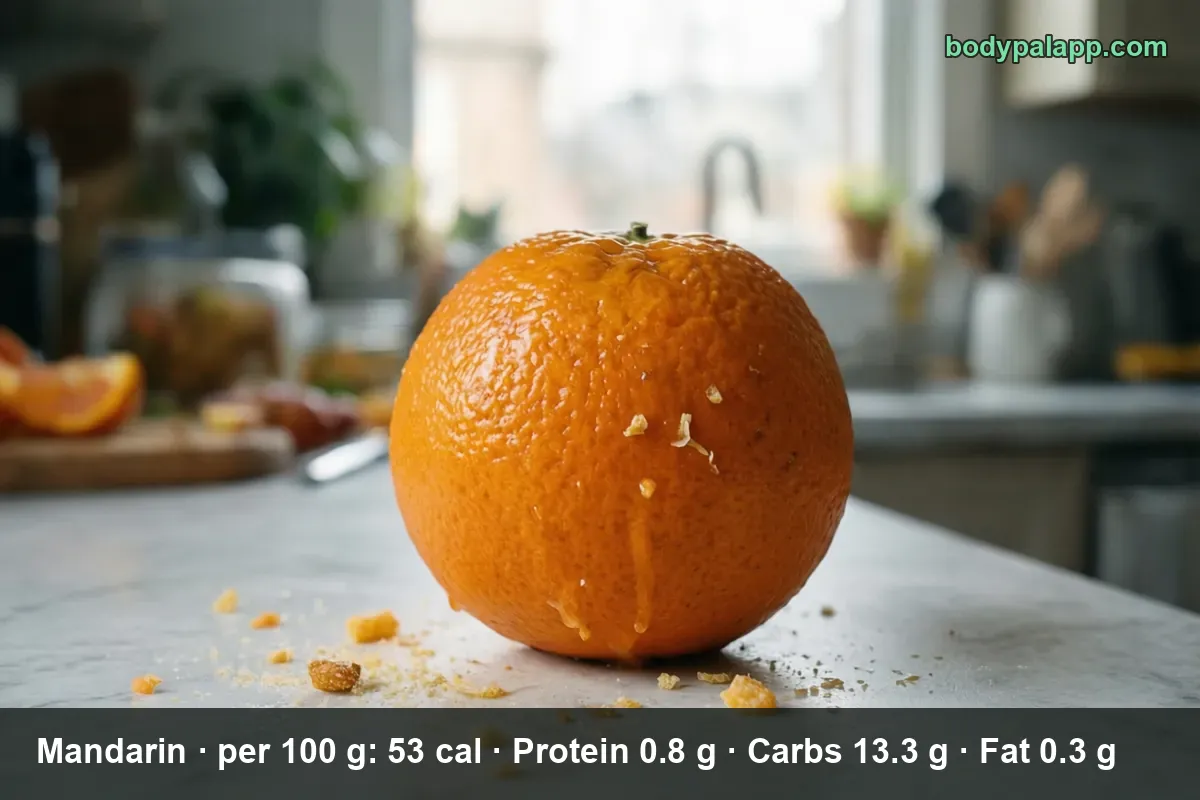
One medium mandarin, 2-1/2 inches across and 88 g on the scale, is 47 calories. Per 100 g the peeled fruit runs 53 calories, which puts it among the lighter things you can eat by the handful. A full cup of sections, 195 g, comes to 103. The peel is not counted.
On this page
- Mandarin quick facts
- US servings from one ounce to a full cup
- Canned mandarins in juice and in light syrup
- Why the Foundation record reads 62 instead of 53
- Fiber beats protein on this label
- How does a mandarin compare?
- Most popular mandarin brands
- Mandarin FAQs
Mandarin quick facts
The record behind every number here is SR Legacy 169105, "Tangerines, (mandarin oranges), raw". It is the one raw entry that carries a full panel — sugars, saturated fat, sodium — together with the household sizes Americans actually use: small, medium, large, and a cup of sections. That matches what a person is holding when they ask the question: a peeled fresh fruit, segments in hand.
The column on the right is the medium fruit, 88 g of edible segments once the peel and any seeds are gone.
| Nutrient | Per 100 g | Per 1 medium (88 g) | % Daily Value |
|---|---|---|---|
| Calories | 53 | 47 | — |
| Total fat | 0.31 g | 0.3 g | 0% |
| Saturated fat | 0.04 g | 0.0 g | 0% |
| Carbohydrate | 13.34 g | 11.7 g | 4% |
| Dietary fiber | 1.8 g | 1.6 g | 6% |
| Total sugars | 10.58 g | 9.3 g | — |
| Protein | 0.81 g | 0.7 g | 1% |
| Sodium | 2 mg | 2 mg | 0% |
% Daily Value is based on a 2,000-calorie diet.
Verified nutrition data
Numbers on this page come from USDA FoodData Central, the U.S. Department of Agriculture’s food composition database, and from manufacturer labels where a branded product is named. Last verified September 2026. How we verify our data →
There is no added sugars row because the SR Legacy edition does not publish added sugars at all, and a fresh peeled fruit has none to publish. Total sugars have no Daily Value on the Nutrition Facts label, which is why that cell stays empty. Two more rows worth knowing: cholesterol is 0 mg, and potassium is 166 mg per 100 g, or 146 mg in the medium fruit — 3% of the 4,700 mg Daily Value.
US servings from one ounce to a full cup
| Serving | Weight | Calories |
|---|---|---|
| 1 oz | 28.4 g | 15 kcal |
| 1 small, 2-1/4 inch | 76 g | 40 kcal |
| 1 medium, 2-1/2 inch | 88 g | 47 kcal |
| 1 large, 2-3/4 inch | 120 g | 64 kcal |
| 1 cup of sections | 195 g | 103 kcal |
| Per 100 g | 100 g | 53 kcal |
Four of those are USDA household measures straight off the record: small, medium, large, and the cup. The 1 oz line is our own arithmetic from the USDA 100 g figure, not a USDA serving, and it is there because that is how a food scale reads in most American kitchens.
The spread between sizes is bigger than people expect. A large mandarin is 64 calories against 40 for a small one — a 24-calorie gap on a fruit nobody bothers to weigh. Eat three larges over a workday and you are at 192 calories, close to five smalls. Diameter is doing all the work here, since the flesh is the same flesh in every one of them.
A cup of sections is the sleeper. At 195 g it is a little over two medium fruits, and 103 calories, but it also carries roughly 26 g of carbohydrate and about 3.5 g of fiber, both scaled by us from the 100 g figures. That fiber is 13% of the daily value in a snack most people log as "some mandarin."
Canned mandarins in juice and in light syrup
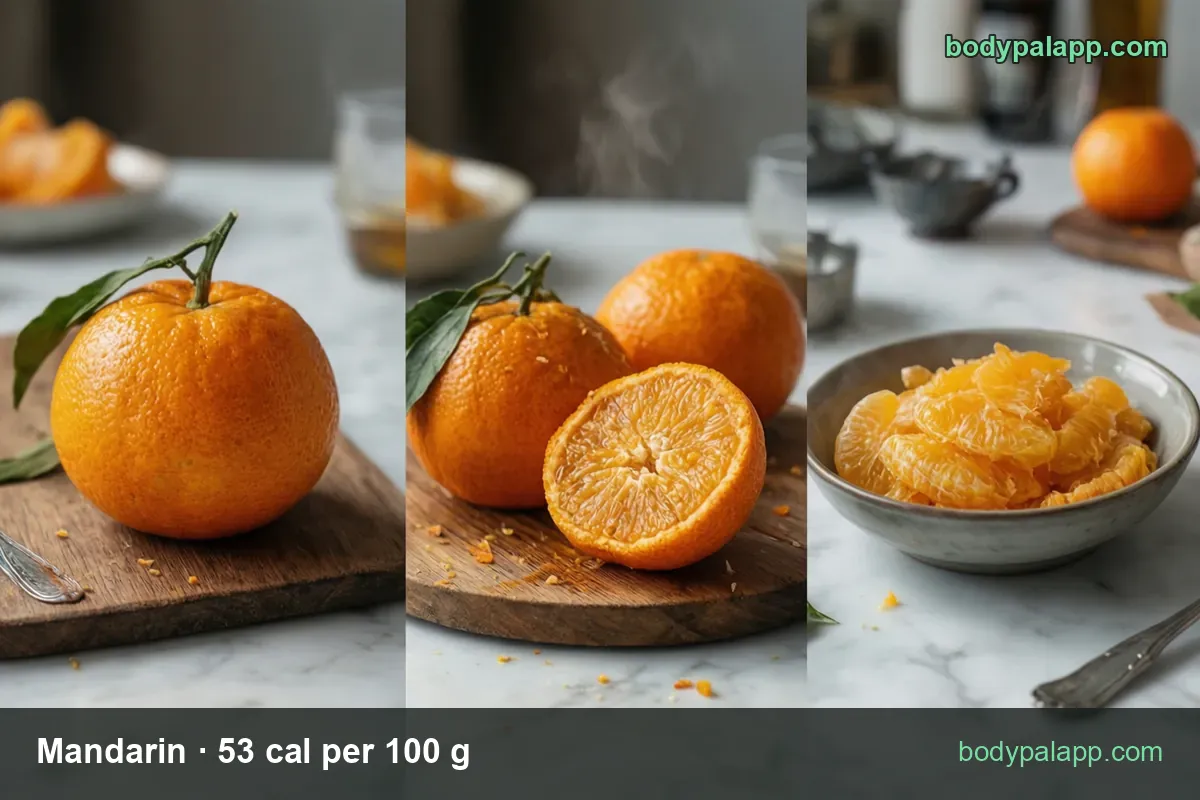
The can is where the calories move, and they move in both directions.
| Version | Per 100 g | Typical serving | Calories |
|---|---|---|---|
| Fresh sections, raw | 53 kcal | 1 cup (195 g) | 103 kcal |
| Canned in juice, undrained | 37 kcal | 1 cup (249 g) | 92 kcal |
| Canned in juice, drained | 38 kcal | 1 cup (189 g) | 72 kcal |
| Canned in light syrup | 61 kcal | 1 cup (252 g) | 154 kcal |
Juice pack comes in under fresh — 37 calories per 100 g against 53 — because a good share of what is in the cup is thin fruit juice rather than fruit. Light syrup goes the other way at 61, and its cup is 154 calories, half again as much as a cup of fresh sections. If you are watching sugar, the syrup pack is the one to skip: 15.49 g of sugars per 100 g against 10.58 g in the raw fruit.
Draining is the part that gets logged wrong. Per 100 g it barely matters, 37 undrained against 38 drained, so a scale user sees almost nothing. Measure by the cup and the picture flips: the cup goes from 249 g to 189 g, and from 92 calories to 72. The liquid you pour off is the calories, but only the volume measure can see it.
Fiber follows the same path down. The raw fruit gives 1.8 g per 100 g, drained juice pack 1.2 g, and light syrup 0.7 g — the last is well under half of fresh.
Store cans read differently again. USDA's Branded records put Dole mandarin oranges between 40 and 71 calories per 100 g depending on the pack, with a label serving of 1 cup at 113 g, or 45 to 80 calories. That 113 g cup is a drained weight and is not comparable to USDA's 249 g cup of fruit plus juice, so read the grams on the can before you copy the number.
Why the Foundation record reads 62 instead of 53
USDA also publishes a newer Foundation entry for seedless peeled mandarin at 62 calories per 100 g. That is 17% above the SR Legacy figure for what looks like the same fruit, and the gap is a method difference, not a disagreement about mandarins.
The Foundation calorie value is calculated from measured macronutrients using Atwater factors, while the older record carries an energy figure from the source analysis. The Foundation entry also has no sugars and no saturated fat, and it lists no household portions — one ounce works out to 18 calories, our own arithmetic from its 100 g value. For a page about how much is on your plate, the record with the sugar row and the medium-fruit weight is the more useful one, so it leads here. Never average the two; pick one and stay with it.
Fiber beats protein on this label
A medium mandarin gives 1.6 g of fiber, 6% of the 28 g Daily Value, and 0.7 g of protein, 1% of the 50 g value. The fiber percentage is four times the protein percentage, on a fruit that costs 47 calories. That is the honest way to place a mandarin: a fiber and water snack, not a protein one.
Sodium is functionally absent at 2 mg, or 0% of the 2,300 mg daily limit, which is worth knowing if you are keeping an eye on salt and want something to eat that adds none. Fat is the same story at 0.3 g. Nearly all the calories are carbohydrate, and most of that carbohydrate is the sugar the fruit grew with.
Two mandarins and a cup of sections both count toward the fruit group tracked by MyPlate. For a mid-afternoon gap, one medium fruit at 47 calories is the cheapest way to close it that still leaves you chewing something.
How does a mandarin compare?
The clean comparison across raw fruit is a flat ounce, since a cup of strawberries and a cup of pineapple are not the same object at all.
| Fruit | Per 100 g | US serving | Calories |
|---|---|---|---|
| Mandarin, raw | 53 kcal | 1 oz (28.4 g) | 15 kcal |
| Pineapple, raw | 60.1 kcal | 1 oz (28.4 g) | 17 kcal |
| Nectarine, raw | 39 kcal | 1 oz (28.4 g) | 11 kcal |
| Strawberries, raw | 31 kcal | 1 oz (28.4 g) | 9 kcal |
Every ounce figure above is our own arithmetic from the USDA 100 g values, not a USDA serving.
Our take: of these four, only nectarines and strawberries are lighter per 100 g, and strawberries win outright at 31 calories. But the mandarin has something they do not — it arrives in a fixed 88 g package with its own wrapper, so the portion decides itself at 47 calories and no scale is needed. For weight loss, strawberries stretch further per calorie. For a snack you can carry, eat clean-handed and log without thinking, the mandarin is the better pick. Pineapple at 60.1 is the one to watch here, because it usually gets eaten by the cup.
Most popular mandarin brands in the United States
Ranked by how widely each product appears among foods sold in the United States, from the BodyPal food database of over 3.3 million products. Calories are the figures printed on each Nutrition Facts label, checked against USDA FoodData Central.
| Product | Calories (per 100 g) |
|---|---|
| Dole Mandarin Oranges | 40 cal |
| Dole Mandarin Oranges in Fruit Juice | 62 cal |
| Dole Mandarin Oranges in Fruit Juice (15 oz jar) | 71 cal |
Brand popularity: BodyPal food database. Nutrition: manufacturer labels / USDA FoodData Central.
Mandarin FAQs
How many calories are in one mandarin?
47 calories for a medium mandarin, 2-1/2 inches across and 88 g of segments. A small one, 76 g, is 40 calories, and a large 120 g fruit is 64. The USDA record works out to 53 calories per 100 g of peeled fruit, so size is the whole story.
How many calories are in a cup of mandarin sections?
103 calories for one cup of fresh sections, which USDA weighs at 195 g. That is a little over two medium fruits. The same cup carries about 26 g of carbohydrate and 3.5 g of fiber by our own arithmetic from the 100 g figures, or 13% of the daily fiber value.
Are canned mandarin oranges higher in calories than fresh?
Only the syrup pack is. Canned in light syrup runs 61 calories per 100 g against 53 for fresh, and a 252 g cup is 154 calories. Canned in juice is lighter than fresh at 37 per 100 g, and 38 once drained, because part of the can is juice rather than fruit.
How much sugar is in a mandarin?
A medium mandarin has 9.3 g of total sugars, scaled from 10.58 g per 100 g. All of it is the sugar the fruit grew with, so the record shows no added sugars. Total sugars carry no Daily Value on the label, which is why that cell stays blank in the table above.
How many carbs are in a mandarin?
11.7 g of carbohydrate in a medium mandarin, or 4% of the Daily Value. Per 100 g the figure is 13.34 g. Fiber accounts for 1.6 g of that and sugars for 9.3 g. A cup of sections roughly doubles the total to about 26 g by our own arithmetic.
How much fiber does a mandarin have?
1.6 g of fiber in one medium mandarin, which is 6% of the 28 g Daily Value. Per 100 g the fresh fruit gives 1.8 g. Canned in juice and drained drops to 1.2 g per 100 g, and the light syrup pack falls to 0.7 g, less than half of fresh.
Do mandarins have potassium?
146 mg of potassium in a medium mandarin, 3% of the 4,700 mg Daily Value, scaled from 166 mg per 100 g. That is a modest amount for a fruit this size. Sodium is the mirror image at 2 mg, which is 0% of the 2,300 mg daily limit.
Is a mandarin the same as a tangerine in USDA data?
Yes. The record used on this page is titled Tangerines, (mandarin oranges), raw, FDC ID 169105, and it covers both names. Stores split the group into clementines, satsumas and tangerines, but USDA keeps one raw entry for all of them at 53 calories per 100 g.
Similar foods
- Cutie Mandarin (Clementine) — 47 cal per Cutie
- Cutie Mandarin Orange — 40 cal per cutie
- Sumo Orange — 103 cal per cup sections
- Tangerine — 47 cal per medium
- Apple — 95 cal per medium apple
- Mixed Berries — 78 cal per cup
Count it without the math
Point the camera at the bowl and BodyPal counts the segments for you, fresh or out of the can.


How long does it take to burn off a mandarin?
One medium mandarin (88 g) is 47 kcal. Enter your weight and the amount you ate to see how long it takes you to burn that off:
lb
| Activity | Time to burn 47 kcal |
|---|---|
| Walking, brisk | 9 min |
| Cycling, moderate | 6 min |
| Swimming, moderate | 7 min |
| Jogging | 6 min |
| Weight training, moderate | 10 min |
Times are for a 155 lb adult at a steady pace; change the weight to see yours. The amount is set to the portion in the text (88 g); change it to what you actually ate. BodyPal works this out from your steps automatically.
Burning it off is one side of it. The other is knowing your number: work out how many calories you need a day, with macros and a goal date.