
How many calories are in a tangerine?
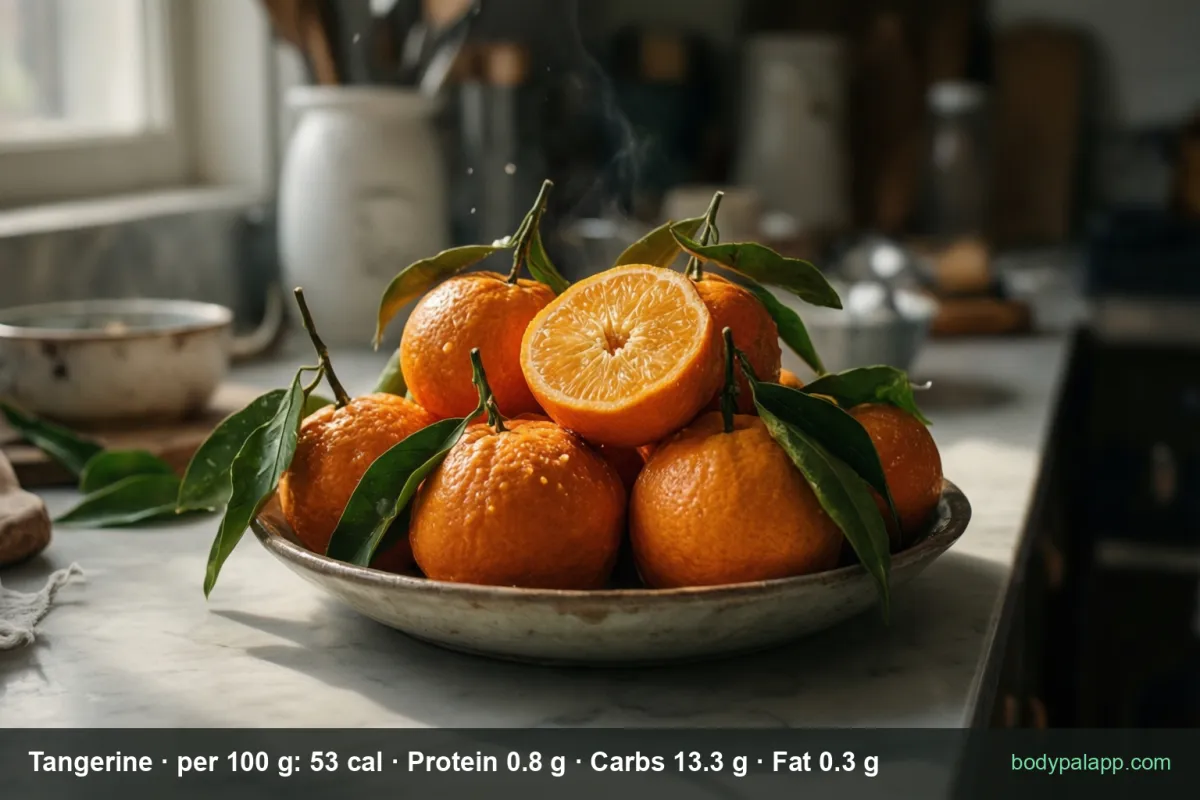
One medium tangerine weighs 88 g and carries 47 calories. Per 100 g the peeled fruit runs 53 calories, with 10.58 g of sugar and 1.8 g of fiber. Pull apart a full cup of sections and you are at 103 instead. The size you pick up decides this, not the variety.
On this page
- Tangerine quick facts
- US servings, from one ounce to a cup of sections
- Juice, canned and syrup: what happens after the peel comes off
- Fiber, potassium and the rows that surprise people
- How does a tangerine compare?
- Most popular tangerine brands
- FAQ
Tangerine quick facts
The row behind every number on this page is SR Legacy 169105, "Tangerines, (mandarin oranges), raw". That is the full analytical record for the fresh fruit you peel by hand, and it is the right one for the search that brought you here: a whole tangerine in your palm, not a can and not a carton. The FNDDS entry 2709175 republishes the same values, so there is nothing to average and nothing to reconcile.
The title of the record is worth reading twice. USDA files tangerines and mandarin oranges together, which settles a question people ask constantly. The small easy-peel fruit sold in mesh bags under names like Cuties or Halos is a mandarin, and this record covers it.
| Nutrient | Per 100 g | Per 1 medium (88 g) | % Daily Value |
|---|---|---|---|
| Calories | 53 | 47 | — |
| Total fat | 0.31 g | 0.3 g | 0% |
| Saturated fat | 0.04 g | 0.0 g | 0% |
| Carbohydrate | 13.34 g | 11.7 g | 4% |
| Dietary fiber | 1.8 g | 1.6 g | 6% |
| Total sugars | 10.58 g | 9.3 g | — |
| Protein | 0.81 g | 0.7 g | 1% |
| Sodium | 2 mg | 2 mg | 0% |
% Daily Value is based on a 2,000-calorie diet.
Verified nutrition data
Numbers on this page come from USDA FoodData Central, the U.S. Department of Agriculture’s food composition database, and from manufacturer labels where a branded product is named. Last verified September 2026. How we verify our data →
There is no added sugars row here, and that is not an oversight. USDA does not publish added sugars for this SR Legacy record, and a fruit that arrives inside its own peel has none to declare. Total sugars have no Daily Value on the US label either, which is why that cell stays empty.
Two more rows are worth naming in passing. Cholesterol is 0 mg, as it is for every plant food. Potassium is 166 mg per 100 g, or 146 mg in a medium fruit, which is 3% of the FDA Daily Value of 4,700 mg. Useful, but a tangerine is not the potassium play some people think it is.
US servings, from one ounce to a cup of sections
Tangerines are sold loose and by the bag, so the honest way to count them is by fruit size. USDA measures three, by diameter, and then a fourth measure for anyone who peels into a bowl.
| Serving | Weight | Calories |
|---|---|---|
| 1 oz | 28.4 g | 15 kcal |
| 1 small, 2-1/4 inch | 76 g | 40 kcal |
| 1 medium, 2-1/2 inch | 88 g | 47 kcal |
| 1 large, 2-3/4 inch | 120 g | 64 kcal |
| 1 cup, sections | 195 g | 103 kcal |
| Per 100 g | 100 g | 53 kcal |
The small, medium, large and cup lines are USDA household measures attached to record 169105. The 1 oz line is our own arithmetic from the USDA 100 g figure, not a USDA serving, and it is there mostly for people logging by a kitchen scale.
Here is the trap. "One tangerine" and "one cup" both get called a serving in casual speech, and they are not close: 47 calories against 103, more than double. A cup of sections is roughly two medium fruits plus a bit, peeled and pulled apart, so it should cost about what two fruits cost. It does. The confusion comes from the word, not the math. If you log a cup when you ate one fruit, you have doubled your entry.
The gap between small and large matters less than people fear. Forty calories at the low end, 64 at the high end — a 24 calorie spread across the whole bin at the store. Grabbing the biggest one in the bag is not a decision worth thinking about.
Juice, canned and syrup: what happens after the peel comes off
Everything that gets done to a tangerine before it reaches you moves the number in a different direction. Juicing lowers it per gram and raises it per serving. Canning in juice lowers it. Canning in light syrup raises it past the fresh fruit.
| Version | USDA record | Per 100 g | Typical serving | Calories |
|---|---|---|---|---|
| Tangerine, raw (medium fruit) | 169105 | 53 kcal | 1 medium (88 g) | 47 kcal |
| Tangerine, raw (FNDDS fruit) | 2709175 | 53 kcal | 1 fruit (109 g) | 58 kcal |
| Tangerine juice, raw | 169925 | 43 kcal | 1 cup (247 g) | 106 kcal |
| Canned mandarin oranges, juice pack | 169106 | 37 kcal | 1 cup (249 g) | 92 kcal |
| Canned mandarin oranges, juice pack, drained | 168184 | 38 kcal | 1 cup (189 g) | 72 kcal |
| Canned mandarin oranges, light syrup pack | 169924 | 61 kcal | 1 cup (252 g) | 154 kcal |
The two raw rows are the same fruit measured by two USDA programs; FNDDS just assumes a bigger average fruit, 109 g against 88 g, which is why 58 sits next to 47. Neither is wrong. Pick the one that matches what is in your hand.
Juice is the sharpest lesson. Per 100 g it is lighter than the fruit, 43 against 53, because the juice carries the water and leaves the pulp behind. But nobody drinks 100 g of juice. A cup is 247 g and 106 calories, more than two medium tangerines, and the fiber collapses from 1.8 g per 100 g in the fruit to 0.2 g in the juice — about 0.5 g in that whole cup by our own scaling of the USDA figure. You get the sugar and lose the part that slows it down. Store-bought 100% tangerine juices in USDA's branded data sit right alongside the raw juice record, between 42 and 46 calories per 100 g, so an 8 fl oz carton lands near 100 to 110 calories depending on the brand — our arithmetic from those label figures, not a USDA serving.
Canned mandarin segments split cleanly by what they are packed in. Juice pack, drained, is the lightest cup on this page at 72 calories for 189 g, because draining removes both liquid and weight. Light syrup is the other end at 154 calories for a 252 g cup, and the extra is sugar. Scaling the USDA rows ourselves, that syrup cup carries about 39 g of total sugars against roughly 16 g in the drained juice-pack cup. Same fruit, same can size on the shelf, more than double the sugar. Note that USDA does not publish added sugars for either canned record, so the label on your can is the only place to see how much of that syrup sugar was added.
Fiber, potassium and the rows that surprise people
Fiber is the row that earns the tangerine its place. A medium fruit gives 1.6 g, which is 6% of the 28 g Daily Value, at a cost of 47 calories. That ratio is the reason a whole tangerine keeps you interested longer than an equal number of calories in juice, and it is the practical argument for peeling rather than pouring.
Carbohydrate lands at 11.7 g per medium fruit, 4% of the Daily Value. Take the fiber out and about 10.1 g are digestible carbs — our own subtraction from the USDA row, not a USDA number. Sugar is 9.3 g of that, all of it the fruit's own.
Protein is 0.7 g and fat is 0.3 g, both close enough to nothing that they round to 1% and 0% of their Daily Values. Sodium is 2 mg, which is 0% of the 2,300 mg Daily Value and less than a rounding error next to a shake of the salt shaker. If you are watching sodium, fresh tangerines are as neutral as food gets; the canned versions climb only to 5 or 6 mg per 100 g, which changes nothing.
MyPlate counts fruit in cup-equivalents, and the 195 g pile of sections in the servings table above is exactly what that means in a bowl. Logging it as "one tangerine" is the single most common way people undercount fruit.
How does a tangerine compare?
| Food | Per 100 g | US serving | Calories |
|---|---|---|---|
| Tangerine, raw | 53 kcal | 1 medium (88 g) | 47 kcal |
| Raspberries, raw | 52 kcal | 1 cup (123 g) | 64 kcal |
| Groundcherries, raw | 53 kcal | 1 cup (140 g) | 74 kcal |
| Pineapple juice, unsweetened | 53 kcal | 1 cup (250 g) | 133 kcal |
Our take: per 100 g these four are effectively tied, with only raspberries a single calorie lighter. The serving column is where they separate, and the tangerine wins it outright at 47 calories because a single fruit is a smaller unit than anyone's cup. That is the whole argument for tangerines as a snack: the portion comes pre-sized in a peel, and you have to make a decision to eat a second one. Pineapple juice at the same density per 100 g costs 133 calories a glass for the same reason in reverse — liquid has no natural stopping point. For weight control, take the fruit. For a bigger volume of food at the lowest cost per gram, drained canned segments at 72 calories a cup beat everything here.
Most popular tangerine brands in the United States
Ranked by how widely each product appears among foods sold in the United States, from the BodyPal food database of over 3.3 million products. Calories are the figures printed on each Nutrition Facts label, checked against USDA FoodData Central.
| Product | Calories (per 100 g) |
|---|---|
| Cuties 100% Pure Squeezed Tangerine Juice | 46 cal |
| Columbia Gorge Organic Tangerine Pure Squeezed Juice | 42 cal |
| Nature's Promise Tangerine Juice | 46 cal |
Brand popularity: BodyPal food database. Nutrition: manufacturer labels / USDA FoodData Central.
Tangerine FAQs
How many calories are in one tangerine?
A medium tangerine, 2-1/2 inches across and 88 g, has 47 calories. A small one at 76 g comes to 40, and a large 120 g fruit reaches 64. The raw fruit runs 53 calories per 100 g, so the size of what you peel is the whole story.
How many calories in a cup of tangerine sections?
One cup of sections weighs 195 g and carries 103 calories, more than double a medium fruit. That cup is roughly two and a bit medium tangerines peeled and pulled apart, which is why the number jumps. It also brings 3.5 g of fiber, our own scaling of the USDA 100 g figure.
Are tangerines and mandarins the same thing?
USDA files them as one record: 169105 is titled Tangerines, (mandarin oranges), raw, at 53 calories per 100 g. Tangerine is the everyday American name for a group of mandarins, and the small easy-peel fruit sold in mesh bags falls under the same numbers.
How much sugar is in a tangerine?
A medium tangerine holds 9.3 g of total sugars, from 10.58 g per 100 g. All of it is the fruit's own sugar; USDA does not publish added sugars for this SR Legacy record, and fresh fruit has none. Total sugars carry no Daily Value on the label.
How many carbs are in a tangerine?
11.7 g in a medium 88 g fruit, which is 4% of the Daily Value, and 13.34 g per 100 g. Subtract the 1.6 g of fiber and about 10.1 g are digestible carbs, our own arithmetic from the USDA row. A cup of sections is 26 g.
Do tangerines have fiber?
Yes: 1.6 g in a medium fruit, 6% of the 28 g Daily Value, from 1.8 g per 100 g. Two tangerines put you at 3.2 g, our own doubling of that figure. Tangerine juice is where it disappears, dropping to 0.2 g per 100 g.
Are canned mandarin oranges as healthy as fresh tangerines?
Drained juice-pack segments run 38 calories per 100 g against 53 for fresh, and a 189 g cup is 72 calories with 1.2 g of fiber per 100 g. Light syrup is the one to watch: 61 calories per 100 g and 154 in a 252 g cup.
How many calories in tangerine juice?
Raw tangerine juice is 43 calories per 100 g, so a 247 g cup is 106 calories, more than two medium tangerines. The fiber falls to 0.5 g in that cup. Store-bought 100% tangerine juices sit close, at 42 to 46 calories per 100 g in USDA's branded data.
Similar foods
- Cutie Mandarin (Clementine) — 47 cal per Cutie
- Mandarin — 47 cal per medium
- Cutie Mandarin Orange — 40 cal per cutie
- Sumo Orange — 103 cal per cup sections
- Apple — 95 cal per medium apple
- Mixed Berries — 78 cal per cup
Count it without the math
Point the camera at the bowl and BodyPal counts the tangerine for you, peel off and sections apart.


How long does it take to burn off a tangerine?
One medium tangerine (88 g) is 47 kcal. Enter your weight and the amount you ate to see how long it takes you to burn that off:
lb
| Activity | Time to burn 47 kcal |
|---|---|
| Walking, brisk | 9 min |
| Cycling, moderate | 6 min |
| Swimming, moderate | 7 min |
| Jogging | 6 min |
| Weight training, moderate | 10 min |
Times are for a 155 lb adult at a steady pace; change the weight to see yours. The amount is set to the portion in the text (88 g); change it to what you actually ate. BodyPal works this out from your steps automatically.
One food is easy to picture; a whole day is harder. See how many calories you need a day and what a deficit actually looks like.