
How many calories are in a Sumo orange?
A peeled Sumo orange breaks down into about one cup of sections, 195 g, and that cup carries 103 calories. Per 100 g the fruit runs 53 calories, light even by citrus standards. The sugar is real, 20.6 g a cup, but it arrives wrapped in 3.5 g of fiber.
On this page
- Sumo orange quick facts
- US servings, from one ounce to a cup of sections
- Canned mandarin oranges, in juice and in syrup
- Fiber is the only double-digit percentage on the label
- How does a Sumo orange compare?
- Most popular sumo orange brands
- Sumo orange FAQs
Sumo orange quick facts
Sumo Citrus is the trademarked American name for Shiranui, a Japanese hybrid of a mandarin and an orange. That parentage matters when you go looking for a number, because there is no USDA record called Sumo, Sumo Citrus or Shiranui. The closest and most honest match is SR Legacy 169105, "Tangerines, (mandarin oranges), raw", and that is the record every figure on this page comes from.
The serving is the second decision. A Sumo is a big piece of fruit, noticeably heavier than a supermarket clementine, and USDA's "1 large (2-3/4 inch diameter)" tangerine at 120 g is smaller than what you actually peel. One cup of sections, 195 g, is much closer to a whole Sumo once the thick, loose skin is off, so that is the column below.
| Nutrient | Per 100 g | Per 1 cup sections (195 g) | % Daily Value |
|---|---|---|---|
| Calories | 53 | 103 | — |
| Total fat | 0.31 g | 0.6 g | 1% |
| Saturated fat | 0.04 g | 0.1 g | 0% |
| Carbohydrate | 13.34 g | 26.0 g | 9% |
| Dietary fiber | 1.8 g | 3.5 g | 13% |
| Total sugars | 10.58 g | 20.6 g | — |
| Protein | 0.81 g | 1.6 g | 3% |
| Sodium | 2 mg | 4 mg | 0% |
% Daily Value is based on a 2,000-calorie diet.
Verified nutrition data
Numbers on this page come from USDA FoodData Central, the U.S. Department of Agriculture’s food composition database, and from manufacturer labels where a branded product is named. Last verified September 2026. How we verify our data →
Two rows you will not find here. There is no added sugars line, because the SR Legacy edition of this record does not carry that nutrient at all; on a raw, unprocessed fruit the answer is zero by definition anyway, and every gram of the 20.6 g is the fruit's own. Cholesterol is 0 mg, as it is in any plant food. Potassium is worth its own mention: 166 mg per 100 g works out to 324 mg a cup, or 7% of the Daily Value, a useful share from a 103-calorie cup.
US servings, from one ounce to a cup of sections
| Serving | Weight | Calories |
|---|---|---|
| 1 oz | 28 g | 15 kcal |
| One medium tangerine, 2-1/2 in | 88 g | 47 kcal |
| One large tangerine, 2-3/4 in | 120 g | 64 kcal |
| One NLEA label serving | 109 g | 58 kcal |
| One cup, sections | 195 g | 103 kcal |
| Per 100 g | 100 g | 53 kcal |
Four of those weights, the medium, the large, the NLEA serving and the cup, are USDA household measures attached to record 169105. The 1 oz line is our own arithmetic from the USDA 100 g figure, not a USDA serving, and it is the one to reach for when you weigh a plate rather than count fruit.
Here is the trap that catches people logging Sumos. A cup of sections at 103 calories is more than one and a half times the "1 large" tangerine at 64, because a Sumo is not a large tangerine, it is bigger. If you log a Sumo as a large mandarin you are about 39 calories light every time. Peeled weight is the honest way through: put the sections on a scale, or log the cup and move on.
The peel itself is part of the story. Sumos have thick, puffy skin that comes away in one piece, and the discarded rind is a real fraction of what you carry home from the store. Weigh the whole fruit and you will be logging peel; weigh what goes in your mouth and the number lands.
Canned mandarin oranges, in juice and in syrup
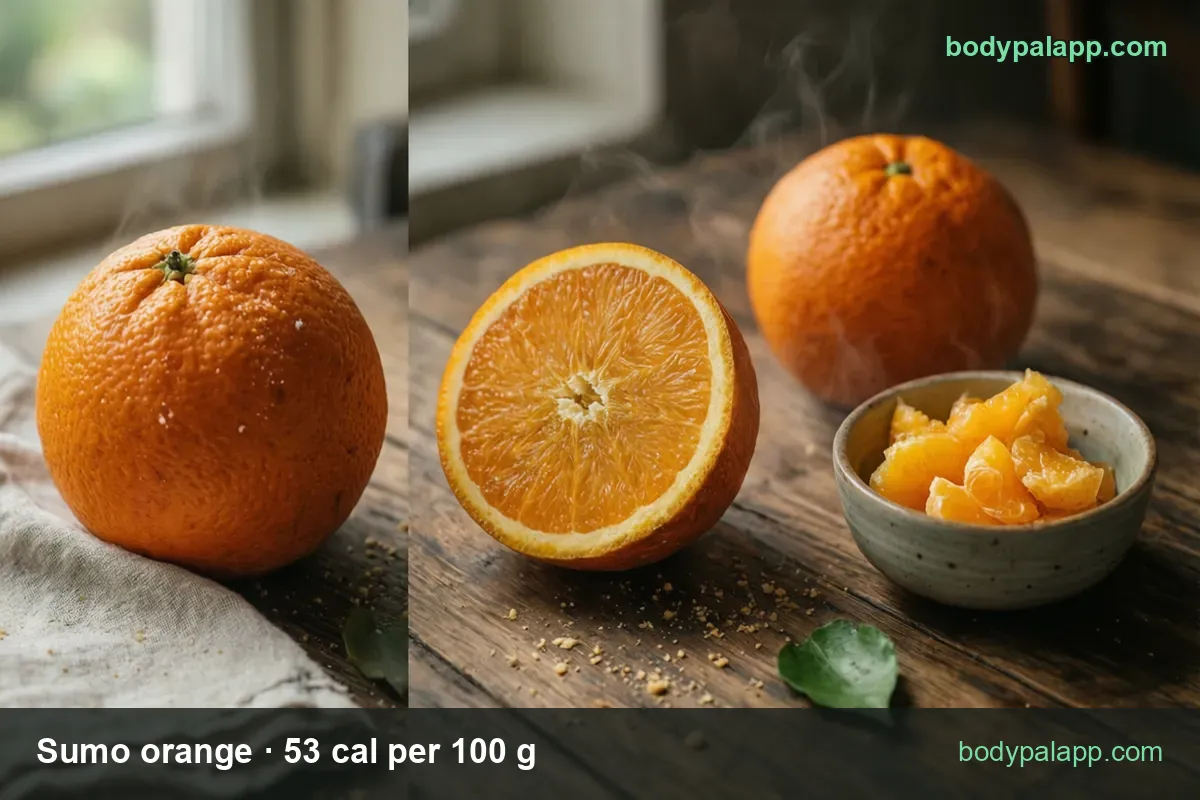
Fresh Sumo Citrus is sold loose, with no nutrition label on it, so the packaged version of this fruit on an American shelf is a can of mandarin segments. Those cans are not the same food once they have been sitting in liquid.
| Version | Per 100 g | Typical serving | Calories |
|---|---|---|---|
| Fresh mandarin sections | 53 kcal | 1 cup (195 g) | 103 kcal |
| Canned in juice, undrained | 37 kcal | 1 cup (249 g) | 92 kcal |
| Canned in juice, drained | 38 kcal | 1 cup (189 g) | 72 kcal |
| Canned in light syrup | 61 kcal | 1 cup (252 g) | 154 kcal |
Canned in juice is the lightest per gram at 37 calories per 100 g, and that is dilution rather than virtue: the packing liquid is part of the weight, and the segments have lost most of their fiber with the membranes, down to 0.7 g per 100 g against 1.8 g in fresh. Drain that same can and you get 38 calories per 100 g and 1.2 g of fiber, slightly denser food because the water went down the sink. A drained cup is 72 calories, the smallest cup on the table.
Light syrup is the version to watch. At 61 calories per 100 g it is the only canned form heavier than the fresh fruit, and its sugar runs 15.49 g per 100 g against 10.58 g fresh. A full cup with the syrup is 154 calories, half again as much as a cup of fresh sections, and the difference is sugar somebody else added.
Store brands sit in a tight band. Dole mandarin oranges come in at 40 calories per 100 g and Roland segments in water at 32, while MW Polar, Green Acres and Great Value all land between 62 and 64 per 100 g, right where the syrup packs are. Read the front of the can: "in water" and "in juice" are the low numbers, "in light syrup" is the high one.
Fiber is the only double-digit percentage on the label
Run down the % Daily Value column and one number stands alone. Fiber is 13% of a day in a single cup. Carbohydrate is 9%, potassium 7%, protein 3%, fat 1%, saturated fat and sodium both 0%. Nothing else on this fruit reaches double digits, which is a fair summary of what citrus does for you: it is fiber and water carrying sugar, and very little else.
Fiber is one of the nutrients Americans are most short on, and the FDA's Daily Value for it is 28 g. Two Sumos would cover a quarter of that on their own. The Dietary Guidelines for Americans put whole fruit ahead of juice for exactly this reason, and a mandarin makes the point neatly: the segments carry 1.8 g of fiber per 100 g, the juice-packed can only 0.7 g.
Sodium is the other line worth a glance, mostly because there is nothing to see. Four milligrams a cup is not a rounding error away from zero, it is essentially zero, 0% of the 2,300 mg Daily Value. If you are tracking sodium, fresh citrus costs you nothing at all. MyPlate counts one cup of fruit sections as one cup toward the fruit group, so a single Sumo is a full serving by the federal measure, not half of one.
How does a Sumo orange compare?
| Form | Per 100 g | US serving | Protein | Carbs | Calories |
|---|---|---|---|---|---|
| Fresh mandarin sections | 53 kcal | 1 cup, 195 g | 0.81 g | 13.34 g | 103 kcal |
| Canned in juice | 37 kcal | 1 cup, 249 g | 0.62 g | 9.57 g | 92 kcal |
| Canned in juice, drained | 38 kcal | 1 cup, 189 g | 0.75 g | 9.41 g | 72 kcal |
| Canned in light syrup | 61 kcal | 1 cup, 252 g | 0.45 g | 16.19 g | 154 kcal |
Protein and carbohydrate figures in that table are per 100 g, so they describe the food itself rather than the cup.
Our take: eat the fresh fruit. A drained can is technically the cheapest cup at 72 calories, but it gets there by throwing away liquid and fiber, and you will be hungry sooner. If you want the lowest-calorie sweet thing on the table, drained mandarins in water or juice do the job; if you want a cup of fruit that actually holds you until lunch, the 103-calorie Sumo with its 3.5 g of fiber is the better trade for eleven extra calories a cup over the undrained can. The one to skip is light syrup, which costs 51 more calories a cup than fresh for less of everything you wanted.
Most popular sumo orange brands in the United States
Ranked by how widely each product appears among foods sold in the United States, from the BodyPal food database of over 3.3 million products. Calories are the figures printed on each Nutrition Facts label, checked against USDA FoodData Central.
| Product | Calories (per 100 g) |
|---|---|
| Dole Mandarin Oranges | 40 cal |
| Roland Fancy Whole Mandarin Oranges | 64 cal |
| Roland Mandarin Orange Segments in Water | 32 cal |
| MW Polar Mandarin Oranges | 64 cal |
| Green Acres Mandarin Oranges | 62 cal |
| Great Value Mandarin Oranges | 62 cal |
Brand popularity: BodyPal food database. Nutrition: manufacturer labels / USDA FoodData Central.
Sumo orange FAQs
How many calories are in a Sumo orange?
103 calories for one cup of peeled sections, 195 g, which is close to a whole Sumo once the thick skin is off. Per 100 g the fruit is 53 calories. A smaller mandarin, the USDA large size at 120 g, comes to 64 calories instead.
How many calories in one Sumo Citrus?
Around 103 calories, since Sumo Citrus is the brand name for the Shiranui variety and USDA has no separate record for it. The figure comes from the raw mandarin orange record at 53 calories per 100 g, scaled to a 195 g cup of sections. Smaller fruit, fewer calories.
How much sugar is in a Sumo orange?
20.6 g of total sugars in a 195 g cup of sections, or 10.58 g per 100 g. All of it is the fruit's own sugar; the USDA record carries no added sugars figure, and raw fruit has none. Total sugars have no Daily Value, so no percentage appears on the label.
How many carbs are in a Sumo orange?
26.0 g of carbohydrate in a cup of sections, 9% of the Daily Value, from 13.34 g per 100 g. Subtract the 3.5 g of fiber and about 22.5 g is left. Canned mandarins in juice are lower per gram at 9.57 g, mostly because the packing liquid adds weight.
How much fiber does a Sumo orange have?
3.5 g in a 195 g cup, which is 13% of the 28 g Daily Value and the only double-digit percentage on this fruit's label. Fresh sections carry 1.8 g per 100 g. Canned mandarins in juice drop to 0.7 g per 100 g once the membranes break down.
How much potassium is in a Sumo orange?
324 mg in a cup of sections, from 166 mg per 100 g, which is 7% of the 4,700 mg Daily Value. That is a useful amount from a 103-calorie food, and it comes with essentially no sodium, just 4 mg a cup, or 0% of a day.
How big is one Sumo orange in grams?
About 195 g of edible sections, the weight USDA assigns to one cup, which is why that is the serving used here. The whole unpeeled fruit weighs more, because Sumo skin is thick and loose. USDA's large tangerine, 120 g at 64 calories, is smaller than a typical Sumo.
Is a Sumo orange good for weight loss?
At 103 calories a cup with 3.5 g of fiber, it is one of the cheaper ways to end a meal on something sweet. If you are counting closely, log the peeled weight rather than the whole fruit, and choose fresh over canned in light syrup, which runs 154 calories a cup.
Similar foods
- Cutie Mandarin (Clementine) — 47 cal per Cutie
- Mandarin — 47 cal per medium
- Cutie Mandarin Orange — 40 cal per cutie
- Tangerine — 47 cal per medium
- Apple — 95 cal per medium apple
- Mixed Berries — 78 cal per cup
Count it without the math
Point the camera at the plate and BodyPal counts the sections for you, peel already out of the picture.


How long does it take to burn off a Sumo orange?
A 1-cup (195 g) serving of sections is 103 kcal. Enter your weight and the amount you ate to see how long it takes you to burn that off:
lb
| Activity | Time to burn 103 kcal |
|---|---|
| Walking, brisk | 21 min |
| Cycling, moderate | 13 min |
| Swimming, moderate | 15 min |
| Jogging | 12 min |
| Weight training, moderate | 23 min |
Times are for a 155 lb adult at a steady pace; change the weight to see yours. The amount is set to the portion in the text (195 g); change it to what you actually ate. BodyPal works this out from your steps automatically.
One food is easy to picture; a whole day is harder. See how many calories you need a day and what a deficit actually looks like.