Marmite calories come to 11 for one teaspoon (6 g) and 185 per 100 g. The calories hardly matter. That same teaspoon carries 203 mg of sodium, 9% of the daily value, so salt is what adds up when you spread it thick. Energy barely moves.
11kcal
1 teaspoon · 6 g, yeast extract spread
52%protein
1.4 gProtein
1 gCarbs
0.1 gFat
How to burn off 11 kcal
—Walking, brisk
—Jogging
—Cycling, moderate
—Swimming
Skip the math. BodyPal counts these calories from your steps and workouts automatically.
Nutrition facts
Yeast extract spread · per 6 g
Calories
11 kcal
Protein
1.4 g
Carbohydrate
1.2 g
Fat
0.1 g
Saturated fat
0 g
Cholesterol
0 mg
Sodium
203 mg
Potassium
126 mg
Iron
0.2 mg
Source: USDA FoodData Central
🛡️
Verified nutrition data
Numbers on this page come from USDA FoodData Central, the U.S. Department of Agriculture’s food composition database, and from manufacturer labels where a branded product is named. Last verified October 2026. How we verify our data →
Marmite: calories, protein and sodium by serving
Percent of daily value uses the FDA reference of 2,000 kcal a day.
Serving
kcal
Protein
Carbs
Fat
Sodium
% DV kcal
1 teaspoon (6 g)
11
1.4 g
1.2 g
0.1 g
203 mg
1%
100 g
185
23.9 g
20.4 g
0.9 g
3,380 mg
9%
3 × 1 teaspoon (6 g)
33
4.3 g
608 mg
5 × 1 teaspoon (6 g)
56
7.2 g
1,014 mg
One teaspoon is 11 calories, five is 56
Marmite is spread thin, and its numbers are small to match. A teaspoon weighs 6 g and brings 11 calories, 1.4 g of protein and 1.2 g of carbs. That is 1% of the daily calorie value, small enough to disappear in a day's log.
The total climbs slowly because each spoonful is so light. Two teaspoons (12 g) come to 22 calories, three (18 g) to 33, and five teaspoons, or 30 g, reach 56. Even a heavy-handed spreader gets nowhere near the 185 calories in a full 100 g, because nobody eats that much yeast extract in one sitting.
So for calories alone, weighing Marmite is rarely worth the effort. Counting teaspoons is accurate enough, and if you snap a photo of your toast, BodyPal can log it for you. Sodium is the number that really changes with each extra spoonful, and it gets its own section below.
More than half the calories are protein
Per 100 g, Marmite has 23.9 g of protein, 20.4 g of carbs and just 0.9 g of fat. In calorie terms that splits into 52% protein, 44% carbs and 4% fat. That is unusual for a spread. Most things you put on toast get their calories from fat.
Sugar is low at 1.6 g per 100 g, and fiber is 6.5 g, so most of the carbohydrate is not sugar. Saturated fat and cholesterol both read 0. Potassium is high on paper too, at 2,100 mg per 100 g.
Do not count on it as a protein source, though. A teaspoon gives 1.4 g, or 3% of the daily value, and even five teaspoons provide only 7.2 g. The 48% daily value for protein per 100 g only applies to an amount no one spreads. Treat Marmite as a flavor ingredient that happens to have lean macros.
Sodium is the row to watch
Marmite has 3,380 mg of sodium per 100 g, which is 147% of the daily value. That explains why it is eaten by the teaspoon. One teaspoon holds 203 mg, or 9% of the daily value, for only 11 calories.
The salt stacks up much faster than the calories. Two teaspoons carry 406 mg, three bring 608 mg, and five reach 1,014 mg. By then a condiment that added just 56 calories has used up a large share of a day's sodium.
If you watch sodium, keep it to a thin scrape. Remember that the bread and butter underneath have their own salt. Marmite is not the saltiest item in the pantry, but it is far saltier than a typical sweet or creamy spread, and its small serving size makes that easy to miss.
Built for toast and a thin scrape
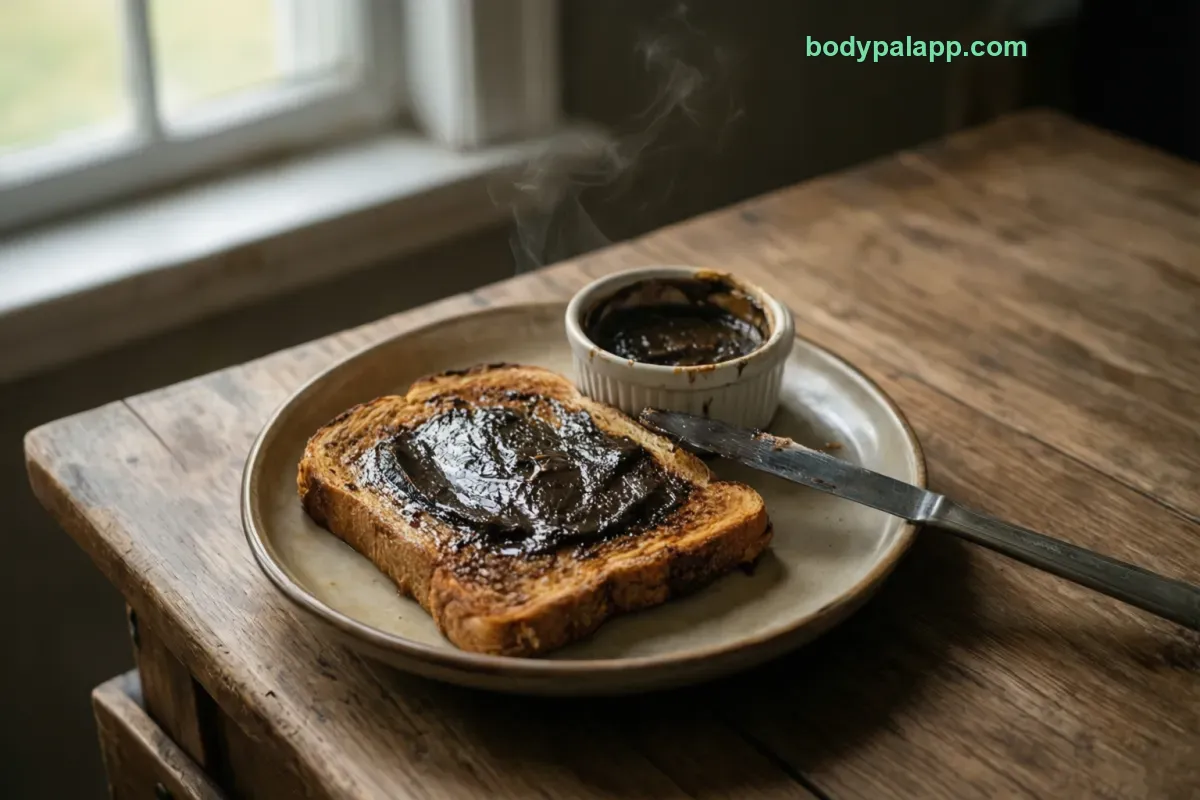
Most people eat Marmite on toast, and that is where the calorie math happens. The spread is the smallest line on the plate: 11 calories a teaspoon, 22 for two. The bread and any butter supply most of the energy, so log them separately. Do not assume the Marmite is the main number.
Its strong, savory taste means a little goes a long way, and that works in your favor. A thin layer on whole-grain toast with an egg or some cheese turns a low-calorie spread into a breakfast that keeps you full longer. It also stirs into soups, stews and gravy as a savory base, where one teaspoon flavors a whole pot.
If you track sodium, balance it with lower-salt foods the rest of the day. If you track calories, Marmite is one of the cheapest flavor boosts on the shelf.
How does marmite compare?
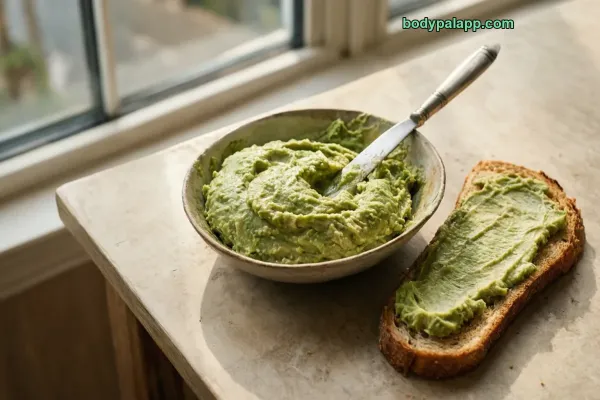
Here is how Marmite compares with a chicken bouillon cube, avocado spread and homemade hummus, per 100 g and per usual serving.
Verdict: For the fewest calories on toast, Marmite wins at 11 per teaspoon against 80 for 2 Tbsp of avocado spread. If sodium is your concern, pick avocado spread at 7 mg per 100 g, compared with 3,380 mg in Marmite.
Marmite FAQs
How many calories are in a teaspoon of Marmite?
About 11 calories in 1 teaspoon (6 g). Per 100 g, Marmite has 185 calories.
Is Marmite good for weight loss?
A teaspoon adds 11 calories and 0.1 g of fat, so it is a low-calorie spread. It is very salty, with 203 mg of sodium per teaspoon.
Marmite vs chicken bouillon cube: which has more calories?
Per 100 g, Marmite has 185 calories and a chicken bouillon cube has 198. Both are used in small amounts.
How much sodium is in Marmite?
One teaspoon (6 g) has 203 mg of sodium, and 100 g has 3380 mg. The same teaspoon has 1.4 g of protein.
How many calories does Marmite add to toast?
A teaspoon of Marmite adds 11 calories to toast, and two teaspoons add 22. The bread and any butter make up most of the total, so log them as separate items alongside the spread.
How many calories are in 2 slices of toast with butter and Marmite?
The Marmite part is about 22 calories if you use one teaspoon per slice. Bread and butter are not covered by this page's data, so add them separately to get the full total.
How much protein is in Marmite?
Marmite has 23.9 g of protein per 100 g, and protein makes up 52% of its calories. A teaspoon provides 1.4 g, which is 3% of the daily value.
Does Marmite have sugar or fat?
Marmite has 1.6 g of sugar and 0.9 g of fat per 100 g, with 0 saturated fat and 0 cholesterol. A teaspoon holds just 0.1 g of sugar and 0.1 g of fat.