Nonfat Greek yogurt calories come to 95 for one 156 g container and 61 per 100 g. The number to notice is protein: 70% of those calories come from it, so one container delivers 16.1 g, or 32% of the daily value, while using only 5% of the daily calorie value.
95kcal
1 container · 156 g, plain
70%protein
16.1 gProtein
6 gCarbs
0.6 gFat
How to burn off 95 kcal
—Walking, brisk
—Jogging
—Cycling, moderate
—Swimming
Skip the math. BodyPal counts these calories from your steps and workouts automatically.
Nutrition facts
Plain · per 156 g
Calories
95 kcal
Protein
16.1 g
Carbohydrate
5.7 g
Fat
0.6 g
Saturated fat
0.2 g
Cholesterol
8 mg
Sodium
56 mg
Potassium
220 mg
Iron
0.1 mg
Source: USDA FoodData Central
🛡️
Verified nutrition data
Numbers on this page come from USDA FoodData Central, the U.S. Department of Agriculture’s food composition database, and from manufacturer labels where a branded product is named. Last verified October 2026. How we verify our data →
Nonfat Greek yogurt: calories, protein and sodium by serving
Percent of daily value uses the FDA reference of 2,000 kcal a day.
Serving
kcal
Protein
Carbs
Fat
Sodium
% DV kcal
1 container (156 g)
95
16.1 g
5.7 g
0.6 g
56 mg
5%
6 oz container (170 g)
104
17.5 g
6.2 g
0.6 g
61 mg
5%
1 cup (245 g)
145
25.2 g
8.9 g
0.9 g
88 mg
7%
100 g
61
10.3 g
3.6 g
0.4 g
36 mg
3%
3 × 1 container (156 g)
285
48.2 g
168 mg
5 × 1 container (156 g)
476
80.3 g
281 mg
A cup is a 145-calorie serving, a container is 95
Container size decides most of the total. A 156 g container lands at 95 calories, the 6 oz container (170 g) at 104, and a full cup (245 g) at 145. The gap between a container and a cup looks small on one morning, but it repeats every time you eat it.
Stacking portions shows how the numbers climb. Two containers make 190 calories with 32.1 g of protein. Three reach 285 calories and 48.2 g. Five containers, 780 g in total, come to 476 calories and 80.3 g of protein, which is roughly what some people eat across a week of breakfasts.
Large tubs are where estimates drift. A generous bowl scooped from a tub is often closer to a cup than to a single container, so it is worth weighing it once. With 61 calories per 100 g, any portion on a kitchen scale is easy to check, and the protein follows at 10.3 g per 100 g. If you log from a photo, BodyPal can record the bowl for you, but a one-time weigh-in teaches you what your usual scoop really is.
Seventy percent of the calories are protein
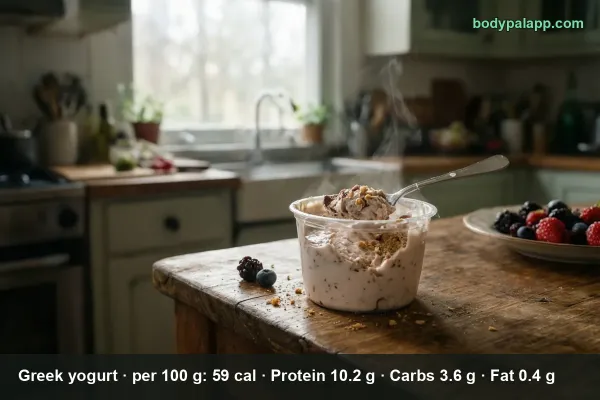
The calorie split is unusually lopsided for a dairy food: 70% protein, 25% carbs and 6% fat. Per 100 g that works out to 10.3 g of protein, 3.6 g of carbs and just 0.4 g of fat, with 0.1 g of it saturated. Straining removes much of the liquid, which concentrates the protein into a thick spoonful.
Scale that to a cup and the picture gets sharper. One cup brings 25.2 g of protein, which is 50% of the daily value, for 145 calories. Carbs sit at 8.9 g and fat at 0.9 g. Few foods in the dairy aisle hand over half a day's protein value for that little energy.
Fat is close to zero here, and that is the trade. Without it, plain nonfat Greek yogurt tastes tart and less rich than whole milk versions. Cholesterol is only 5 mg per 100 g and potassium is 141 mg, so the label stays quiet apart from that protein line.
Sodium stays low; flavors are the real variable
Sodium is not a concern in the plain version. A container has 56 mg, which is 2% of the daily value, and a full cup has 88 mg, or 4%. Even three containers stay at 168 mg. If you track sodium closely, this is one of the easier foods on your list.
Sugar is the line to read instead. The plain cup lists 8 g of sugars, and the figures on this page come from the USDA row for plain nonfat Greek yogurt. Flavored cups are a different product. The page lists options such as Sunnyside Farms Honey, Sunnyside Farms Peach and Coburn Farms Blueberry next to plain cups from Chobani, Friendly Farms and Upstate Farms.
If you buy flavored cups, check the label rather than borrowing the plain numbers. The protein usually comes along for the ride, but the carbs and calories do not stay at 95 per container once fruit or honey goes in. Buying plain and adding your own topping keeps you in control of that line.
Plain yogurt leaves room for what you add
Because a container uses only 5% of the daily calorie value, the yogurt itself is rarely the problem in a bowl. The toppings are. Granola, nut butter and honey can quietly outweigh the yogurt, so measure them with the same care you give the scoop.
Fresh fruit adds sweetness and volume, and it balances the tart taste. Nuts or seeds bring the fat the yogurt lacks, which makes the bowl feel more filling. A spoon of jam or honey works too if you count it.
Savory uses are worth trying. Nonfat Greek yogurt stands in for sour cream on tacos or baked potatoes, thins out into a dressing, and forms the base of a dip. In each case you keep the 10.3 g of protein per 100 g and add little fat, which suits a high-protein, lower-fat pattern of eating if that is what you are aiming for.
How does nonfat Greek yogurt compare?
Here is how nonfat Greek yogurt compares with cup Greek yogurt, regular cup yogurt and Fage 2% Greek yogurt, per 100 g and per usual serving.
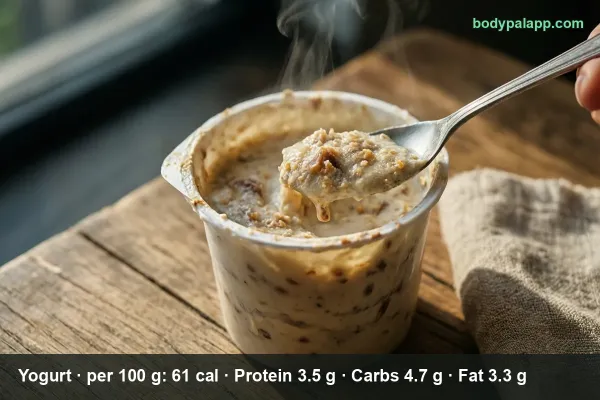
Verdict: For the most protein per calorie, pick nonfat Greek yogurt or cup Greek yogurt, which sit at 61 and 59 calories per 100 g with about 10 g of protein, while regular cup yogurt matches the calories but gives only 3.5 g. If you want a creamier spoon, Fage 2% costs 73 calories per 100 g and 146 per 200 g container for the same 10 g of protein.
Most popular nonfat Greek yogurt brands in the United States
Flavored products (blueberry, honey, peach) contain added sugar, so they read higher than the plain number above. Source: manufacturer labels / USDA FoodData Central.
Nonfat Greek yogurt FAQs
How many calories are in one container of nonfat Greek yogurt?
A 156 g container of plain nonfat Greek yogurt has about 95 calories, and a 6 oz (170 g) container has 104.
Is nonfat Greek yogurt good for weight loss?
It has 61 calories per 100 g with 10.3 g of protein and 0.4 g of fat, so it is high in protein for its calories.
Nonfat Greek yogurt vs whole milk Greek yogurt: which has fewer calories?
Plain nonfat Greek yogurt has 61 calories per 100 g, while whole milk Greek yogurt has 94 calories and 4.4 g of fat versus 0.4 g.
How much protein is in nonfat Greek yogurt?
One 156 g container has 16.1 g of protein and 5.7 g of carbs. Per 100 g it has 10.3 g of protein.
How many calories are in 1 cup of nonfat Greek yogurt?
One cup of plain nonfat Greek yogurt (245 g) has 145 calories. That is 7% of the daily calorie value, compared with 95 calories for a single 156 g container.
How many grams of nonfat Greek yogurt are in a cup?
A cup of nonfat Greek yogurt weighs 245 g. A standard container is 156 g and a 6 oz container is 170 g, so a cup is noticeably larger than either.
What are the nutrition facts for 1 cup of plain nonfat Greek yogurt?
One cup has 145 calories, 25.2 g of protein, 8.9 g of carbs, 0.9 g of fat and 88 mg of sodium. The protein covers 50% of the daily value and the sodium only 4%.
How much sugar is in a cup of plain nonfat Greek yogurt?
A cup of plain nonfat Greek yogurt lists 8 g of sugars within 8.9 g of total carbs. Flavored cups such as honey or fruit versions will differ, so read their labels.
How much protein is in 1 cup of nonfat Greek yogurt per the USDA?
The USDA row for plain nonfat Greek yogurt gives 25.2 g of protein and 145 calories per 245 g cup. That protein equals 50% of the daily value, and it makes up 70% of the calories.